Table of Contents
ToggleRevenue Deficit: Concept, Formula and Its Role in Fiscal Policy
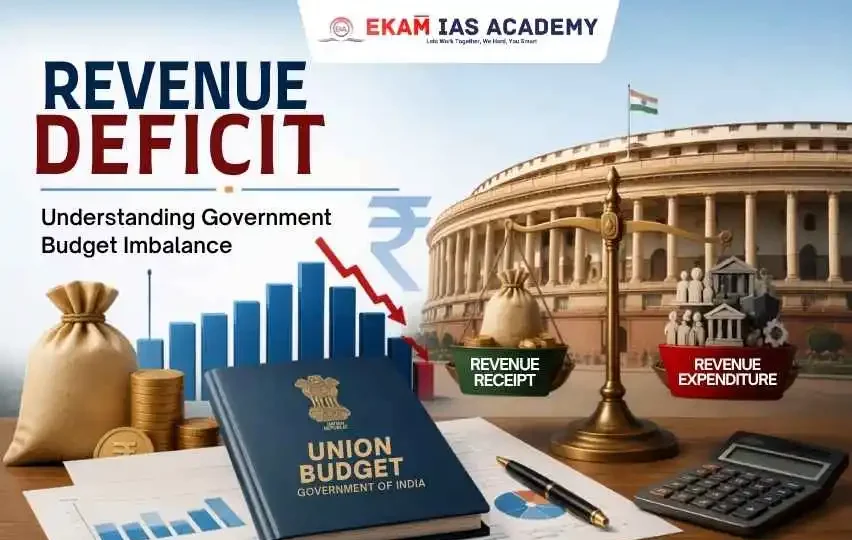
Revenue Deficit is a crucial macroeconomic indicator that reflects the excess of the government’s targeted operational expenditure over its routine revenue receipts. For Civil Services Examination candidates, mastering Revenue Deficit UPSC concepts is vital for analyzing government budgeting, fiscal health, and public expenditure management under GS Paper III. Understanding this imbalance forms a foundational pillar of Revenue Deficit Notes for UPSC, Public Finance UPSC, and broader Economy Notes for UPSC.
What is Revenue Deficit
Revenue Deficit occurs when the government’s total Revenue Expenditure exceeds its aggregate Revenue Receipts in a financial year. It indicates that the state is living beyond its current means, borrowing funds not to build income-yielding capital assets, but to meet its day-to-day administrative running costs.
Formula for Revenue Deficit & Components
The standard Revenue Deficit Formula is expressed as:
Core Components
- Revenue Receipts: Comprises routine non-redeemable receipts, including Tax Revenue (GST, Income Tax, Corporate Tax) and Non-Tax Revenue (dividends from PSUs, RBI surpluses, administrative fees).
- Revenue Expenditure: Encompasses routine, non-asset-creating costs such as interest payments on past borrowings, defense maintenance, government salaries, pensions, and subsidies.
Difference Between Key Fiscal Indicators
Navigating Budget Deficits in India requires distinguishing between primary Fiscal Policy in India metrics:
| Fiscal Metric | Definition / Core Equation | Structural Focus |
| Revenue Deficit | Revenue Expenditure – Revenue Receipts | Daily operational shortfall |
| Effective Revenue Deficit | Revenue Deficit – Grants for Creation of Capital Assets | Excludes capital-building transfers to states |
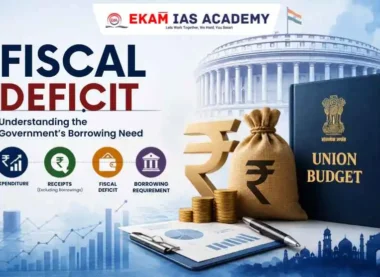
| Fiscal Deficit | Total Expenditure – Total Receipts (excluding borrowings) | Total net borrowing requirement |
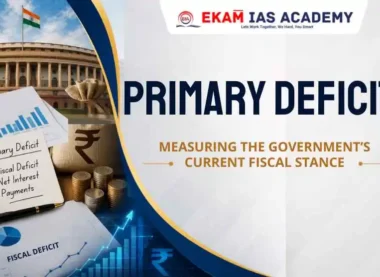
| Primary Deficit | Fiscal Deficit – Net Interest Payments | Current policy borrowing needs |
Causes & Impact of Revenue Deficit
- Causes of Revenue Deficit: Structural sticky expenditures on subsidies and interest, sluggish Tax Revenue growth, tax evasion, and unexpected operational expenses.
- Impact of Revenue Deficit: Forced reliance on borrowings to meet consumption, crowding out private investment, elevating Fiscal Deficit targets, and reducing capital allocations available for long-term Capital Expenditure.
Measures to Reduce Revenue Deficit
- Tax Base Expansion: Broadening the tax net, rationalizing GST slabs, and leveraging digital tools to curb tax evasion.
- Expenditure Rationalization: Retargeting fuel and fertilizer subsidies via Direct Benefit Transfer (DBT) networks.
- Structural Reform: Adhering to fiscal discipline mandates outlined in the Fiscal Responsibility and Budget Management (FRBM) Act.
Revenue Deficit in the Indian Context & Recent Developments
In analyzing Revenue Deficit in India, successive Union Budget UPSC updates have focused on fiscal consolidation pathways. While unexpected crisis spending previously widened operational deficits, recent fiscal management strategies prioritize keeping operational expenditure tight while expanding strategic Capital Expenditure.
Way Forward
- Establish strict statutory spending caps on non-productive routine spending.
- Increase non-tax revenue collections through asset monetization and PSU dividend optimization.
- Transition fiscal accounting toward Effective Revenue Deficit tracking to protect capital creation grants extended to state governments.
Conclusion
Understanding Revenue Deficit dynamics is critical for analyzing Government Budget UPSC frameworks and aggregate Fiscal Policy in India. Striking a balance between daily operational spending and long-term asset creation will remain central to driving sustainable Economic Growth in India under the vision of Viksit Bharat 2047.
UPSC Prelims: PYQs & Practice Questions
Previous Year Questions (Prelims)
Q: There has been a persistent deficit budget year after year in India. Which of the following actions can be taken by the government to reduce the deficit?
1. Reducing revenue expenditure
2. Introducing new welfare schemes
3. Rationalizing subsidies
4. Expanding industries
Select the correct answer using the code given below:
(a) 1 and 3 only
(b) 2 and 3 only
(c) 1 and 4 only
(d) 1, 2, 3 and 4
Answer: (a) 1 and 3 only
Explanation:
Reducing Revenue Expenditure such as administrative costs and operational expenses directly helps in lowering the revenue deficit. Rationalizing subsidies reduces unnecessary revenue spending. However, introducing new welfare schemes increases expenditure, while industrial expansion requires capital investment and does not directly reduce revenue deficit.
Q: Along with the Budget, the Finance Minister also places other documents before the Parliament, which includes the Macro Economic Framework Statement. The aforesaid document is presented because this is mandated by:
(a) Long Standing Parliamentary Convention
(b) Article 112 and Article 110(1) of the Constitution of India
(c) Article 113 of the Constitution of India
(d) Provisions of the Fiscal Responsibility and Budget Management Act, 2003
Answer: (d) Provisions of the Fiscal Responsibility and Budget Management Act, 2003
Explanation:
The FRBM Act, 2003 mandates the presentation of three important fiscal statements along with the Union Budget:
1. Macro-Economic Framework Statement
2. Medium-Term Fiscal Policy Statement
3. Fiscal Policy Strategy Statement
These documents promote fiscal transparency and help the government maintain discipline in managing Revenue Deficit, Fiscal Deficit, and public debt.
Practice Questions
Q: Which of the following best defines the Effective Revenue Deficit?
(a) The difference between Total Fiscal Deficit and Net Foreign Borrowings.
(b) The difference between Revenue Deficit and Grants for Creation of Capital Assets.
(c) The aggregate of Revenue Deficit and Primary Deficit.
(d) Revenue Receipts minus interest payments on public debt.
Answer: (b) The difference between Revenue Deficit and Grants for Creation of Capital Assets
Explanation:
Effective Revenue Deficit was introduced in the Union Budget 2011–12 based on the recommendations of the Rangarajan Committee. It is calculated as:
Effective Revenue Deficit = Revenue Deficit − Grants-in-aid for creation of capital assets
It excludes grants provided to states and other agencies for creating durable infrastructure assets, as these transfers contribute to long-term productive capacity rather than routine consumption expenditure.
Q: Consider the following items of government expenditure:
1. Payment of interest on public debt
2. Capital infusion into public sector banks
3. Defense operational salaries and pensions
4. Subsidies provided for food and fertilizers
Which of the above are categorized under Revenue Expenditure?
(a) 1, 2 and 3 only
(b) 1, 3 and 4 only
(c) 2 and 4 only
(d) 1, 2, 3 and 4
Answer: (b) 1, 3 and 4 only
Explanation:
Revenue Expenditure includes government spending that does not directly create physical or financial assets. It includes:
• Interest payments on public debt
• Defense salaries and pensions
• Subsidies on food, fertilizers, etc.
However, capital infusion into public sector banks creates financial assets for the government and is therefore classified as Capital Expenditure.
UPSC Mains – Previous Year & Practice Questions
Mains Previous Year Questions
Question: What is Revenue Deficit? How does it differ from Fiscal Deficit? Discuss the measures taken by the Government of India under the FRBM Act to curb these deficits. (Mains 2013)
Question: High Revenue Deficit indicates government over-reliance on consumption spending. Analyze the impact of high revenue deficits on public capital formation and overall economic growth. (Mains 2016)
Question: Distinguish between Revenue Expenditure and Capital Expenditure. Why is shifting the balance of government spending toward Capital Expenditure necessary for sustained macroeconomic growth? (Mains 2018)
Question: Explain the concept of Effective Revenue Deficit. How far has its inclusion in budget documents helped in preventing the suppression of capital creation grants to states? (Mains 2021)
Question: Fiscal consolidation remains a balancing act between spending rationalization and growth requirements. In light of this, evaluate India's post-pandemic fiscal deficit reduction roadmap. (Mains 2023)
Mains Practice Questions
[15 Marks | 250 Words]
Question: A high Revenue Deficit forces governments to resort to borrowing for routine consumption, leading to a debt spiral. Examine the structural bottlenecks causing persistent revenue deficits in Indian public finance.
[15 Marks | 250 Words]
Question: Critically evaluate the role of Direct Benefit Transfer (DBT) networks and subsidy rationalization in reducing the government's Revenue Expenditure without compromising social welfare.
[15 Marks | 250 Words]
Question: In the context of the Viksit Bharat @ 2047 framework, discuss how eliminating the Revenue Deficit can unlock fiscal space for strategic public infrastructure investments.



Revenue Deficit-FAQs
What is Revenue Deficit?
Revenue Deficit occurs when the government’s revenue expenditure exceeds its revenue receipts in a financial year.
What is the formula for Revenue Deficit?
Revenue Deficit = Revenue Expenditure - Revenue Receipts
Why is Revenue Deficit a concern?
It shows that the government is borrowing to meet routine expenditure like salaries, pensions, subsidies and interest payments, rather than creating capital assets.
What is the difference between Revenue Deficit and Fiscal Deficit?
Revenue Deficit measures only the shortfall in the revenue account, while Fiscal Deficit measures the government’s total borrowing requirement.
Why is Revenue Deficit important for UPSC GS 3?
It is important because it connects public finance, fiscal policy, government budgeting, FRBM targets, subsidies, capital expenditure and economic growth.