Table of Contents
ToggleUnderstanding Fiscal Deficit: India’s Public Finance & Economic Management
Fiscal Deficit is a vital macroeconomic indicator that reflects the total borrowing required by the government to meet its budgetary expenses. For Civil Services Examination candidates, mastering Fiscal Deficit UPSC concepts is crucial for understanding Government Budget dynamics, Public Debt in India, and monetary policy interactions under GS Paper III. Analyzing this metric provides an essential foundation for Fiscal Deficit Notes for UPSC, Public Finance UPSC, and broader Economy Notes for UPSC.
What is Fiscal Deficit
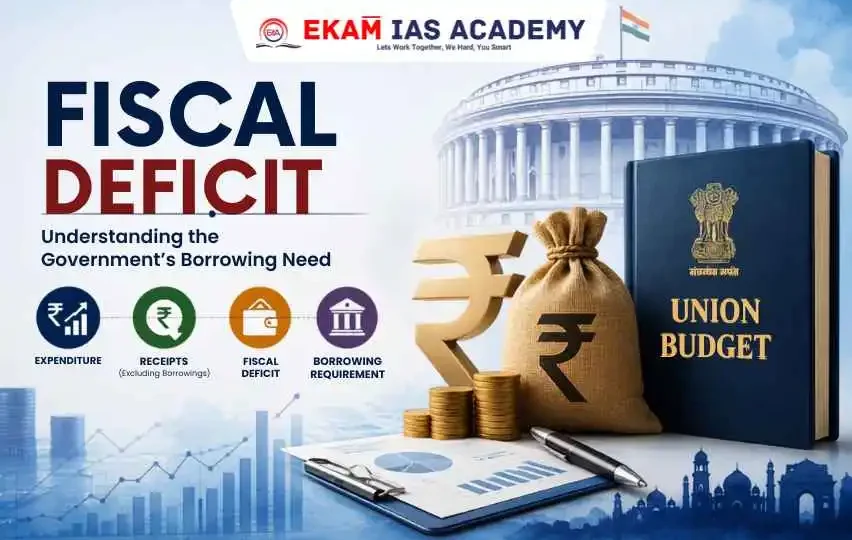
Fiscal Deficit measures the excess of the government’s total expenditure over its total non-borrowed receipts during a financial year. It indicates the total resource gap that must be financed through Government Borrowing, drawing down cash balances, or issuing treasury bills.
Formula for Fiscal Deficit & Components
The standard Fiscal Deficit Formula is expressed as:
Core Components
- Total Expenditure: Includes Revenue Expenditure (salaries, interest, subsidies) and productive Capital Expenditure (infrastructure, defense assets, loans to states).
- Non-Borrowing Receipts: Comprises Revenue Receipts (taxes, dividends) and non-debt capital receipts (disinvestment proceeds, recovery of past loans).
Difference Between Key Fiscal Indicators
Navigating public finance requires comparing key budgetary shortfall metrics:
| Fiscal Indicator | Formula / Core Metric | Focus Area |
| Fiscal Deficit | Total Expenditure – Total Non-Debt Receipts | Aggregate financial borrowing requirement |
| Revenue Deficit | Revenue Expenditure – Revenue Receipts | Operational, consumption-led shortfall |
| Effective Revenue Deficit | Revenue Deficit – Grants for Creation of Capital Assets | Adjusts operational spending for asset creation |
| Primary Deficit | Fiscal Deficit – Net Interest Payments | Borrowing needed for current policy execution |
Causes & Impact of Fiscal Deficit
- Causes of Fiscal Deficit: Sluggish tax collection, high revenue expenditure, unexpected economic shocks, and elevated public capital spending.
- Impact of Fiscal Deficit: High deficits risk crowding out private investment, elevating inflation, increasing the sovereign debt burden, and raising long-term interest rates.
Measures to Reduce Fiscal Deficit
- Fiscal Consolidation: Enforcing target ceilings outlined in the Fiscal Responsibility and Budget Management (FRBM) Act.
- Revenue Expansion: Broadening the direct tax base, rationalizing GST structures, and accelerating non-debt capital realization via PSU disinvestments.
- Expenditure Rationalization: Redirecting funds from non-targeted operational subsidies to high-multiplier public Capital Expenditure.
Fiscal Deficit in the Indian Context & Recent Developments
In evaluating Fiscal Deficit in India, the Union Budget UPSC documents detail the government’s glide path toward sustainable deficit levels. Recent fiscal management strategies balance maintaining debt sustainability under the FRBM Act UPSC guidelines with expanding strategic public spending to support long-term economic momentum.
Way Forward
- Align public borrowing with transparent fiscal rules to maintain macroeconomic stability.
- Increase reliance on capital creation grants to spur domestic economic activity.
- Boost private investment participation through public-private partnerships (PPPs) to minimize state borrowing needs.
Conclusion
Understanding Fiscal Deficit dynamics is indispensable for evaluating national economic management. Achieving structured fiscal targets while preserving strategic investments will remain central to driving sustainable Economic Growth in India and fulfilling the vision of Viksit Bharat 2047.
UPSC Prelims: PYQs & Practice Questions
Previous Year Questions (Prelims)
Q: Which one of the following is likely to be the most inflationary in its effect?
(a) Repayment of public debt
(b) Borrowing from the public to finance a budget deficit
(c) Borrowing from the banks to finance a budget deficit
(d) Creation of new money to finance a budget deficit
Answer: (d) Creation of new money to finance a budget deficit
Explanation:
Creation of new money to finance a fiscal deficit directly increases the
money supply without an immediate corresponding increase in the supply of
goods and services. This can create a situation of
"too much money chasing too few goods", generating stronger inflationary pressure.
It is generally more inflationary than financing the deficit through borrowing from existing savings.
Q: In the context of governance, consider the following measures: (UPSC CSE Prelims 2010)
1. Reducing tax rates
2. Increasing non-tax revenue
3. Rationalizing public expenditure
4. Introducing new subsidies
Which of the above can be used as effective measures to control the Fiscal Deficit in India?
(a) 1 and 4 only
(b) 2 and 3 only
(c) 1, 2 and 3 only
(d) 2, 3 and 4 only
Answer: (b) 2 and 3 only
Explanation:
Fiscal Deficit = Total Expenditure − Total Non-Debt Receipts.
Increasing non-tax revenue, such as dividends and user charges, raises government receipts,
while rationalizing public expenditure reduces unnecessary spending.
In contrast, reducing tax rates may lower tax receipts, while introducing new subsidies increases
government expenditure and can widen the fiscal deficit.
Practice Questions
Q: Consider the following statements regarding the Primary Deficit:
1. It measures the total borrowing requirement of the government including historical interest obligations.
2. A Primary Deficit equal to zero indicates that current fiscal operations are entirely funded by current non-borrowed revenues.
Which of the statements given above is/are correct?
(a) 1 only
(b) 2 only
(c) Both 1 and 2
(d) Neither 1 nor 2
Answer: (b) 2 only
Explanation:
Statement 1 is incorrect because Primary Deficit is calculated as
Fiscal Deficit − Interest Payments. It excludes interest obligations arising from past debt and therefore helps assess the impact of the government's current fiscal policy.
Statement 2 is correct. When the Primary Deficit is zero, the government's fiscal borrowing is effectively equal to its interest payments. This indicates that current administrative and developmental expenditure is being financed through non-debt receipts.
Q: Which of the following non-debt capital receipts directly assist in containing the Fiscal Deficit without creating future repayment liabilities?
1. Proceeds from disinvestment of Public Sector Undertakings (PSUs)
2. Recovery of past loans and advances granted to states
3. Issue of Sovereign Green Bonds in international markets
Select the correct answer using the code given below:
(a) 1 and 2 only
(b) 2 and 3 only
(c) 1 and 3 only
(d) 1, 2 and 3
Answer: (a) 1 and 2 only
Explanation:
Non-debt capital receipts help reduce the Fiscal Deficit without creating new repayment obligations.
Disinvestment proceeds bring revenue through the sale of government equity, while
recovery of loans and advances returns previously lent government funds.
In contrast, Sovereign Green Bonds are debt instruments. Their issuance constitutes government borrowing and creates a future repayment liability, so they are not classified as non-debt capital receipts.
UPSC Mains – Previous Year & Practice Questions
Mains Previous Year Questions
Question: What is Fiscal Deficit? How does it differ from Revenue Deficit? Discuss the measures taken by the Government of India under the FRBM Act, 2003 to curb these deficits. (UPSC CSE Mains 2013, GS Paper III)
Question: There is a clear trade-off between fiscal consolidation and economic growth. In the context of India, critically examine how adhering to rigid fiscal deficit targets under the FRBM framework impacts public infrastructure spending. (UPSC CSE Mains 2015, GS Paper III)
Question: The Primary Deficit reflects the true fiscal health of the current government's policy execution. Differentiate between Fiscal Deficit and Primary Deficit, and evaluate why narrowing the Primary Deficit is critical for debt sustainability. (UPSC CSE Mains 2018, GS Paper III)
Question: Explain the economic implications of off-budget borrowings on official fiscal deficit targets. How does off-budget financing affect transparency in public financial management? (UPSC CSE Mains 2020, GS Paper III)
Question: Fiscal consolidation remains a balancing act between spending rationalization and economic growth needs. In light of this, evaluate India's post-pandemic fiscal deficit reduction path towards achieving target levels. (UPSC CSE Mains 2023, GS Paper III)
Mains Practice Questions
[15 Marks | 250 Words]
Question: Persistent high fiscal deficits risk crowding out private investment and destabilizing macroeconomic indicators. Analyze the structural causes of persistent fiscal deficits in India and suggest suitable structural reforms.
[15 Marks | 250 Words]
Question: In the context of the N.K. Singh Committee recommendations, discuss the feasibility of shifting India's primary fiscal anchor from the Fiscal Deficit-to-GDP ratio to the Debt-to-GDP ratio.
[15 Marks | 250 Words]
Question: How does quality fiscal spending—shifting expenditure from routine consumption towards capital asset creation—help mitigate the inflationary impact of a high Fiscal Deficit? Discuss with reference to India's national infrastructure targets.



Fiscal Deficit-FAQs
What is Fiscal Deficit?
Fiscal Deficit is the excess of the government’s total expenditure over its total receipts, excluding borrowings.
What is the formula for Fiscal Deficit?
Fiscal Deficit = Total Expenditure – Total Receipts excluding borrowings
Why is Fiscal Deficit important?
It shows the government’s total borrowing requirement and indicates the gap between expenditure and non-borrowed receipts.
What is the difference between Fiscal Deficit and Revenue Deficit?
Fiscal Deficit measures the total borrowing requirement, while Revenue Deficit shows the shortfall in the revenue account only.
Why is Fiscal Deficit important for UPSC GS 3?
It is important because it connects government budgeting, public debt, fiscal policy, inflation, capital expenditure and economic growth.