Table of Contents
ToggleIndia’s Opportunity to Strengthen BRICS
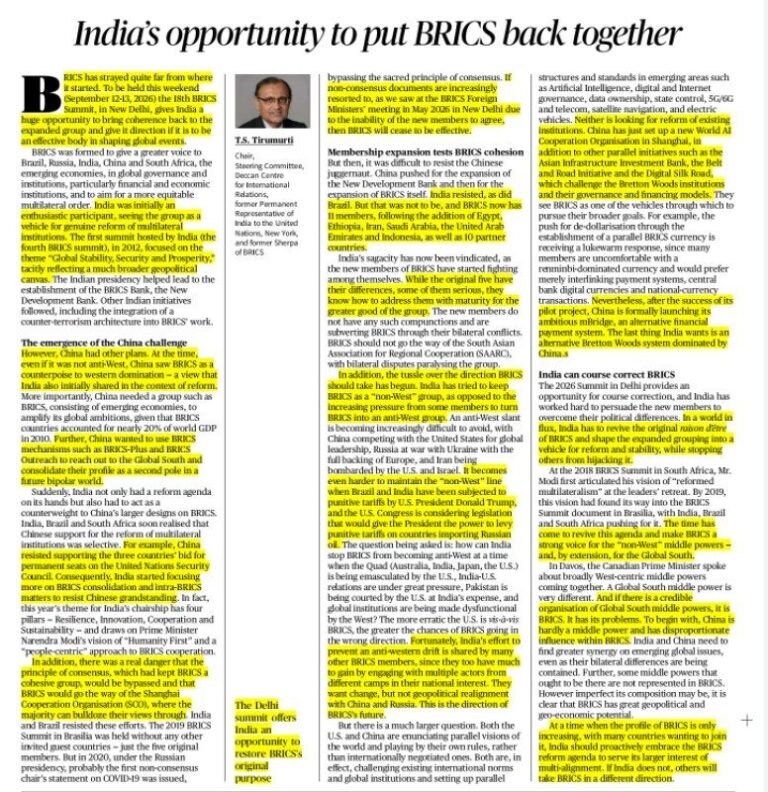
India has an important opportunity to reshape BRICS cooperation and restore its original purpose of promoting a more balanced global order. The grouping, which includes Brazil, Russia, India, China and South Africa, has expanded significantly but faces internal differences and strategic challenges.
Evolution of BRICS
BRICS was initially created as a platform for emerging economies to increase their influence in global governance.
The grouping focused on:
- Reforming global financial institutions
- Increasing representation of developing countries
- Promoting economic cooperation
- Creating alternative development mechanisms
A major achievement was the establishment of the New Development Bank (NDB), aimed at financing infrastructure and sustainable development projects.
Challenges Facing BRICS
The expansion of BRICS has created new opportunities but also increased complexities.
The article highlights several challenges:
- Differences among member countries
- Strategic competition between India and China
- Diverging foreign policy interests
- Difficulty in maintaining consensus-based decision-making
China’s growing influence within BRICS has also raised concerns regarding the grouping’s original objectives.
India’s Role in Reviving BRICS
India can play a crucial role in ensuring that BRICS remains focused on cooperation rather than geopolitical rivalry.
India’s approach can include:
- Strengthening economic cooperation
- Promoting transparency and institutional reforms
- Supporting developing countries
- Encouraging dialogue among members
India’s position as a major emerging economy gives it the ability to balance competing interests within the grouping.
BRICS Expansion and Global South
The expansion of BRICS with countries from West Asia, Africa and other regions reflects growing interest among developing nations in alternative global platforms.
The article suggests that BRICS can become an important voice for the Global South by addressing issues such as:
- Financial inequality
- Development challenges
- Technology access
- Climate concerns
- Global governance reforms
Balancing China’s Influence
A major challenge for India is managing the increasing influence of China within BRICS.
India needs to ensure that BRICS does not become dominated by any single country and continues to represent diverse interests of emerging economies.
Strengthening partnerships with other members and promoting issue-based cooperation can help India maintain balance.
Future of BRICS
The success of BRICS depends on whether member countries can overcome differences and focus on common objectives.
India can use its leadership role to promote a more inclusive, transparent and cooperative BRICS that supports a multipolar world order.
Conclusion
BRICS remains an important platform for emerging economies seeking greater representation in global affairs. India’s challenge is to strengthen cooperation within the group while protecting its strategic interests.
By promoting consensus, economic cooperation and Global South priorities, India can help BRICS regain its original vision and become a stronger force in global governance.
Vocabulary
1. Multipolarity – Global order with multiple power centres
2. Consensus-based Decision Making – Decisions through agreement of all members
3. Global South – Developing and emerging economies
4. De-dollarisation – Reducing dependence on the US dollar in trade
5. Strategic Autonomy – Independent foreign policy choices
Prelims MCQs
MCQ 1
With reference to BRICS, consider the following statements:
- BRICS was established to increase the voice of emerging economies in global governance.
- The New Development Bank (NDB) was created by BRICS countries to finance infrastructure and sustainable development projects.
- BRICS operates as a military alliance among member countries.
Which of the statements given above is/are correct?
A) 1 and 2 only
B) 1 only
C) 2 and 3 only
D) 1, 2 and 3
Answer: A) 1 and 2 only
MCQ 2
Consider the following objectives associated with BRICS:
- Reforming global financial institutions
- Promoting economic cooperation among emerging economies
- Establishing a common defence organisation
- Increasing representation of developing countries in global institutions
Which of the above are correct?
A) 1, 2 and 4 only
B) 1 and 3 only
C) 2, 3 and 4 only
D) 1, 2, 3 and 4
Answer: A) 1, 2 and 4 only
UPSC Mains Question
“BRICS has the potential to become a stronger voice for the Global South, but internal differences pose challenges to its effectiveness.” Discuss India’s role in strengthening BRICS.
Frequently Asked Questions (FAQs)
What is BRICS?
BRICS is a grouping of major emerging economies that aims to promote economic cooperation, global governance reforms and greater representation of developing countries in international institutions.
What was the original purpose of BRICS?
BRICS was created to strengthen the voice of emerging economies, reform global financial institutions and promote cooperation among countries of the Global South.
What is the significance of the New Development Bank (NDB)?
The New Development Bank was established by BRICS to provide financing for infrastructure and sustainable development projects in member and developing countries.
What are the major challenges faced by BRICS?
BRICS faces challenges such as strategic differences among members, India–China tensions, expansion-related complexities and difficulty in maintaining consensus-based decision-making.
How can India strengthen BRICS cooperation?
India can strengthen BRICS by promoting inclusive decision-making, economic cooperation, Global South priorities, institutional reforms and a balanced multipolar world order.
Source From : The Hindu
Draft SIR List Shows Anomalies: Need for Independent Audit of Electoral Rolls
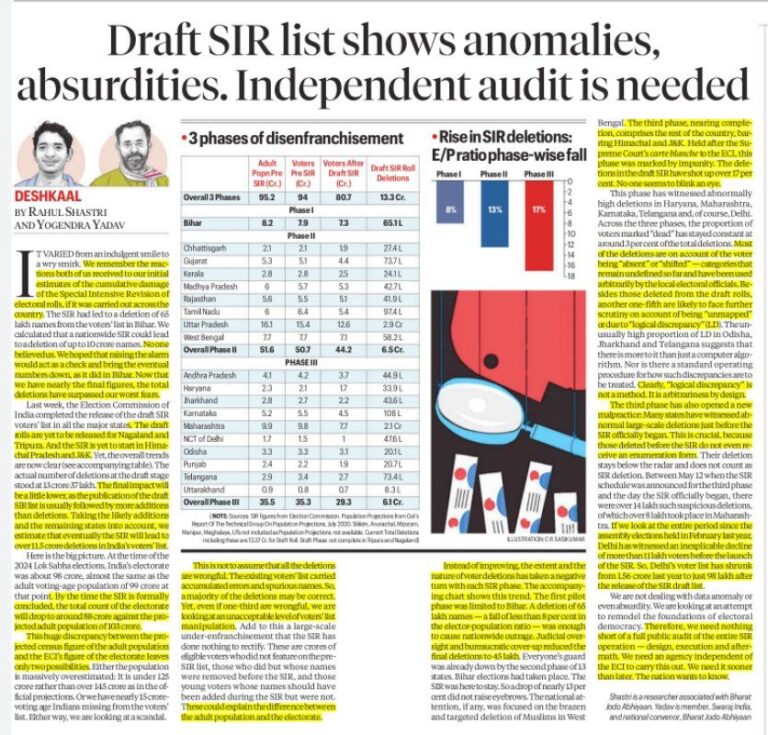
The Special Intensive Revision (SIR) of electoral rolls conducted by the Election Commission of India has generated debate over the accuracy of voter lists and the possibility of large-scale voter exclusions. While electoral roll revision is necessary to remove duplicate and invalid entries, concerns have emerged regarding the deletion of genuine voters without adequate verification.
Special Intensive Revision (SIR) of Electoral Rolls
The Election Commission undertakes electoral roll revisions to ensure that voter lists remain accurate and updated.
The objectives of SIR include:
- Identifying eligible voters
- Removing duplicate entries
- Correcting errors in electoral databases
- Ensuring clean and reliable electoral rolls
However, the draft SIR list has raised concerns due to significant deletions reported across different phases.
Concerns Over Large-Scale Deletions
The article highlights that millions of names have been removed from draft electoral rolls during the SIR exercise.
Major concerns include:
- Possible exclusion of genuine voters
- Lack of clarity in deletion procedures
- Errors in voter verification
- Impact on citizens’ right to vote
Large-scale deletions without proper safeguards may result in disenfranchisement and weaken democratic participation.
Issues in the Verification Process
The electoral roll revision process requires accurate identification and verification of voters.
Concerns highlighted include:
- Inadequate verification mechanisms
- Documentation-related difficulties
- Errors in identifying eligible voters
- Possibility of wrongful deletions
The process must ensure that removal of names happens only after proper verification and providing citizens an opportunity to respond.
Need for Independent Audit
The article argues that an independent audit is necessary to examine the SIR process.
An audit can evaluate:
- Reasons behind voter deletions
- Accuracy of the deletion data
- Verification methods followed
- Effectiveness of grievance redressal mechanisms
Independent review can improve transparency and strengthen public confidence in electoral institutions.
Role of the Election Commission of India
The Election Commission, under Article 324 of the Constitution, is responsible for conducting elections and supervising electoral processes.
It must ensure:
- Accurate electoral rolls
- Transparency in revision exercises
- Protection of eligible voters
- Fair opportunities for inclusion and correction
Impact on Electoral Democracy
A reliable electoral roll is the foundation of free and fair elections.
Incorrect deletions can affect:
- Universal adult franchise
- Equal political participation
- Public trust in elections
- Democratic representation
The revision process should balance the need for accuracy with the constitutional principle of inclusion.
Way Forward
To ensure a transparent and fair electoral roll system:
- Conduct independent audits of large-scale deletions
- Strengthen verification procedures
- Provide adequate notice before deletion
- Improve grievance redressal systems
- Use technology with proper safeguards
- Ensure citizens have opportunities for correction and inclusion
Conclusion
Electoral roll revision is essential for maintaining the integrity of elections, but it must not result in the exclusion of legitimate voters. The SIR exercise should follow transparent procedures, independent scrutiny and strong safeguards to protect the constitutional right to political participation.
A fair electoral system requires not only accurate voter lists but also public confidence that every eligible citizen has an equal opportunity to participate in democracy.
Vocabulary
1. Disenfranchisement – Loss of voting rights
2. Electoral Roll – Official list of eligible voters
3. Universal Adult Franchise – Equal voting rights for all adults
Prelims MCQs
MCQ 1
Consider the following statements:
- Special Intensive Revision (SIR) aims to update electoral rolls by verifying eligible voters and removing incorrect entries.
- Electoral roll revision is conducted by the Election Commission of India.
- The primary objective of electoral revision is to reduce voter participation.
Which of the statements given above is/are correct?
A) 1 and 2 only
B) 2 and 3 only
C) 1 and 3 only
D) 1, 2 and 3
Answer: A) 1 and 2 only
MCQ 2
Which of the following indicators can provide supporting evidence for assessing the underlying strength of economic activity?
- Index of Industrial Production (IIP)
- Capital goods production
- Vehicle registrations
- Consumption indicators
Select the correct answer using the code below:
A) 1 and 2 only
B) 1, 2 and 3 only
C) 2, 3 and 4 only
D) 1, 2, 3 and 4
Answer: D) 1, 2, 3 and 4
UPSC Mains Question
“Electoral roll revision is essential for maintaining electoral integrity, but the process must ensure that genuine voters are not excluded.” Discuss.
Frequently Asked Questions (FAQs)
What is Special Intensive Revision (SIR) of electoral rolls?
Special Intensive Revision (SIR) is an exercise conducted to update electoral rolls by verifying eligible voters, removing duplicate entries and correcting inaccuracies in voter lists.
Why has the SIR process raised concerns?
The SIR process has raised concerns due to reports of large-scale voter deletions and the possibility that genuine voters may be excluded without adequate verification.
Why are accurate electoral rolls important for democracy?
Accurate electoral rolls ensure that eligible citizens can exercise their right to vote and help maintain free, fair and credible elections.
What is disenfranchisement?
Disenfranchisement refers to the loss or denial of voting rights. In electoral processes, wrongful deletion of eligible voters can lead to disenfranchisement.
How can electoral roll revisions become more transparent?
Transparency can be improved through independent audits, proper verification procedures, notice to affected voters, grievance redressal mechanisms and opportunities for correction.