Table of Contents
ToggleUnderstanding Primary Deficit UPSC Concepts for Fiscal Analysis
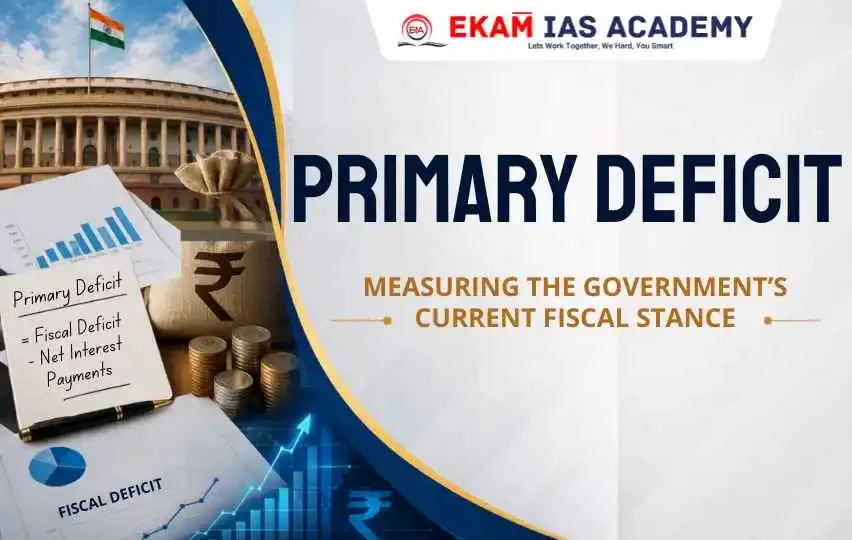
Primary Deficit is a vital macroeconomic indicator that isolates the government’s current fiscal stance by removing historical debt obligations. For Civil Services Examination candidates, mastering Primary Deficit UPSC concepts is crucial for evaluating real-time budgetary discipline, Public Finance UPSC management, and debt sustainability under GS Paper III. Understanding this metric forms an essential foundation for Primary Deficit Notes for UPSC, Macroeconomics UPSC, and broader Economy Notes for UPSC.
What is Primary Deficit
Primary Deficit reflects the total amount of Government Borrowing required to meet current financial year expenditures, excluding past Interest Payments. While overall fiscal aggregates include cumulative debt service costs, primary balance indicators reveal whether current government operations—excluding historical debt loads—are fiscally balanced.
Formula for Primary Deficit & Components
The standard Primary Deficit Formula is expressed as:
Core Components
- Fiscal Deficit: The total net borrowing requirement of the government (Total Expenditure – Total Receipts excluding borrowings).
- Interest Payments: Mandatory annual debt servicing costs incurred on past accumulated Public Debt in India.
Difference Between Key Fiscal Indicators
Navigating Government Budget indicators requires comparing core fiscal metrics:
| Fiscal Metric | Formula / Equation | Analytical Focus |
| Primary Deficit | $\text{Fiscal Deficit} – \text{Interest Payments}$ | Real-time operational borrowing needs |
| Fiscal Deficit | $\text{Total Expenditure} – \text{Non-Debt Receipts}$ | Total financial borrowing requirement |
| Revenue Deficit | $\text{Revenue Expenditure} – \text{Revenue Receipts}$ | Daily consumption spending shortfall |
| Effective Revenue Deficit | $\text{Revenue Deficit} – \text{Capital Grants}$ | Adjusts operational spending for asset creation |
Causes, Impact & Importance of Primary Deficit
- Causes & Impact: Driven by sticky operational spending, un-targeted subsidies, and sluggish revenue growth. A persistent primary deficit expands the national debt burden and forces reliance on market borrowings.
- Importance of Primary Deficit: Highlights current policy execution health without distortion from past debt burdens. A zero primary deficit indicates that current government spending is fully covered by non-debt receipts, with borrowings dedicated solely to servicing legacy debt.
Measures to Reduce Primary Deficit & Indian Context
- Fiscal Consolidation: Aligning budgetary targets with guidelines established under the Fiscal Responsibility and Budget Management (FRBM) Act.
- Expenditure Rationalization: Shifting spending from non-productive subsidies to high-multiplier infrastructure projects.
- Primary Deficit in India: Successive Union Budget UPSC updates highlight a narrowing primary deficit trajectory, reflecting improved revenue collection and structured fiscal management.
Way Forward
- Enhance tax revenue collections by broadening the direct tax base and streamlining GST frameworks.
- Prioritize capital creation grants to support long-term productivity and domestic development.
- Enforce statutory targets under the FRBM Act UPSC framework to ensure long-term fiscal stability.
Conclusion
Mastering Primary Deficit dynamics is essential for analyzing overall fiscal health and policy performance. Maintaining a disciplined primary balance while expanding strategic public investments will remain critical for driving sustainable Economic Growth in India under the vision of Viksit Bharat 2047.
UPSC Prelims: PYQs & Practice Questions
Previous Year Questions (Prelims)
Q: A country's fiscal deficit stands at ₹50,000 crores. It is receiving ₹10,000 crores through non-debt creating capital receipts. The country's interest liabilities are ₹1,500 crores. What is the gross primary deficit?
(a) ₹48,500 crores
(b) ₹51,500 crores
(c) ₹58,500 crores
(d) None of the above
Answer: (a) ₹48,500 crores
Explanation:
The standard formula is:
Primary Deficit = Fiscal Deficit − Interest Payments
Given:
Fiscal Deficit = ₹50,000 crores
Interest Liabilities = ₹1,500 crores
Therefore,
Primary Deficit = ₹50,000 − ₹1,500 = ₹48,500 crores
Note: Non-debt creating capital receipts are already taken into account while calculating the
Fiscal Deficit. Hence, they should not be subtracted again.
Q: Suppose the revenue expenditure is ₹80,000 crores and the revenue receipts of the Government are ₹60,000 crores. The Government budget also shows borrowings of ₹10,000 crores and interest payments of ₹6,000 crores. Which of the following statements are correct? (UPSC CSE Prelims 2025)
1. Revenue deficit is ₹20,000 crores.
2. Fiscal deficit is ₹10,000 crores.
3. Primary deficit is ₹4,000 crores.
Select the correct answer using the code given below:
(a) 1 and 2 only
(b) 2 and 3 only
(c) 1 and 3 only
(d) 1, 2 and 3
Answer: (d) 1, 2 and 3
Explanation:
Revenue Deficit = Revenue Expenditure − Revenue Receipts
= ₹80,000 − ₹60,000 = ₹20,000 crores.
Therefore, Statement 1 is correct.
Fiscal Deficit represents the total borrowing requirement of the Government.
Given borrowings are ₹10,000 crores.
Therefore, Statement 2 is correct.
Primary Deficit = Fiscal Deficit − Interest Payments
= ₹10,000 − ₹6,000 = ₹4,000 crores.
Therefore, Statement 3 is correct.
Practice Questions
Q: If a government reports a Primary Deficit of zero in its annual budget, which of the following is the most accurate inference?
(a) The government has no total net public debt outstanding.
(b) Total government expenditure is equal to total revenue receipts.
(c) Fresh net borrowings are being utilized solely to cover past interest liabilities.
(d) Non-tax revenue receipts have matched capital expenditure.
Answer: (c) Fresh net borrowings are being utilized solely to cover past interest liabilities.
Explanation:
Since Primary Deficit = Fiscal Deficit − Interest Payments, a zero Primary Deficit means:
Fiscal Deficit = Interest Payments
Thus, the government's entire fresh borrowing requirement is effectively being used to meet
interest obligations on past debt, while current operational and developmental expenditure is financed through
non-debt receipts.
Q: Consider the following statements regarding fiscal metrics in India:
1. Primary Deficit measures the current-year spending imbalance by excluding historical interest obligations.
2. A persistent decline in the Primary Deficit relative to GDP indicates improvement in current fiscal policy execution and discipline.
Which of the statements given above is/are correct?
(a) 1 only
(b) 2 only
(c) Both 1 and 2
(d) Neither 1 nor 2
Answer: (c) Both 1 and 2
Explanation:
Statement 1 is correct. Primary Deficit removes interest payments arising from past debt and therefore highlights the
current fiscal imbalance.
Statement 2 is correct. A declining Primary Deficit-to-GDP ratio generally indicates that current expenditure is becoming less dependent on fresh borrowing, reflecting improvement in the
primary fiscal balance.
UPSC Mains – Previous Year & Practice Questions
Mains Previous Year Questions
Question: The Primary Deficit reflects the true fiscal health of the current government's policy execution. Differentiate between Fiscal Deficit and Primary Deficit, and evaluate why narrowing the Primary Deficit is critical for debt sustainability. (UPSC CSE Mains 2018, GS Paper III)
Question: What is Fiscal Deficit? How does it differ from Revenue Deficit? Discuss the measures taken by the Government of India under the FRBM Act, 2003 to curb these deficits. (UPSC CSE Mains 2013, GS Paper III)
Question: There is a clear trade-off between fiscal consolidation and economic growth. In the context of India, critically examine how adhering to rigid fiscal deficit targets under the FRBM framework impacts public infrastructure spending. (UPSC CSE Mains 2015, GS Paper III)
Question: Explain the economic implications of off-budget borrowings on official fiscal deficit targets. How does off-budget financing affect transparency in public financial management? (UPSC CSE Mains 2020, GS Paper III)
Question: Fiscal consolidation remains a balancing act between spending rationalization and economic growth needs. In light of this, evaluate India's post-pandemic fiscal deficit reduction path towards achieving target levels. (UPSC CSE Mains 2023, GS Paper III)
Mains Practice Questions
[15 Marks | 250 Words]
Question: While Fiscal Deficit measures total annual government borrowing, Primary Deficit isolates current fiscal performance. Discuss why tracking the Primary Deficit is essential for assessing true fiscal sustainability in economies burdened by high debt-servicing obligations.
[15 Marks | 250 Words]
Question: A zero Primary Deficit is often cited as a benchmark of current fiscal balance. Examine whether achieving a zero Primary Deficit guarantees long-term debt stability when legacy interest liabilities remain exceptionally high.
[15 Marks | 250 Words]
Question: Analyse how targeted capital expenditure can contribute to reducing the Primary Deficit over the long term by expanding productive capacity, accelerating economic growth, and widening the tax base.



Primary Deficit-FAQs
What is Primary Deficit?
Primary Deficit is the government’s borrowing requirement after excluding interest payments from Fiscal Deficit.
What is the formula for Primary Deficit?
Primary Deficit = Fiscal Deficit – Net Interest Payments
Why is Primary Deficit important?
It shows whether the government is borrowing for current expenditure or mainly to service past debt obligations.
What does zero Primary Deficit mean?
Zero Primary Deficit means the government’s current non-interest expenditure is covered by non-debt receipts, and borrowing is mainly used for interest payments.
Why is Primary Deficit important for UPSC GS 3?
It is important because it connects fiscal policy, public debt, government borrowing, interest payments, FRBM targets and macroeconomic stability.