Table of Contents
ToggleKhilafat Movement
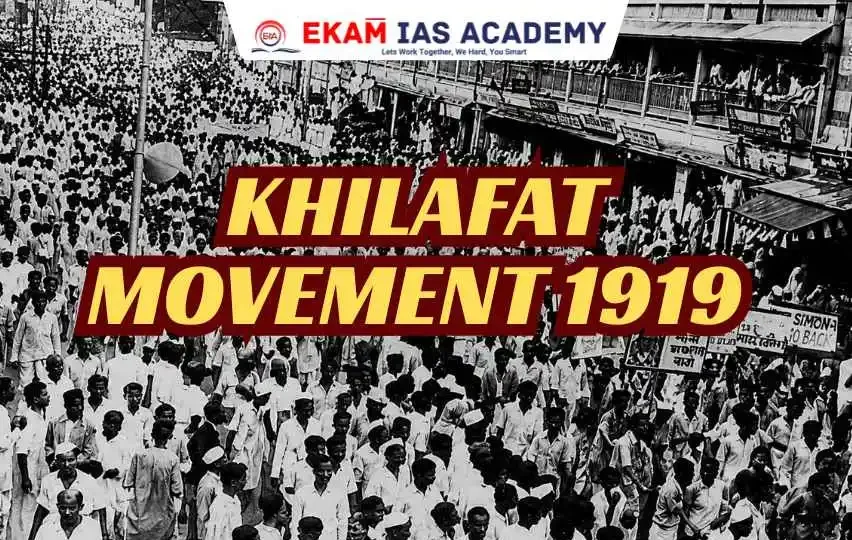
The Khilafat Movement was an important Muslim political movement in India that emerged in the aftermath of the First World War. Beginning around 1919, it sought to protect the position of the Ottoman Sultan, regarded by many Indian Muslims as the Caliph or Khalifa of the Islamic world. The movement soon became closely associated with the Indian National Movement when Mahatma Gandhi extended Congress support to the Khilafat cause.
Background of the Khilafat Movement
The defeat of the Ottoman Empire during the First World War created anxiety among Indian Muslims regarding the future of the Caliph and the Ottoman territories. The harsh terms imposed on Turkey after the war intensified these concerns. Indian Muslim leaders therefore organised political mobilisation to influence British policy.
Causes of the Khilafat Movement
Major Khilafat Movement causes included opposition to the dismemberment of the Ottoman Empire, concern over the position of the Caliph, dissatisfaction with British wartime policies and growing anti-colonial political consciousness among Indian Muslims.
Leaders of the Khilafat Movement
The principal Khilafat Movement leaders included the Ali Brothers—Muhammad Ali and Shaukat Ali, along with Maulana Abul Kalam Azad, Hakim Ajmal Khan and other Muslim leaders. The Khilafat Committee became an important organisational platform.
Formation and Programme of the Khilafat Movement
The Khilafat Committee organised meetings, petitions, conferences and public mobilisation. Its programme increasingly emphasised cooperation with the broader nationalist struggle against British rule.
Gandhi and the Khilafat Movement
Gandhi and Khilafat Movement cooperation represented an important attempt to unite Hindus and Muslims against colonial rule. Gandhi viewed the issue as an opportunity to build Hindu-Muslim unity and strengthen mass nationalism.
Khilafat and Non-Cooperation Movement
The Khilafat Movement and Non Cooperation Movement became closely interconnected in 1920. Gandhi supported a joint programme of boycott and non-cooperation, transforming both movements into a major phase of mass mobilisation.
Decline of the Khilafat Movement
The movement declined after the abolition of the Caliphate by Mustafa Kemal in 1924. The withdrawal of the Non-Cooperation Movement after the Chauri Chaura incident also weakened the broader political alliance.
Significance of the Khilafat Movement
The Khilafat Movement significance lies in its contribution to mass political mobilisation, Hindu-Muslim cooperation, and the expansion of the nationalist movement beyond educated elites. It became an important episode in Khilafat Movement in India and Modern Indian History UPSC.
Limitations of the Khilafat Movement
Its principal limitation was its dependence on an issue outside India. The movement also faced ideological differences and could not sustain Hindu-Muslim political unity for long.
Conclusion
The Khilafat Movement 1919 occupies an important place in Khilafat Movement history because it linked Muslim political mobilisation with Gandhi’s mass nationalist strategy. For Khilafat Movement UPSC, its causes, Ali Brothers, Gandhi’s role, connection with Non-Cooperation, significance and limitations are essential Khilafat Movement notes.
UPSC Prelims: PYQs & Practice Questions
Previous Year Questions (Prelims)
Q: What was the main reason for the launch of the Khilafat Movement in India?
(a) Demand for separate electorates for Indian Muslims
(b) To protest against the injustice done to Turkey and the Caliph after the First World War
(c) To oppose the Rowlatt Act passed by the British Government
(d) To demand immediate Dominion Status for India
Answer: (b) To protest against the injustice done to Turkey and the Caliph after the First World War
Explanation:
The Khilafat Movement (1919–1924) was launched by Indian Muslims to protest against the harsh treatment of the
Ottoman Empire after the First World War and to protect the position of the
Ottoman Sultan as the Caliph.
Prominent leaders included the
Ali Brothers—Muhammad Ali and Shaukat Ali,
Maulana Abul Kalam Azad, Hakim Ajmal Khan and other Muslim leaders.
The movement opposed the proposed dismemberment of Ottoman territories and the weakening of the Caliph’s political and religious position.
Q: What was the purpose with which Mahatma Gandhi supported the Khilafat Movement? (UPSC CSE Prelims 2011)
(a) To seek the support of Indian Muslims for the struggle against British rule
(b) To secure the reinstatement of the Caliph in Turkey
(c) To counter the communal politics of Mohammad Ali Jinnah
(d) To consolidate Congress influence over the Muslim League
Answer: (a) To seek the support of Indian Muslims for the struggle against British rule
Explanation:
Mahatma Gandhi regarded the Khilafat agitation as a
“golden opportunity” to promote Hindu-Muslim unity and expand the social base of the Indian National Movement.
By supporting the Khilafat cause, Gandhi sought to bring large sections of Indian Muslims into the broader
anti-imperialist struggle against British rule.
The Congress–Khilafat alliance eventually became closely associated with the
Non-Cooperation Movement of 1920, transforming the nationalist struggle into a wider mass movement.
Practice Questions
Q: With reference to the Khilafat Movement in India, consider the following statements:
1. The All-India Khilafat Conference held in Delhi in November 1919 elected Mahatma Gandhi as its President.
2. The Khilafat Committee accepted Gandhi’s proposal for a non-cooperation programme at its Allahabad meeting in June 1920.
3. The movement formally came to an end due to political developments in Turkey under Mustafa Kemal Pasha.
Which of the statements given above are correct?
(a) 1 and 2 only
(b) 2 and 3 only
(c) 1 and 3 only
(d) 1, 2 and 3
Answer: (d) 1, 2 and 3
Explanation:
Statement 1 is correct. Mahatma Gandhi was elected President of the
All-India Khilafat Conference held in Delhi in November 1919.
Statement 2 is correct. At its Allahabad meeting in June 1920, the
Khilafat Committee accepted Gandhi’s proposal for launching a
non-cooperation programme against British rule and invited him to lead the movement.
Statement 3 is correct. The movement lost its central objective following political changes in Turkey. The
Caliphate was abolished in 1924 under the leadership of
Mustafa Kemal Pasha, who established a secular Turkish republic.
Q: Which among the following nationalist leaders opposed Gandhi’s decision to associate the Indian National Congress with the Khilafat issue?
1. Mohammad Ali Jinnah
2. Madan Mohan Malaviya
3. Annie Besant
Select the correct answer using the code given below:
(a) 1 only
(b) 1 and 2 only
(c) 2 and 3 only
(d) 1, 2 and 3
Answer: (d) 1, 2 and 3
Explanation:
Mohammad Ali Jinnah, Madan Mohan Malaviya and Annie Besant opposed the association of the Congress with the Khilafat issue.
They were concerned that combining an
extra-territorial religious demand with the Indian nationalist struggle could encourage religious emotionalism and weaken secular constitutional politics.
Jinnah, in particular, disagreed with Gandhi’s methods of mass agitation and warned against mixing religion with political mobilisation. Other leaders, including
Bipin Chandra Pal, also expressed reservations.
UPSC Mains – Previous Year & Practice Questions
Mains Previous Year Questions
[10 Marks | 150 Words]
Question: Do you think Mahatma Gandhi’s support for the Khilafat Movement diluted his secular credentials? Present your arguments based on an assessment of the events. (UPSC CSE Mains 2007)
[10 Marks | 150 Words]
Question: Discuss the aims and objectives of the Khilafat Movement. To what extent was the movement successful? (UPSC CSE Mains 2001)
[15 Marks | 250 Words]
Question: Examine the circumstances that led to the convergence of the Khilafat Movement and the Non-Cooperation Movement. (UPSC CSE Mains 1996)
[10 Marks | 150 Words]
Question: How far was Hindu-Muslim unity during the Khilafat and Non-Cooperation movements real and lasting? Analyze. (UPSC CSE Mains 1989)
[10 Marks | 150 Words]
Question: Trace the origin, development and decline of the Khilafat Movement in India. (UPSC CSE Mains 1982)
Mains Practice Questions
[15 Marks | 250 Words]
Question: “The Khilafat Movement was a Pan-Islamic reaction to European imperialism, but in India, it served as a catalyst for a mass anti-colonial struggle.” Discuss.
[15 Marks | 250 Words]
Question: Critically evaluate the long-term impact of integrating religious demands into nationalist politics during the Khilafat–Non-Cooperation phase on communal harmony in India.
[10 Marks | 150 Words]
Question: Examine the political, international and organisational factors that led to the sudden collapse of the Khilafat Movement in the early 1920s.



Khilafat Movement-FAQs
What was the Khilafat Movement?
The Khilafat Movement was a political movement launched by Indian Muslims after World War I to protect the position of the Ottoman Caliph.
Who were the main leaders of the Khilafat Movement?
The main leaders were the Ali Brothers, Muhammad Ali and Shaukat Ali, along with Maulana Abul Kalam Azad, Hakim Ajmal Khan and other leaders.
Why did Gandhi support the Khilafat Movement?
Gandhi supported it to build Hindu-Muslim unity and link the Khilafat issue with the broader anti-colonial struggle against British rule.
How was the Khilafat Movement linked with the Non-Cooperation Movement?
In 1920, Gandhi and Congress linked Khilafat demands with the Non-Cooperation Movement, creating a major phase of mass nationalist mobilisation.
Why did the Khilafat Movement decline?
It declined after the withdrawal of the Non-Cooperation Movement, Gandhi’s arrest, and the abolition of the Caliphate by Mustafa Kemal in 1924. The Amrit Mahotsav page also notes that Gandhi’s suspension of Non-Cooperation after Chauri Chaura weakened the Khilafat Movement.