Table of Contents
ToggleLeft and Communist Trends in National Movement
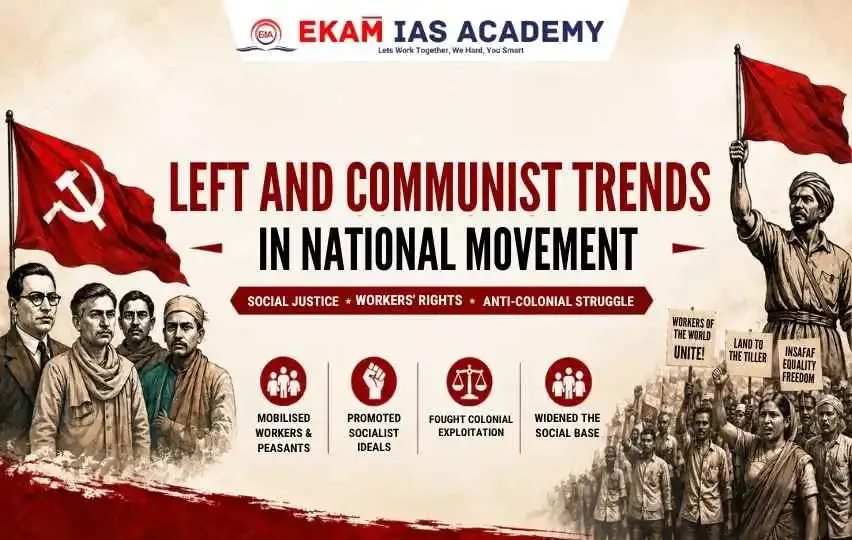
The emergence of Left and Communist Trends in National Movement marked a revolutionary shift in the anti-colonial struggle. From the 1920s onwards, socialist and radical ideologies introduced class-based mobilization, transforming the broader Left Wing Movement in India.
Background of Left-Wing Politics in India
The Russian Revolution of 1917, coupled with severe post-WWI economic distress, radicalized Indian youth. This environment catalyzed the growth of the Left Movement in Indian National Movement as a distinct socio-political force.
Emergence of Communist Ideas in India
Revolutionary intellectuals embraced Marxism in India to address poverty, landlordism, and capitalist exploitation alongside political freedom. Pioneer leaders like M N Roy, S A Dange, Muzaffar Ahmad, and S V Ghate began publishing radical literature to organize workers and peasants.
Formation of the Communist Party of India
The Communist Party of India 1925 was formally established following the Kanpur Communist Conference, consolidating early groups into a unified party. This CPI Formation 1925 event provided an organized ideological platform for Socialist Movement in India.
Growth of Trade Union Movements
Leftist leaders actively organized industrial labor, leading to the formation of the All India Trade Union Congress (AITUC) in 1920. Strikes across Bombay, Calcutta, and Kanpur turned urban working-class agitation into an anti-imperialist force.
Communist Movement and Peasant Mobilisation
Communist leaders organized agricultural laborers and tenant farmers against feudal oppression, eventually leading to the creation of the All India Kisan Sabha in 1936 to demand landlordism abolition.
Congress Socialist Party
Formed in 1934 within the Indian National Congress, the Congress Socialist Party 1934 aimed to give the national movement a socialist orientation. It was spearheaded by leaders such as Jayaprakash Narayan, Ram Manohar Lohia, and Acharya Narendra Deva.
Left-Wing Trends Within the Congress
Younger nationalist leaders like Jawaharlal Nehru and Subhash Chandra Bose embraced socialist ideals, urging the Indian National Congress to integrate economic emancipation into its independence agenda.
Communist Movement During the 1920s
Colonial authorities sought to crush early communist organizing through famous conspiracy trials, including the Kanpur Conspiracy Case (1924) and the Meerut Conspiracy Case (1929).
Communists and the Civil Disobedience Movement
During the early 1930s, communists initially distanced themselves from the Congress-led Civil Disobedience Movement, criticizing it as a bourgeois campaign, which temporarily isolated them from mainstream nationalism.
Communists and the Government of India Act, 1935
By 1935, following Comintern guidelines, communists adopted a United Front strategy, joining hands with the Congress Socialist Party and Congress to fight colonial constitutional schemes.
Left and Communist Trends During the Second World War
The onset of WWII caused ideological realignments. After Nazi Germany invaded the Soviet Union in 1941, the CPI characterized the conflict as a “People’s War,” altering its tactical stance toward the British.
Communists and the Quit India Movement
Due to their “People’s War” stance, communists officially opposed the Quit India Movement in 1942, creating temporary alienation from mass nationalist sentiment.
Major Communist and Left-Led Movements
In the mid-1940s, communists spearheaded massive agrarian and popular revolts, most notably the Tebhaga Movement in Bengal and the Telangana Peasant Movement in Hyderabad state.
Role of the Left in the National Movement
The Left widened the social base of the freedom struggle by mobilizing industrial workers, sharecroppers, and landless peasants into active political participation.
Contribution of Left-Wing Trends
Leftist pressure forced the Indian National Congress to adopt progressive economic resolutions, such as the 1931 Karachi Resolution on Fundamental Rights and Economic Policy.
Limitations of the Communist Movement
Frequent ideological shifts guided by international mandates and occasional alienation from mainstream Gandhian mass movements limited the CPI’s political reach.
Left Trends vs Gandhian Nationalism
- Left Trends: Emphasized class struggle, radical land redistribution, and socio-economic transformation.
- Gandhian Nationalism: Focused on moral persuasion, multi-class unity, non-violence, and trusteeship.
Communist Movement vs Congress Socialist Party
- CPI: Functioned as an independent cadre party adhering strictly to Marxist-Leninist doctrines.
- CSP: Operates within the Congress umbrella to combine democratic socialism with national liberation.
Timeline of Left and Communist Trends
- 1920: Formation of the All India Trade Union Congress; CPI formed in Tashkent by M N Roy.
- 1924: Kanpur Conspiracy Case trial.
- 1925: CPI Formation 1925 conference at Kanpur led by S A Dange, Muzaffar Ahmad, and S V Ghate.
- 1929: Launch of the Meerut Conspiracy Case.
- 1934: Formation of the Congress Socialist Party 1934 under Jayaprakash Narayan, Ram Manohar Lohia, and Acharya Narendra Deva.
- 1936: Establishment of the All India Kisan Sabha.
- 1946: Outbreak of the Tebhaga Movement and Telangana Peasant Movement.
Conclusion
Examining the Left and Communist Trends in National Movement provides key insights for Communist Movement in India UPSC preparation. The Left radically reshaped India’s political landscape, ensuring that independent India prioritized socialist principles, land reform, and economic justice.
UPSC Prelims: PYQs & Practice Questions
Previous Year Questions
Q: With reference to the Congress Socialist Party (CSP), consider the following statements:
1. It advocated the boycott of British goods and evasion of taxes.
2. It wanted to establish the dictatorship of the proletariat.
3. It advocated separate electorates for minorities and depressed classes.
Which of the statements given above is/are correct?
(a) 1 and 2 only
(b) 3 only
(c) 1, 2 and 3
(d) None
Answer: (d) None
Explanation:
Statement 1 is incorrect.
The Congress Socialist Party, formed in
1934 under leaders such as
Jayaprakash Narayan and
Acharya Narendra Deva,
worked within the Indian National Congress to give the national movement a
socialist orientation.
Boycott of British goods and tax evasion were not its defining ideological programme.
Statement 2 is incorrect.
The CSP broadly supported
democratic socialism, mass mobilisation, agrarian reforms and economic restructuring.
It did not adopt the Marxist-Leninist objective of establishing a
dictatorship of the proletariat.
Statement 3 is incorrect.
The CSP opposed
communal political divisions and separate electorates
and emphasized unified
anti-imperialist mass mobilisation.
Therefore, option (d) None is correct.
Q: The
Kanpur Conspiracy Case (1924)
and the
Meerut Conspiracy Case (1929)
were directed by the British Government against which of the following?
(a) The Arya Samajists
(b) The Khilafat leaders
(c) The Communist and Trade Union leaders
(d) The Indian National Congress leadership
Answer: (c) The Communist and Trade Union leaders
Explanation:
The British Government launched these
conspiracy cases
to suppress the growing influence of
communist ideas and trade union activities
in India.
Kanpur Conspiracy Case – 1924:
Prominent communist leaders such as
S. A. Dange, Muzaffar Ahmad, Shaukat Usmani and Nalini Gupta
were prosecuted on charges related to revolutionary communist activity.
Meerut Conspiracy Case – 1929:
Several
trade unionists and communist leaders
were arrested and prosecuted for allegedly conspiring against British rule.
The case attracted considerable
national and international attention.
Therefore, option
(c) The Communist and Trade Union leaders
is correct.
Practice Questions
Q: With reference to the emergence of the Left movement in India, consider the following statements:
1. The Communist Party of India (CPI) was first formed in Tashkent in 1920 by M. N. Roy and Abani Mukherji.
2. The Kanpur Communist Conference of 1925, chaired by M. Singaravelu, formally founded the CPI on Indian soil.
3. The CPI supported the Quit India Movement of 1942 from its launch to maintain solidarity with Gandhian mass action.
Which of the statements given above are correct?
(a) 1 and 2 only
(b) 2 and 3 only
(c) 1 and 3 only
(d) 1, 2 and 3
Answer: (a) 1 and 2 only
Explanation:
Statements 1 and 2 are correct.
The Communist Party of India had an early formation at
Tashkent in October 1920
under leaders such as
M. N. Roy, Evelyn Roy and Abani Mukherji.
In December 1925, communist leaders including
S. A. Dange, S. V. Ghate and M. Singaravelu
participated in the
Kanpur Communist Conference,
which marked the formal organisation of the CPI on Indian soil.
Statement 3 is incorrect.
After Nazi Germany invaded the Soviet Union in
1941, the CPI characterized the Second World War as a
"People's War".
Consequently, it
did not support the Quit India Movement of 1942.
Therefore, Statements 1 and 2 are correct.
Q: Which of the following organizations/journals are correctly matched with their respective Left-wing founders or leaders?
1. The Socialist — S. A. Dange
2. Navayug — Muzaffar Ahmad
3. Congress Socialist Party (1934) — Jayaprakash Narayan & Acharya Narendra Deva
4. All India Trade Union Congress (AITUC, 1920) — First presided over by Lala Lajpat Rai
Select the correct answer using the code given below:
(a) 1, 2 and 3 only
(b) 2 and 4 only
(c) 1 and 3 only
(d) 1, 2, 3 and 4
Answer: (d) 1, 2, 3 and 4
Explanation:
All four matches are correct.
S. A. Dange launched
The Socialist
from Bombay in 1922 as an important early communist publication.
Muzaffar Ahmad was associated with
Navayug
in Bengal along with
Kazi Nazrul Islam.
The Congress Socialist Party (1934) emerged under leaders such as
Jayaprakash Narayan and
Acharya Narendra Deva,
with figures like
Ram Manohar Lohia also playing an important role.
The All India Trade Union Congress (AITUC) was established in
1920,
and Lala Lajpat Rai served as its
first president.
Therefore, option (d) 1, 2, 3 and 4 is correct.
UPSC Mains – Previous Year & Practice Questions
Mains Previous Year Questions
[15 Marks | 250 Words]
Question: Highlight the differences between the approach of Gandhian Nationalism and the Leftist Movement towards mass mobilisation and economic reorganisation during the freedom struggle. (UPSC CSE Mains 2020, GS Paper I)
[10 Marks | 150 Words]
Question: How did the Russian Revolution of 1917 influence the growth of socialist and communist ideology within the Indian National Movement during the 1920s and 1930s? (UPSC CSE Mains 2015, GS Paper I)
[10 Marks | 150 Words]
Question: Critically evaluate the role and contributions of the Congress Socialist Party (CSP), formed in 1934, in shaping the socio-economic policy of the Indian National Congress. (UPSC CSE Mains 2011, Modern History)
[15 Marks | 250 Words]
Question: Analyse the factors responsible for the emergence of the Trade Union Movement in India during the 1920s. What was the impact of the Meerut Conspiracy Case on the movement? (UPSC CSE Mains 2004, Modern History)
[15 Marks | 250 Words]
Question: Examine the causes, nature and historical significance of the Tebhaga Movement in Bengal and the Telangana Peasant Movement in Hyderabad. (UPSC CSE Mains 1997, Modern History)
Mains Practice Questions
[15 Marks | 250 Words]
Question: “ Left-wing trends within the Indian National Congress acted as an internal ideological pressure group, forcing the nationalist leadership to adopt progressive economic agendas.” Discuss with reference to the Karachi Session and the Faizpur Session.
[15 Marks | 250 Words]
Question: The tactical dilemma between adherence to Comintern directives and national anti-colonial priorities often alienated Indian Communists from mainstream freedom struggles. Critically analyse.
[10 Marks | 150 Words]
Question: Examine the contribution of communist and socialist leaders in expanding the social base of the Indian National Movement from an urban middle-class platform to a broader agrarian mass struggle.
Left and Communist Trends in National Movement-FAQs
What were Left and Communist Trends in National Movement?
They were socialist, Marxist and working-class political trends that linked India’s freedom struggle with labour rights, peasant mobilisation and economic justice.
When was the Communist Party of India formed?
The Communist Party of India was formally formed at the Kanpur Communist Conference in 1925.
What was the role of AITUC in the freedom struggle?
AITUC organised industrial workers and connected labour issues such as wages, working conditions and rights with the wider anti-colonial struggle.
What was the Congress Socialist Party?
The Congress Socialist Party was formed in 1934 within the Congress to give the national movement a socialist and pro-worker orientation.
Why is this topic important for UPSC?
It is important because it connects Marxism, trade unionism, peasant movements, Congress socialism, CPI, CSP, Tebhaga, Telangana and economic ideas of the freedom struggle.