Table of Contents
ToggleCabinet Mission Plan
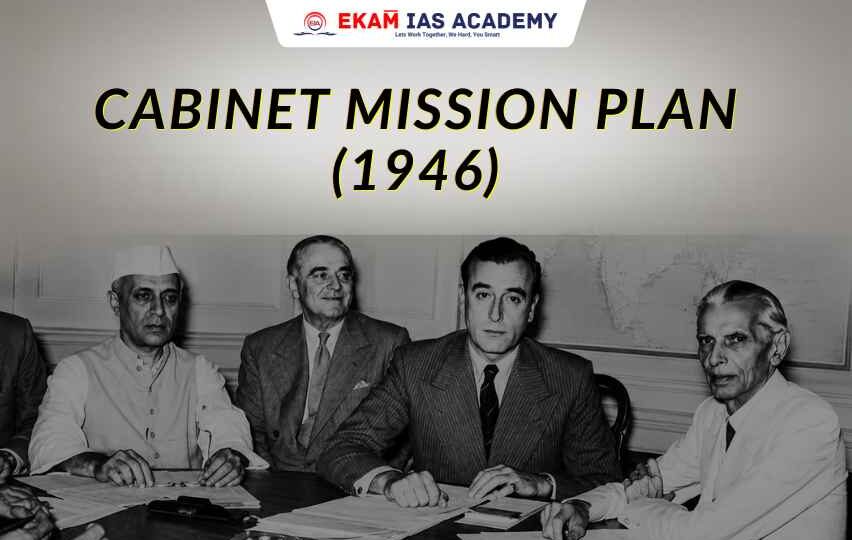
The Cabinet Mission Plan 1946 was a historic initiative sent by the British government to transfer power from the British Crown to Indian leadership. A vital topic in Modern Indian History UPSC preparation, the Cabinet Mission 1946 aimed to preserve the unity of India while devising a framework to draft the nation’s new constitution during the final phase of the Indian National Movement.
Background of the Cabinet Mission
Following World War II, Clement Attlee’s Labour government took office in Britain and recognized that imperial rule was no longer sustainable. Deepening political stalemates and widespread anti-colonial ferment pushed London to formulate a definitive constitutional exit strategy for the Indian Freedom Struggle UPSC framework.
Members of the Cabinet Mission
The high-powered delegation comprised three British Cabinet Mission members:
- Lord Pethick-Lawrence (Secretary of State for India)
- Sir Stafford Cripps (President of the Board of Trade)
- A. V. Alexander (First Lord of the Admiralty)
Objectives of the Cabinet Mission
The main Cabinet Mission Plan proposals sought to secure an agreement with Indian leaders on framing a constitution, setting up a representative constitution-making body, and establishing an executive Interim Government 1946.
Major Proposals of the Cabinet Mission Plan
Key Cabinet Mission Plan features included:
- Rejection of the demand for a sovereign, independent Pakistan.
- Establishment of an Indian Union controlling Defense, Foreign Affairs, and Communications.
- Vesting of all residual powers in the provinces.
Provincial Grouping Under the Cabinet Mission Plan
To address communal concerns, the plan introduced compulsory provincial grouping 1946, organizing provinces into three sections:
- Group A: Non-Muslim majority provinces (Madras, Bombay, UP, Bihar, Central Provinces, Orissa).
- Group B: Muslim-majority provinces in the northwest (Punjab, NWFP, Sind).
- Group C: Muslim-majority provinces in the northeast (Bengal, Assam).
Constituent Assembly Under the Cabinet Mission Plan
The plan mapped out the election of a 389-member Constituent Assembly 1946 via indirect voting by provincial assemblies, structured proportionally among Hindus, Muslims, and Sikhs.
Interim Government, 1946
The scheme provided for an all-Indian interim cabinet to administer central portfolios until the constitution was adopted. Jawaharlal Nehru subsequently took charge as Vice President of the Executive Council in September 1946.
Response of the Indian National Congress
Evaluating Congress and Cabinet Mission Plan interactions, Congress accepted the long-term plan to construct the Constituent Assembly but rejected compulsory grouping, asserting that provinces should have the freedom to opt out of groups initially.
Response of the Muslim League
Regarding Muslim League and Cabinet Mission Plan negotiations, the League initially accepted the plan, interpreting the mandatory Cabinet Mission Group A B C sections as an implicit step toward Pakistan.
Failure of the Cabinet Mission Plan
The Cabinet Mission Plan failure unfolded after Nehru’s press statement in July 1946 asserting Congress’s sovereignty to alter grouping rules inside the Constituent Assembly. In response, Jinnah withdrew acceptance and launched Direct Action Day 1946 on August 16, triggering severe communal violence.
Significance of the Cabinet Mission Plan
Evaluating Cabinet Mission Plan significance, it represented the final major effort by the British Raj to maintain a united, undivided India before shifting to partition schemes.
Cabinet Mission Plan and Partition
The breakdown of negotiations directly linked the Cabinet Mission Plan and Partition, convincing both colonial rulers and nationalist leaders that an undivided constitutional settlement was no longer viable.
Cabinet Mission Plan vs Cripps Mission
- Cabinet Mission Plan (1946): Envisaged a three-tier federal structure and rejected an immediate sovereign partition.
- Cabinet Mission Plan vs Cripps Mission (1942): Cripps focused on post-war Dominion Status with an explicit right for provinces to secede immediately.
Cabinet Mission Plan vs Wavell Plan
- Cabinet Mission Plan (1946): Addressed long-term constitution-making machinery alongside an interim government.
- Cabinet Mission Plan vs Wavell Plan (1945): Wavell focused purely on immediate, short-term interim administrative parity within the Viceroy’s Executive Council.
Timeline of Important Events
- March 24, 1946: Cabinet Mission arrives in New Delhi.
- May 16, 1946: Announcement of the Cabinet Mission Plan 1946.
- August 16, 1946: Muslim League observes Direct Action Day 1946.
- September 2, 1946: Formation of the Interim Government 1946.
Conclusion
Mastering these Cabinet Mission Plan UPSC concepts provides essential clarity for your notes. As the ultimate constitutional landmark before independence, it remains a cornerstone topic in Cabinet Mission Plan 1946 studies for civil services preparation.
UPSC Prelims: PYQs & Practice Questions
Previous Year Questions
Q: With reference to the Cabinet Mission, which of the following statements is/are correct?
1. It recommended a federal government.
2. It enlarged the powers of the Indian courts.
3. It provided for more Indians in the Indian Civil Service (ICS).
Select the correct answer using the code given below:
(a) 1 only
(b) 2 and 3
(c) 1 and 3
(d) None
Answer: (a) 1 only
Explanation:
Statement 1 is correct. The
Cabinet Mission proposed a loose federal structure for a
united India, with the Union controlling only
Defence, Foreign Affairs and Communications.
The remaining subjects and
residuary powers were to remain with the provinces.
Statements 2 and 3 are incorrect. The Cabinet Mission did not propose the enlargement of the powers of Indian courts or changes relating to the recruitment of more Indians into the
Indian Civil Service (ICS).
Q: With reference to the
Indian freedom struggle, who among the following was
NOT a member of the Cabinet Mission?
(a) Sir Stafford Cripps
(b) A.V. Alexander
(c) Lord Pethick-Lawrence
(d) Lord Wavell
Answer: (d) Lord Wavell
Explanation:
The Cabinet Mission of 1946 consisted of three British Cabinet ministers:
1. Lord Pethick-Lawrence – Secretary of State for India
2. Sir Stafford Cripps – President of the Board of Trade
3. A.V. Alexander – First Lord of the Admiralty
Lord Wavell was the
Viceroy of India at the time and was therefore
not a member of the Cabinet Mission delegation.
Practice Questions
Q: With reference to the Provincial Grouping Scheme under the Cabinet Mission Plan (1946), consider the following statements:
1. Group A comprised non-Muslim majority provinces like Bombay, Madras and Bihar.
2. Group B and Group C consisted of Muslim-majority provinces in the Northwest and Northeast respectively.
3. Assam was placed in Group A alongside Bengal to ensure economic balance.
Which of the statements given above are correct?
(a) 1 and 2 only
(b) 2 and 3 only
(c) 1 and 3 only
(d) 1, 2 and 3
Answer: (a) 1 and 2 only
Explanation:
Statement 1 is correct. Under the
Cabinet Mission Plan,
Group A consisted of provinces such as
Madras, Bombay, United Provinces, Bihar, Central Provinces and Orissa.
Statement 2 is correct.
Group B consisted of
Punjab, North-West Frontier Province and Sind, while
Group C consisted of
Bengal and Assam.
Statement 3 is incorrect.
Assam was placed in Group C alongside Bengal, not in Group A.
This grouping was strongly opposed by sections of the Congress leadership in Assam, including
Gopinath Bordoloi.
Q: Which of the following proposals were features of the Cabinet Mission Plan of 1946?
1. Explicit rejection of a full-fledged independent State of Pakistan.
2. Vesting of all residuary powers in the Central Government.
3. Creation of a Constituent Assembly elected indirectly by Provincial Legislative Assemblies.
Select the correct answer using the code given below:
(a) 1 and 2 only
(b) 1 and 3 only
(c) 2 and 3 only
(d) 1, 2 and 3
Answer: (b) 1 and 3 only
Explanation:
Statement 1 is correct. The
Cabinet Mission rejected the demand for a sovereign Pakistan,
arguing that partition would not satisfactorily resolve the minority problem and could create difficulties relating to
defence, communications and administration.
Statement 2 is incorrect. The proposed Union was to deal mainly with
Defence, Foreign Affairs and Communications,
while residuary powers were to remain with the Provinces.
Statement 3 is correct. The
Constituent Assembly was to be formed through
indirect election by members of the Provincial Legislative Assemblies.
UPSC Mains – Previous Year & Practice Questions
Mains Previous Year Questions
[10 Marks | 150 Words]
Question: Why did the Cabinet Mission Plan reject the demand for a separate State of Pakistan? Evaluate its main constitutional recommendations. (UPSC CSE Mains 2021, GS Paper I)
[15 Marks | 250 Words]
Question: Examine the constitutional mechanics of the Provincial Grouping Clause in the Cabinet Mission Plan and explain how conflicting interpretations led to its ultimate breakdown. (UPSC CSE Mains 2019, GS Paper I)
[15 Marks | 250 Words]
Question: Analyse the circumstances that led to the formation of the Interim Government in 1946 and discuss the challenges it faced due to Muslim League participation. (UPSC CSE Mains 2013, GS Paper I)
[10 Marks | 150 Words]
Question: Discuss the main features of the Cabinet Mission Plan. Why was it rejected by both the Indian National Congress and the Muslim League after initial acceptance? (UPSC CSE Mains 2004, Modern History)
[15 Marks | 250 Words]
Question: Evaluate the Cabinet Mission Plan as the last major British attempt to preserve the unity of India. (UPSC CSE Mains 1999, Modern History)
Mains Practice Questions
[15 Marks | 250 Words]
Question: “The Cabinet Mission Plan attempted to solve an unsolvable political dilemma by offering a weak Centre and compulsory provincial grouping, which satisfied neither nationalist unity nor communal separatism.” Critically evaluate.
[15 Marks | 250 Words]
Question: Trace the chain of events from Jawaharlal Nehru’s 10 July 1946 press conference to the Muslim League’s call for Direct Action Day. How did this period mark the point of no return for the partition of India?
[10 Marks | 150 Words]
Question: Compare the structural proposals of the Cabinet Mission Plan (1946) with the Mountbatten Plan (1947) in terms of State sovereignty, defence and territorial division.
Cabinet Mission Plan-FAQs
What was the Cabinet Mission Plan 1946?
The Cabinet Mission Plan was a British proposal announced in 1946 to frame India’s Constitution, create an interim government and transfer power.
Who were the members of the Cabinet Mission?
The members were Lord Pethick-Lawrence, Sir Stafford Cripps and A. V. Alexander.
What were the major proposals of the Cabinet Mission Plan?
It rejected Pakistan, proposed an Indian Union for Defence, Foreign Affairs and Communications, gave residuary powers to provinces and introduced provincial grouping.
Why did the Cabinet Mission Plan fail?
It failed due to differences between Congress and the Muslim League over compulsory grouping and the future constitutional structure of India.
Why is Cabinet Mission Plan important for UPSC?
It is important because it connects Constituent Assembly formation, Interim Government, provincial grouping, Direct Action Day, partition debate and transfer of power.