
Table of Contents
TogglePeasant Movements
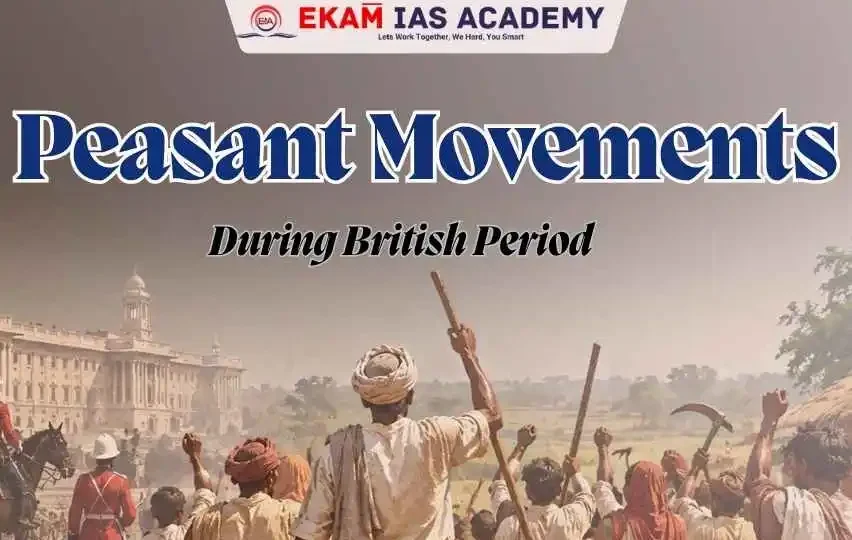
The Peasant Movements During British Period represent a prolonged resistance by India’s rural agrarian masses against colonial economic exploitation and feudal oppression. These Peasant Movements in India evolved from localized, violent agrarian eruptions into organized mass struggles linked directly to the national freedom movement.
Causes of Peasant Movements
The fundamental drivers behind Peasant Rebellions in India emerged from colonial land revenue systems:
- Exorbitant revenue demands under Permanent, Ryotwari, and Mahalwari settlements.
- Widespread land alienation, forced evictions, and debt traps created by predatory moneylenders.
- High rents, illegal cesses (abwabs), and unremunerated forced labor (veth or begar) imposed by zamindars.
- Destruction of traditional rural handicrafts, pushing millions into agricultural dependency.
Peasant Movements Before 1857
Early agrarian uprisings were spontaneous and aimed directly at oppressive local landlords and British revenue agents. Prominent early movements included the Indigo Revolt 1859 in Bengal, where ryots refused to cultivate indigo under coercive European contracts, followed by the Pabna Agrarian Movement (1870s–1880s) contesting illegal rent hikes, and the Deccan Riots 1875 targeting Marwari and Gujarati moneylenders.
Major Peasant Movements in the 20th Century
The 20th century marked a transition toward institutionalized and organized Agrarian Movements in India. Key milestones include:
- Champaran Satyagraha 1917: Directed against the Tinkathia system imposed on indigo farmers in Bihar.
- Kheda Satyagraha 1918: Organized to demand land revenue remissions following crop failure in Gujarat.
- Bardoli Satyagraha 1928: Led by Vallabhbhai Patel against an unjust 22% land revenue hike imposed by the Bombay Presidency.
Peasant Movements During the Civil Disobedience Era
During the Civil Disobedience Movement (1930–1934), peasant resistance coalesced around non-payment of land revenue in Ryotwari areas and no-rent campaigns in Zamindari regions across the United Provinces, Bihar, and Andhra Pradesh.
Peasant Movements During the 1930s
The 1930s saw the emergence of formal class-conscious peasant leadership:
- All India Kisan Sabha (AIKS) was established in Lucknow in 1936.
- Prominent leaders like Swami Sahajanand Saraswati (President) and N G Ranga (General Secretary) organized agrarian manifestos demanding abolition of zamindari and rent reductions.
Major Peasant Movements During the 1940s
During the decade preceding independence, radical agrarian struggles erupted:
- Tebhaga Movement 1946: Bengal sharecroppers (bargadars) demanded two-thirds of the harvest share instead of half.
- Telangana Peasant Movement: A massive armed peasant uprising against the feudal deshmukhs and the Nizam’s regime in Hyderabad state.
Nature of Peasant Movements
- Shifted gradually from spontaneous anti-landlord riots to organized, anti-imperialist agrarian movements.
- Earlier phases sought restoration of customary rights, whereas 20th-century campaigns demanded systemic land reforms.
Role of Mahatma Gandhi in Peasant Movements
The integration of Mahatma Gandhi Peasant Movements strategies transformed localized agrarian grievances into nationwide mass mobilization. Through Satyagraha in Champaran and Kheda, Gandhi bridged the gap between rural peasant grievances and the national Congress platform.
Role of Peasant Organisations
Bodies like the Bihar Provincial Kisan Sabha and All India Kisan Sabha provided institutional leadership, formulated clear political demands, published agrarian manifestos, and linked agrarian struggles across provincial boundaries.
British Response to Peasant Movements
The colonial state utilized a dual strategy of brutal police repression alongside minor legislative concessions, such as passing the Bengal Tenancy Act of 1885 and appointing the Floud Commission (1940).
Significance of Peasant Movements
- Exposed the deep structural flaws of British land revenue settlements.
- Forced post-independence Indian governments to prioritize Zamindari abolition and land reform legislation.
Limitations of Peasant Movements
- Lacked a comprehensive revolutionary vision to dismantle colonial capitalism in its early phases.
- Often constrained by regional isolation and religious/caste fragmentations.
Peasant Movements and Indian Nationalism
The alignment between Peasant Movements and Indian Nationalism broadened the social base of the Indian National Congress, turning an elite political movement into a genuine mass anti-colonial struggle.
Peasant Movements vs Tribal Movements
- Peasant Movements: Centered primarily on legal, economic, tenancy, and revenue grievances within settled agricultural zones.
- Tribal Movements: Fought for complete autonomy over ancestral forests and land against all external intruders (dikus).
Timeline of Major Peasant Movements
- 1859: Outbreak of the Indigo Revolt 1859.
- 1875: Occurrence of the Deccan Riots 1875.
- 1917: Champaran Satyagraha 1917 led by Mahatma Gandhi.
- 1918: Kheda Satyagraha 1918 in Gujarat.
- 1928: Launch of the Bardoli Satyagraha 1928 led by Vallabhbhai Patel.
- 1936: Formation of the All India Kisan Sabha under Swami Sahajanand Saraswati.
- 1946: Outbreak of the Tebhaga Movement 1946 and Telangana Peasant Movement.
Conclusion
Compiling detailed UPSC History Notes on agrarian resistance provides crucial insights into India’s socio-economic history. These Peasant Movements During British Rule fundamentally reshaped rural socio-economic structures and formed the agrarian backbone of the Indian national movement.
UPSC Prelims: PYQs & Practice Questions
Previous Year Questions (Prelims)
Q: With reference to the history of India, consider the following pairs:
1. Indigo Revolt — Bengal
2. Pabna Movement — Maharashtra
3. Deccan Riots — Gujarat
Which of the pairs given above is/are correctly matched?
(a) 1 only
(b) 1 and 2 only
(c) 2 and 3 only
(d) 1, 2, and 3
Answer: (a) 1 only
Explanation:
Pair 1 is correct: The Indigo Revolt (1859–60)
took place mainly in Bengal, where peasants resisted coercive
indigo cultivation imposed by European planters.
Pair 2 is incorrect: The Pabna Movement occurred in Pabna district of Bengal, not Maharashtra.
Pair 3 is incorrect: The Deccan Riots of 1875 took place primarily in the Deccan region of Maharashtra, particularly among peasants affected by indebtedness and moneylender exploitation.
Q: With reference to the Indigo Revolt (1859–60), which of the following statements is/are correct?
1. It was launched by peasants in Bengal who refused to grow
indigo under forced contracts enforced by European planters.
2. Digambar Biswas and Bishnu Biswas were
prominent leaders of this movement.
3. The movement received active support from the educated intelligentsia of
Bengal through newspapers like Hindu Patriot.
Select the correct answer using the code given below:
(a) 1 and 2 only
(b) 2 and 3 only
(c) 1 and 3 only
(d) 1, 2, and 3
Answer: (d) 1, 2, and 3
Explanation:
Statement 1 is correct: Bengal peasants resisted the coercive
indigo cultivation system imposed by European planters, which often forced them
to cultivate indigo instead of food crops.
Statement 2 is correct: Digambar Biswas and Bishnu Biswas emerged as prominent leaders of the resistance, particularly in the Nadia region of Bengal.
Statement 3 is correct: The Bengali intelligentsia supported the peasants by highlighting planter oppression. Harish Chandra Mukherjee used the Hindu Patriot to expose the exploitation, while Dinabandhu Mitra portrayed the plight of indigo cultivators in Neel Darpan.
Practice Questions
Q: With reference to the Bardoli Satyagraha (1928), consider the following statements:
1. It was organized against an oppressive 22% land revenue hike
imposed by the Bombay Presidency administration.
2. Vallabhbhai Patel was bestowed the title of
'Sardar' by the women of Bardoli during this struggle.
3. The British government appointed the Maxwell-Broomfield Committee,
which significantly reduced the revenue enhancement.
Which of the statements given above are correct?
(a) 1 and 2 only
(b) 2 and 3 only
(c) 1 and 3 only
(d) 1, 2, and 3
Answer: (d) 1, 2, and 3
Explanation:
Statement 1 is correct: The Bombay government had imposed a
22% increase in land revenue in Bardoli taluka, leading to
widespread opposition among peasants.
Statement 2 is correct: Vallabhbhai Patel led the non-payment campaign and earned the title 'Sardar', associated with the support of the women of Bardoli.
Statement 3 is correct: The government appointed the Broomfield-Maxwell Inquiry Committee. Its recommendations resulted in the proposed revenue enhancement being substantially reduced, from about 22% to 6.03%.
Q: Which of the following peasant movements are correctly matched with their key objective/cause?
1. Champaran Satyagraha (1917) — Abolition of the
Tinkathia system
2. Tebhaga Movement (1946) — Sharecroppers demanding
two-thirds share of the harvest
3. Deccan Riots (1875) — Destruction of debt bonds held
by Marwari and Gujarati moneylenders
4. Eka Movement (1921) — No-rent campaign led by
Madari Pasi in Avadh
Select the correct answer using the code given below:
(a) 1, 2, and 3 only
(b) 2 and 4 only
(c) 1 and 3 only
(d) 1, 2, 3, and 4
Answer: (d) 1, 2, 3, and 4
Explanation:
Pair 1 is correct: The Champaran Satyagraha
sought relief from the Tinkathia system, which compelled cultivators
to grow indigo on a portion of their land.
Pair 2 is correct: The Tebhaga Movement involved Bengal sharecroppers (bargadars) demanding two-thirds of the produce instead of the customary half.
Pair 3 is correct: The Deccan Riots of 1875 targeted moneylenders and their debt records, particularly in the Poona and Ahmednagar regions.
Pair 4 is correct: The Eka Movement emerged in the United Provinces against high rents and exploitative practices. Madari Pasi was one of its prominent leaders.
UPSC Mains – Previous Year & Practice Questions
Mains Previous Year Questions
[15 Marks | 250 Words]
Question: Explain how the peasant movements of the 1930s differed structurally and ideologically from the early agrarian uprisings of the 19th century. (UPSC CSE Mains 2019, GS Paper 1)
[10 Marks | 150 Words]
Question: Examine the role of Mahatma Gandhi in transforming agrarian grievances into mass political campaigns, with special reference to Champaran and Kheda. (UPSC CSE Mains 2014, GS Paper 1)
[10 Marks | 150 Words]
Question: Discuss the impact of the Indigo Revolt (1859–60) on the socio-political consciousness of Bengal's intelligentsia and rural peasantry. (UPSC CSE Mains 2012, Modern History)
[10 Marks | 150 Words]
Question: Write a critical note on the origin, leadership, and demands of the All India Kisan Sabha formed in 1936. (UPSC CSE Mains 2005, Modern History)
[15 Marks | 250 Words]
Question: Analyze the factors that led to the Telangana Peasant Movement (1946–51). What was its contribution to post-independence land reform policy in India? (UPSC CSE Mains 1998, Modern History)
Mains Practice Questions
[15 Marks | 250 Words]
Question: "Colonial land revenue systems transformed Indian agriculture from a community-based subsistence model into a commercialized, debt-ridden enterprise." Elucidate how this transition triggered peasant revolts across British India.
[15 Marks | 250 Words]
Question: "The integration of peasant movements with the Indian National Movement broadened the social base of Indian nationalism, yet Congress often constrained radical agrarian demands to preserve multi-class unity." Critically analyze.
[10 Marks | 150 Words]
Question: Discuss the nature and historical significance of the Tebhaga Movement (1946) in Bengal. How did it reflect the growing class consciousness of sharecroppers on the eve of independence?
Peasant Movements-FAQs
What were the major causes of peasant movements during British rule?
The major causes included high land revenue, excessive rents, illegal cesses, forced labour, eviction, indebtedness, land alienation and exploitation by zamindars and moneylenders. The decline of traditional handicrafts also increased pressure on agriculture.
What were the important peasant movements in India during British rule?
Important movements included the Indigo Revolt (1859–60), Pabna Agrarian Movement, Deccan Riots (1875), Champaran Satyagraha (1917), Kheda Satyagraha (1918), Bardoli Satyagraha (1928), Tebhaga Movement (1946–47) and Telangana Movement (1946–51).
What was the role of Mahatma Gandhi in peasant movements?
Gandhi connected local agrarian grievances with the broader national movement through methods such as Satyagraha and non-violent resistance. Champaran and Kheda were important examples, while Bardoli demonstrated the effectiveness of organised non-tax resistance.
What was the significance of the All India Kisan Sabha?
The All India Kisan Sabha (AIKS), established in 1936, provided an organised platform for peasant struggles. It helped bring agrarian issues such as rent reduction, abolition of zamindari and protection from exploitation into wider political debate.
How did peasant movements contribute to Indian nationalism?
Peasant movements expanded the social base of the freedom struggle by bringing rural communities and agrarian grievances into nationalist politics. However, many early movements remained regional and focused primarily on immediate economic and tenancy issues.