Table of Contents
ToggleThe Simon Commission and the Nehru Report are pivotal milestones in Modern Indian History UPSC preparation. Occurring in the late 1920s, these twin developments marked a decisive turn in the Indian National Movement, transitioning the struggle from reactive protests to proactive constitutional drafting.
Historical Background
Under the Government of India Act 1919, a statutory commission was mandated after ten years to evaluate the working of Dyarchy and suggest further Constitutional Reforms in India. However, the British Conservative government appointed the committee two years early in November 1927 to prevent a prospective Labour government from handling Indian affairs.
Simon Commission (1927)
Officially named the Indian Statutory Commission, the Simon Commission 1927 was headed by Sir John Simon. The commission consisted of seven British Members of Parliament, completely excluding Indians.
Recommendations of the Simon Commission
Key Simon Commission recommendations included:
- Abolition of Dyarchy in provinces and establishment of representative provincial autonomy.
- Rejection of parliamentary responsibility at the Centre.
- Continuation of separate communal electorates until tension subsided.
Indian Response to the Simon Commission
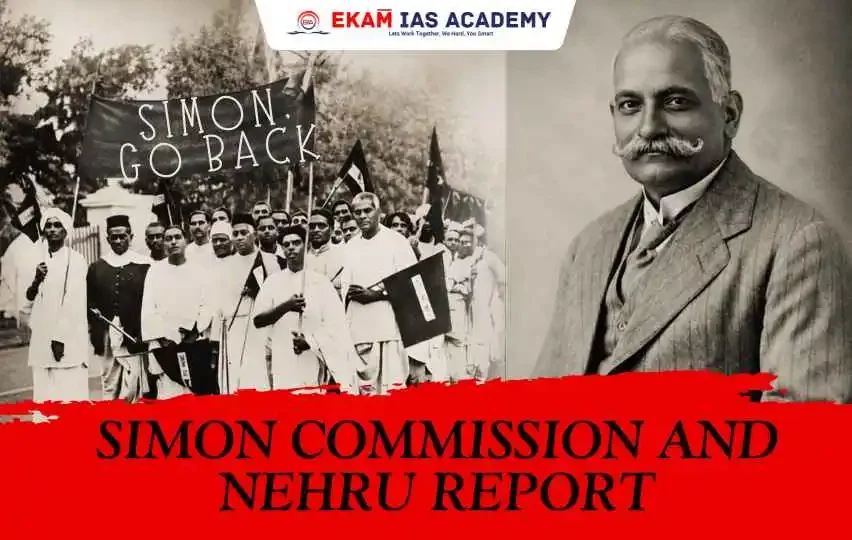
The all-white composition triggered a widespread Simon Commission boycott. Across the nation, mass demonstrations erupted with slogans of “Simon Go Back”. During a peaceful protest in Lahore, Lala Lajpat Rai suffered fatal lathi blows from colonial police.
Nehru Report (1928)
Outraged by Lord Birkenhead’s challenge that Indians could not draft an agreed constitution, the All Parties Conference 1928 appointed the Motilal Nehru Committee. Their drafted constitution became famous as the Nehru Report 1928.
Major Recommendations of the Nehru Report
Essential recommendations in the Nehru Report UPSC syllabus include:
- Recommendation of Dominion Status on parliamentary lines.
- Complete rejection of separate electorates in favor of joint electorates with reservation for minorities.
- A bill of rights securing fundamental rights and universal adult suffrage.
Reactions to the Nehru Report
The report faced internal and external opposition:
- Younger leaders like Jawaharlal Nehru and Subhash Chandra Bose demanded complete independence (Purna Swaraj) instead of Dominion Status.
- M.A. Jinnah rejected the report and formulated his famous Jinnah Fourteen Points in 1929.
Simon Commission vs Nehru Report
| Aspect | Simon Commission | Nehru Report |
|---|---|---|
| Nature | Imposed by imperial authority | Indigenous constitutional effort |
| Political Structure | Retained central control | Advocated democratic self-governance |
| Electoral System | Retained communal electorates | Advocated joint electorates |
| Rights | No provision for fundamental rights | Advocated fundamental rights |
Significance in the Indian Freedom Struggle
This period demonstrated Indian political maturity. The failure of the British to accept the Nehru Report directly paved the way for the Lahore Congress Session (1929) and the Civil Disobedience Movement.
Timeline of Important Events
- November 1927: Appointment of the Simon Commission.
- February 1928: Arrival of Simon Commission in India; mass boycotts.
- August 1928: Submission of the Nehru Report.
- March 1929: Proposal of Jinnah Fourteen Points.
Conclusion
Mastering the Simon Commission UPSC and Nehru Report content is essential for revising UPSC History Notes. Together, they shifted Indian national politics toward the goal of total independence.
UPSC Prelims: PYQs & Practice Questions
Previous Year Questions (Prelims)
Q: With reference to the Nehru Report of 1928, which of the following recommendations were made by it?
1. Complete Independence for India
2. Joint electorates with reservation of seats for minorities
3. Fundamental Rights for the people of India in the Constitution
Select the correct answer using the code given below:
(a) 1 and 2 only
(b) 2 and 3 only
(c) 1 and 3 only
(d) 1, 2 and 3
Answer: (b) 2 and 3 only
Explanation:
Statement 1 is incorrect. The Nehru Report recommended
Dominion Status for India rather than Complete Independence or
Purna Swaraj.
This position was opposed by younger nationalist leaders such as
Jawaharlal Nehru and Subhas Chandra Bose, who demanded complete independence.
Statement 2 is correct. The Report rejected
separate electorates and recommended joint electorates with reservation of seats for minorities, including Muslims at the Centre and in provinces where they were in a minority.
Statement 3 is correct. It proposed
19 Fundamental Rights, including freedom of expression, equality before law, equal rights for women and universal adult suffrage.
Q: With reference to the recommendations of the Simon Commission, which one of the following statements is correct?
(a) It recommended the replacement of Dyarchy with responsible government in the provinces.
(b) It proposed the establishment of an Inter-Provincial Council under the Home Department.
(c) It suggested the abolition of the bicameral legislature at the Centre.
(d) It recommended the creation of the Indian Police Service with a provision for international recruitment.
Answer: (a) It recommended the replacement of Dyarchy with responsible government in the provinces
Explanation:
The Simon Commission recommended the abolition of
Dyarchy in the provinces and the introduction of representative and responsible provincial government.
Provincial administration was to be entrusted to ministers responsible to the provincial legislatures, paving the way for
provincial autonomy.
Practice Questions
Q: Why was the Indian Statutory Commission, popularly known as the Simon Commission, boycotted by almost all major Indian political parties in 1928?
(a) It refused to discuss the issue of Dominion Status for India.
(b) It did not include any Indian member in its composition.
(c) It recommended the immediate partition of Bengal and Punjab.
(d) It proposed the abolition of the office of the Secretary of State for India.
Answer: (b) It did not include any Indian member in its composition
Explanation:
The Simon Commission consisted of seven members, all of whom were
British Members of Parliament. It was therefore popularly described as an
“all-white commission.”
Indian leaders belonging to the
Indian National Congress, sections of the Muslim League and Liberal groups
regarded the complete exclusion of Indians as an insult to India’s political maturity, national self-respect and right to self-determination.
Consequently, the Commission faced widespread protests under the slogan
“Simon Go Back.”
Q: With reference to Jinnah’s Fourteen Points of 1929, consider the following statements:
1. They were formulated as a reaction and an alternative proposal to the recommendations of the Nehru Report.
2. They demanded a federal Constitution with residuary powers vested in the Central Government.
3. They advocated separate electorates for Muslims unless joint electorates were accepted with specific safeguards.
Which of the statements given above are correct?
(a) 1 and 2 only
(b) 1 and 3 only
(c) 2 and 3 only
(d) 1, 2 and 3
Answer: (b) 1 and 3 only
Explanation:
Statement 1 is correct. Jinnah’s Fourteen Points were formulated after amendments proposed by
M.A. Jinnah to the Nehru Report were rejected. They served as an alternative constitutional framework representing Muslim political demands.
Statement 2 is incorrect. Jinnah demanded a
federal Constitution with residuary powers vested in the Provinces, rather than in the Central Government. This was intended to protect provincial autonomy, especially in Muslim-majority provinces.
Statement 3 is correct. The Fourteen Points supported
separate electorates for Muslims, while permitting the possibility of joint electorates if adequate constitutional safeguards were accepted.
UPSC Mains – Previous Year & Practice Questions
Mains Previous Year Questions
[15 Marks | 250 Words]
Question: “The Nehru Report was the first major Indian effort to draft a constitutional framework for the country.” Discuss its key features and explain why it failed to secure consensus among different political factions. (UPSC CSE Mains 2019)
[10 Marks | 150 Words]
Question: Evaluate the circumstances that led to the appointment of the Simon Commission. Why did its arrival trigger widespread protest across India? (UPSC CSE Mains 2011)
[15 Marks | 250 Words]
Question: Examine the challenge posed by Lord Birkenhead to Indian political leaders and analyse the response of the All Parties Conference through the Nehru Report. (UPSC CSE Mains 2002)
[10 Marks | 150 Words]
Question: How did the recommendations of the Simon Commission influence the subsequent constitutional negotiations at the Round Table Conferences? (UPSC CSE Mains 1998)
[10 Marks | 150 Words]
Question: Discuss the ideological division within the Indian National Congress over the goals of Dominion Status and Purna Swaraj during the period 1928–1929. (UPSC CSE Mains 1990)
Mains Practice Questions
[15 Marks | 250 Words]
Question: “The boycott of the Simon Commission created a rare moment of political unity in India, while the debate over the Nehru Report exposed deep-rooted communal and generational divisions.” Critically analyse.
[15 Marks | 250 Words]
Question: Compare and contrast the constitutional framework proposed by the Nehru Report of 1928 with the statutory provisions subsequently enacted under the Government of India Act, 1935.
[10 Marks | 150 Words]
Question: Discuss the significance of the Nehru Report in articulating the fundamental democratic principles that later influenced the Constitution of independent India.



Simon Commission and Nehru Report-FAQs
What was the Simon Commission?
The Simon Commission was a British statutory commission appointed in 1927 to review the working of the Government of India Act 1919 and suggest constitutional reforms.
Why was the Simon Commission boycotted?
It was boycotted because all its members were British and no Indian was included, despite the commission deciding India’s constitutional future.
What was the slogan against the Simon Commission?
The famous slogan was “Simon Go Back,” raised during protests across India.
What was the Nehru Report 1928?
The Nehru Report was an Indian constitutional draft prepared by the Motilal Nehru Committee after the All Parties Conference of 1928.
Why is the Nehru Report important for UPSC?
It is important because it recommended Dominion Status, joint electorates, fundamental rights and parliamentary democracy, marking India’s proactive constitutional thinking.