Table of Contents
ToggleMountbatten Plan
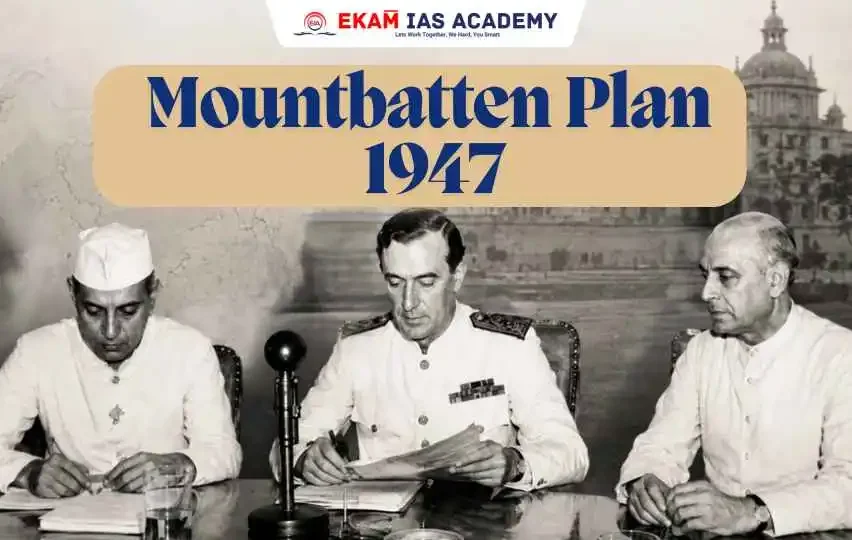
The Mountbatten Plan 1947, also known as the 3 June Plan or June 3 Plan 1947, was the final constitutional framework announced by Lord Mountbatten, the last Viceroy of India, to transfer power from British rule to Indian leadership. A vital topic in Modern Indian History UPSC preparation, this strategy formally finalized the Partition of India 1947, bringing an end to centuries of colonial rule and concluding the Indian Freedom Struggle.
Historical Background
By early 1947, widespread communal riots following Direct Action Day, coupled with administrative collapse and political paralysis inside the Interim Government, rendered an undivided India impossible. British Prime Minister Clement Attlee announced on February 20, 1947, that power would be transferred by June 1948, appointing Lord Mountbatten to oversee the Transfer of Power 1947.
Why Was the Mountbatten Plan Introduced
Evaluating Partition of India UPSC causes, the plan was introduced to prevent impending civil war, advance the exit timeline from June 1948 to August 1947, and address the irreconcilable standoff between the Congress and the Muslim League.
Major Provisions of the Mountbatten Plan
Key Mountbatten Plan features and Mountbatten Plan provisions included:
- Immediate partition of British India into two sovereign dominions: India and Pakistan.
- Autonomy for legislative assemblies of Punjab and Bengal to vote on partition.
- Creation of a Boundary Commission to demarcate borders.
- Freedom for Princely States to accede to either India or Pakistan, or remain independent initially.
Partition of Punjab and Bengal
Under the scheme, the Partition of Punjab and Bengal was decided by legislative voting. To draw the international borders, the Radcliffe Boundary Commission was established, headed by Sir Cyril Radcliffe, which ultimately carved out the Radcliffe Line.
Princely States and the Mountbatten Plan
The plan terminated British paramountcy over the Princely States, advising them to join either India or Pakistan based on geographical contiguity and public demographic realities.
Indian Response to the Mountbatten Plan
- Congress: Accepted partition reluctantly as a necessary compromise to avoid national fragmentation and secure immediate Indian Independence 1947.
- Muslim League: Accepted the proposal, realizing it granted their core demand for Pakistan, despite getting a “moth-eaten” territory.
Indian Independence Act, 1947
The provisions were given statutory force through the Indian Independence Act 1947, passed rapidly by the British Parliament in July 1947, establishing two independent Dominions on August 15, 1947.
Transfer of Power
The Transfer of Power 1947 occurred at midnight on August 14–15, 1947, creating the independent nations of India and Pakistan.
Significance of the Mountbatten Plan
Evaluating Mountbatten Plan significance, it ended British colonial rule in South Asia, birthed two sovereign democratic nations, and fundamentally reshaped regional geopolitics.
Consequences of Partition
- Mass migration of over 14 million people across new borders.
- Widespread communal violence resulting in tragic human loss.
- Long-term geopolitical rivalries in South Asia.
Criticism of the Mountbatten Plan
Critics argue that rushing the exit timeline from June 1948 to August 1947 left boundary demarcations unannounced until after independence, causing catastrophic, unmanaged violence.
Mountbatten Plan vs Cabinet Mission Plan
Comparing Mountbatten Plan vs Cabinet Mission Plan:
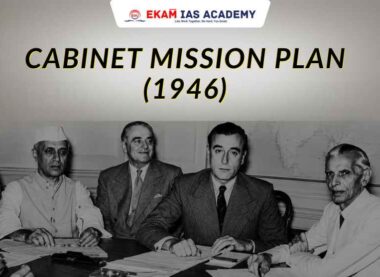
- Cabinet Mission Plan (1946): Aimed to preserve Indian unity via a weak federal center and three provincial groups.
- Mountbatten Plan (1947): Abandoned unity in favor of immediate territorial partition and full sovereignty.
Mountbatten Plan vs Indian Independence Act, 1947
- Mountbatten Plan: The executive political policy statement presented on June 3, 1947.
- Indian Independence Act 1947: The formal parliamentary law passed by the British Parliament to execute the plan legally.
Timeline of Important Events
- February 20, 1947: Attlee’s declaration setting a deadline for power transfer.
- March 24, 1947: Lord Mountbatten takes charge as Viceroy.
- June 3, 1947: Announcement of the 3 June Plan.
- July 18, 1947: Indian Independence Act 1947 receives Royal Assent.
- August 15, 1947: Indian Independence 1947 achieved.
Conclusion
Mastering Mountbatten Plan UPSC concepts is essential for preparing your Mountbatten Plan and Partition study notes. As the final landmark of modern colonial history, it marks the definitive end of the British Raj and the birth of modern India.
UPSC Prelims: PYQs & Practice Questions
Practice Questions
Q: On the basis of the Mountbatten Plan, which of the following were provisions for deciding the Partition of Punjab and Bengal?
(a) Referendum by universal adult franchise across the provinces
(b) Voting by the members of the respective Legislative Assemblies in two groups (Muslim-majority and non-Muslim-majority)
(c) Direct nomination of borders by the Viceroy's Executive Council
(d) Resolution passed by the Central Legislative Assembly
Answer: (b) Voting by the members of the respective Legislative Assemblies in two groups
Explanation:
Under the Mountbatten Plan of 3 June 1947, the
Provincial Legislative Assemblies of Punjab and Bengal
were to meet in separate sections representing
Muslim-majority districts and
non-Muslim-majority districts.
If a simple majority of either section voted in favour of partition, the province was to be divided.
Thus, the decision regarding partition was to be taken through
section-wise voting by the provincial legislators, not through universal adult franchise.
Q: An important aspect of the Mountbatten Plan was:
(a) Universal adult franchise to decide accession of princely states
(b) The proposal that Indian States (Princely States) should remain independent
(c) A referendum in the North-West Frontier Province (NWFP) and Sylhet district of Assam
(d) Rejection of the demand for the creation of Pakistan
Answer: (c) A referendum in the North-West Frontier Province (NWFP) and Sylhet district of Assam
Explanation:
The Mountbatten Plan provided for a
referendum in the North-West Frontier Province (NWFP)
to determine whether it would join India or Pakistan.
It also provided for a
referendum in Sylhet district of Assam
to decide whether Sylhet would remain in Assam or join
East Bengal.
Therefore, option (c) is the correct answer.
Practice Questions
Q: With reference to the Radcliffe Boundary Commission established under the Mountbatten Plan, consider the following statements:
1. Sir Cyril Radcliffe chaired two separate boundary commissions: one for Punjab and one for Bengal.
2. The boundary awards were officially published before August 15, 1947, to ensure a peaceful transfer of population.
3. The demarcation was primarily based on contiguous majority areas of Muslims and non-Muslims alongside natural geographical factors.
Which of the statements given above are correct?
(a) 1 and 2 only
(b) 1 and 3 only
(c) 2 and 3 only
(d) 1, 2 and 3
Answer: (b) 1 and 3 only
Explanation:
Statement 1 is correct. Sir Cyril Radcliffe chaired two separate
Boundary Commissions—one for
Punjab and another for
Bengal.
Statement 2 is incorrect. The
Radcliffe Award was officially published on
17 August 1947, two days after India became independent.
Statement 3 is correct. The commissions were required to demarcate boundaries on the basis of
contiguous majority areas of Muslims and non-Muslims,
while also taking into account
other relevant factors, including geographical and administrative considerations.
Q: What option was extended to the Princely States under the Mountbatten Plan and the Indian Independence Act, 1947?
(a) They were legally compelled to join the Indian Union.
(b) British paramountcy lapsed, leaving them free to join India or Pakistan, or theoretically remain independent.
(c) They were required to form a separate confederation of princely states.
(d) They were integrated automatically on the basis of geographical location by the Viceroy.
Answer: (b) British paramountcy lapsed, leaving them free to join India or Pakistan, or theoretically remain independent
Explanation:
Under the
Indian Independence Act, 1947,
British paramountcy over the Princely States lapsed.
This ended their treaty obligations to the
British Crown and left the rulers to decide their future political relationship.
In practice, the princely states were encouraged to
accede either to India or Pakistan, especially by considering
geographical contiguity and practical administrative considerations.
UPSC Mains – Previous Year & Practice Questions
Mains Previous Year Questions
[10 Marks | 150 Words]
Question: Why did the Indian National Congress accept the Partition of India under the Mountbatten Plan despite its long-standing commitment to an undivided India? (UPSC CSE Mains 2023, GS Paper I)
[15 Marks | 250 Words]
Question: Assess the role of Lord Mountbatten in advancing the date of transfer of power from June 1948 to August 1947. How did this haste impact the human cost of Partition? (UPSC CSE Mains 2017, GS Paper I)
[10 Marks | 150 Words]
Question: Explain the significance of the 3 June Plan. How did it differ fundamentally from the Cabinet Mission Plan of 1946? (UPSC CSE Mains 2010, Modern History)
[15 Marks | 250 Words]
Question: Critically examine the provisions of the Indian Independence Act, 1947 and show how it derived its core features from the Mountbatten Plan. (UPSC CSE Mains 2002, Modern History)
[15 Marks | 250 Words]
Question: “The Mountbatten Plan was a compromise between the impossible ideal of a united India and the dangerous reality of civil war.” Discuss. (UPSC CSE Mains 1995, Modern History)
Mains Practice Questions
[15 Marks | 250 Words]
Question: “The decision to withhold the publication of the Radcliffe Award until after 15 August 1947 transformed a planned political partition into an unmanaged humanitarian catastrophe.” Critically analyse.
[10 Marks | 150 Words]
Question: How did ‘Plan Balkan’ differ from the final Mountbatten Plan (3 June Plan), and why did Jawaharlal Nehru vehemently reject the initial draft prepared by Mountbatten's staff?
[15 Marks | 250 Words]
Question: Discuss the diplomatic and political role played by Sardar Vallabhbhai Patel and V.P. Menon in utilizing the provisions associated with the Mountbatten Plan to achieve the integration of the Princely States into the Indian Union.
Mountbatten Plan-FAQs
What was the Mountbatten Plan 1947?
The Mountbatten Plan 1947 was the final British plan for transferring power to India and creating the two Dominions of India and Pakistan.
Why is the Mountbatten Plan called the 3 June Plan?
It is called the 3 June Plan because it was announced on June 3, 1947.
What were the main provisions of the Mountbatten Plan?
It proposed partition of British India, creation of India and Pakistan, partition voting in Punjab and Bengal, a Boundary Commission, and the end of British paramountcy over princely states.
What was the Radcliffe Line?
The Radcliffe Line was the boundary drawn by the Radcliffe Boundary Commission to divide India and Pakistan.
Why is the Mountbatten Plan important for UPSC?
It is important because it connects Partition of India, Transfer of Power, Indian Independence Act 1947, princely states, Radcliffe Line and the end of British rule.