Table of Contents
ToggleSocio-Religious Reform Movements
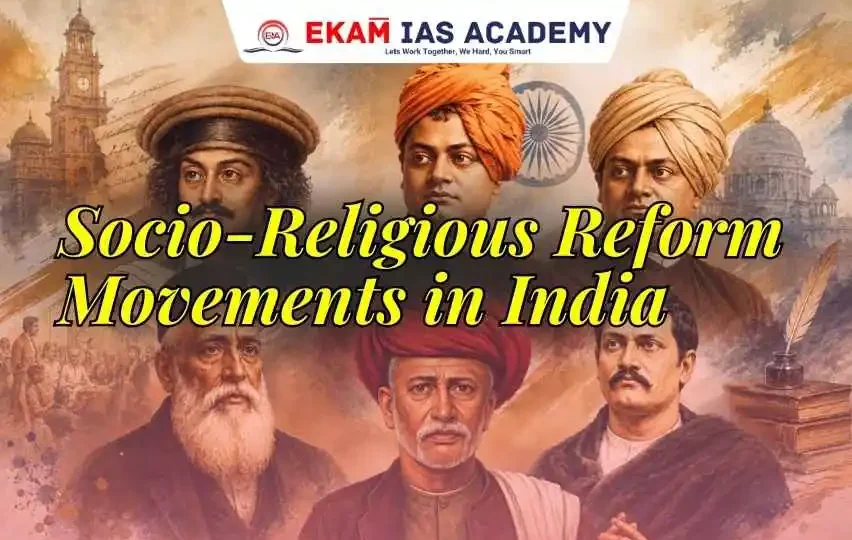
The Socio Religious Reform Movements of the 19th and early 20th centuries signaled the dawn of the Indian Renaissance. Crucial for Socio Religious Reform Movements UPSC preparation, these initiatives sought to modernize Indian society, eliminate entrenched social evils, and reform religious practices within the broader framework of Modern Indian History UPSC.
Background of Socio-Religious Reform Movements
The introduction of Western education, colonial rule, and exposure to rationalist principles led 19th-century intellectuals to critically evaluate indigenous cultural traditions. This intellectual awakening gave rise to dynamic Social Reform Movements in India aimed at transforming societal norms.
Major Social Problems in 19th-Century India
19th Century Social Reform Movements targeted pervasive structural orthodoxies, including:
- Practice of Sati, child marriage, female infanticide, and polygamy.
- Rigidity of the caste system, untouchability, and ritualistic supremacy.
- Denial of education and basic legal rights to women.
Brahmo Samaj
Founded in 1828 by Raja Ram Mohan Roy, the Brahmo Samaj laid the bedrock for modern Religious Reform Movements in India.
- Advocated monotheism and denounced idol worship and ritualism.
- Led a successful campaign resulting in the legal abolition of Sati in 1829.
- Expanded under Debendranath Tagore and Keshab Chandra Sen.
Arya Samaj
Established in 1875 by Swami Dayanand Saraswati, the Arya Samaj focused on Vedic revivalism.
- Popularized the call “Go Back to the Vedas” and regarded Vedic texts as infallible.
- Opposed idol worship, caste discrimination by birth, and child marriage.
- Established DAV (Dayanand Anglo-Vedic) institutions and launched the Shuddhi Movement.
Ramakrishna Mission
Founded in 1897 by Swami Vivekananda in honor of his guru Ramakrishna Paramahamsa, the Ramakrishna Mission combined spiritual awakening with social service.
- Emphasized social service and humanitarian relief as the highest forms of worship.
- Promoted Vedanta philosophy globally, highlighted at the 1893 Chicago Parliament of Religions.
Prarthana Samaj
Formed in 1867 in Bombay by Dr. Atmaram Pandurang and championed by M.G. Ranade, the Prarthana Samaj focused on socio-religious reforms in Western India.
- Promoted inter-caste dining, widow remarriage, and female education.
- Focused on social reform rather than breaking completely from traditional Hindu faith.
Satyashodhak Samaj
Founded in 1873 by Jyotirao Phule in Maharashtra, the Satyashodhak Samaj spearheaded anti-caste social reform.
- Fought against Brahmanical dominance and religious exploitation.
- Promoted education and socio-economic equality for lower castes and women.
Theosophical Society
Founded by Madam H.P. Blavatsky and Colonel H.S. Olcott, and later popularized in India by Annie Besant, the Theosophical Society revived interest in ancient Hindu scriptures and established the Central Hindu College at Banaras.
Aligarh Movement
Pioneered by Sir Syed Ahmad Khan, the Aligarh Movement focused on modernizing the Muslim community.
- Promoted modern scientific education alongside Islamic principles.
- Founded the Mohammedan Anglo-Oriental College in 1875 (later Aligarh Muslim University).
Deoband Movement
Founded as an orthodox revivalist movement in 1866 by Muhammad Qasim Nanautavi and Rashid Ahmad Gangohi, the Deoband Movement aimed at preserving traditional Islamic teachings and welcomed political union with the Indian National Congress against British rule.
Singh Sabha Movement
Formed in 1873 in Amritsar, the Singh Sabha Movement sought to restore Sikhism to its original purity, eliminate non-Sikh customs, and spread modern education among Sikhs.
Young Bengal Movement
Spearheaded by Henry Vivian Derozio in the late 1820s at Hindu College, Calcutta, the Young Bengal Movement inspired youth to think radically, question authority, and demand freedom of expression.
Parsi and Other Reform Movements
- Rahnumai Mazdayasnan Sabha (1851): Founded by Naoroji Furdonji, Dadabhai Naoroji, and S.S. Bengalee to modernize Parsi social customs.
- Akali Movement (1920s): Aimed at liberating Sikh Gurudwaras from corrupt mahants.
Role of Women in Social Reform
Pioneers like Savitribai Phule, Pandita Ramabai, and Tarabai Shinde actively led campaigns for female education, widow rehabilitation, and structural gender equality.
Important Social Reform Legislations
- Abolition of Sati Act (1829): Championed by Raja Ram Mohan Roy.
- Hindu Widows’ Remarriage Act (1856): Led by Ishwar Chandra Vidyasagar.
- Age of Consent Act (1891): Raised the marriageable age for girls.
- Child Marriage Restraint Act / Sharda Act (1929): Restricted underage marriages.
Impact of Socio-Religious Reform Movements
- Instilled rationalism, humanism, and cultural self-respect across Indian society.
- Created a national consciousness integral to the Indian National Movement.
Limitations of Socio-Religious Reform Movements
- Possessed an urban and upper-caste orientation with limited reach into rural masses.
- Over-reliance on ancient scriptures sometimes inadvertently nurtured communal compartmentalization.
Socio-Religious Reform Movements and Indian Nationalism
By instilling cultural pride and challenging colonial notions of Indian inferiority, these movements provided vital ideological momentum to the broader Indian Freedom Struggle.
Comparison of Major Socio-Religious Movements
- Reformist Movements (Brahmo Samaj, Prarthana Samaj, Aligarh): Responded to Western influence by adapting modern rationalist principles.
- Revivalist Movements (Arya Samaj, Deoband): Sought regeneration by appealing to past scriptural purity.
Timeline of Major Reform Movements
- 1828: Founding of Brahmo Samaj.
- 1867: Establishment of Prarthana Samaj.
- 1873: Launch of Satyashodhak Samaj.
- 1875: Founding of Arya Samaj.
- 1897: Formation of Ramakrishna Mission.
Conclusion
Developing structured UPSC History Notes on these movements is essential. As an integral component of the Indian Renaissance, these reform initiatives created the socio-cultural bedrock for political self-determination and modern Indian nationhood.
UPSC Prelims: PYQs & Practice Questions
Previous Year Questions
Q: Consider the following statements regarding the Brahmo Samaj under Raja Ram Mohan Roy:
1. It opposed idol worship and denied the need for a priestly class for interpreting religious texts.
2. It emphasized monotheism and incorporated ethical teachings from other religions like Christianity and Islam.
3. It rejected the authority of the Vedas completely.
Which of the statements given above are correct?
(a) 1 and 2 only
(b) 2 and 3 only
(c) 1 and 3 only
(d) 1, 2 and 3
Answer: (a) 1 and 2 only
Explanation:
Statements 1 and 2 are correct.
Raja Ram Mohan Roy founded the
Brahmo Sabha in 1828, which later developed into the
Brahmo Samaj.
It emphasized monotheism, opposed
idol worship, ritualism and priestly domination,
and drew ethical ideas from different religious traditions, including
Christianity and Islam.
Statement 3 is incorrect.
Raja Ram Mohan Roy did not completely reject the
Vedas and Upanishads. He relied particularly on
Vedantic and Upanishadic teachings to support the idea of
one supreme God and to argue against idolatry.
Q: Satya Shodhak Samaj organized:
(a) A movement for the upliftment of tribals in Bihar
(b) A temple-entry movement in Gujarat
(c) An anti-caste movement in Maharashtra
(d) A peasant movement in Punjab
Answer: (c) An anti-caste movement in Maharashtra
Explanation:
The Satyashodhak Samaj, or
Truth-Seekers' Society, was founded by
Jyotirao Phule in 1873 in Maharashtra.
It aimed to challenge caste hierarchy and Brahmanical dominance
and worked for the social upliftment of
Shudras, Ati-Shudras and other marginalized communities.
It also promoted women's education, social equality and the removal of caste-based discrimination.
Therefore, option (c) is correct.
Practice Questions
Q: With reference to the Arya Samaj and Swami Dayanand Saraswati, consider the following statements:
1. It launched the Shuddhi Movement to reconvert people who had converted from Hinduism to other religions.
2. It completely discarded the authority of the Vedas in favour of modern scientific literature.
3. It established Dayanand Anglo-Vedic (DAV) institutions to synthesize modern Western education with Vedic instruction.
Which of the statements given above are correct?
(a) 1 and 2 only
(b) 1 and 3 only
(c) 2 and 3 only
(d) 1, 2 and 3
Answer: (b) 1 and 3 only
Explanation:
Statements 1 and 3 are correct.
The Arya Samaj, founded by
Swami Dayanand Saraswati in 1875, promoted the
Shuddhi Movement for reconversion and social reform.
It also promoted education through the
Dayanand Anglo-Vedic (DAV) schools and colleges,
which sought to combine
modern Western education with Vedic learning.
Statement 2 is incorrect.
Swami Dayanand strongly upheld the authority of the
Vedas and gave the call
“Back to the Vedas”.
He opposed later religious practices such as
idol worship, ritualism and caste based purely on birth.
Q: Which of the following reform movements/organizations are correctly matched with their founders?
1. Prarthana Samaj — Dr. Atmaram Pandurang
2. Young Bengal Movement — Ishwar Chandra Vidyasagar
3. Rahnumai Mazdayasnan Sabha — Naoroji Furdonji and Dadabhai Naoroji
4. Deoband Movement — Sir Syed Ahmad Khan
Select the correct answer using the code given below:
(a) 1 and 3 only
(b) 2 and 4 only
(c) 1, 2 and 3 only
(d) 1, 3 and 4 only
Answer: (a) 1 and 3 only
Explanation:
Pair 1 is correctly matched.
The Prarthana Samaj was established in
1867 in Bombay by
Dr. Atmaram Pandurang.
It was later closely associated with reformers such as
M.G. Ranade.
Pair 2 is incorrectly matched.
The Young Bengal Movement was led by
Henry Vivian Derozio and his students at
Hindu College, Calcutta.
Pair 3 is correctly matched.
The Rahnumai Mazdayasnan Sabha, a Parsi reform organization,
was founded in 1851 by reformers including
Naoroji Furdonji, Dadabhai Naoroji and S.S. Bengalee.
Pair 4 is incorrectly matched.
The Deoband Movement was associated with
Muhammad Qasim Nanotavi and
Rashid Ahmad Gangohi.
Sir Syed Ahmad Khan was associated with the
Aligarh Movement.
UPSC Mains – Previous Year & Practice Questions
Mains Previous Year Questions
[15 Marks | 250 Words]
Question: Trace the rise and growth of socio-religious reform movements in 19th-century India. How far did they contribute to the growth of national consciousness? (UPSC CSE Mains 2021, GS Paper I)
[10 Marks | 150 Words]
Question: “The 19th-century Indian Renaissance was an amalgam of Western rationalism and Indian scriptural revivalism.” Examine. (UPSC CSE Mains 2019, GS Paper I)
[15 Marks | 250 Words]
Question: Analyse the role of women in the socio-religious reform movements of 19th-century India, highlighting the transition from women as objects of reform to agents of reform. (UPSC CSE Mains 2016, GS Paper I)
[10 Marks | 150 Words]
Question: In what ways did the reform movements led by Raja Ram Mohan Roy and Swami Vivekananda differ in their approach towards Indian tradition and modern Western thought? (UPSC CSE Mains 2012, GS Paper I)
[15 Marks | 250 Words]
Question: Critically evaluate the anti-caste social reform initiatives in Western and Southern India during the late 19th and early 20th centuries. (UPSC CSE Mains 2006, Modern History)
Mains Practice Questions
[15 Marks | 250 Words]
Question: “Although the 19th-century socio-religious reform movements sought to eliminate social evils, their over-reliance on ancient religious scriptures created unintended communal compartmentalization.” Critically analyse.
[15 Marks | 250 Words]
Question: Compare and contrast the Reformist movements, such as the Brahmo Samaj and Aligarh Movement, with the Revivalist movements, such as the Arya Samaj and Deoband Movement, in terms of their ideology, methodology and socio-political impact.
[10 Marks | 150 Words]
Question: Discuss the major legislative landmarks enacted during the 19th and early 20th centuries as a result of the sustained campaigns of Indian social reformers.
Socio-Religious Reform Movements-FAQs
What were Socio Religious Reform Movements?
Socio Religious Reform Movements were 19th and early 20th century reform efforts that aimed to remove social evils, modernize religious practices and promote rational thinking in Indian society.
Who founded Brahmo Samaj?
Brahmo Samaj was founded by Raja Ram Mohan Roy in 1828.
Who founded Arya Samaj?
Arya Samaj was founded by Swami Dayanand Saraswati in 1875.
What was the role of Ramakrishna Mission?
Ramakrishna Mission combined Vedantic spirituality with social service, education, humanitarian relief and moral upliftment.
Why are Socio Religious Reform Movements important for UPSC?
They are important because they connect Indian Renaissance, social reform, women’s rights, caste reform, religious revival, rationalism and the rise of Indian nationalism.