Table of Contents
ToggleNewspapers, Journals & Congress Sessions for UPSC
The evolution of Important Newspapers, Journals and Congress Sessions formed the intellectual and organizational backbone of the Indian National Movement. While Newspapers During British Period served as vehicles for socio-political awakening, annual Indian National Congress Sessions shaped national policy and political strategy. Mastering Newspapers and Journals UPSC alongside Congress Sessions UPSC data is essential for completing Modern Indian History UPSC study notes.
Role of Newspapers and Journals in the National Movement
- Acted as political education platforms to critique colonial economic policies and expose wealth drain.
- United geographically fragmented regional movements under a cohesive anti-imperialist umbrella.
- Functioned as democratic instruments of opposition despite facing severe censorship under colonial law.
Important Newspapers, Journals and Congress Sessions
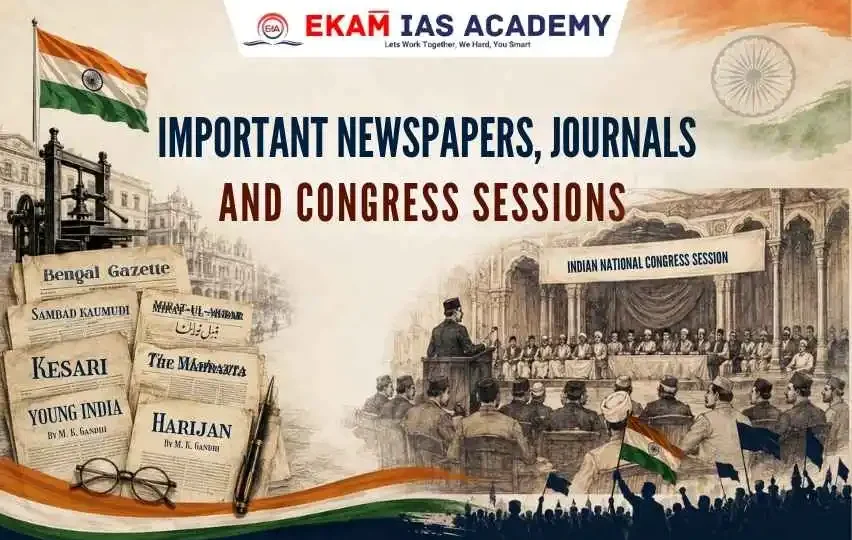
- Bengal Gazette (1780): Founded by James Augustus Hickey, marking the birth of Indian print media.
- Sambad Kaumudi & Mirat-ul-Akbar: Published by Raja Ram Mohan Roy to promote social reform and anti-sati awareness.
- Kesari & Mahratta: Edited by Bal Gangadhar Tilak to mobilize public support for Swaraj.
- Young India & Harijan: Published by Mahatma Gandhi to spread non-violent resistance and advocate anti-untouchability.
Important Newspapers
| Newspaper/Journal | Founder/Editor | Language | Importance |
|---|---|---|---|
| Bengal Gazette | James Augustus Hickey | English | First printed newspaper in India |
| Sambad Kaumudi | Raja Ram Mohan Roy | Bengali | Social reform |
| Mirat-ul-Akhbar | Raja Ram Mohan Roy | Persian | Press freedom |
| Kesari | Bal Gangadhar Tilak | Marathi | Nationalist mobilisation |
| The Mahratta | Bal Gangadhar Tilak | English | Nationalist politics |
| Amrita Bazar Patrika | Sisir Kumar Ghosh, Motilal Ghosh | Bengali/English | Nationalist journalism |
| The Hindu | G. Subramania Iyer and associates | English | Nationalist public opinion |
| Bande Mataram | Sri Aurobindo | English | Extremist nationalism |
| Al-Hilal | Maulana Abul Kalam Azad | Urdu | Anti-colonial mobilisation |
| Young India | Mahatma Gandhi | English | Gandhian nationalism |
| Harijan | Mahatma Gandhi | English | Social reform |
Press Laws During British Rule
- Censorship of Press Act, 1799: Introduced by Lord Wellesley to impose wartime pre-censorship.
- Licensing Regulations, 1823: Enacted by John Adam, leading to the closure of Ram Mohan Roy’s Mirat-ul-Akbar.
- Vernacular Press Act 1878: Enacted under Lord Lytton to muzzle indigenous language publications.
- Indian Press Act 1910: Authorized local authorities to demand financial security deposits from newspaper owners.
Indian National Congress Sessions
- Founded in 1885 at Gokuldas Tejpal Sanskrit College in Bombay under the presidency of W. C. Bonnerjee.
- Served as an annual national assembly to formulate resolutions and press democratic demands.
- Evolved from early Moderate petitions into a mass anti-colonial movement demanding complete independence (Purna Swaraj).
Important Congress Sessions Before 1905
- Bombay Session (1885): Inaugural session of the INC, attended by 72 delegates.
- Calcutta Session (1886): Presided over by Dadabhai Naoroji, marking the merger of the National Conference with INC.
- Madras Session (1887): Headed by Badruddin Tyabji, the first Muslim President of the INC.
- Allahabad Session (1888): Led by George Yule, the first European President of the INC.
Important Congress Sessions, 1905–1919
- Banaras Session (1905): Presided over by G. K. Gokhale, expressing formal protest against the Partition of Bengal.
- Calcutta Session (1906): Led by Dadabhai Naoroji, passing resolutions on Swadeshi, Boycott, and Swaraj.
- Surat Session (1907): Resulted in the historic split between Moderates and Extremists under Rash Behari Ghosh.
- Lucknow Session (1916): Presided over by A. C. Majumdar, reuniting Congress factions and signing the Lucknow Pact.
Important Congress Sessions During the Gandhian Era
- Calcutta Special Session (1920): Approved the Non-Cooperation Movement draft under Lala Lajpat Rai.
- Belgaum Session (1924): The only INC session presided over directly by Mahatma Gandhi.
- Lahore Session (1929): Headed by Jawaharlal Nehru, adopting the historic Purna Swaraj (Complete Independence) declaration.
Congress Sessions During the 1930s and 1940s
- Karachi Session (1931): Presided over by Sardar Vallabhbhai Patel, adopting resolutions on Fundamental Rights and the National Economic Programme.
- Haripura Session (1938): Headed by Subhash Chandra Bose, establishing the National Planning Committee.
- Ramgarh Session (1940): Led by Abul Kalam Azad, who served as President throughout the WWII period (1940–1946).
Most Important Congress Sessions for UPSC
| Year | Place | President | Key Event |
|---|---|---|---|
| 1885 | Bombay | W.C. Bonnerjee | First INC Session |
| 1905 | Benaras | G.K. Gokhale | Swadeshi debate |
| 1906 | Calcutta | Dadabhai Naoroji | Swaraj, Swadeshi, Boycott |
| 1907 | Surat | Rash Behari Ghosh | Surat Split |
| 1916 | Lucknow | Ambika Charan Mazumdar | Lucknow Pact |
| 1920 | Nagpur | C. Vijayaraghavachariar | Non-Cooperation and reorganisation |
| 1924 | Belgaum | Mahatma Gandhi | Gandhi presided |
| 1929 | Lahore | Jawaharlal Nehru | Poorna Swaraj |
| 1931 | Karachi | Vallabhbhai Patel | Fundamental Rights |
| 1936 | Faizpur | Jawaharlal Nehru | First rural session |
| 1938 | Haripura | Subhas Chandra Bose | National Planning |
| 1939 | Tripuri | Subhas Chandra Bose | Internal Congress crisis |
| 1940 | Ramgarh | Maulana Abul Kalam Azad | War-time politics |
Congress Sessions and Major Turning Points
- Transitioned the national struggle from elite constitutional petitions to mass non-violent campaigns.
- Formulated economic plans that laid the foundation for post-independence industrial policy.
- Bridged regional political demands to build a unified national platform for Indian self-determination.
Conclusion
Analyzing Important Newspapers, Journals and Congress Sessions reveals how written media and structured political assemblies reinforced each other during the freedom struggle. Mastering these historical milestones provides the foundation for solving high-yield Role of Press in Indian National Movement questions in the UPSC Civil Services Examination.
UPSC Prelims: PYQs & Practice Questions
Previous Year Questions
Q: The Lahore Session of the Indian National Congress (1929) is very important in history because:
1. The Congress passed a resolution demanding complete independence
(Purna Swaraj).
2. The rift between the Extremists and Moderates was resolved in this session.
3. A resolution was passed deciding to launch the
Civil Disobedience Movement.
Which of the statements given above is/are correct?
(a) 1 only
(b) 2 and 3 only
(c) 1 and 3 only
(d) 1, 2 and 3
Answer: (c) 1 and 3 only
Explanation:
Statement 1 is correct.
The
Lahore Session of 1929,
presided over by
Jawaharlal Nehru,
adopted the historic
Purna Swaraj resolution,
making complete independence the official goal of the Congress.
The Congress also decided to observe
26 January 1930 as Independence Day.
Statement 2 is incorrect.
The split between the
Moderates and Extremists
was healed earlier at the
Lucknow Session of the Congress in 1916.
Statement 3 is correct.
The Lahore Session authorized the
Congress Working Committee
to launch a programme of
Civil Disobedience.
Mahatma Gandhi subsequently began the movement with the
Dandi March in March 1930.
Therefore, option (c) 1 and 3 only is correct.
Q: Which of the following pairs is/are correctly matched? (UPSC CSE Prelims 2014)
1. Radical Democratic Party — M. N. Roy
2. All India Anti-Untouchability League — Mahatma Gandhi
3. All India Kisan Sabha — Swami Sahajanand Saraswati
Select the correct answer using the code given below:
(a) 1 only
(b) 1 and 2 only
(c) 2 and 3 only
(d) 1, 2 and 3
Answer: (d) 1, 2 and 3
Explanation:
All three pairs are correctly matched.
M. N. Roy founded the
Radical Democratic Party
in 1940.
Mahatma Gandhi established the
All India Anti-Untouchability League
in 1932.
It later came to be known as the
Harijan Sevak Sangh.
Swami Sahajanand Saraswati
became the first president of the
All India Kisan Sabha,
founded in 1936 at Lucknow.
Therefore, option
(d) 1, 2 and 3
is correct.
Practice Questions
Q: Consider the following pairs of Newspapers/Journals and their respective Founders/Editors:
1. Kudi Arasu — Periyar E. V. Ramasamy
2. Al-Hilal — Maulana Abul Kalam Azad
3. Bande Mataram — Madam Bhikaji Cama (Paris)
4. National Herald — Jawaharlal Nehru
Which of the pairs given above are correctly matched?
(a) 1, 2 and 3 only
(b) 2 and 4 only
(c) 1 and 3 only
(d) 1, 2, 3 and 4
Answer: (d) 1, 2, 3 and 4
Explanation:
All four pairs are correctly matched.
Kudi Arasu – 1925:
It was a Tamil weekly associated with
Periyar E. V. Ramasamy
and became an important medium for propagating the
Self-Respect Movement.
Al-Hilal – 1912:
It was an Urdu weekly started by
Maulana Abul Kalam Azad
and was used to criticize British colonial policies and promote nationalist ideas.
Bande Mataram:
The Paris-based nationalist publication was associated with
Madam Bhikaji Cama
and the revolutionary activities of Indian nationalists abroad.
National Herald – 1938:
It was established by
Jawaharlal Nehru
in Lucknow as a nationalist newspaper.
Therefore, option (d) 1, 2, 3 and 4 is correct.
Q: With reference to important sessions of the Indian National Congress and their presidents, consider the following matches:
1. 1906 – Calcutta Session — Dadabhai Naoroji
2. 1924 – Belgaum Session — Mahatma Gandhi
3. 1931 – Karachi Session — Sardar Vallabhbhai Patel
4. 1938 – Haripura Session — Subhash Chandra Bose
Select the correct answer using the code given below:
(a) 1 and 2 only
(b) 2, 3 and 4 only
(c) 1, 3 and 4 only
(d) 1, 2, 3 and 4
Answer: (d) 1, 2, 3 and 4
Explanation:
All four matches are correct.
Calcutta Session – 1906:
Presided over by
Dadabhai Naoroji.
The session prominently endorsed
Swaraj, Swadeshi, Boycott and National Education.
Belgaum Session – 1924:
Presided over by
Mahatma Gandhi.
It was the
only annual session of the Indian National Congress presided over by Gandhi.
Karachi Session – 1931:
Presided over by
Sardar Vallabhbhai Patel.
The session adopted the landmark
Resolution on Fundamental Rights and National Economic Programme.
Haripura Session – 1938:
Presided over by
Subhash Chandra Bose.
During this period, the Congress pushed forward the idea of
national economic planning,
with Jawaharlal Nehru later heading the
National Planning Committee.
Therefore, option (d) 1, 2, 3 and 4 is correct.
UPSC Mains – Previous Year & Practice Questions
Mains Previous Year Questions
[10 Marks | 150 Words]
Question: Evaluate the significance of the Karachi Session (1931) of the Indian National Congress in shaping the socio-economic vision of independent India. (UPSC CSE Mains 2022, GS Paper I)
[15 Marks | 250 Words]
Question: How did the regional language press contribute to the growth of national consciousness and political awakening in 19th-century India? (UPSC CSE Mains 2019, GS Paper I)
[10 Marks | 150 Words]
Question: The Lucknow Session of 1916 was a watershed moment in the history of the Indian National Congress. Discuss. (UPSC CSE Mains 2014, GS Paper I)
[15 Marks | 250 Words]
Question: Examine the circumstances leading to the Surat Split in the Indian National Congress (1907) and its impact on the nationalist struggle. (UPSC CSE Mains 2008, Modern History)
[10 Marks | 150 Words]
Question: Analyse the role played by Bal Gangadhar Tilak through his newspapers Kesari and Mahratta in mobilising popular support during the Swadeshi Movement. (UPSC CSE Mains 2001, Modern History)
Mains Practice Questions
[15 Marks | 250 Words]
Question: “ Colonial press laws were designed as gagging measures, yet Indian nationalist editors transformed courtroom trials over sedition charges into public forums for anti-imperialist political education.” Discuss with reference to Bal Gangadhar Tilak and Mahatma Gandhi.
[15 Marks | 250 Words]
Question: Trace the transition of the Indian National Congress from an elite petitioning organisation during 1885–1905 to a mass-based nationalist organisation through important annual Congress sessions and political developments.
[10 Marks | 150 Words]
Question: Analyse how journals and newspapers published abroad, such as The Indian Sociologist, Ghadar and Bande Mataram, provided ideological sustenance and political support to Indian revolutionaries operating outside British jurisdiction.
Newspapers, Journals & Congress Sessions for UPSC-FAQs
Why were newspapers important during the freedom struggle?
Newspapers spread political awareness, criticized colonial policies, exposed economic exploitation and connected regional struggles with national movements.
Which was the first newspaper in India?
Bengal Gazette, started in 1780 by James Augustus Hickey, is considered the beginning of Indian print media.
What was the Vernacular Press Act of 1878?
It was a repressive press law enacted under Lord Lytton to restrict Indian-language newspapers critical of British rule.
Which Congress session adopted Purna Swaraj?
The Lahore Session of 1929, presided over by Jawaharlal Nehru, adopted the historic Purna Swaraj declaration.
Why are Congress Sessions important for UPSC?
Congress Sessions are important because they mark major turning points like Swadeshi, Surat Split, Lucknow Pact, Non-Cooperation, Purna Swaraj and Karachi Resolution.