Table of Contents
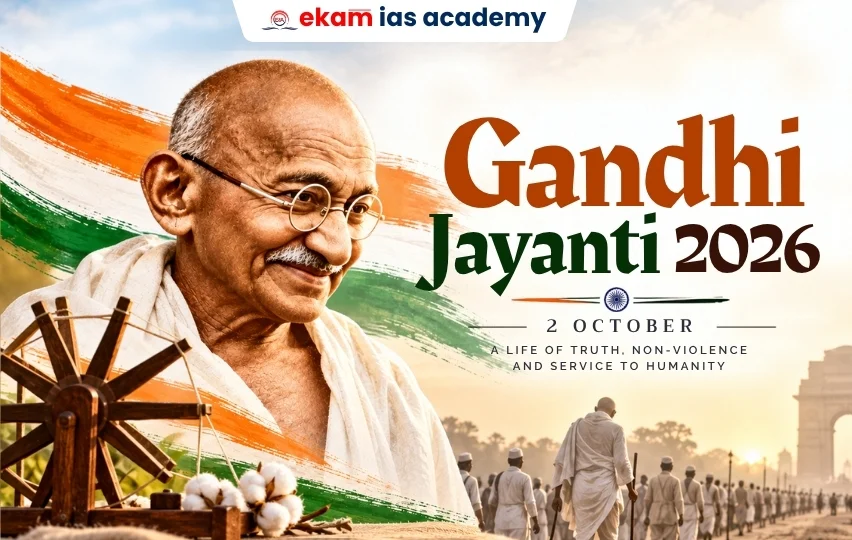
ToggleGandhi Jayanti 2026 will be observed on 2 October, marking the 157th birth anniversary of Mahatma Gandhi. Born in 1869 at Porbandar, Gandhi became a central figure in India’s freedom struggle and is associated with Satyagraha, Ahimsa, Swaraj and Swadeshi. The United Nations also observes 2 October as the International Day of Non-Violence.
About Mahatma Gandhi
- Born: 2 October 1869, Porbandar, Gujarat.
- Education: Studied law in England and was called to the Bar in 1891.
- South Africa: Developed Satyagraha while opposing racial discrimination and unjust laws.
- India: Returned in 1915 and emerged as a major leader of the national movement.
- Major ideas: Ahimsa, Satyagraha, Swaraj, Swadeshi, Sarvodaya and Trusteeship.
- Death: Assassinated on 30 January 1948 in New Delhi.
Gandhi and India’s National Movement
Gandhi transformed the freedom struggle into a mass movement by involving peasants, workers, women, students and other sections of society.
Early Satyagrahas
- Champaran Satyagraha (1917): Addressed the problems of indigo cultivators.
- Kheda Satyagraha (1918): Sought revenue relief for peasants affected by crop failure.
- Ahmedabad Mill Strike (1918): Supported textile workers in their dispute with mill owners.
Non-Cooperation Movement
The Non-Cooperation Movement (1920–22) promoted the boycott of colonial institutions, Swadeshi and khadi. Gandhi withdrew the movement after the Chauri Chaura incident in 1922, reaffirming his commitment to non-violence.
Civil Disobedience Movement
In 1930, Gandhi launched the Dandi March against the colonial salt law. The Salt Satyagraha became a powerful symbol of civil resistance and attracted participation from different sections of society.
Quit India Movement
During the Quit India Movement of 1942, Gandhi gave the call of “Do or Die”, demanding an end to British rule. The movement became the final major mass mobilisation against colonial rule.
Core Ideas of Gandhian Philosophy
- Satyagraha: Resistance to injustice through truth and non-violence.
- Ahimsa: Rejection of physical violence and hatred.
- Swaraj: Political freedom combined with self-discipline and responsibility.
- Swadeshi: Promotion of indigenous production and self-reliance.
- Sarvodaya: Welfare and upliftment of all.
- Trusteeship: Use of wealth as a social responsibility.
Gandhi Jayanti and the United Nations
In 2007, the UN General Assembly declared 2 October as the International Day of Non-Violence, recognising the global relevance of non-violent methods for promoting peace and tolerance.
Gandhi Jayanti and Swachh Bharat Mission
The Swachh Bharat Mission was launched on 2 October 2014, Gandhi’s birth anniversary, with emphasis on sanitation, cleanliness and behavioural change. It continues to provide a contemporary context to discussions on community participation and responsible citizenship.


FAQs: Gandhi Jayanti 2026
When is Gandhi Jayanti observed?
Gandhi Jayanti is observed annually on 2 October, marking the birth anniversary of Mahatma Gandhi, who was born on 2 October 1869 in Porbandar, Gujarat.
Why is 2 October observed as the International Day of Non-Violence?
The United Nations General Assembly declared 2 October as the International Day of Non-Violence in 2007, recognising the relevance of non-violent methods in promoting peace and tolerance.
What were the major movements led by Mahatma Gandhi?
Major movements associated with Gandhi include the Non-Cooperation Movement (1920–22), Civil Disobedience Movement (1930) and Quit India Movement (1942). His early satyagrahas included Champaran, Kheda and Ahmedabad.
What are the core ideas of Gandhian philosophy?
Key Gandhian concepts include Satyagraha, Ahimsa, Swaraj, Swadeshi, Sarvodaya and Trusteeship, emphasising truth, non-violence, self-reliance and social welfare.
Why is Gandhi Jayanti associated with the Swachh Bharat Mission?
The Swachh Bharat Mission was launched on 2 October 2014, Gandhi’s birth anniversary, with a focus on sanitation, cleanliness, behavioural change and community participation.