

Table of Contents
ToggleThe Mahatma’s Unfinished Work on the World Stage
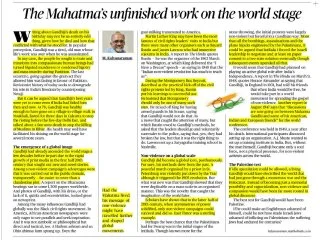
Mahatma Gandhi’s legacy extends far beyond India’s freedom struggle. His ideas of Ahimsa, Satyagraha and non-violent resistance influenced movements across the world, particularly struggles for civil rights and political freedom. The article “The Mahatma’s Unfinished Work on the World Stage” reflects on how Gandhi’s methods acquired global significance and considers the international role he might have played had he lived beyond 1948.
Gandhi’s Global Influence
Gandhi demonstrated that non-violent resistance could be organised on a mass scale and used as a political strategy against powerful opponents. The public nature of his campaigns also attracted international attention. Reports of events such as the Dharasana Satyagraha were published widely across the world, helping establish Gandhi as an international symbol of peaceful resistance.
His influence was particularly visible in the American Civil Rights Movement. Leaders and organisers such as Martin Luther King Jr., Bayard Rustin and James Lawson studied Gandhian methods. Rustin applied lessons from India’s freedom movement during the Montgomery Bus Boycott, while Lawson established a Satyagraha training school in Nashville.
Non-Violence as a Global Political Strategy
Gandhi’s contribution went beyond moral philosophy. His experiments demonstrated how civil disobedience, voluntary suffering, mass mobilisation and disciplined non-violence could challenge unequal power relationships.
The article notes that later non-violent movements, including examples from East Timor and the initial phase of the First Intifada, illustrate the continuing relevance of organised non-violent resistance. These examples also demonstrate that the effectiveness of such strategies depends on political circumstances and the organisation of movements.
Gandhi’s Unfinished Global Mission
According to the article, Gandhi had contemplated an active international role after India achieved independence. Discussions were reportedly underway for a world conference on non-violence, and such a conference was eventually held in 1949, a year after his assassination.
The article further identifies Palestine as a hypothetical test of Gandhi’s philosophy, while recognising that this is necessarily speculative because Gandhi did not live to engage with the issue in that period.
Conclusion
Gandhi’s unfinished global work highlights the continuing relevance of peaceful resistance, ethical politics and non-violent conflict resolution. His influence on international civil rights movements shows how an Indian political philosophy became a global instrument for challenging injustice. For UPSC aspirants, Gandhi’s global legacy provides an important link between Modern Indian History, International Relations, Ethics and peace studies.
Vocabulary
1. Satyagraha – Non-violent resistance based on truth.
2. Pacifism – Opposition to violence and war.
3. Power Asymmetry – Unequal power between opposing sides.
Prelims MCQs
MCQ 1
With reference to Mahatma Gandhi’s global influence, consider the following statements:
- Gandhian methods of non-violent resistance influenced movements beyond India.
- Martin Luther King Jr. was influenced by Gandhian ideas in the American Civil Rights Movement.
- Satyagraha was based primarily on the use of armed resistance against colonial rule.
Which of the statements given above is/are correct?
A. 1 and 2 only
B. 2 and 3 only
C. 1 and 3 only
D. 1, 2 and 3
Answer: A. 1 and 2 only
Explanation: Gandhian philosophy influenced several international movements, including the American Civil Rights Movement. Satyagraha emphasised truth, non-violence and disciplined resistance, not armed struggle.
MCQ 2
| Gandhian Concept | Meaning |
|---|---|
| 1. Ahimsa | Non-violence |
| 2. Satyagraha | Non-violent resistance based on truth |
| 3. Civil Disobedience | Peaceful refusal to comply with certain unjust laws |
Which of the pairs given above are correctly matched?
A. 1 and 2 only
B. 2 and 3 only
C. 1 and 3 only
D. 1, 2 and 3
Answer: D. 1, 2 and 3
Explanation: All three concepts are closely associated with Gandhi’s philosophy and methods of political resistance. They contributed to the wider global influence of Gandhian non-violence.
UPSC Mains Question
“Gandhi’s philosophy of non-violence transcended India’s freedom struggle and influenced global movements.” Discuss. (10 Marks)
Key points to cover:
- Gandhi transformed non-violence into a method of mass political action.
- Gandhian methods influenced global civil-rights leaders, including Martin Luther King Jr. and Bayard Rustin.
- The editorial argues that non-violence can be effective even under major power asymmetries.
- Gandhi’s unfinished legacy lies in applying non-violence and compassion to global conflicts.
Frequently Asked Questions (FAQs)
What is Gandhi’s contribution to the world?
Gandhi demonstrated how organised non-violent resistance and civil disobedience could become powerful instruments for political and social change.
How did Gandhi influence the American Civil Rights Movement?
Gandhian ideas influenced leaders and organisers including Martin Luther King Jr., Bayard Rustin and James Lawson, particularly in developing non-violent protest strategies.
What is Satyagraha?
Satyagraha is Gandhi’s philosophy of non-violent resistance based on truth, moral courage and peaceful action.
What is Ahimsa according to Gandhian thought?
Ahimsa means non-violence or non-injury and was a central principle of Gandhi’s political and ethical philosophy.
What was Gandhi’s proposed global role after Indian Independence?
The article reports that Gandhi had plans to participate in a global movement promoting non-violence, including discussions around an international conference.
Source From : The Hindu
India’s Model BIT and the Challenge of Attracting Foreign Investment
India’s Bilateral Investment Treaty (BIT) policy plays an important role in balancing foreign investment protection with the country’s regulatory interests. The article highlights concerns that India’s Model BIT of 2016, while designed to protect policy space and reduce excessive investor claims, may also create uncertainty for foreign investors and affect India’s attractiveness as an investment destination.
India’s Model BIT Framework
The 2016 Model BIT introduced significant changes to India’s earlier investment treaty approach. One important feature was the requirement for foreign investors to generally pursue remedies through Indian courts for a specified period before initiating international arbitration. The framework also narrowed the scope of investments and introduced greater emphasis on the state’s regulatory space.
The article argues that subsequent treaties have retained relatively long waiting periods before investors can access international arbitration. It questions whether such provisions adequately reflect global investment practices and whether they create additional uncertainty for investors.
Investment Arbitration and Investor Confidence
Investor-State Dispute Settlement (ISDS) allows qualifying foreign investors to seek arbitration against a host state under the applicable investment treaty. The article argues that restrictions on access to ISDS may influence investor perceptions of India’s investment environment.
At the same time, India’s approach reflects a broader policy objective: protecting the government’s ability to regulate areas such as taxation, public policy and economic governance without facing excessive international claims.
The article also discusses India’s foreign investment trends. It highlights that while foreign investors continue to invest in India, substantial amounts of foreign capital are also being repatriated or invested abroad. This raises questions about whether India’s investment treaties and broader economic policies should be recalibrated.
Reforming India’s Investment Treaty Policy
The article suggests that India could consider clearer treaty provisions, predictable dispute-resolution mechanisms and commercially accessible arbitration remedies. A carefully designed framework could protect legitimate regulatory authority while improving investor confidence.
India’s expanding network of FTAs and BITs provides an opportunity to establish a more consistent investment-policy framework. Greater clarity on commercial arbitration, third-party funding and dispute settlement could strengthen India’s position as an investment destination.
Conclusion
India’s investment treaty policy must balance sovereign regulatory autonomy with investor confidence. A predictable legal framework, efficient domestic courts and credible dispute-resolution mechanisms can help reduce investment uncertainty. As India seeks greater foreign capital and deeper integration with global markets, continual evaluation of its Model BIT and investment agreements remains important.
Vocabulary
1. De-risking – Reducing strategic dependence without complete separation.
2. Compute – Computing capacity required to develop AI systems.
3. echnological Sovereignty – Ability to control critical technological capabilities.
Prelims MCQs
MCQ 1
With reference to India’s Model Bilateral Investment Treaty (BIT) of 2016, consider the following statements:
- It seeks to balance protection of foreign investments with the regulatory powers of the State.
- It provides for a mandatory period of pursuing remedies before Indian courts before certain international arbitration proceedings.
- It completely eliminates Investor-State Dispute Settlement (ISDS) from India’s investment treaties.
Which of the statements given above is/are correct?
A. 1 and 2 only
B. 2 and 3 only
C. 1 and 3 only
D. 1, 2 and 3
Answer: A. 1 and 2 only
Explanation: The article highlights the Model BIT’s emphasis on regulatory autonomy and the requirement to pursue domestic remedies before accessing international arbitration in specified circumstances. It does not support the claim that ISDS has been completely eliminated from all Indian investment treaties.
MCQ 2
Consider the following statements regarding Investor-State Dispute Settlement (ISDS):
- It can allow eligible foreign investors to bring claims against a host State under an applicable investment treaty.
- India’s investment treaty policy has sought to balance investor protection with the State’s right to regulate.
- Commercial arbitration and investment arbitration are necessarily identical in their scope and legal basis.
Which of the statements given above is/are correct?
A. 1 and 2 only
B. 2 and 3 only
C. 1 and 3 only
D. 1, 2 and 3
Answer: A. 1 and 2 only
Explanation: ISDS can provide treaty-based dispute settlement between qualifying foreign investors and host States. India’s approach attempts to balance investment protection and sovereign regulatory space. The article distinguishes commercial arbitration from treaty-based investment disputes, so they cannot automatically be treated as identical.
UPSC Mains Question
“India’s position in the global AI order will depend on capabilities built at home.” Discuss. (10 Marks)
Key points to cover:
- AI has emerged as a strategic arena in US-China technological competition.
- Competition extends to chips, AI models, standards, data and critical infrastructure.
- India needs differentiated de-risking—protect sensitive sectors while avoiding excessive dependence on either power.
- India’s global influence in AI will ultimately depend on domestic compute, chips, models, datasets and talent.
Frequently Asked Questions (FAQs)
What is a Bilateral Investment Treaty (BIT)?
A BIT is an agreement between two countries that establishes rules for protecting and promoting investments made by investors of one country in the other.
What is India’s Model BIT?
India’s Model BIT 2016 provides a framework for negotiating bilateral investment treaties while seeking to balance investor protection with the government’s regulatory powers.
What is Investor-State Dispute Settlement (ISDS)?
ISDS is a mechanism through which eligible foreign investors can bring certain disputes against a host state before an international arbitral tribunal under an applicable investment agreement.
Why is investment arbitration important?
Investment arbitration can provide foreign investors with an additional dispute-resolution mechanism when disagreements arise with a host government.
What is the key challenge for India’s investment treaty policy?
The central challenge is to balance foreign-investor protection, regulatory autonomy, legal certainty and India’s objective of attracting long-term investment.