Table of Contents
ToggleNon-Cooperation Movement
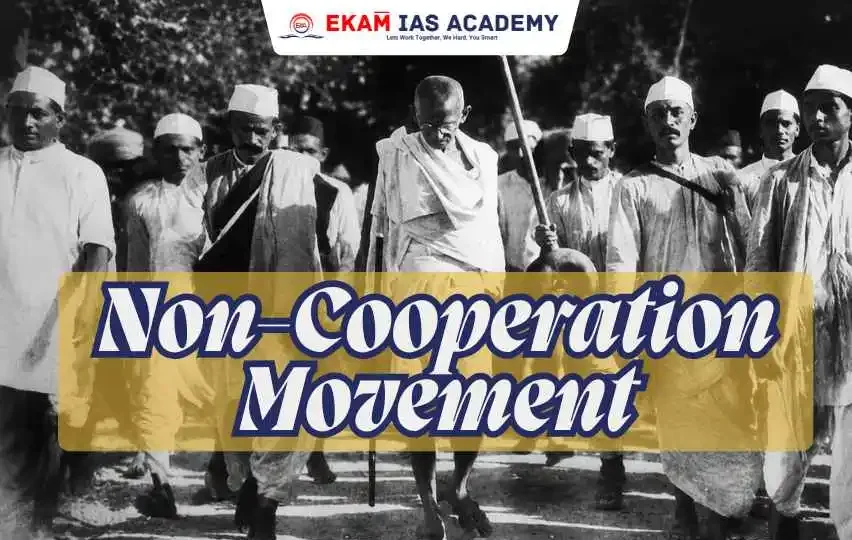
The Non-Cooperation Movement launched in 1920 under the visionary leadership of Mahatma Gandhi Non Cooperation Movement initiatives was a crucial turning point in Modern Indian History UPSC preparation. It marked the transition of the nationalist struggle from elite constitutional politics to a organized mass struggle across India.
Historical Background
Understanding the Non Cooperation Movement causes requires looking at post-WWI developments. Deep resentment against the repressive Rowlatt Act, the brutal Jallianwala Bagh Massacre (1919), and economic hardship laid the groundwork. Furthermore, the alliance between the Khilafat and Non Cooperation Movement united Hindus and Muslims under a common banner against imperialism.
Objectives of the Non-Cooperation Movement
The core Non Cooperation Movement objectives included:
- Attaining Swaraj (self-rule).
- Redressing the Punjab grievances (Jallianwala Bagh massacre).
- Remedying the Khilafat injustice regarding the Ottoman Caliphate.
Launch of the Non-Cooperation Movement
The movement was approved at the special Congress session in Calcutta (September 1920) and ratified at the Nagpur session (December 1920), formally initiating a new chapter in the Indian National Movement.
Programme of the Movement
Key Non Cooperation Movement features and its boycott/constructive Non Cooperation Movement programme involved:
- Surrender of government titles and honors.
- Boycott of foreign goods, schools, colleges, and law courts.
- Promotion of Swadeshi, hand-spinning (Charkha), Khadi, and national education.
Major Events During the Movement
Mass participation spanned peasants, workers, students, and women. Boycotts of foreign cloth were highly successful, alongside liquor shop picketing and civil disobedience across provinces.
Chauri Chaura Incident (1922)
On February 5, 1922, a violent clash at Chauri Chaura in Gorakhpur led to an angry mob burning a police station, killing 22 policemen.
Reasons for the Withdrawal
Devastated by the breach of non-violence, Mahatma Gandhi unilaterally suspended the movement on February 12, 1922, believing the masses needed thorough training in satyagraha.
Impact and Significance
The Non Cooperation Movement significance resides in transforming the Congress into a mass organization and instilling unprecedented national confidence.
Limitations of the Non-Cooperation Movement
- Failed to achieve Swaraj within the promised one-year timeline.
- Communal harmony weakened following its sudden withdrawal.
Non-Cooperation Movement vs Civil Disobedience Movement
While Non-Cooperation focused on passive non-cooperation and boycott, the Civil Disobedience Movement (1930) actively broke specific colonial laws.
Timeline of Important Events
A brief Non Cooperation Movement timeline:
- 1919: Rowlatt Act & Jallianwala Bagh Massacre.
- 1920: Launch of the movement.
- 1922: Chauri Chaura Incident and withdrawal.
Conclusion
This movement remains essential in UPSC History Notes and Non Cooperation Movement notes. For candidates reviewing Gandhi movements in India, it established the foundation for future freedom struggles.
UPSC Prelims: PYQs & Practice Questions
Previous Year Questions (Prelims)
Q: What was the major reason for Mahatma Gandhi withdrawing the Non-Cooperation Movement in 1922?
(a) Most of the leaders had been arrested and imprisoned
(b) The British Government agreed to accept the demands of the Congress
(c) He felt that the movement was turning violent in many places
(d) There was no prospect of the movement succeeding
Answer: (c) He felt that the movement was turning violent in many places
Explanation:
Mahatma Gandhi withdrew the
Non-Cooperation Movement in February 1922 following the
Chauri Chaura incident in the Gorakhpur district of present-day Uttar Pradesh.
On 5 February 1922, an enraged crowd attacked and set fire to a police station, resulting in the death of
22 policemen.
Gandhi believed that the people had not yet fully understood or internalised the principle of
non-violence or Ahimsa. He therefore considered the continuation of the movement morally unjustified.
Q: Consider the following statements regarding the Non-Cooperation Movement: (UPSC CSE Prelims 2021)
1. The Nagpur Session of the Indian National Congress in 1920 endorsed the Non-Cooperation resolution proposed by Mahatma Gandhi.
2. The Chauri Chaura incident led Gandhi to suspend the Non-Cooperation Movement.
3. The Congress Working Committee meeting at Bardoli endorsed the decision to call off the movement.
Which of the statements given above are correct?
(a) 1 and 2 only
(b) 2 and 3 only
(c) 1 and 3 only
(d) 1, 2 and 3
Answer: (d) 1, 2 and 3
Explanation:
Statement 1 is correct. The special session of the Congress held at
Calcutta in September 1920 approved the Non-Cooperation resolution. It was subsequently endorsed and ratified at the regular
Nagpur Session in December 1920.
Statement 2 is correct. The violent incident at
Chauri Chaura on 5 February 1922 prompted Gandhi to suspend the movement because he believed that non-violent discipline had broken down.
Statement 3 is correct. The
Congress Working Committee met at Bardoli on
12 February 1922 and adopted the
Bardoli Resolution, formally ending the movement.
Practice Questions
Q: Which of the following programmes were part of the positive or constructive agenda of the Non-Cooperation Movement (1920–1922)?
1. Promotion of Swadeshi and hand-spinning using the Charkha
2. Establishment of national educational institutions such as Jamia Millia Islamia and Kashi Vidyapith
3. Complete boycott of legislative councils, law courts and government schools
Select the correct answer using the code given below:
(a) 1 and 2 only
(b) 2 and 3 only
(c) 1 and 3 only
(d) 1, 2 and 3
Answer: (a) 1 and 2 only
Explanation:
Statements 1 and 2 are correct. The constructive programme of the Non-Cooperation Movement focused on creating
self-reliance and alternative national institutions.
It included the promotion of Swadeshi, Khadi and hand-spinning through the Charkha, along with the establishment of national educational institutions such as
Jamia Millia Islamia and Kashi Vidyapith.
Statement 3 is incorrect. The boycott of legislative councils, law courts and government educational institutions formed part of the
negative or boycott programme, rather than the constructive agenda.
Q: With reference to leadership during the Non-Cooperation Movement, who among the following resigned from or left the Indian National Congress in opposition to the Non-Cooperation Resolution?
1. Mohammad Ali Jinnah
2. Annie Besant
3. Bipin Chandra Pal
Select the correct answer using the code given below:
(a) 1 and 2 only
(b) 2 and 3 only
(c) 1 and 3 only
(d) 1, 2 and 3
Answer: (d) 1, 2 and 3
Explanation:
Mohammad Ali Jinnah, Annie Besant and Bipin Chandra Pal opposed Gandhi’s programme of Non-Cooperation and extra-constitutional mass agitation.
They expressed reservations about the boycott strategy, the use of mass civil resistance and the association of the Congress with the
Khilafat issue.
Other leaders, including G.S. Khaparde, also disagreed with the resolution and distanced themselves from the Congress programme.
UPSC Mains – Previous Year & Practice Questions
Mains Previous Year Questions
[15 Marks | 250 Words]
Question: Trace the origin, spread and withdrawal of the Non-Cooperation Movement. What was its significance in shaping the national movement under Mahatma Gandhi? (UPSC CSE Mains 2018)
[10 Marks | 150 Words]
Question: How did the Non-Cooperation Movement transform the Indian National Congress from a middle-class deliberative organisation into a mass political movement? (UPSC CSE Mains 2014)
[10 Marks | 150 Words]
Question: Discuss the role of the Khilafat Movement in promoting Hindu-Muslim unity during the Non-Cooperation Movement. Why did this unity prove short-lived? (UPSC CSE Mains 2008)
[15 Marks | 250 Words]
Question: Critically evaluate Gandhi’s decision to suspend the Non-Cooperation Movement after the Chauri Chaura incident. Was it a tactical mistake or a moral imperative? (UPSC CSE Mains 1999)
[10 Marks | 150 Words]
Question: Analyze the constructive and boycott dimensions of the Non-Cooperation Movement (1920–22) and examine their impact on the British Indian economy. (UPSC CSE Mains 1991)
Mains Practice Questions
[15 Marks | 250 Words]
Question: “The Non-Cooperation Movement provided the template for all subsequent mass movements led by Mahatma Gandhi.” Critically examine.
[15 Marks | 250 Words]
Question: Discuss the regional variations in the intensity, social composition and character of the Non-Cooperation Movement across different provinces of India.
[10 Marks | 150 Words]
Question: How far is it correct to argue that the abrupt suspension of the Non-Cooperation Movement created a political vacuum that contributed to the rise of revolutionary extremism and communal politics during the 1920s?



Non-Cooperation Movement-FAQs
What was the Non-Cooperation Movement?
The Non-Cooperation Movement was a mass nationalist movement launched by Mahatma Gandhi in 1920 against British rule.
What were the causes of the Non-Cooperation Movement?
Major causes included the Rowlatt Act, Jallianwala Bagh Massacre, Khilafat issue, economic hardship after World War I and growing anti-colonial sentiment.
What was the programme of the Non-Cooperation Movement?
The programme included surrender of titles, boycott of foreign goods, schools, colleges, courts and promotion of Swadeshi, Charkha, Khadi and national education.
Why was the Non-Cooperation Movement withdrawn?
Gandhi withdrew the movement after the Chauri Chaura incident in February 1922 because the incident violated the principle of non-violence.
Why is the Non-Cooperation Movement important for UPSC?
It is important because it marked the beginning of mass nationalism under Gandhi and connected Khilafat, Swadeshi, boycott, non-violence and anti-colonial mobilisation.