
Table of Contents
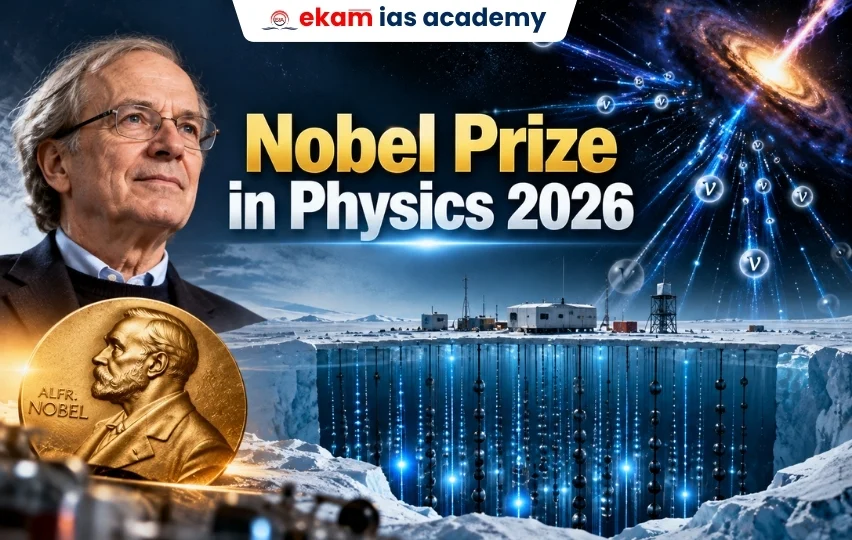
ToggleThe 2026 Nobel Prize in Physics has been awarded to Francis Halzen for his decisive contributions to the IceCube Neutrino Observatory and the discovery of high-energy neutrinos originating from astrophysical sources. The award was announced by the Royal Swedish Academy of Sciences on 6 October 2026.
Halzen’s work has advanced the study of neutrinos and opened a new approach to understanding the universe through extremely energetic particles travelling from distant cosmic environments.
Nobel Prize in Physics 2026 Key Highlights
- Winner: Francis Halzen
- Award: Nobel Prize in Physics 2026
- Recognised for: Contributions to IceCube and the discovery of astrophysical high-energy neutrinos
- Major facility: IceCube Neutrino Observatory
- Location: South Pole, Antarctica
- Scientific field: Neutrino physics and particle astrophysics
- Announcement: 6 October 2026
- Detector volume: Approximately one cubic kilometre of Antarctic ice
Who is Francis Halzen?
Francis Halzen is a physicist whose scientific vision and leadership were central to the development of the IceCube Neutrino Observatory.
He recognised the potential of the exceptionally clear Antarctic ice as a massive natural medium for detecting neutrinos. His work helped turn this concept into a large-scale observatory capable of studying particles arriving from distant cosmic sources.
What is the Nobel Prize in Physics 2026 Awarded For?
The award recognises Halzen’s role in establishing IceCube and enabling the detection of high-energy neutrinos of astrophysical origin.
Unlike conventional astronomical observations based mainly on electromagnetic radiation, neutrinos can provide information from extreme cosmic environments that may otherwise remain difficult to investigate.
What is the IceCube Neutrino Observatory?
IceCube is a giant particle detector constructed deep beneath the South Pole. It uses roughly one cubic kilometre of Antarctic ice and more than 5,000 light sensors embedded within it.
When neutrinos interact with matter, they can produce faint flashes of light. IceCube’s sensors capture these signals, allowing researchers to estimate the particles’ energy and direction.
What are Neutrinos?
Neutrinos are electrically neutral subatomic particles that interact extremely weakly with matter. They can travel across enormous distances and pass through substantial amounts of material with little interaction.
High-energy neutrinos therefore act as valuable messengers from powerful astrophysical processes.
Why is Ice Used to Detect Neutrinos?
The exceptionally transparent Antarctic ice provides a huge natural detection medium. When a neutrino interaction produces charged particles, these can generate faint flashes of light known as Cherenkov radiation.
IceCube sensors detect these flashes and help scientists reconstruct the neutrino’s properties and possible cosmic origin.
Significance of the Nobel Prize in Physics 2026
The research has strengthened neutrino astronomy, providing scientists with another method of investigating the universe. IceCube observations have helped identify astrophysical neutrino sources and study energetic phenomena that cannot always be understood through light alone.
IceCube Upgrade 2026
The observatory also underwent a major upgrade in 2026, adding more than 600 enhanced light sensors and calibration instruments through five additional strings installed deep in the Antarctic ice.
The upgraded facility is expected to improve neutrino measurements and support research into neutrino oscillations, cosmic rays, supernovae and other astrophysical phenomena.


FAQs: Nobel Prize in Physics 2026
Who won the Nobel Prize in Physics 2026?
According to the article, Francis Halzen received the 2026 Nobel Prize in Physics for his contributions to the IceCube Neutrino Observatory and the discovery of high-energy astrophysical neutrinos.
What is the IceCube Neutrino Observatory?
IceCube is a massive neutrino detector located deep beneath the South Pole in Antarctica. It uses about one cubic kilometre of Antarctic ice and thousands of light sensors to detect neutrino interactions.
What are neutrinos?
Neutrinos are electrically neutral subatomic particles that interact extremely weakly with matter. They can travel enormous cosmic distances, making them valuable messengers for studying distant astrophysical phenomena.
How does IceCube detect neutrinos?
When neutrinos interact with matter, they can produce charged particles that emit Cherenkov radiation. IceCube’s sensors detect this faint light and help determine the neutrino’s energy and direction.
Why is the 2026 Nobel Prize in Physics significant?
The recognised research helped advance neutrino astronomy, allowing scientists to investigate high-energy cosmic environments using neutrinos alongside traditional electromagnetic observations.