

India has reduced leprosy prevalence and disability, yet continuing transmission, especially among children and high-burden districts, threatens elimination targets.
About Leprosy
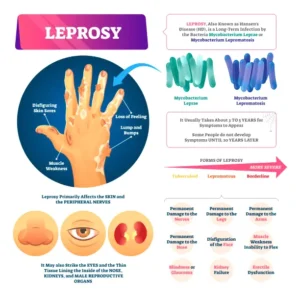
- Leprosy (Hansen’s disease) is a chronic infectious disease caused by Mycobacterium leprae.
- It mainly affects the skin, peripheral nerves, eyes and upper respiratory tract.
- It is curable through multidrug therapy (MDT); early treatment prevents disability.
- Prolonged close contact with untreated cases increases transmission risk, making household contacts particularly important for surveillance.
India’s Progress and Changing Goal
- India achieved national-level “elimination as a public health problem” in 2005, meaning prevalence fell below one case per 10,000 population.
- However, low prevalence does not necessarily mean transmission has stopped.
- WHO now emphasises zero transmission, zero disability and zero discrimination, shifting policy beyond prevalence reduction.
- Persistent child cases are particularly concerning because they indicate relatively recent community transmission.
Challenges
- Regional inequality: Chhattisgarh, Jharkhand, Odisha and Maharashtra continue to carry significant disease burden.
- Delayed diagnosis: Social stigma discourages patients from seeking timely medical care, increasing nerve damage and disability.
- Diagnostic gaps: Leprosy may be mistaken for ordinary skin conditions by inadequately trained healthcare workers.
- Hidden transmission: Long incubation periods make identification of infection chains difficult.
- Social discrimination: Stigma can affect education, employment, marriage and social participation.
- The NSP targets only 1,000 child cases and 0.5 Grade-2 disability cases per million by 2026–27, highlighting the need for accelerated action.
Way Forward
- Shift programme assessment from merely reducing prevalence towards district-level interruption of transmission.
- Intensify contact tracing, active case detection and prophylaxis in endemic clusters.
- Train primary healthcare personnel for early and accurate diagnosis.
- Use digital surveillance to identify geographical transmission hotspots.
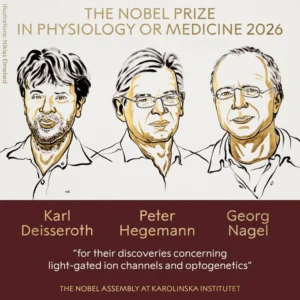
The 2026 Nobel Prize in Physiology or Medicine recognised Karl Deisseroth, Peter Hegemann and Georg Nagel for discoveries related to light-gated ion channels and optogenetics.
- Their work enables scientists to control selected nerve cells using light, transforming research on brain circuits, behaviour and neurological disorders.
What is Optogenetics?
- Optogenetics combines genetics and light-based stimulation to study the activity of specific cells, especially neurons.
- Its foundations emerged from research on light-sensitive proteins called channelrhodopsins, found in microorganisms such as green algae.
- These proteins act as light-controlled ion channels, allowing electrically charged ions to cross cell membranes.
- Scientists can introduce genes encoding these proteins into selected neurons and use precisely timed light pulses to activate or inhibit neural activity.
How Does It Work?
- A gene for a light-sensitive protein is introduced into targeted nerve cells.
- The neurons then produce these proteins in their cell membranes.
- Light of a particular wavelength opens or influences the channels.
- Movement of ions changes the neuron’s electrical activity.
- Researchers can consequently examine how particular neural circuits influence memory, movement, emotion and behaviour.
Scientific and Medical Significance
- Brain mapping: Helps establish links between specific neural circuits and bodily functions.
- Neurological disorders: Improves understanding of Parkinson’s disease, epilepsy and Alzheimer’s disease.
- Mental health: Neural pathways associated with depression, anxiety and addiction can be investigated.
- Vision restoration: Light-sensitive proteins are being explored as possible tools for restoring aspects of visual function.
- Precision research: Unlike broad electrical stimulation, optogenetics can target particular cell populations with high spatial and temporal precision.
Challenges
- Delivering genes safely to precisely targeted human brain cells remains technically difficult.
- Long-term effects of genetic modification and repeated stimulation require careful assessment.
- Human applications raise biosafety, ethical, regulatory and informed-consent concerns.
- Sophisticated equipment and high research costs could widen inequalities in access to advanced therapies.
Relevance for India
- The National Brain Research Centre (NBRC), an autonomous institution under the Department of Biotechnology, undertakes multidisciplinary research on brain function and disorders.
- DBT has supported development of neuro-tools, diagnostic techniques and affordable therapeutic technologies, demonstrating India’s growing focus on translational neuroscience.
- India should strengthen neuroscience infrastructure, interdisciplinary training, biotechnology research and academia-industry collaboration.
- Public investment must also ensure that breakthrough therapies become affordable and accessible, rather than remaining limited to specialised centres.
Conclusion
Optogenetics shows how curiosity-driven basic science can illuminate the brain while creating pathways towards precise, accessible and transformative medical treatments.
The National Household Travel Survey (NHTS) reveals a significant gender divide in how Indian workers travel to their workplaces.
Findings of the Survey
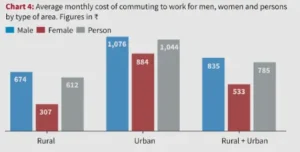
- Women are nearly twice as likely as men to reach workplaces through walking, buses, trains or other public transport.
- Nearly 67% of commuting women depend on walking or public transport, compared with about 33% of men, highlighting gender-sensitive mobility needs.
- In rural India, more than half of working women walk to their workplaces.
- Men show considerably greater dependence on two-wheelers, indicating better access to private mobility.
- Urban women use a wider combination of two-wheelers, buses, autos, cars and walking.
- Women generally experience slightly longer commuting times than men across several major States.
Regional Differences
- In States such as Madhya Pradesh, Uttar Pradesh and Bihar, a relatively high proportion of women walk to work.
- This may indicate limited availability and accessibility of affordable public transport, particularly in rural areas.
- Southern States generally show stronger bus-based mobility; for example, Kerala has a smaller rural-urban difference in women’s bus usage.
Why Does the Gender Mobility Gap Exist?
- Lower vehicle ownership: Household vehicles may be disproportionately available to male members.
- Income differences: Lower earnings make affordable buses, trains and walking more important for women.
- Safety concerns: Poor lighting, unsafe stops and harassment can restrict women’s travel choices.
- Care responsibilities: Women often combine employment journeys with childcare and household-related trips.
Why Gender-Responsive Transport Matters
- Economic: Better mobility can raise female labour-force participation and expand employment choices.
- Social: Safe transport improves access to education, healthcare and public services.
- Urban planning: Women’s travel patterns underline the need for walkable, connected and inclusive cities.
- Environment: Reliable mass transit can reduce private vehicle dependence, congestion and emissions.
- SDGs: Inclusive mobility supports SDG 5 (Gender Equality) and SDG 11 (Sustainable Cities).
Government Initiatives
- PM-eBus Sewa seeks to expand electric bus services in Indian cities.
- PM GatiShakti promotes integrated infrastructure and multimodal connectivity.
- Metro systems, electric buses and non-motorised transport infrastructure can further improve women’s mobility.
Way Forward
- Expand affordable and frequent buses in rural, peri-urban and underserved areas.
- Ensure well-lit stops, CCTV, safe footpaths and reliable last-mile connectivity.
- Use gender-disaggregated mobility data in transport planning.
- Integrate transport policy with employment centres, childcare facilities and affordable housing.
- Increase women’s participation as drivers, conductors, planners and transport administrators.
Conclusion
Safe, affordable and accessible public transport is not merely a mobility service; it is essential infrastructure for women’s economic empowerment and equal participation.
Rachakonda Fort, located near Hyderabad, has attracted attention over concerns that inadequate conservation and tourism infrastructure have prevented the historic site from realising its heritage potential.
About Rachakonda Fort
- It is a medieval hill fort situated at Rachakonda village in Yadadri Bhuvanagiri district, Telangana.
- Spread across nearly 6 sq. km, the fort occupies a strategically important rocky hill landscape.
- It is an important example of medieval Hindu military architecture in the Deccan.
Historical Significance
- The fort is closely associated with the Recherla Nayaks (Velama chiefs), who emerged as an important regional power after the decline of the Kakatiyas.
- Recherla Singama Nayak is traditionally associated with establishing Rachakonda as a stronghold during the 14th century.
- Rachakonda subsequently developed into an important political and military centre.
- In 1433 CE, it came under the control of the Bahmani Sultanate during its expansion in the Deccan.
Architectural Features
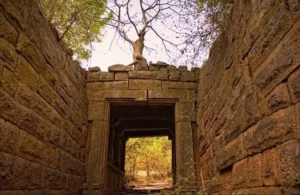
- The fort is famous for its massive stone fortifications and cyclopean masonry, where large irregular stones were fitted together with minimal or no conventional mortar.
- It has two concentric defensive walls and multiple gateways.
- The complex contains temples, gateways, water-retaining structures, stone buildings and extensive ruins.
- Religious remains include Sri Rama temples and Shaiva shrines, including structures associated with Shiva and Veerabhadra worship.
Way Forward
- Conservation requires scientific restoration, vegetation management, improved visitor facilities, archaeological documentation and sustainable heritage tourism involving local communities.
Conclusion
Preserving Rachakonda Fort can protect Telangana’s medieval heritage while creating opportunities for cultural tourism and local development.