
Table of Contents
ToggleCHILDREN IN POLITICAL CAMPAIGNING AND DEMOCRATIC PARTICIPATION
TOPIC: (GS2) POLITY: THE HINDU
A controversy over the alleged use of children to influence family members during Tamil Nadu’s 2026 Assembly elections raised concerns about ethical campaigning.
What Is the Main Issue?
- Political campaigns increasingly use celebrity influence, social media and emotional appeals to attract supporters.
- Pester power: Children repeatedly persuade parents to support a candidate, similar to marketing strategies used to sell consumer products.
- The central concern is whether children are expressing independent opinions or repeating messages promoted by adults.
- Example: Campaign videos showing children urging family members to vote for a particular party.
Constitutional and Legal Framework
- Article 19(1)(a): Protects freedom of speech and expression, including children’s opinions.
- Article 21: Protects life, dignity and personal liberty.
- Article 21A: Guarantees free and compulsory education for children aged 6–14.
- Article 39(f): Directs the State to protect children’s development and dignity.
- Article 51A(k): Places responsibility on parents or guardians to provide educational opportunities.
- Representation of the People Act, 1951: Section 123 addresses corrupt electoral practices, including undue influence.
- UN Convention on the Rights of the Child: Recognises children’s right to express views on matters affecting them.
Arguments Supporting Children’s Participation
- Democratic awareness: Discussions about public issues develop civic understanding.
- Freedom of expression: Children should be able to communicate their genuine political views.
- Active citizenship: Activities such as mock parliaments and school debates encourage responsible participation.
- Social awareness: Children can raise concerns about education, pollution and public safety.
Concerns About Political Campaigning
- Manipulation: Political organisations may exploit children’s admiration for celebrities.
- Emotional pressure: Family affection may be used to influence adult voting decisions.
- Loss of autonomy: Scripted messages can replace independent thinking.
- Digital privacy: Campaign videos may remain online and cause future embarrassment.
- Child welfare: Political activities may expose children to harassment, unsafe crowds or disrupted schooling.
Electoral and Ethical Dimensions
- The Election Commission’s guidelines discourage involving children in election-related campaign activities.
- However, genuine civic education differs from using children for party promotion.
- Emotional persuasion does not automatically constitute legally proven undue influence.
- Ethical campaigning requires respect for both children’s dignity and voters’ independent choices.
Way Forward
- Enforce safeguards against using children in rallies, promotional videos and campaign work.
- Promote age-appropriate civic education without party-based pressure.
- Strengthen parental responsibility, informed consent and digital privacy protections.
- Ensure election authorities investigate complaints fairly and apply proportionate penalties.
- Encourage political parties to adopt child-protection codes.
Conclusion
A healthy democracy must nurture children’s independent political awareness without turning their innocence, affection or identity into instruments of electoral persuasion.
ECONOMICS BEYOND THE INDIVIDUAL AND THE ROLE OF INVESTMENT
TOPIC: (GS3) ECONOMY: THE HINDU
A recent economic analysis questions whether individual saving and consumption decisions can fully explain economic growth and instability.
Microeconomics and Macroeconomics
- Microeconomics: Studies how individuals, families and businesses make decisions about spending, saving, production and prices. Example: Why a family buys fewer goods when prices increase.
- Macroeconomics: Studies the performance of the entire economy, including GDP, inflation, unemployment and economic growth. Example: Why unemployment rises or economic growth slows across India.
- Microfoundations Approach: Explains how the decisions of individuals and businesses together influence the overall economy. Example: When many families reduce spending, demand for goods falls, affecting business production and employment.
- Role of Interest Rates: Central banks, such as the RBI, influence borrowing, saving and spending by changing interest rates. Example: Lower interest rates generally make loans cheaper, encouraging people to buy houses and businesses to invest.
Relationship Between Interest Rates and Savings
- Higher interest rates generally encourage saving by increasing returns on deposits.
- Lower interest rates can encourage borrowing, consumption and investment.
- Mainstream models often assume that households distribute consumption across their lifetimes.
- However, savings may also reflect uncertainty, precautionary needs or future emergencies.
Keynesian Perspective on Investment
- Economist John Maynard Keynes argued that savings do not automatically create productive investment.
- Businesses invest mainly when they expect sufficient future profits.
- Effective demand: Total spending on goods and services determines production and employment.
- Income adjustment: Increased investment raises national income, generating additional savings.
- Example: Building a factory creates employment, raises household incomes and increases demand for other products.
Why Do Economic Crises Occur?
- Uncertainty: Businesses postpone projects when future demand appears weak.
- Herd behaviour: Investors imitate others, sometimes creating speculative bubbles.
- Financial instability: Excessive borrowing during economic booms increases vulnerability.
- Example: The 2008 global financial crisis demonstrated how risky housing loans and financial speculation could destabilise economies.
- Economist Hyman Minsky explained how prolonged financial optimism can encourage dangerous risk-taking.
Role of Economic Structure and Inequality
- Heterodox economics: Examines institutions, class relations, ownership and distribution of economic power.
- Investment decisions are concentrated among businesses and owners of productive assets.
- Workers depend heavily on wages and employment generated through these decisions.
- Therefore, unequal ownership can influence income distribution, economic opportunities and overall demand.
Policy Implications for India
- Monetary policy: RBI uses the repo rate to influence inflation, borrowing and demand.
- Fiscal policy: Public infrastructure spending can support employment when private investment weakens.
- Private investment: Stable policies, credit access and infrastructure encourage business confidence.
- Inclusive growth: Stronger wages, social protection and MSME support can improve household purchasing power.
- Balanced approach: Policymakers should examine investment trends, employment and inequality alongside interest rates.
Conclusion
Sustainable economic growth requires not only sound individual decisions but also productive investment, stable institutions and policies that distribute economic opportunities fairly.
ALBERTA'S REFERENDUM AND CANADA'S NATIONAL UNITY
TOPIC: (GS2) POLITY: THE HINDU
Alberta, an oil-rich Canadian province, reportedly voted overwhelmingly to remain part of Canada in a non-binding referendum held on October 19, 2026.
What Happened in Alberta?
- Alberta held a public vote on whether to remain within Canada or begin the process of seeking separation.
- According to the article, approximately 75% supported remaining in Canada after more than 97% of votes were counted.
- The referendum was non-binding, meaning its result did not directly change Alberta’s constitutional status.
- Separatist groups nevertheless received substantial support, indicating continuing political dissatisfaction.
Why Is Separatism Growing?
- Oil resources: Alberta produces most of Canada’s crude oil and possesses extensive oil-sands deposits.
- Economic grievances: Some residents believe the province contributes more revenue than it receives through federal arrangements.
- Environmental regulations: Federal climate policies have created tensions with Alberta’s petroleum industry.
- Provincial autonomy: Separatists demand greater control over natural resources, taxation and economic decisions.
- Political influence: Conservative movements and developments in neighbouring America have shaped regional political debates.
Significance of the Referendum
- National unity: The reported majority supports Canada’s continued territorial integrity.
- Federalism: The debate reveals tensions between provincial powers and central authority.
- Economic stability: Continued unity reduces uncertainty over investment, trade and energy infrastructure.
- Democratic participation: Voting provides citizens an opportunity to express their preferences peacefully.
- Political warning: Minority support for separation indicates that regional grievances require attention.
Constitutional and International Dimensions
- Canada follows a federal system where powers are divided between national and provincial governments.
- In the Reference re Secession of Quebec (1998), Canada’s Supreme Court held that a province cannot unilaterally secede under Canadian constitutional law.
- A clear majority favouring separation on a clear question would create an obligation to negotiate, not automatic independence.
- The issue reflects tensions between self-determination and territorial integrity.
Implications for India
- Comparative federalism: Both India and Canada manage regional identities within federal constitutional systems.
- Resource sharing: Disputes over revenue and natural resources require fair institutional arrangements.
- National integration: Regional concerns should be addressed through dialogue and constitutional mechanisms.
- Example: India’s Finance Commission supports fiscal transfers to reduce regional inequalities.
Referendum | Citizens vote directly to approve or reject a proposed law, policy or constitutional change. Example: Brexit referendum (2016), in which UK voters chose to leave the European Union. |
Initiative | Citizens propose a new law or constitutional change, usually by collecting a required number of signatures. Example: Citizens in Switzerland can propose constitutional amendments through popular initiatives. |
Recall | Voters can remove an elected representative before the normal completion of their term, subject to legal conditions. Example: California’s 2003 gubernatorial recall election. |
Plebiscite | A popular vote, generally concerning a major political question such as sovereignty, territorial status or independence. Example: The 2011 South Sudan independence vote. |
Conclusion
Alberta’s referendum highlights that lasting national unity depends on responsive federalism, fair resource sharing and democratic accommodation of regional aspirations.
NAMAMI GANGE PROGRAMME AND INNOVATION FOR RIVER REJUVENATION
TOPIC: (GS2) POLITY: THE HINDU
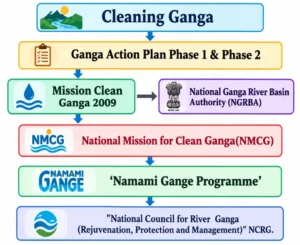
The Namami Gange Programme is adopting different wastewater treatment technologies to address pollution across the Ganga basin.
About Namami Gange Programme
- Launched: 2014 by the Government of India.
- Objective: Reduce pollution, conserve biodiversity and restore the ecological health of River Ganga.
- Implementing agency: National Mission for Clean Ganga (NMCG), under the Ministry of Jal Shakti.
- Major components: Sewage treatment, industrial pollution control, river cleaning, afforestation, biodiversity protection and public participation.
Why Are Different Technologies Needed?
- Large cities: Require centralised sewage treatment plants (STPs) connected through sewer networks.
- Villages: Need smaller, decentralised systems where underground sewerage is unavailable.
- Hilly regions: Require compact treatment facilities suitable for difficult terrain and cold weather.
- Crowded cities: Need technologies that occupy less land and consume less energy.
Important Wastewater Treatment Technologies
- Activated Sludge Process: Uses microorganisms to break down organic pollutants in sewage.
- Sequential Batch Reactor (SBR): Treats wastewater through different stages in a single tank.
- Food Chain Reactor (FCR): Combines microorganisms, artificial surfaces and plant roots for biological treatment.
- Electrocoagulation: Uses electricity to separate pollutants from wastewater; suitable for certain difficult locations.
- Constructed Wetlands: Use plants, soil and microorganisms to naturally filter wastewater.
- NEREDA Technology: Uses compact bacterial granules for efficient treatment with reduced space requirements.
- Soil Biotechnology: Uses soil, beneficial microorganisms and natural filtration processes to clean wastewater.
Resource Recovery and Circular Economy
- Biogas: Sewage sludge can produce renewable energy through anaerobic digestion.
- Example: Dinapur STP in Varanasi uses biogas-based electricity to meet a substantial share of its energy needs.
- Solar power: Reduces dependence on conventional electricity.
- Treated-water reuse: Supports irrigation and industrial activities, reducing freshwater consumption.
- Sludge management: Properly processed sludge can support safe resource recovery.
Challenges
- Environmental benefits: Reduced river pollution improves water quality and aquatic biodiversity.
- Economic benefits: Energy recovery and suitable decentralised systems can reduce operating costs.
- Public health: Better sanitation reduces exposure to contaminated water.
- Challenges: Inadequate sewer connections, industrial discharge, maintenance costs and weak monitoring can limit results.
Conclusion
Sustainable Ganga rejuvenation requires innovative technology, effective pollution control and continuous community participation—not merely the construction of sewage treatment plants.
THREE INDIAN SITES ADDED TO UNESCO'S TENTATIVE WORLD HERITAGE LIST
TOPIC: (GS1) INDIAN ART AND CULTURE: THE HINDU
Three Indian locations have reportedly been added to UNESCO’s Tentative World Heritage List, taking India’s total to 81.
Baratang Karst–Mud Volcano Complex
- Location: Baratang Island, Andaman and Nicobar Islands.
- Features: Limestone caves formed through the gradual dissolution of rocks by water.
- Mud volcanoes: Release mud, water and gases instead of molten lava.
- Importance: Demonstrates unusual geological processes and supports scientific research.
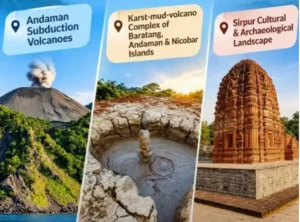
Andaman Subduction Volcanoes
- Location: Barren Island and Narcondam Island, Andaman Sea.
- Barren Island: Contains India’s only confirmed active volcano.
- Narcondam Island: A volcanic island supporting unique forest ecosystems.
- Biodiversity: Habitat of the endemic Narcondam hornbill.
- Importance: Illustrates plate tectonics, volcanic activity and ecological development.
Sirpur Cultural and Archaeological Landscape
- Location: Mahasamund district, Chhattisgarh, near the Mahanadi River.
- History: Important centre under the Sharabhapuriya and Panduvamshi dynasties.
- Heritage: Contains Buddhist, Hindu and Jain archaeological remains.
- Example: Lakshmana Temple, noted for its early brick architecture.
- Importance: Reflects religious coexistence, artistic traditions and ancient trade networks.
UNESCO Tentative List
- Countries identify potential World Heritage properties through their Tentative Lists.
- Inclusion is a necessary preliminary step before World Heritage nomination.
- Tentative listing does not mean UNESCO World Heritage inscription.
Conclusion
Protecting these sites will preserve India’s geological wonders, unique biodiversity and rich cultural legacy for future generations.