
Table of Contents
ToggleINDIA'S WORLDSKILLS SUCCESS AND BUILDING A SKILLED WORKFORCE FOR VIKSIT BHARAT
TOPIC: (GS3) ECONOMY: THE HINDU
India secured 10th position at WorldSkills Shanghai 2026, winning six silver medals and 20 Medallions for Excellence, its best-ever performance.
What is WorldSkills Competition?
• WorldSkills is a global competition held every two years, often called the Olympics of Skills.
• It evaluates practical abilities in manufacturing, construction, technology and services.
• The 2026 competition brought together over 1,400 participants from around 70 countries and regions.
• India participated in 63 skill categories with 70 competitors.
India’s Performance and Achievements
• Improved global ranking: India moved from 39th position in 2011 to 13th in 2024 and 10th in 2026.
• Diversification: Indian participants demonstrated excellence in both traditional occupations and emerging technologies.
• Examples: Mohammed Salam won silver in dental prosthetics, while Smriti Nambiar secured silver in bakery.
• Grassroots participation: Over 3.65 lakh candidates registered for IndiaSkills, demonstrating growing interest in vocational careers.
Why Skill Development Matters for India
• Demographic dividend: Equipping India’s young population with employable skills can improve economic productivity.
• Employment generation: Vocational training supports jobs in manufacturing, construction, logistics and services.
• Global competitiveness: Skilled workers strengthen India’s position in international supply chains.
• Social inclusion: Affordable training creates opportunities for rural youth, women and economically disadvantaged groups.
• Technological transition: Skills in artificial intelligence, robotics and automation prepare workers for Industry 4.0.
Challenges
• Skill mismatch: Training programmes do not always meet employers’ requirements.
• Social attitudes: Academic degrees often receive greater recognition than vocational qualifications.
• Infrastructure gaps: Several training institutions lack modern equipment and qualified instructors.
• Unequal access: Rural youth and women face financial, geographical and social barriers.
• Technological changes: Rapid automation requires continuous reskilling.
Way Forward
• Promote Skill-Ex: Treat investment in workforce capabilities as seriously as capital expenditure (Capex) and operational expenditure (Opex).
• Industry partnerships: Encourage companies to design courses, provide apprenticeships and support placements.
• Outcome-based training: Measure success through employment, wages and skill proficiency rather than enrolment alone.
• Global standards: Align Indian certifications with international requirements to improve workforce mobility.
• Dignity of labour: Promote vocational careers through schools, awareness campaigns and successful role models.
GOVERNMENT INITIATIVES
• PM-SETU: A ₹60,000 crore programme to modernise 1,000 government ITIs through 200 hubs and 800 spokes, with industry participation.
• PMKVY 4.0: Provides industry-relevant training, including emerging technological skills.
• Skill India Digital Hub: Connects training, certification and employment opportunities through a unified digital platform.
• National Education Policy 2020: Encourages vocational education and practical learning alongside academic studies.
• National Apprenticeship Promotion Scheme: Supports workplace-based training through employer participation.
Conclusion:
India must transform its demographic dividend into a skilled workforce by making vocational education accessible, industry-oriented and socially respected to achieve Viksit Bharat 2047.
NOBEL PRIZE IN LITERATURE 2026 ANNE CARSON AND THE IMPORTANCE OF LITERARY INNOVATION
TOPIC: (GS2) POLITY: THE HINDU
Canadian poet and scholar Anne Carson received the 2026 Nobel Prize in Literature for her innovative writing that combines ancient literary traditions with modern experiences.
About the Nobel Prize in Literature
• Established under Alfred Nobel’s will of 1895, the prize has been awarded since 1901.
• The Swedish Academy selects the winner, while nominations remain confidential for 50 years.
• Carson became the 19th woman to receive the Literature Nobel, highlighting the continuing gender gap in literary recognition.
Who is Anne Carson?
• A Canadian poet, essayist, translator and scholar specialising in ancient Greek literature.
• Known for combining poetry, prose, philosophy and visual arts instead of following conventional literary structures.
• Her writings examine love, identity, grief, human relationships and emotional complexity.
Major Literary Contributions
• Eros the Bittersweet (1986): Examines desire through ancient Greek philosophy.
• Autobiography of Red (1998): Reinterprets Greek mythology to explore identity and personal growth.
• The Beauty of the Husband (2001): Explores marriage and separation; received the T.S. Eliot Prize.
• Nox (2010): Combines writing, photographs and personal memories to express grief.
Broader Significance
• Literary innovation: Encourages writers to experiment beyond traditional genres.
• Cultural continuity: Demonstrates how ancient knowledge can address contemporary concerns.
• Gender representation: Recognition of women writers promotes greater visibility in global literature.
• Human creativity: Highlights imagination, originality and emotional understanding amid growing AI-generated content.
• Cultural diversity: Literature encourages empathy by presenting different identities and experiences.
Relevance for India
• NEP 2020: Promotes multidisciplinary education, creative thinking and integration of arts with learning.
• Indian literary traditions: Writers can reinterpret epics such as the Mahabharata through contemporary perspectives.
• Cultural preservation: Translation helps regional literature reach wider audiences.
• Creative economy: Supporting writers, artists and publishers can generate employment and strengthen cultural diplomacy.
Way Forward
• Encourage interdisciplinary literary research and creative writing.
• Strengthen translation programmes and regional publishing.
• Protect artistic freedom and promote responsible AI use in creative industries.
Conclusion
Anne Carson’s Nobel Prize reinforces that literature progresses when human imagination crosses established boundaries while keeping cultural traditions alive.
INDIA'S RISING SHARE IN GLOBAL GREENFIELD INVESTMENTS
TOPIC: (GS3) ECONOMY: THE HINDU
According to the UNCTAD Trade and Development Report 2026, India attracted 5.7% of global greenfield investments during 2020–25, compared to China’s 2.8%.
What is Greenfield Investment?
• Greenfield investment: Investment in establishing entirely new business facilities, factories or infrastructure rather than acquiring existing enterprises.
• Example: A foreign semiconductor company constructing a new manufacturing plant in India.
• Brownfield investment: Investment involving the purchase or expansion of existing facilities.
• Greenfield projects can generate employment, introduce technology and strengthen industrial capacity.
Key Findings of UNCTAD Report
• India’s performance: India (5.7%) surpassed Malaysia (4%), Indonesia (3.8%) and China (2.8%).
• Strategic sectors: Their share in global greenfield investment increased from 16% to 44% during 2020–25.
• Major sectors: AI infrastructure (12.4%), semiconductors (8.1%) and energy-transition technologies (7.8%).
• Regional concentration: Europe attracted 28.4% of strategic investments, followed by North America (28%).
• Industrial policies: India introduced 1,416 industrial policy measures during 2008–21, behind China and the US.
Significance for India
• Manufacturing growth: Supports Make in India and strengthens domestic production.
• Employment: Creates direct factory jobs and indirect opportunities for MSMEs.
• Supply-chain diversification: Benefits from multinational companies adopting the China+1 strategy.
• Technology transfer: Encourages advanced manufacturing and innovation.
• Strategic autonomy: Reduces dependence on imported critical technologies.
Challenges
• Regional inequality: Investment remains concentrated in developed economies and selected Indian States.
• Infrastructure gaps: Improve electricity reliability, logistics and industrial land availability.
• Skill shortages: Strengthen technical education and industry-linked apprenticeships.
• Limited domestic value addition: Integrate MSMEs into global production networks.
• Environmental concerns: Promote renewable energy and sustainable industrial development.
• Policy stability: Ensure predictable regulations and faster project approvals.
GOVERNMENT INITIATIVES
• PLI Schemes: Encourage manufacturing investment across 14 sectors.
• India Semiconductor Mission: Supports domestic chip manufacturing and technological capabilities.
• PM Gati Shakti: Improves logistics and infrastructure connectivity.
• National Industrial Corridor Programme: Develops modern industrial cities, including Dholera in Gujarat.
Conclusion
India must convert rising greenfield investment into sustainable manufacturing, quality employment and technological self-reliance to emerge as a globally competitive economic power.
NOBEL PEACE PRIZE 2026
TOPIC: (GS2) SOCIAL JUSTICE AND HEALTH: THE HINDU
South African jurist Navi Pillay received the 2026 Nobel Peace Prize for promoting international justice, human rights and the rule of law.
Who is Navi Pillay?
• A South African lawyer of Indian origin who opposed racial discrimination under apartheid.
• Served as UN High Commissioner for Human Rights (2008–2014).
• Worked as a judge at the International Criminal Tribunal for Rwanda (ICTR) and International Criminal Court (ICC).
• Contributed to recognising sexual violence during conflicts as an international crime.
Major Contributions
• Fight against apartheid: Defended vulnerable communities against discriminatory laws in South Africa.
• International criminal justice: Helped strengthen accountability for genocide, war crimes and crimes against humanity.
• Gender justice: Supported legal recognition of conflict-related sexual violence.
• Gaza investigations: Chaired a UN commission investigating alleged violations by Israeli authorities and Palestinian armed groups.

Important International Legal Institutions
• International Court of Justice (ICJ): Settles legal disputes between countries and provides advisory opinions.
• International Criminal Court (ICC): Prosecutes individuals accused of genocide, war crimes, crimes against humanity and aggression.
• UN Human Rights Council: Investigates human rights violations and promotes international accountability.
• Geneva Conventions (1949): Establish protections for civilians, prisoners and wounded persons during armed conflicts.
Significance for Global Governance
• Rule of law: International disputes should be addressed through legal institutions rather than military power.
• Civilian protection: Accountability mechanisms can discourage attacks on vulnerable populations.
• Human rights: Independent investigations help document abuses and support victims.
• Challenges: Political interference, selective enforcement and limited cooperation weaken international justice.
Relevance for India
• Constitutional values: Articles 14 and 21 protect equality and life, while Article 51 promotes international peace.
• Foreign policy: India supports peaceful dispute resolution, sovereignty and dialogue.
• International institutions: India is not a party to the Rome Statute establishing the ICC.
• Global South: India can advocate fair and consistent application of international law.
Way Forward
• Strengthen judicial independence and international cooperation.
• Ensure impartial investigation of violations by all parties.
• Improve victim protection, humanitarian assistance and accountability.
Conclusion
Lasting global peace requires independent institutions, equal application of international law and justice that protects human dignity regardless of political power.
CONSERVATION ASSURED TIGER STANDARDS (CA|TS)
TOPIC: (GS3) ENVIRONMENT: THE HINDU
Nameri Tiger Reserve in Assam has reportedly received Conservation Assured Tiger Standards (CA|TS) Approved status.
What is CA|TS?
• CA|TS is an international accreditation framework that evaluates the management effectiveness of tiger conservation areas.
• Launched at the First Asian Parks Congress, Japan, in 2013.
• It promotes scientific monitoring, habitat protection and community participation.
Assessment Framework
• Seven pillars: Importance and status, management, community, tourism (optional), protection, habitat management and tiger populations.
• Contains 17 elements covering conservation standards and management practices.
• Five pillars address general conservation management, while two specifically assess tiger habitats and populations.
• Sites undergo assessment before receiving approval.
Implementation in India
• National Tiger Conservation Authority (NTCA) coordinates implementation with the Global Tiger Forum and WWF-India.
• India adopted CA|TS across its tiger reserves in 2020.
• Accredited reserves include Kaziranga, Manas, Sundarbans, Kanha, Bandipur and Periyar.
• Government records reported 23 accredited tiger reserves in 2024, exceeding the earlier list of 15.
Significance
• Biodiversity: Protects tigers and associated ecosystems.
• Accountability: Encourages transparent conservation assessments.
• Community welfare: Promotes local participation and conflict reduction.
• Climate resilience: Conserves forests that function as carbon sinks
Way Forward
• Address poaching, habitat fragmentation and human-wildlife conflict.
• Strengthen wildlife corridors, scientific monitoring and community-based conservation.
• Integrate CA|TS with Project Tiger and the Wildlife (Protection) Act, 1972.
Conclusion
CA|TS strengthens tiger conservation by combining scientific management, institutional accountability and community participation to protect India’s biodiversity.
SNOW LEOPARD
TOPIC: (GS3) ENVIRONMENT: THE HINDU
India has launched its first high-altitude snow leopard wildlife safari in Ladakh, promoting wildlife-based ecotourism.
About Snow Leopard
• Scientific name: Panthera uncia.
• A large mountain cat popularly called the “Ghost of the Mountains” because of its camouflage and secretive behaviour.
• IUCN Status: Vulnerable; CITES: Appendix I.
• Protected under Schedule I of India’s Wildlife (Protection) Act, 1972, providing the highest level of legal protection.
Habitat and Distribution
• Occurs across the high mountains of Central and South Asia, including the Himalayas, Tibetan Plateau and Altai ranges.
• In India, it occurs mainly in Ladakh, Jammu & Kashmir, Himachal Pradesh, Uttarakhand, Sikkim and Arunachal Pradesh.
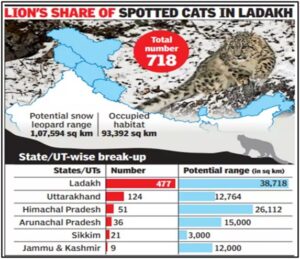
• India’s first scientific population assessment estimated 718 snow leopards, with Ladakh recording the largest number (477).
• It is the State Animal of Ladakh and Himachal Pradesh.
Adaptations
• Thick fur provides insulation against extreme cold.
• Broad, furry paws act like natural snowshoes.
• Long tail provides balance and can protect the face from cold.
• Large nasal cavities help warm cold mountain air.
Threats
• Climate change and shrinking alpine habitats.
• Decline of prey such as bharal (blue sheep) and ibex.
• Retaliatory killing following livestock losses.
• Infrastructure development and habitat fragmentation.
• Illegal wildlife trade.
Conservation Measures
• Project Snow Leopard (2009): Promotes landscape-level and community-based conservation.
• SECURE Himalaya Project: Strengthened biodiversity conservation and sustainable livelihoods in high-altitude landscapes.
• Responsible ecotourism can provide local income, but safaris require strict visitor limits and wildlife safeguards.
Conclusion
Protecting the snow leopard means safeguarding the entire fragile Himalayan ecosystem and the ecological security of India’s high mountains.