Table of Contents
ToggleSpecial Officer for Linguistic Minorities
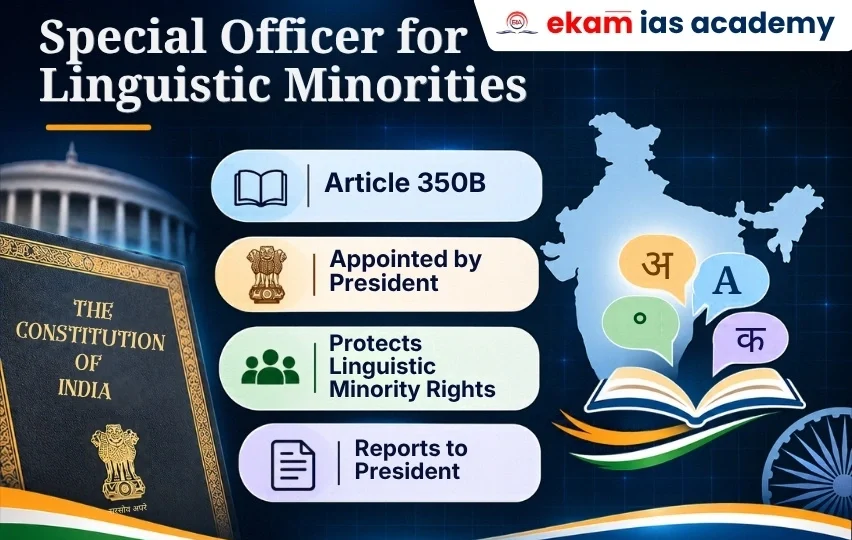
- The Special Officer for Linguistic Minorities is a constitutional authority appointed to oversee and protect Linguistic Minority Rights in India.
- Commonly designated as the Commissioner for Linguistic Minorities, this office operates under Article 350B Indian Constitution to safeguard diverse language speakers at the state level.
- For Indian Polity and Governance UPSC preparation, understanding this body is crucial because linguistic diversity shapes federalism, cultural preservation, and Minority Rights in India.
Constitutional Background
- Inserted via the 7th Constitutional Amendment Act, 1956, Article 350B Indian Constitution provides for a single Special Officer for Linguistic Minorities appointed by the President of India.
- It investigates all matters relating to Constitutional Safeguards for Linguistic Minorities and submits reports to the President to be laid before Parliament and state legislatures.
- Unlike multi-member commissions, Article 350B establishes a one-person constitutional office without specifying qualifications, tenure, salary, or removal procedures in the Constitution itself.
Historical Background
- Following the reorganization of Indian states along linguistic lines in the 1950s, communities speaking a language in minority within a specific state needed dedicated institutional protection.
- The States Reorganisation Commission (SRC) recommended appointing a special officer to monitor Protection of Linguistic Rights and prevent discrimination against linguistic minorities.
- Pursuant to Article 350B, the office of the Commissioner for Linguistic Minorities was established in July 1957 to monitor compliance with constitutional and nationally agreed safeguards.
Appointment and Organisational Structure
- The Special Officer for Linguistic Minorities UPSC aspirants study is appointed by the President of India and functions administratively under the Union Ministry of Minority Affairs.
- The Commissioner for Linguistic Minorities has headquarters in New Delhi (after earlier operating from Allahabad/Prayagraj) and maintains regional offices in Belagavi (Belgaum), Chennai, and Kolkata, each headed by an Assistant Commissioner.
- At headquarters, the Commissioner is assisted by deputy and assistant commissioners, while coordinating with states and Union Territories through designated nodal officers.
Functions and Responsibilities
- The Commissioner for Linguistic Minorities UPSC framework centers on investigating complaints and monitoring how states and UTs implement Constitutional Safeguards for Linguistic Minorities.
- It reviews facilities for primary-stage instruction in the mother tongue, grievance redressal mechanisms, and Language Rights in Indian Constitution frameworks across administrations.
- It also spreads awareness among Linguistic Minorities in India and submits periodic reports recommending corrective steps to promote inclusive growth and national integration.
Constitutional Safeguards for Linguistic Minorities
- Article 350A Indian Constitution directs every state and local authority to endeavour to provide adequate facilities for instruction in the mother tongue at the primary stage to children of linguistic minority groups.
- Article 29 and Article 30 protect the right of any section of citizens to conserve distinct language, script, or culture and grant religious and linguistic minorities the right to establish and administer educational institutions.
- Article 347 and Article 350 address official recognition of a language spoken by a substantial section of a state’s population and the right to submit representations in any language used in the Union or a state, extending beyond just the Eighth Schedule of Indian Constitution.
Reporting Mechanism
- Under Article 350B, the Special Officer for Linguistic Minorities submits reports to the President of India at such intervals as the President directs.
- At the central level, these annual and special reports are routed through the Union Minister for Minority Affairs to the President.
- The President causes each report to be laid before each House of Parliament and sent to the governments of the states concerned for follow-up action.
Special Officer vs National Commission for Minorities
← Swipe left or right to view the full comparison →
| Comparison Feature | Special Officer for Linguistic Minorities | National Commission for Minorities (NCM) |
|---|---|---|
| Legal Basis | Article 350B of the Indian Constitution. | National Commission for Minorities Act, 1992. |
| Institutional Status | A single-officer constitutional authority, also known as the Commissioner for Linguistic Minorities. | A multi-member statutory body. |
| Primary Focus | Linguistic minority rights and constitutional language safeguards. | Issues and safeguards concerning nationally notified religious minority communities. |
| Basis of Minority Identification | Language-based minority status assessed at the State or Union Territory level. | Communities notified as minorities by the Central Government under the NCM Act. |

Challenges and Issues
- The Special Officer for Linguistic Minorities lacks civil court powers, enforcement authority, and binding quasi-judicial remedies, making implementation dependent on state cooperation.
- Because the Constitution leaves tenure, service conditions, and removal undefined, institutional continuity and independence can face practical limitations.
- Uneven implementation of mother-tongue schooling under Article 350A Indian Constitution and limited public awareness continue to test Protection of Linguistic Rights across states.
Way Forward
- Strengthening administrative responsiveness and periodic review mechanisms between the Commissioner for Linguistic Minorities and state nodal officers can improve compliance with Article 350A Indian Constitution.
- Expanding mother-tongue primary education and digital access to minority languages will reinforce Linguistic Minorities in India and support educational inclusion.
- Clearer institutional guidelines on tenure and follow-up tracking of tabled reports can enhance the effectiveness of Special Officer for Linguistic Minorities UPSC governance.
Conclusion
- The Special Officer for Linguistic Minorities remains a vital pillar of Indian Polity and Governance UPSC by safeguarding Linguistic Minority Rights in India within a multilingual federation.
- Together with Article 350A Indian Constitution, Articles 29–30, and Article 350B Indian Constitution, it balances regional language administration with cultural inclusivity.
- Consistent implementation of its recommendations ensures that Protection of Linguistic Rights strengthens unity amidst India’s vast linguistic diversity.
UPSC Prelims: PYQs & Practice Questions
Previous Year Questions (Prelims)
Q: Consider the following statements regarding the Special Officer for Linguistic Minorities in India:
1. The office of the Special Officer for Linguistic Minorities was created by the Seventh Constitutional Amendment Act, 1956 following the recommendations of the States Reorganisation Commission.
2. The Constitution of India prescribes the exact tenure, salary, and procedure for removal of the Special Officer for Linguistic Minorities.
Which of the statements given above is/are correct?
(a) 1 only
(b) 2 only
(c) Both 1 and 2
(d) Neither 1 nor 2
Answer: (a) 1 only
Explanation:
Statement 1 is correct: Following the recommendations of the States Reorganisation Commission (1953–55), the Seventh Constitutional Amendment Act, 1956 inserted Article 350B in Part XVII of the Constitution to provide for a Special Officer for Linguistic Minorities, designated as the Commissioner for Linguistic Minorities.
Statement 2 is incorrect: The Constitution does not specify the qualifications, tenure, salaries and allowances, service conditions, or procedure for removal of the Special Officer for Linguistic Minorities.
Q: Which of the following constitutional provisions directly relate to the protection and promotion of linguistic minorities in India?
1. Article 29
2. Article 30
3. Article 350A
4. Article 350B
Select the correct answer using the code given below:
(a) 1 and 2 only
(b) 3 and 4 only
(c) 1, 2 and 3 only
(d) 1, 2, 3 and 4
Answer: (d) 1, 2, 3 and 4
Explanation:
All four provisions form core pillars of Constitutional Safeguards for Linguistic Minorities.
Article 29: Protects the right of any section of citizens having a distinct language, script, or culture to conserve it.
Article 30: Gives linguistic and religious minorities the right to establish and administer educational institutions of their choice.
Article 350A: Directs States and local authorities to provide adequate facilities for instruction in the mother tongue at the primary stage.
Article 350B: Provides for the Special Officer for Linguistic Minorities to investigate and report on these safeguards.
Practice Questions
Q: With reference to the Commissioner for Linguistic Minorities (Article 350B), consider the following statements:
1. It is a multi-member constitutional commission headed by a Chairperson and four members.
2. The Special Officer submits reports to the President of India, who causes them to be laid before each House of Parliament and sent to the state governments concerned.
3. Administratively, the office functions under the Union Ministry of Education.
Which of the statements given above is/are correct?
(a) 1 and 2 only
(b) 2 only
(c) 1 and 3 only
(d) 1, 2 and 3
Answer: (b) 2 only
Explanation:
Statement 1 is incorrect: Article 350B(1) provides for a single Special Officer for Linguistic Minorities, not a multi-member commission.
Statement 2 is correct: Under Article 350B(2), the Special Officer submits reports to the President of India. The President causes these reports to be laid before each House of Parliament and sent to the Governments of the States concerned.
Statement 3 is incorrect: Administratively, the office functions under the Union Ministry of Minority Affairs, not the Ministry of Education.
Q: Consider the following statements regarding linguistic minorities in India:
1. Linguistic minority status in India is determined on a State-wise (or Union Territory-wise) basis rather than at the national level.
2. A language must be included in the Eighth Schedule of the Constitution for a group speaking it to claim safeguards as a linguistic minority.
Which of the statements given above is/are correct?
(a) 1 only
(b) 2 only
(c) Both 1 and 2
(d) Neither 1 nor 2
Answer: (a) 1 only
Explanation:
Statement 1 is correct: Linguistic minority status is determined on a State-wise or Union Territory-wise basis, rather than at the national level.
Statement 2 is incorrect: Constitutional safeguards under Articles 29, 30, 350A and 350B protect linguistic minorities regardless of whether their mother tongue is included in the Eighth Schedule of the Constitution.
UPSC Mains – Previous Year & Practice Questions
Mains Previous Year Questions
Question: Discuss the safeguards for linguistic minorities in India. (Mains 2022 – Anthropology Optional Paper II)
Question: Special rights are not privileges, but they are granted to make it possible for minorities to preserve their identity, culture and traditions. Elaborate in the context of India with examples. (UPSC CSE Mains – GS Paper II)
Question: The Right of Children to Free and Compulsory Education Act, 2009 remains inadequate in promoting incentive-based system for children's education without generating awareness about the importance of schooling. Analyse. (Mains 2022 – GS Paper II)
Question: National Education Policy 2020 is in conformity with the Sustainable Development Goal-4 (2030). It intends to restructure and reorient education system in India. Critically examine the statement. (Mains 2020 – GS Paper II)
Question: Discuss the possible factors that inhibit India from enacting for its citizens a uniform civil code as provided for in the Directive Principles of State Policy. (Mains 2015 – GS Paper II)
Mains Practice Questions
[10 Marks | 150 Words]
Question: Examine the constitutional mandate and organizational setup of the Special Officer for Linguistic Minorities under Article 350B. Why is the office often described as having investigative and reporting significance without direct enforcement powers?
[15 Marks | 250 Words]
Question: Trace the evolution of constitutional safeguards for linguistic minorities from the States Reorganisation Commission to Articles 29, 30, 350A, and 350B. How do these provisions balance regional linguistic majorities with minority cultural preservation?
[10 Marks | 150 Words]
Question: Despite the constitutional directive under Article 350A and the oversight of the Commissioner for Linguistic Minorities, instruction in the mother tongue at the primary stage faces uneven implementation across states. Analyze the administrative and practical challenges.


Special Officer for Linguistic Minorities-FAQs
Who is the Special Officer for Linguistic Minorities?
The Special Officer, commonly known as the Commissioner for Linguistic Minorities, is a constitutional authority established under Article 350B to safeguard the rights and interests of linguistic minorities.
Who appoints the Special Officer for Linguistic Minorities?
The President of India appoints the Special Officer under Article 350B. The office was created through the 7th Constitutional Amendment Act, 1956.
What are the main functions of the Commissioner for Linguistic Minorities?
The Commissioner investigates matters relating to constitutional safeguards for linguistic minorities, monitors their implementation and submits reports to the President.
What constitutional safeguards protect linguistic minorities in India?
Important safeguards include Articles 29, 30, 347, 350, 350A and 350B, covering cultural preservation, minority educational institutions, language recognition, representations and mother-tongue instruction.
What is the difference between the Special Officer and the National Commission for Minorities?
The Special Officer is a single-officer constitutional authority under Article 350B focused specifically on linguistic minorities, whereas the National Commission for Minorities is a statutory multi-member body dealing with notified religious minorities.