Table of Contents
ToggleArticle 45 of the Indian Constitution
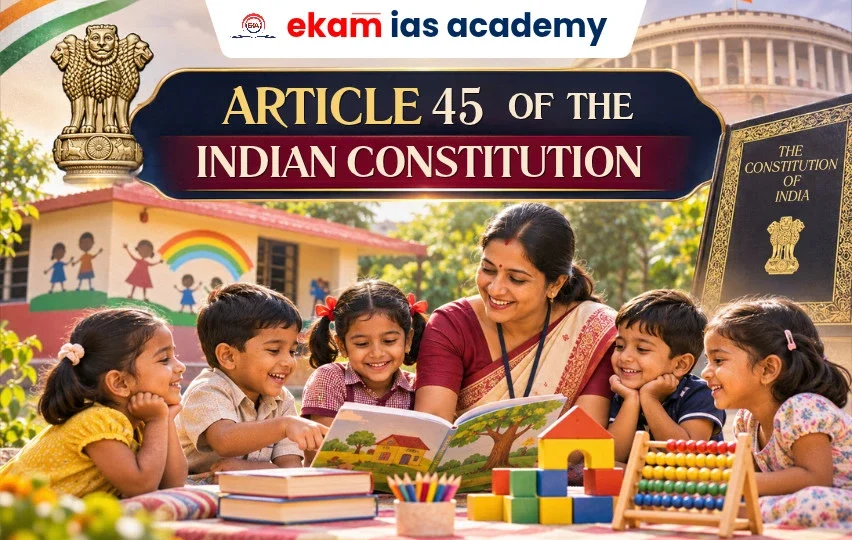
- Article 45 of the Indian Constitution serves as a vital directive principle aimed at securing foundational care and foundational learning for young children across the nation.
- It occupies a prominent place under Part IV of Indian Constitution, operating as a non-justiciable directive that guides state policy formulation.
- As a cornerstone of Indian Polity UPSC preparation, it outlines the administrative commitment to holistic welfare and early development.
Constitutional Background
- Originally enacted as part of the Article 45 Constitution of India, it set a ten-year timeline to provide free and compulsory education for all children up to the age of fourteen years.
- Framed within the Directive Principles of State Policy UPSC chapter, it underscores the constitutional vision of transforming India into a progressive welfare state.
- Because it is non-justiciable under Part IV of Indian Constitution, it historically functioned as an aspirational moral obligation rather than an enforceable legal right.
Evolution of Article 45
- The scope of this provision witnessed a paradigm shift following the enactment of the 86th Constitutional Amendment Act 2002.
- Prior to this amendment, the article addressed the entire elementary education bracket up to age fourteen, a target that faced severe infrastructural delays.
- Post-amendment, the framework was refocused exclusively toward Education for Children Below Six Years, shifting older children’s educational claims into the fundamental rights domain.
Key Features of Article 45
- It explicitly mandates that the State shall endeavour to provide Early Childhood Care and Education for all children until they complete the age of six years.
- It covers pre-school grooming, cognitive stimulation, and health safeguards during the most crucial developmental window of human life.
- It bridges the gap between early nutritional support and formal school readiness through structured institutional planning.
Article 45 vs Article 21A
← Swipe left or right to view the full comparison →
| Comparison Feature | Article 45 | Article 21A |
|---|---|---|
| Age Group | Children below six years. | Children aged six to fourteen years. |
| Constitutional Status | Directive Principle of State Policy under Part IV. | Fundamental Right under Part III. |
| Legal Enforceability | Non-justiciable, but fundamental in governance under Article 37. | Justiciable and enforceable through courts. |
| Educational Mandate | The State shall endeavour to provide early childhood care and education until children complete six years. | The State shall provide free and compulsory education in the manner determined by law. |

Importance of Article 45
- It provides robust backing for Child Development and Education by targeting the formative neurological years of human capital formation.
- By prioritizing early developmental milestones, it helps mitigate future learning deficits and dropout tendencies associated with Free and Compulsory Education for Children.
- It acts as a structural equalizer for disadvantaged socio-economic groups by emphasizing institutional early interventions.
Government Initiatives
- The nationwide Anganwadi network and the Integrated Child Development Services (ICDS) serve as primary delivery channels for early childhood health and pre-school education.
- Modern administrative frameworks like POSHAN Abhiyaan and the National Education Policy (NEP) align closely with early developmental targets.
- Community-backed crèches and nutritional tracking missions actively complement the structural objectives envisioned under Article 45 of the Indian Constitution.
Challenges
- Regional disparities in physical infrastructure and trained pedagogical personnel across rural and urban Anganwadi centers hinder uniform outcomes.
- Financial constraints and variable resource allocation limit the expansion of comprehensive pre-school curricula.
- Integration gaps between early childhood setups and primary educational institutions sometimes cause transitional learning hurdles.
Way Forward
- Enhancing budgetary outlays for early childhood infrastructure can ensure universal access to standardized pre-school facilities.
- Conducting rigorous, periodic capacity-building programs for frontline workers will substantially improve educational delivery quality.
- Fostering multi-sectoral convergence between health, women, and child development ministries will optimize long-term developmental dividends.
Conclusion
- Article 45 of the Indian Constitution remains a critical instrument for building strong human capital from infancy.
- Operating alongside Article 21A Indian Constitution, it completes the lifecycle approach to universal educational rights.
- Its effective execution is indispensable for realizing the broader socio-economic goals embedded in Part IV of Indian Constitution.
UPSC Prelims: PYQs & Practice Questions
Previous Year Questions (Prelims)
Q: Consider the following statements regarding the provisions of the Constitution of India:
1. According to the Constitution of India, it is the duty of the State to provide early childhood care and education for all children until they complete the age of six years.
2. The 86th Constitutional Amendment Act, 2002 inserted Article 21A and substituted Article 45 in the Constitution of India.
Which of the statements given above is/are correct?
(a) 1 only
(b) 2 only
(c) Both 1 and 2
(d) Neither 1 nor 2
Answer: (c) Both 1 and 2
Explanation:
The 86th Constitutional Amendment Act, 2002 fundamentally altered the educational framework of the Indian Constitution. It inserted Article 21A (Fundamental Right to elementary education for children aged 6 to 14 years), added a new Fundamental Duty under Article 51A(k), and substituted Article 45 under Part IV (Directive Principles of State Policy) to direct the State to provide Early Childhood Care and Education (ECCE) for all children until they complete the age of six years.
Q: Which of the following provisions of the Constitution of India have a bearing on Education?
1. Directive Principles of State Policy
2. Rural and Urban Local Bodies
3. Fifth Schedule
4. Sixth Schedule
5. Seventh Schedule
Select the correct answer using the codes given below:
(a) 1 and 2 only
(b) 3, 4 and 5 only
(c) 1, 2 and 5 only
(d) 1, 2, 3, 4 and 5
Answer: (d) 1, 2, 3, 4 and 5
Explanation:
Education has a direct bearing across all five constitutional provisions. Directive Principles of State Policy explicitly include Article 45 (early childhood care and education) and Article 46 (educational interests of SCs, STs, and weaker sections). Rural and Urban Local Bodies (Eleventh and Twelfth Schedules) manage primary/secondary schools and adult education. The Fifth and Sixth Schedules empower Tribal Advisory Councils and Autonomous District Councils to manage primary education in scheduled areas, while the Seventh Schedule places Education on the Concurrent List (Entry 25).
Practice Questions
Q: With reference to Article 45 of the Indian Constitution, consider the following statements:
1. Originally, Article 45 directed the State to provide free and compulsory education for all children until they complete the age of fourteen years.
2. Unlike Article 21A, the provisions under Article 45 are non-justiciable in any court of law.
3. The Right of Children to Free and Compulsory Education (RTE) Act, 2009 was enacted exclusively to enforce Article 45.
Which of the statements given above is/are correct?
(a) 1 and 2 only
(b) 2 and 3 only
(c) 1 and 3 only
(d) 1, 2 and 3
Answer: (a) 1 and 2 only
Explanation:
Statements 1 and 2 are correct: Before the 86th Amendment Act, 2002, Article 45 directed the State to provide free and compulsory education to children up to the age of 14 years. Being part of Part IV (DPSP), Article 45 is non-justiciable under Article 37.
Statement 3 is incorrect: The RTE Act, 2009 was enacted primarily to operationalize Article 21A for children aged 6–14 years, whereas the present Article 45 concerns Early Childhood Care and Education for children below six years.
Q: Which of the following pairs regarding constitutional provisions on education in India is/are correctly matched?
1. Article 21A: Free and compulsory education for children aged 6 to 14 years
2. Article 45: Early childhood care and education for children below 6 years
3. Article 51A(k): Duty of parents/guardians to provide educational opportunities to children aged 6 to 14 years
Select the correct answer using the code given below:
(a) 1 only
(b) 1 and 2 only
(c) 2 and 3 only
(d) 1, 2 and 3
Answer: (d) 1, 2 and 3
Explanation:
All three provisions form the educational triad introduced or modified by the 86th Constitutional Amendment Act, 2002. Article 21A establishes the Fundamental Right to education for children aged 6–14 years, Article 45 provides the Directive Principle concerning early childhood care and education for children below six years, and Article 51A(k) establishes the corresponding Fundamental Duty of parents and guardians.
UPSC Mains – Previous Year & Practice Questions
Mains Previous Year Questions
Question: Discuss the possible factors that inhibit India from enacting for its citizens a uniform civil code as provided for in the Directive Principles of State Policy. (Mains 2015 – GS Paper II)
Question: The Right of Children to Free and Compulsory Education Act, 2009 remains inadequate in promoting incentive-based system for children's education without generating awareness about the importance of schooling. Analyse. (Mains 2022 – GS Paper II)
Question: National Education Policy 2020 is in conformity with the Sustainable Development Goal-4 (2030). It intends to restructure and reorient education system in India. Critically examine the statement. (Mains 2020 – GS Paper II)
Question: Professor Amartya Sen has advocated important reforms in the realms of primary education and primary health care. What are your suggestions to improve their status and performance? (Mains 2016 – GS Paper II)
Question: Despite consistent experience of high growth, India still goes with the lowest indicators of human development. Examine the issues that make balanced and inclusive development elusive. (Mains 2019 – GS Paper II)
Mains Practice Questions
[10 Marks | 150 Words]
Question: Trace the constitutional evolution of Article 45 of the Indian Constitution. How does the interplay between Article 45 and Article 21A create a continuum of educational rights from early childhood to adolescence?
[15 Marks | 250 Words]
Question: Despite the constitutional mandate of Early Childhood Care and Education (ECCE) under Article 45, India's Anganwadi ecosystem faces structural and pedagogical deficits. Critically examine these challenges in light of the National Education Policy (NEP) 2020.
[10 Marks | 150 Words]
Question: "Directive Principles of State Policy are not mere pious declarations; they are instruments of socio-economic transformation." Substantiate this statement with special reference to Article 45 and child welfare policies in India.


Article 45 of the Indian Constitution
What is Article 45 of the Indian Constitution?
Article 45 directs the State to provide early childhood care and education for all children until they complete six years of age.
How did the 86th Constitutional Amendment change Article 45?
The 86th Constitutional Amendment Act, 2002 shifted the focus of Article 45 from free and compulsory education up to 14 years to early childhood care and education for children below six years.
What is the difference between Article 45 and Article 21A?
Article 21A provides a justiciable Right to Education for children aged 6–14 years, while Article 45 is a Directive Principle focusing on early childhood care and education below six years.
Why is Article 45 important for child development?
It focuses on the formative years through early learning, nutrition, health and school readiness, helping build stronger human capital and reduce developmental inequalities.
Which government initiatives support the objectives of Article 45?
Initiatives such as Anganwadi services, ICDS, POSHAN Abhiyaan and the National Education Policy (NEP) support the broader objectives of early childhood care and development.