Table of Contents
ToggleNational Commission for SCs and STs
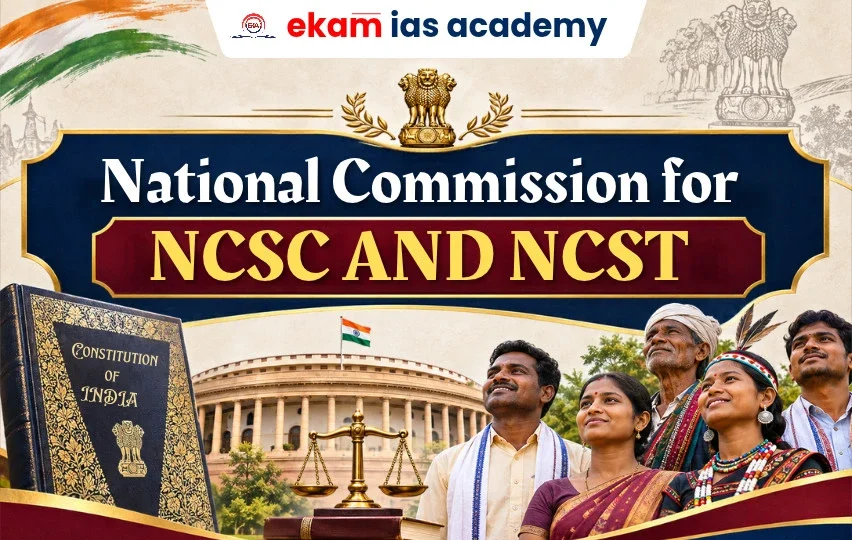
- The National Commission for Scheduled Castes and the National Commission for Scheduled Tribes are premier constitutional bodies established to safeguard the rights and socio-economic interests of marginalized communities.
- Mastering NCSC UPSC and NCST UPSC concepts is vital for civil services candidates preparing for Constitutional Bodies in India, Social Justice in India, and Indian Polity and Governance UPSC modules.
- Operating as institutional watchdogs, the National Commission for SCs and STs investigate complaints of rights violations and monitor constitutional protections across India.
- A comprehensive analysis of the Powers and Functions of NCSC and Powers and Functions of NCST equips candidates with critical insights into affirmative action and inclusive governance.
Constitutional Background
- Article 338 Indian Constitution: Establishes the independent National Commission for Scheduled Castes to monitor legal and constitutional safeguards for SCs.
- Article 338A Indian Constitution: Establishes the separate National Commission for Scheduled Tribes to protect the distinct cultural, land, and forest rights of STs.
- Part XVI Placement: Located under Part XVI of the Constitution (“Special Provisions Relating to Certain Classes”), reflecting the State’s commitment to Constitutional Safeguards for SCs and STs.
- Mandatory Consultation Clause: Requires the Union and every State Government to consult the respective Commission on all major policy matters affecting Scheduled Castes and Scheduled Tribes.
Historical Evolution
- Special Officer (1950): Originally, Article 338 provided for the appointment of a single Special Officer designated as the Commissioner for Scheduled Castes and Scheduled Tribes.
- 65th Constitutional Amendment Act (1990): Replaced the single-member Special Officer system with a high-level, multi-member National Commission for Scheduled Castes and Scheduled Tribes.
- 89th Constitutional Amendment Act (2003): Bifurcated the combined body into two distinct constitutional institutions—NCSC under Article 338 and NCST under Article 338A—effective from 2004.
- Targeted Institutional Focus: Recognised that geographically and culturally distinct challenges of Scheduled Caste Welfare in India and Scheduled Tribe Welfare in India required dedicated oversight mechanisms.
Composition and Appointment
- Five-Member Structure: Both NCSC and NCST consist of a Chairperson, a Vice-Chairperson, and three other Members.
- Presidential Warrant: All members of both Commissions are appointed directly by the President of India by warrant under his hand and seal.
- Service Conditions: The conditions of service and tenure of office of the Chairperson, Vice-Chairperson, and Members are determined by the President by rule (currently fixed at a 3-year term).
- Rank and Status: The Chairperson holds the rank of a Union Cabinet Minister, the Vice-Chairperson holds the rank of a Minister of State, and Members hold the rank of Secretary to the Government of India.
Powers of Civil Court
- Quasi-Judicial Authority: While investigating any matter or inquiring into any complaint, both Commissions possess all the powers of a civil court trying a suit.
- Summoning & Attendance: Empowered to summon and enforce the attendance of any person from any part of India and examine them on oath.
- Discovery & Evidence: Can require the discovery and production of any document, receive evidence on affidavits, and requisition any public record from any court or office.
- Witness Examination: Authorised to issue commissions for the examination of witnesses and documents to ensure thorough fact-finding.
Reporting and Implementation
- Annual & Special Reports: Both Commissions submit an annual report—and special reports whenever deemed necessary—to the President of India regarding the working of constitutional safeguards.
- Parliamentary Tabling: The President causes all such reports to be laid before each House of Parliament along with a memorandum explaining the action taken or proposed to be taken on recommendations, including reasons for non-acceptance.
- State-Level Forwarding: Where any report relates to a matter concerning a State Government, the President forwards a copy to the Governor of the State.
- State Legislature Scrutiny: The Governor places the report before the State Legislature accompanied by an Action Taken Memorandum detailing state-level compliance.
NCSC vs NCST
← Swipe left or right to view the full comparison →
| Comparison Feature | National Commission for Scheduled Castes (NCSC) | National Commission for Scheduled Tribes (NCST) |
|---|---|---|
| Constitutional Article | Article 338 Indian Constitution (Original, amended by 65th & 89th Amendments). | Article 338A Indian Constitution (Inserted by the 89th Amendment Act, 2003). |
| Core Mandate | Safeguards civil, educational, service, and anti-untouchability rights for Scheduled Caste Welfare in India. | Safeguards land alienation, forest rights (FRA), PESA implementation, and displacement issues for Scheduled Tribe Welfare in India. |
| Additional Historical Scope | Previously discharged functions for Anglo-Indians (and OBCs until the 102nd Amendment Act, 2018 established NCBC under Article 338B). | Focuses exclusively on Scheduled Tribes, tribal sub-plans, and Fifth/Sixth Schedule governance frameworks. |
| Composition & Powers | Chairperson, Vice-Chairperson, and 3 Members appointed by the President with Civil Court powers. | Identical 5-member composition appointed by the President with Civil Court powers. |
Conclusion
- The National Commission for Scheduled Castes and National Commission for Scheduled Tribes serve as indispensable pillars of Social Justice in India.
- Empowering these bodies with binding enforcement mechanisms and timely parliamentary action on their reports will further strengthen grassroots rights protection.
- Mastery of Article 338 Indian Constitution, Article 338A Indian Constitution, and their evolutionary trajectory equips civil services aspirants to write analytical, high-scoring answers in Indian Polity and Governance UPSC examinations.
UPSC Prelims: PYQs & Practice Questions
Previous Year Questions (Prelims)
Q: Which one of the following statements with regard to the National Commission for Scheduled Tribes is not correct?
(a) The Union and every State Government shall consult the Commission on all major policy matters affecting Scheduled Tribes.
(b) All the reports of the Commission and its recommendations shall be laid only before Lok Sabha.
(c) The Commission, while investigating any matter, has all the powers of a Civil Court.
(d) The Commission has the power to regulate its own procedures.
Answer: (b) All the reports of the Commission and its recommendations shall be laid only before Lok Sabha
Explanation:
Option (b) is incorrect: Under Article 338A(6), the President causes all reports of the National Commission for Scheduled Tribes (NCST) to be laid before each House of Parliament (both Lok Sabha and Rajya Sabha), along with a memorandum explaining the action taken or proposed to be taken on the recommendations, and the reasons for non-acceptance, if any.
Options (a), (c), and (d) are correct: Under Article 338A, the Union and State Governments must consult the Commission on major policy matters affecting STs; the Commission possesses all powers of a civil court during investigations; and it has constitutional authority to regulate its own procedure.
Q: Consider the following statements:
1. It is the Governor of the State who recognizes and declares any community of that State as a Scheduled Tribe.
2. A community declared as a Scheduled Tribe in a State need not be so in another State.
Which of the statements given above is/are correct?
(a) 1 only
(b) 2 only
(c) Both 1 and 2
(d) Neither 1 nor 2
Answer: (b) 2 only
Explanation:
Statement 1 is incorrect: Under Article 342(1) of the Indian Constitution, it is the President of India (after consultation with the Governor of the concerned State) who specifies the tribes or tribal communities deemed to be Scheduled Tribes in relation to that State or Union Territory. Subsequent inclusions or exclusions can only be made by an Act of Parliament.
Statement 2 is correct: The specification of Scheduled Castes (Article 341) and Scheduled Tribes (Article 342) is state-specific. Therefore, a community recognized as an ST (or SC) in one State need not automatically hold the same status in another State.
Practice Questions
Q: With reference to the National Commission for Scheduled Castes (NCSC) and the National Commission for Scheduled Tribes (NCST), consider the following statements:
1. The 89th Constitutional Amendment Act, 2003 bifurcated the combined National Commission for SCs and STs into two separate constitutional bodies under Articles 338 and 338A.
2. The Chairperson of the NCST must be a retired Judge of the Supreme Court of India.
3. Both Commissions consist of a Chairperson, a Vice-Chairperson, and three other Members appointed by the President by warrant under his hand and seal.
Which of the statements given above are correct?
(a) 1 and 2 only
(b) 1 and 3 only
(c) 2 and 3 only
(d) 1, 2, and 3
Answer: (b) 1 and 3 only
Explanation:
Statement 1 is correct: Originally, Article 338 provided for a Special Officer. The 65th Amendment Act (1990) created a combined multi-member Commission, and the 89th Amendment Act (2003) bifurcated it into NCSC (Article 338) and NCST (Article 338A).
Statement 2 is incorrect: The Constitution does not prescribe that the Chairperson of the NCST (or NCSC) must be a retired Supreme Court Judge. Under the rules framed by the President, the Chairperson is appointed from among eminent socio-political workers or administrators dedicated to tribal welfare.
Statement 3 is correct: Both NCSC and NCST follow an identical five-member composition appointed directly by the President of India.
Q: While investigating any matter or inquiring into any complaint, the National Commission for Scheduled Castes (NCSC) possesses all the powers of a Civil Court trying a suit, which include:
1. Summoning and enforcing the attendance of any person from any part of India and examining them on oath.
2. Requisitioning any public record or copy thereof from any court or office.
3. Passing binding punitive sentences and awarding monetary compensation directly enforceable as a criminal decree.
Which of the statements given above are correct?
(a) 1 and 2 only
(b) 2 and 3 only
(c) 1 and 3 only
(d) 1, 2, and 3
Answer: (a) 1 and 2 only
Explanation:
Statements 1 and 2 are correct: Under Article 338(8), the NCSC has civil court powers to summon witnesses, require discovery/production of documents, receive evidence on affidavits, requisition public records, and issue commissions for witness examination.
Statement 3 is incorrect: While the NCSC exercises civil court powers for the purpose of investigation and inquiry, its final findings and recommendations are advisory/recommendatory in nature. It cannot pass binding judicial decrees or criminal sentences like a regular court of law.
UPSC Mains – Previous Year & Practice Questions
Mains Previous Year Questions
Question: Do constitutional bodies like the National Commission for Scheduled Castes (NCSC) and the National Commission for Scheduled Tribes (NCST) possess adequate enforcement powers to secure substantive social equality? Suggest measures to enhance their institutional effectiveness. (Mains 2026)
Question: Discuss the role of the National Commission for Backward Classes in the wake of its transformation from a statutory body to a constitutional body. (Mains 2022)
Question: Whether the National Commission for Scheduled Castes (NCSC) can enforce the implementation of constitutional reservation for the Scheduled Castes in the religious minority institutions? Examine. (Mains 2018)
Question: Two parallel enforcement mechanisms of the same substantive rights—one under the judiciary and the other under constitutional commissions like NCSC and NCST—often create overlapping jurisdictions. Discuss. (Mains 2014)
Question: Evaluate the effectiveness of the National Commission for Scheduled Tribes (NCST) in safeguarding tribal land and forest rights amidst rapid infrastructure and industrial development. (Mains 2010 – GS Paper II / Public Administration)
Mains Practice Questions
[15 Marks | 250 Words]
Question: Despite enjoying constitutional status under Articles 338 and 338A and civil court powers during inquiries, the recommendatory nature of NCSC and NCST reports limits their ability to curb systemic discrimination. Critically analyze.
[15 Marks | 250 Words]
Question: Examine the rationale behind the 89th Constitutional Amendment Act, 2003, which bifurcated the National Commission for Scheduled Castes and Scheduled Tribes. How has this institutional specialization impacted tribal governance under PESA and the Forest Rights Act?
[10 Marks | 150 Words]
Question: Analyze the significance of the mandatory consultation clause under Articles 338(9) and 338A(9) in ensuring inclusive policy formulation by Union and State Governments.


National Commission for SCs and STs-FAQs
What are the NCSC and NCST?
The National Commission for Scheduled Castes (NCSC) and National Commission for Scheduled Tribes (NCST) are constitutional bodies established under Articles 338 and 338A to safeguard the rights and interests of SCs and STs.
How were the NCSC and NCST established separately?
The 89th Constitutional Amendment Act, 2003 bifurcated the earlier combined commission into two separate bodies: the NCSC under Article 338 and the NCST under Article 338A.
What powers do the NCSC and NCST have?
While investigating complaints, both Commissions have powers of a civil court, including summoning persons, examining them on oath, requiring documents and receiving evidence on affidavits.
Who appoints the members of NCSC and NCST?
The President of India appoints the Chairperson, Vice-Chairperson and other Members of both Commissions by warrant under his hand and seal.
What is the difference between NCSC and NCST?
The NCSC focuses on constitutional safeguards and welfare of Scheduled Castes, while the NCST focuses on the distinct rights and interests of Scheduled Tribes, including tribal land, forest and cultural concerns.