Table of Contents
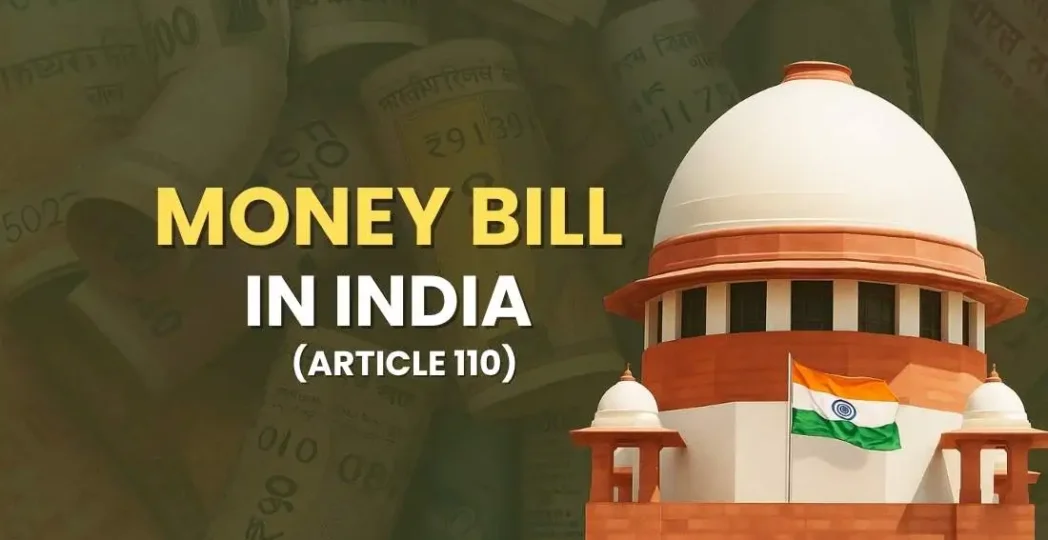
ToggleA Money Bill is a special type of bill that exclusively deals with matters related to the revenue, expenditure, and borrowing of the government, primarily from the Consolidated Fund of India. It is distinct from other bills because of the special procedure it follows in Parliament, particularly concerning the role of the Rajya Sabha.
Constitutional Basis:
- Article 110 of the Constitution of India defines what constitutes a Money Bill.
- A Money Bill can be introduced only in the Lok Sabha (the lower house of Parliament).
Matters Included in a Money Bill (Article 110)
A Money Bill can contain provisions dealing with:
- Imposition, abolition, remission, alteration, or regulation of taxes.
- Appropriation of money from the Consolidated Fund of India.
- Authorization of borrowing by the government.
- Custody or operation of the Consolidated Fund or Contingency Fund of India.
- Declaration of expenditure charged on the Consolidated Fund of India.
- Raising of loans for the government or providing guarantees by the government.
- Any matter incidental to the above items.
Key Note: A bill that contains matters beyond the scope of Article 110 cannot be classified as a Money Bill, even if it deals with financial matters.

Introduction and Passage of Money Bill
Introduction:
- Money Bills can only be introduced in the Lok Sabha with prior recommendation from the President.
- They cannot be introduced in the Rajya Sabha.
Lok Sabha Role:
- The Lok Sabha debates, amends, and passes the Money Bill.
- Majority approval is needed for the bill to move forward.
Rajya Sabha Role:
- After passing in the Lok Sabha, the Money Bill is sent to the Rajya Sabha for consideration.
- The Rajya Sabha cannot amend the bill; it can only make recommendations.
- It must return the bill within 14 days.
President's Assent:
- Once passed by both Houses (considering Rajya Sabha’s recommendations), the Money Bill is sent to the President for assent.
- After receiving assent, it becomes a law.
Key Features of Money Bill
Feature | Description |
Only in Lok Sabha | Can only be introduced in the lower house |
President’s Recommendation | Required before introduction |
Rajya Sabha Role | Can suggest recommendations only; cannot amend or reject |
Time Limit for Rajya Sabha | 14 days to return with recommendations |
Certification | Speaker of Lok Sabha certifies whether a bill is a Money Bill |
Article Reference | Article 110 defines scope; Article 117 outlines procedure; Article 109 relates to joint sitting |
Difference Between Money Bill and Financial Bill
| Feature | Money Bill | Financial Bill |
|---|---|---|
| Definition | Exclusively deals with Article 110 matters | Deals with financial matters, may include non-Money Bill matters |
| Introduction | Only in Lok Sabha | Can be in Lok Sabha or Rajya Sabha |
| Rajya Sabha Role | Only recommendations; cannot amend | Can amend if not classified as Money Bill |
| Speaker’s Role | Speaker certifies Money Bill | No certification required |
| Presidential Recommendation | Mandatory | Mandatory for financial matters, not always for others |
Importance of Money Bill
- Ensures efficient financial governance by prioritizing budget and expenditure matters.
- Prevents unnecessary delays in passing financial legislation due to Rajya Sabha’s limitations.
- Strengthens the principle of collective responsibility, as the government must maintain majority in Lok Sabha for finance-related bills.
- Plays a crucial role in Union budget passage, taxation laws, and government expenditure.
Examples of Money Bills
- Annual Budget (Finance Bill, containing taxation and expenditure proposals)
- Appropriation Bill (authorizing government spending from the Consolidated Fund)
- Tax-related Bills (Income Tax amendments, GST compensation, etc.)
Controversies and Issues
Speaker’s Certification Power:
- Article 110 grants the Speaker absolute authority to certify a Money Bill, which cannot be challenged in court.
- Critics argue this may be misused to bypass Rajya Sabha scrutiny.
Inclusion of Non-Money Matters:
- Sometimes, provisions not strictly under Article 110 are inserted, leading to disputes about the bill’s validity.
- Example: Controversies over GST-related amendments being included in Finance Bills.
Limited Rajya Sabha Power:
- The upper house cannot amend or reject Money Bills, raising concerns about bicameralism and parliamentary checks.
Process of a Money Bill – Step-by-Step (Article 110 & 109)
| Step No. | Stage | Details | Authority Involved |
|---|---|---|---|
| 1 | Recommendation of the President | A Money Bill can be introduced only with the prior recommendation of the President. | President of India |
| 2 | Introduction in Lok Sabha | The Bill can be introduced only in the Lok Sabha (never in Rajya Sabha), and only by a Minister. | Lok Sabha |
| 3 | Consideration & Passage in Lok Sabha | The Lok Sabha debates, amends, and passes the Bill by a simple majority. | Lok Sabha Members |
| 4 | Transmission to Rajya Sabha | After passage, the Bill is sent to Rajya Sabha for recommendations. Rajya Sabha cannot amend or reject it. | Rajya Sabha |
| 5 | Time Limit for Rajya Sabha | Rajya Sabha must return the Bill within 14 days, with or without recommendations. If not returned, it is deemed passed by both Houses. | Rajya Sabha |
| 6 | Lok Sabha’s Decision on Recommendations | Lok Sabha may accept or reject any or all of Rajya Sabha’s suggestions. The decision of Lok Sabha is final. | Lok Sabha |
| 7 | President’s Assent | After passage in Lok Sabha, the Bill is sent to the President for assent. The President cannot return or withhold assent to a Money Bill. | President of India |
| 8 | Becomes an Act | Once the President gives assent, the Money Bill becomes an Act of Parliament and is enforced as law. | President & Government of India |
Key Highlights:
Aspect | Money Bill Provision |
Introduced in | Lok Sabha only |
President’s Recommendation | Mandatory |
Rajya Sabha’s Role | Advisory (14 days to return) |
Speaker’s Certification | Final and binding |
President’s Role | Must give assent; no veto |
Joint Sitting | Not applicable |
Example | Finance Bill, Appropriation Bill |
Prelims Practice Questions
Money Bill – Introduction & Certification
Q: Which of the following statements regarding a Money Bill is/are correct?
- It can be introduced only in the Lok Sabha.
- The Rajya Sabha can suggest amendments which must be accepted by Lok Sabha.
- The Speaker of Lok Sabha certifies a Bill as a Money Bill.
Options:
a) 1 and 2 only
b) 2 and 3 only
c) 1 and 3 only ✅
d) 1, 2 and 3
Money Bill – Rajya Sabha Powers
Q: Consider the following statements:
- Money Bills can be introduced in the Rajya Sabha only with the prior recommendation of the President.
- Rajya Sabha can reject a Money Bill.
Correct Answer: Both are incorrect (Money Bills can be introduced only in Lok Sabha, and Rajya Sabha cannot reject them).
Mains Practice Questions
Money Bill – Constitutional Provisions
Question: Discuss the constitutional provisions related to a Money Bill in India. How does it differ from a Financial Bill?
(UPSC GS Paper 2 – Polity)
Aadhaar Bill & Bicameralism
Question: Critically analyze the implications of certifying the Aadhaar Bill as a Money Bill. Do you think it undermines the spirit of bicameralism?
(UPSC GS Paper 2 – Polity)
Money Bill in India - FAQs Answered
What is a Money Bill in India under Article 110?
A Money Bill is a special type of legislation defined under Article 110 of the Indian Constitution that deals exclusively with matters related to taxation, government expenditure, Consolidated Fund of India, and government borrowing.
Who decides whether a bill is a Money Bill in India?
The Speaker of the Lok Sabha has the final authority to certify a bill as a Money Bill, and this decision cannot be challenged in any court.
Can the Rajya Sabha amend or reject a Money Bill?
No. The Rajya Sabha can only offer recommendations, which the Lok Sabha may accept or reject. The Upper House cannot amend or reject a Money Bill.
Why can Money Bills be introduced only in the Lok Sabha?
Since financial control lies with the Directly Elected House, the Lok Sabha alone can introduce a Money Bill with prior recommendation from the President of India.
What is the difference between a Money Bill and a Financial Bill?
A Money Bill deals strictly with matters listed under Article 110, while a Financial Bill may include financial as well as non-financial provisions. The Rajya Sabha has more powers over Financial Bills than Money Bills.