

Table of Contents
ToggleBATTERY STORAGE AND SOLAR ENERGY IN INDIA
TOPIC: (GS2) POLITY: THE HINDU
Solar energy supplied a record 21.5% of the afternoon load, but its share fell to 10.8% of total daily generation and almost negligible after sunset, underscoring the urgent need to expand battery storage capacity to complement India’s growing solar power.
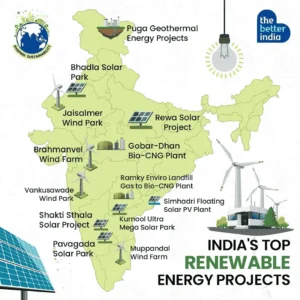
Current Scenario
- Solar Expansion: Share of solar in installed capacity rose from 15% (2022) to 28% (2026). On April 25, 2026, India recorded its highest-ever peak power demand of 256.1 GW.
- Generation Gap: Despite higher capacity, contribution to daily generation remains modest (10.8%).
- Curtailment: In 2025, India curtailed 2.3 TWh of solar power, with 0.9 TWh wasted in October alone.
- Grid Stability: States asked to halt solar supply due to lack of storage, leading to financial losses as producers must be compensated.
Challenge
- Battery Storage Status: Only 0.7 GWh operational by end2025; expected to reach 2 GWh by Dec 2026.
- Tariff Trends: Standalone twohour battery tariffs fell from ₹2.21 lakh/MW/month (early 2025) to ₹1.48 lakh (yearend).
- Execution Gap: Focus remains on tendering, while commissioning and integration lag behind.
Why Storage is Critical
- Day vs Night Demand: Solar peaks in daytime but demand continues into evening.
- Climate Factor: IMD forecast of belownormal monsoon (92% of LPA) implies hotter summers and higher daytime demand.
- Economic Cost: Curtailment wastes resources and burdens the exchequer.
- Reliability: Storage ensures roundtheclock availability, stabilises grid, and reduces dependence on fossil fuels.
Way Forward
- Mandatory Storage Integration: Pair every new solar auction with colocated battery storage.
- Accelerated Commissioning: Shift focus from tendering to execution and commissioning.
- Financing Solutions: Address funding challenges for lowtariff solar projects with storage.
- Policy Push: Provide incentives for battery manufacturing under PLI schemes and promote domestic supply chains.
- StateCentre Coordination: Align state policies with national targets to avoid curtailment.
- Diversified Storage: Explore pumped hydro and hybrid systems alongside batteries.
- Grid Modernisation: Invest in smart grids and digital monitoring for efficient integration.
Conclusion
India’s solar growth is impressive, but without adequate battery storage, it remains a halfbuilt bridge. Strengthening storage capacity is essential to convert solar potential into reliable, roundtheclock power, ensuring energy security, fiscal efficiency, and climate resilience.
GLOBAL RENEWABLE ENERGY MEETING DEMAND & INDIA’S FOSSIL FUEL DEPENDENCE
TOPIC: (GS3) ENVIRONMENT: THE HINDU
In 2025, for the first time, global electricity demand growth was met entirely by renewable energy sources (solar, wind, and others), without increasing fossil fuel generation.
Global Energy Transition
- Renewable Growth: Global electricity generation rose by 850 TWh in 2025. Solar contributed 636 TWh, wind 204 TWh, and other renewables 23 TWh.
- Decline in Fossil Fuels: Coal generation fell by 67 TWh, oil by 12 TWh. First time demand growth did not require fossil fuel expansion.
- Cost Factor: Sharp fall in solar/wind costs and improved battery storage supported transition.
- China’s Role: Electricity demand grew by 5%, clean energy by 15%. Solar grew 40%, wind 14%. Fossil fuel generation fell for the first time since 2015.
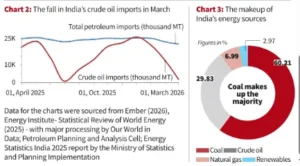
- India’s Role: Fossil fuel generation fell by 3.3% in 2025. Driven by clean power usage and demand growth.
India’s Energy Dependence
- Crude Oil Imports: Fell 17% YoY in March 2026 due to Strait of Hormuz closure.
- Price Impact: Indian basket crude rose to $113.49/barrel (from $72.47 in 2025).
- Natural Gas: Consumption rose 7%, despite domestic production decline (4.9%).
- LNG Imports: Jumped 20.5%, reaching 27 mmt in 202425 (highest ever).
- LPG Imports: Rose to 18 mmt in 202526, driven by nearuniversal household access under PM Ujjwala Yojana.
- Coal Dependence: Despite being world’s 3rd largest producer, India imports 26% of coal.
Challenges
- Renewable buildout takes years; fossil fuels remain critical for shortterm shocks.
- Heavy reliance on West Asia for crude, LNG, and LPG creates strategic vulnerability.
- Curtailment and storage gaps limit renewable utilisation.
Way Forward
- Accelerate Storage Capacity: Pair renewable projects with battery and pumped hydro storage.
- Diversify Import Sources: Reduce dependence on West Asia by exploring Africa, Americas, and domestic expansion.
- Strengthen Domestic Production: Boost coal efficiency, expand gas infrastructure, and incentivise renewable manufacturing.
- Policy Push: Ensure faster commissioning of renewable projects, not just approvals.
- Consumer Protection: Cushion households against LPG and fuel price shocks through subsidies and efficiency schemes.
Conclusion
For India, however, import dependence on conflictprone regions remains a major vulnerability. Bridging this gap requires storage expansion, diversification, and stronger domestic energy security.
INDIA’S ENERGY SECURITY AMID CONFLICTS
TOPIC: (GS3) ECONOMY: THE HINDU
The West Asia conflict has disrupted global oil supply chains, exposing India’s heavy dependence on crude imports (over 85% of needs) and highlighting the importance of diversification and resilience in energy security.
India’s Energy Dependence
- High Import Reliance: India imports ~89% of crude oil, 47% of natural gas, and 26% of coal.
- Strait of Hormuz Risk: About 45% of India’s crude imports transit through this chokepoint, making disruptions highly impactful.
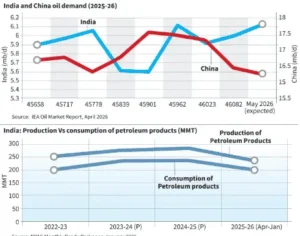
- Domestic Production: Only 28.7 million metric tonnes of crude produced in FY202425, insufficient to meet demand.
- Macroeconomic Impact: Brent crude rose to $109/barrel; India’s GDP growth projected to slow from 7.4% (FY26) to 6.5% (FY27), with inflation rising from 2.3% to 4.4%.
Breakdown of Old Energy Order
- RussiaUkraine War: Exposed Europe’s dependence on pipeline gas; EU reduced Russian gas reliance from 45% (2021) to 12% (2025).
- West Asia Conflict: Showed vulnerability of seabased oil transport through Hormuz.
- Global Adaptations:
- China secured longterm LNG contracts (~25 mmt annually).
- South Korea arranged crude flows outside Hormuz.
- Japan stockpiled 470 million barrels (254 days of consumption).
India’s Tactical Gains
- Diversified Basket: Imports from Iraq, Saudi Arabia, UAE, Russia, and USA.
- Russian Oil Shift: From 2% (pre2022) to 36% of imports by FY202425.
- Demand Growth: India projected to consume 5.99 mb/d in 2026, becoming a key driver of global oil demand.
- Operational Measures: Naval escorts under Operation Sankalp ensured LPG carrier safety during Gulf tensions.
Structural Risks
- Geographic Constraints: Diversification cannot bypass chokepoints like Hormuz.
- Energy Transition Risks: Expansion into solar, EVs, and batteries reduces oil use but increases dependence on critical minerals (lithium, cobalt, nickel, rare earths).
- Mineral Processing Gap: China controls 91% of rareearth production; India processes <5% of projected 2035 batterygrade needs.
Way Forward
- Expand Strategic Reserves: Build larger oil and gas reserves to cushion shocks.
- Reduce Oil Intensity: Promote EVs, public transport, and efficiency in industry.
- Maritime Resilience: Strengthen naval capacity to secure sea lanes.
- Critical Mineral Security: Invest in domestic mining and processing; diversify supply chains beyond China.
- Balanced Transition: Ensure renewable expansion is paired with storage and grid resilience.
Conclusion
India’s energy security lies not in selfsufficiency, but in flexibility and diversification. While tactical gains have cushioned shocks, longterm resilience requires stronger reserves, reduced oil intensity, and secure supply chains for both fossil fuels and critical minerals.
ELECTRONIC GOLD RECEIPTS (EGRS)
TOPIC: (GS3) ECONOMY: THE HINDU
The National Stock Exchange (NSE) has recently launched Electronic Gold Receipts (EGRs) as a new trading segment, offering investors a transparent and standardised way to trade gold digitally.
About Electronic Gold Receipts
- Definition: EGRs are dematerialised securities representing ownership of physical gold.
- Storage: The underlying gold is kept in SEBIregulated vaults.
- Holding: Investors hold EGRs in their demat accounts, similar to shares or ETFs.
- Vault Manager: A new SEBIregistered entity provides vaulting services for deposited gold.
- Authenticity: Each EGR is backed by actual gold, ensuring trust and standardisation.

Working of EGRs
- Physical gold is deposited in accredited vaults.
- Converted into EGR units, credited to the investor’s demat account.
- Units can be traded on the exchange like other securities.
- Investors can reconvert EGRs into physical gold, offering flexibility between digital and physical ownership.
Participants in the Ecosystem
- Jewellers and refiners
- Traders and brokers
- Retail investors
- Institutional investors
Significance
- Promotes transparent gold trading and reduces blackmarket transactions.
- Enhances financial inclusion by allowing small investors to access gold digitally.
- Supports formalisation of the gold market under SEBI regulation.
- Provides flexibility and liquidity, bridging the gap between physical and financial gold.
Conclusion
Electronic Gold Receipts mark a modern reform in India’s gold market, combining the trust of physical gold with the efficiency of digital trading. This initiative strengthens transparency, investor confidence, and integration of gold into the formal financial system.

ASIAN DEVELOPMENT BANK (ADB)
TOPIC: (GS3) ECONOMY: THE HINDU
The Asian Development Bank (ADB) has announced a $70 billion programme to expand energy and digital infrastructure across the AsiaPacific region by 2035, marking a major push for regional development.
About ADB
- Established: 19 December 1966.
- Nature: Multilateral development finance institution for the AsiaPacific region.
- Vision: A prosperous, inclusive, resilient, and sustainable AsiaPacific, with focus on poverty eradication.
- Membership: 69 countries (50 regional, 19 nonregional).
- Headquarters: Manila, Philippines.
Governance
- Board of Governors: One representative from each member; top policymaking body.
- Board of Directors: 12 directors (8 regional, 4 nonregional).
- President: Chairs the Board of Directors and manages ADB.
- Voting System: Weighted by capital contribution.
- Key Shareholders: Japan & USA (15.6% each), China (6.4%), India (6.3%), Australia (5.8%).
Functions
- Loans & Grants: For infrastructure, social sectors, and environment.
- Technical Assistance: Advisory services for governance and policy reforms.
- Regional Cooperation: Funds crossborder projects, promotes trade and investment.
- Private Sector Support: Provides financing, guarantees, and equity for socially beneficial projects.
Conclusion
The ADB plays a critical role in regional development financing, balancing infrastructure growth with sustainability. Its new programme signals deeper investment in energy transition and digital connectivity, strengthening AsiaPacific’s resilience and integration.
PROJECT DEEPAK (BRO)
TOPIC: (GS3) SEQURITY: THE HINDU
The Border Roads Organisation’s Project Deepak celebrated its 66th Raising Day at Shimla, Himachal Pradesh, highlighting its long service in building strategic infrastructure in border regions.
Project Deepak
- Initiation: Started in 1962 under the Border Roads Organisation (BRO).
- Objective: To construct and maintain critical roads and infrastructure in challenging terrains of Himachal Pradesh.
- Area of Responsibility: Covers districts like Shimla, Kinnaur, Kullu, and LahaulSpiti.
Achievements
- Among the oldest BRO projects, vital in developing:
- HindustanTibet Road.
- Key stretches of the ManaliLeh axis.
- Played a major role in disaster relief and humanitarian assistance during natural calamities.
- Strengthened connectivity in remote border areas, supporting both civilian needs and defence logistics.
Border Roads Organisation
- Establishment: Formed on 7 May 1960 to secure borders and develop infrastructure in remote northern and northeastern regions.
- Nature: Road construction executive force supporting the Indian Armed Forces.
- Ministry: Brought fully under the Ministry of Defence in 2015.
- Scope: Builds and maintains road networks in border areas and friendly neighbouring countries.
- Motto: Shramena Sarvam Sadhyam — “Everything is achievable through hard work.”
Conclusion
Project Deepak exemplifies BRO’s role in nationbuilding and border security, combining infrastructure development with humanitarian service. Its legacy in Himachal Pradesh reflects India’s commitment to strategic connectivity and resilience in highaltitude regions.
CORPORATISATION OF MAJOR PORTS AND REFORMING INDIA’S PORT GOVERNANCE
TOPIC: (GS3) ECONOMY: THE HINDU
India’s maritime sector, which carries 95% of trade by volume and 70% by value, is being restructured under the Major Port Authorities Act, 2021 to introduce corporatised governance for greater efficiency and competitiveness.
Corporatisation of Major Ports
- Shift in Governance Model: Moves ports from the old Port Trust system (1963 Act) to a corporatised structure (2021 Act).
- Not Privatisation: Ports remain publicly owned, but gain commercial autonomy and professional management.
- Legal Basis: Introduced through the Major Port Authorities Act, 2021.
Key Features
- Commercial Autonomy: Ports can make faster decisions on tariffs, investments, and operations without bureaucratic delays.
- Financial Flexibility: Corporatised ports can raise funds from markets, enter PublicPrivate Partnerships (PPPs), and mobilise investment.
- Professional Management: Boards function like corporate boards, ensuring efficiency and accountability.
- Integration with Logistics: Ports evolve into multimodal logistics hubs, connected with rail, road, and digital systems.
- Global Competitiveness: Aligns Indian ports with international best practices (e.g., Rotterdam, Singapore).
Objectives
- Improve operational efficiency and reduce delays.
- Enhance global competitiveness in shipping and logistics.
- Attract private and institutional investment.
- Support national programmes like Sagarmala, PM Gati Shakti, and National Logistics Policy.
Limitations of Old Model
- Governed by Major Port Trusts Act, 1963.
- Problems:
- Bureaucratic delays in decisionmaking.
- Limited financial autonomy.
- Slow pace of infrastructure expansion.
- Inability to compete with private ports.
- Weak integration with modern logistics chains.
Case Study – Kamarajar Port (Ennore, Tamil Nadu)
- Corporatised in 2001.
- Achievements:
- Higher efficiency.
- Better mobilisation of investment.
- Stronger strategic decisionmaking.
- Became a model for sectoral reforms.
Rationale for Corporatisation
- Global Competitiveness: Ports must function as multimodal hubs with digital integration.
- Financial Autonomy: Access to capital markets and PPPs for deepwater berths, terminals, and IT systems.
- Faster Decisions: Reduced bureaucracy in tariffs, investments, and operations.
- National Alignment: Supports Sagarmala, PM Gati Shakti, National Logistics Policy.
Global Best Practices
- Rotterdam (Netherlands): Corporatised public entity balancing efficiency with state oversight.
- PSA International (Singapore): Governmentlinked corporation, global leader in port operations.
- UK Model: Fully privatised, efficient but less suited for strategic infrastructure control.
Challenges
- Workforce Resistance: Employees fear job insecurity and loss of benefits under corporatised governance.
- Skill Deficit: Lack of expertise in automation, digital logistics, and modern port technologies.
- Profit vs Public Interest: Risk that commercial motives may overshadow social and strategic responsibilities.
- Transparency Issues: Greater autonomy may weaken accountability unless strong oversight is ensured.
Way Forward
- Inclusive Reform: Engage workers in decisionmaking, safeguard benefits, and build trust.
- Capacity Building: Invest in training, reskilling, and digital literacy to prepare workforce for modern logistics.
- Robust Regulation: Establish clear checks and balances to maintain transparency and accountability.
- PPP Synergy: Encourage private participation through PPP models while retaining strategic control.
- Technology Integration: Adopt automation, AI, and digital platforms to enhance efficiency and global competitiveness.
Conclusion
By combining public ownership with commercial flexibility, it enhances efficiency, attracts investment, and integrates India into global supply chains. Success depends on careful implementation, workforce inclusion, and robust oversight.
SILENCING ACADEMIA AND DEMOCRATIC EROSION IN INDIA
TOPIC: (GS2) POLITY: THE HINDU
Global reports such as VDem 2026 and Scholars at Risk 2024 highlight India’s decline in democratic freedoms and classify academic freedom as “completely restricted,” raising concerns about shrinking space for dissent in universities and civil society.
Global Assessments
- VDem 2026 Report: India ranked as an “electoral autocracy.” Notes decline in free expression, media independence, and civil society space.
- Scholars at Risk Report (2024): Academic freedom in India marked as “completely restricted.” Universities face political interference, curriculum changes, and reduced autonomy.
- Aligns with other indices like Freedom House, showing democratic erosion.
Academic Freedom and Democracy
- Universities are meant to be spaces of inquiry and debate.
- Shrinking autonomy weakens democracy by limiting: Critical thinking and evidencebased debate. Civil society’s capacity to hold leaders accountable.
- Proposed Viksit Bharat Shiksha Adhishthan Bill centralises control, prioritising conformity over free inquiry.
Disturbing Trends
- Punitive Actions: 62 academics penalised (2014–26) for opinions or political stances.
- Suppression: Events disrupted, faculty/student arrests, visa hurdles for foreign scholars.
- Institutional Failure: Oversight committees often symbolic, failing to protect rights.
- Selfcensorship: Fear and regulatory pressure erode trust and autonomy.
Wider Democratic Concerns
- Civil Society Impact: Weakening of universities undermines accountability and pluralism.
- Human Rights Dimension: India is party to ICCPR (1979) but refuses to sign the First Optional Protocol, denying citizens access to UN complaint mechanisms.
- Judicial Asymmetry: Cases like Umar Khalid and Sharjeel Imam show harsh treatment of dissenters, while leniency is extended to powerful figures accused of serious crimes.
Cost of Homogenisation
- Higher education thrives on pluralism and dissent.
- Suppressing diverse thought leads to authoritarian drift within democracy.
- Academic Freedom Index decline reflects erosion of democratic accountability.
- Conditioning of society through fear and conformity gradually dismantles freedoms.
Significance of Academic Freedom
- Pillar of Democracy: Academic freedom is not confined to universities; it is a core democratic value that sustains pluralism and accountability.
- Strengthening Civil Society: Silencing scholars and students weakens civil society’s ability to question power, reducing checks on governance.
- EvidenceBased Policymaking: Free inquiry ensures datadriven and rational policymaking, vital for inclusive development.
- Pluralistic Debate: Protecting academic spaces nurtures diverse viewpoints and critical thinking, essential for democratic resilience.
Way Forward
- Legal Safeguards: Strengthen statutory protections for academic freedom, aligning with Articles 19 and 21 of the Constitution.
- Institutional Autonomy: Ensure universities have independent governance structures, free from political interference.
- Strengthening Oversight: Make internal complaints committees and regulatory bodies functional and accountable, not symbolic.
- International Commitments: Consider adopting mechanisms like the ICCPR Optional Protocol to allow global redress for rights violations.
Conclusion
The erosion of academic freedom in India mirrors the broader democratic decline, where dissent is criminalised and institutions fail to protect rights. Safeguarding universities as spaces of free thought is vital to revitalise democracy and preserve pluralism.