

Table of Contents
ToggleUNDERSTANDING INEQUALITY IN INDIA’S GROWTH STORY
TOPIC: (GS3) ECONOMY: THE HINDU
Recent policy changes such as the new Labour Codes and the Viksit BharatGuarantee for Rozgar and Ajeevika Mission (Gramin) Bill, 2025 replacing MGNREGA have raised concerns about the welfare of informal workers and rural households.
Inequality Estimates
- Measurement Issues: Inequality can be assessed by income, wealth, or consumption, across axes like caste, class, gender, and religion.
- HCES 202324 Findings:
- Gini Index: 0.29 (higher than World Bank’s 0.25).
- Urban vs Rural: Urban inequality > Rural inequality.
- Food vs NonFood: Nonfood expenditure shows higher inequality.
- UrbanRural Gap:
- Urban nonfood MPCE ≈ 1.5 times the allIndia average.
- Rural nonfood MPCE much lower than national average.
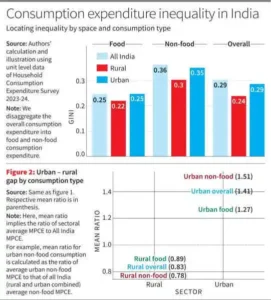
DecileBased Analysis
- Urban Sector: Top 10% contributes 27% of nonfood expenditure. Mean MPCE of top decile ≈ 6 times bottom decile.
- Rural Sector: Mean MPCE of top decile ≈ 4.5 times bottom decile.
- CrossComparison: Urban top decile ≈ 9 times rural bottom decile.
- Richest vs Poorest: Richest 5% spend ≈ 6 times poorest 5% in rural areas. Richest 5% spend ≈ 9 times poorest 5% in urban areas.
- Decomposition: Urban food inequality: 33% withindecile, 67% betweendecile. Urban nonfood inequality: 10% withindecile, 90% betweendecile.
Inequality Dynamics in India
- Survey Limitations: NSS surveys underrepresent the superrich, leading to underestimation.
- Surprising Findings: Even among the richest 10%, some benefited from PMGKY and held BPL ration cards.
- ClassBased Inequality: Urban owners, managers, professionals gained disproportionately since the 1980s. Informal workers, small farmers, and agricultural labourers lagged behind.
- DebtLed Consumption: A large share of households rely on borrowing to sustain consumption.
- Policy Blind Spots: Assuming inequality is low may lead to misguided welfare policies.
Conclusion
India’s growth story is marked by persistent and widening inequality, While reforms aim at efficiency, ignoring inequality risks deepening social divides. A nuanced approach considering class, caste, and ruralurban disparities is essential to ensure that growth translates into inclusive development.
FIXING STRUCTURAL DEFICITS IN INDIA’S HEALTH SYSTEM
TOPIC: (GS2) SOCIAL JUSTICE AND HEALTH: THE HINDU
On March 11, 2026, the Minister of State for Health announced the establishment of 43 new medical colleges and approval of 11,682 MBBS seats and 8,967 postgraduate seats for 202526.
Medical Education & Deployment
- Distribution of Colleges: 27 private, 8 staterun, 8 ESI sector. Private colleges charge high fees and have no obligation to serve in government hospitals.
- Vacancies in AIIMS: 11 out of 18 AIIMS report ~40% faculty vacancies, affecting teaching and research.
- Mismatch: More seats created, but specialist posts remain vacant in public health institutions.
Specialist Shortage in Rural Health System
- Community Health Centres (CHCs): Serve ~1.6–2 lakh population, expected to have 30 beds + 5 specialists. Vacancy rate is 79.9% (only 4,413 specialists vs requirement of 21,964).
- Persistent Shortfall: Since 2014, ~17,500 specialist posts remain unfilled despite 72,627 PG seats across 731 colleges.
- Reasons for Reluctance: Lack of equipment, housing, schools, peer support. Poor working conditions in remote areas.
- Operational Reality: With current specialists, only 882 CHCs can function fully — effectively one per district.
Budgetary & Policy Gaps
- Focus on Infrastructure: Central health budget prioritises construction of CHCs.
- Neglect of Operations: Limited funds for drugs, diagnostics, ambulances, emergency care, and staff salaries.
- Result: New CHCs often function like primary health centres, failing to deliver specialist care.
Suggested Reforms
- Classification of Facilities: Categorise PHCs/CHCs into normal, difficult, and most difficult areas (like Chhattisgarh’s Rural Medical Corps).
- Incentives for Difficult Areas: Extra allowances, housing, schooling facilities. Priority for PG seats.
- Link PG Seats to Vacancies: Governmentsponsored PG admissions tied to specialist posts in CHCs/district hospitals.
- Service Bonds: Doctors to commit to 10year service in difficult areas with incentives under NHM.
- Team Deployment: Follow “all or none” principle — post all 5 specialists together, not piecemeal.
Conclusion
Real reform requires linking education with service obligations, incentivising rural postings, and prioritising operational outcomes over mere infrastructure. Only then can public health institutions deliver equitable care to the poor and marginalised.
KARNATAKA’S NEW GIG WORKER GRIEVANCE SYSTEM
TOPIC: (GS2) POLITY: THE HINDU
On May 1, 2026 (Labour Day), Karnataka launched India’s first governmentbacked grievance redressal system for gig workers, allowing them to lodge complaints through the Integrated Public Grievance Redressal System (IPGRS).
How the System Works
- Gig workers can file complaints on IPGRS, covering pay disputes, account blocking, termination, penalties, or unsafe conditions.
- Complaints are routed to the platform’s Internal Dispute Resolution Committee (IDRC).
- Timeline: Resolution attempt within 15 working days. Final order within 45 days.
- Appeal: If dissatisfied, workers can escalate to the Karnataka Gig Workers Welfare Board within 30 days.
Issues Workers Can Raise
- Suspension, blocking, or deactivation of accounts.
- Termination or unfair penalties.
- Delayed or reduced payments.
- Discrimination or unsafe working conditions.
- Violation of rights under the Karnataka Gig Workers Act, 2025.
Gap Addressed
- Earlier, platforms had internal grievance systems but lacked transparency and legal backing.
- Workers often reported no resolution or platforms ignoring complaints.
- The new system ensures structured, monitored, and legally enforceable redressal.
Why Now?
- Act Notified: Karnataka Gig Workers (Social Security & Welfare) Act, 2025 (September 2025).
- Rules Enacted: March 2026 — Karnataka became the first state to notify rules.
- Grievance mechanism is a core part of the Act, aimed at preventing arbitrary terminations and protecting worker rights.
Other Key Developments
- Welfare Board: Constituted in January 2026 to oversee gig worker benefits.
- Data Collection: Platforms must submit worker details (name, Aadhaar, UAN, bank account).
- Coverage: 12 platforms have registered ~12 lakh workers (numbers may overlap).
- Unique IDs: Planned to avoid duplication.
- Welfare Fee: 1% of every transaction collected from platforms for social security.
Use of Welfare Fee
Funds go to the Gig Workers’ Welfare Fund to provide:
- Life insurance.
- Accidental and disability benefits.
- Medical and maternity benefits.
- Oldage protection schemes.
- Benefits tailored to the nature of gig work.
Conclusion
By combining legal recourse, welfare funding, and structured dispute resolution, it addresses longstanding gaps in worker rights. This model could serve as a template for other states, ensuring gig workers are not left outside the social security net.
WHEN DOES A CHIEF MINISTER CEASE TO HOLD OFFICE
TOPIC: (GS2) POLITY: THE HINDU
After the West Bengal Assembly elections (May 2026), Mamata Banerjee announced she would not resign as CM despite defeat, alleging irregularities. This raised questions about the Governor’s powers, floor tests, Assembly tenure, and election challenges.
Appointment & Removal of CM
- Article 164(1): CM is appointed by the Governor; ministers hold office “during the pleasure of the Governor.”
- Interpretation: On paper, Governor seems to have removal power. But in practice, CM holds office only so long as they enjoy majority support in the Legislative Assembly.
- Constituent Assembly Debate: Mohammad Ismail Khan suggested replacing “pleasure” with “confidence of Assembly.” Dr. B.R. Ambedkar clarified that parliamentary systems worldwide imply this principle.
- Supreme Court View: Governor acts on aid and advice of Council of Ministers. Example: A.G. Perarivalan v. State (2022) — Governor is only a formal head, bound by ministerial advice.
Floor Test Requirement
- If Governor doubts CM’s majority, a floor test in Assembly is required.
- CM must prove majority support; failure → resignation.
- If no stable government possible → President’s Rule under Article 356.
Assembly Tenure & Dissolution
- Article 172: Assembly lasts five years from first sitting unless dissolved earlier.
- After expiry, Assembly dissolves automatically.
- With dissolution, CM and Council of Ministers cease to hold office.
- Example: Current West Bengal Assembly (May 2021–May 2026) ends on May 7, 2026 → CM automatically demits office.
Election Challenges
- Representation of the People Act, 1951 (Section 100):
- Election can be challenged in High Court within 45 days of result.
- Grounds: corrupt practices, violation of statutory provisions, irregularities by returning officer.
- Writ Petition: Maintainable if challenge concerns integrity of electoral process (e.g., arbitrary voter deletions).
Key Takeaways
- Governor cannot arbitrarily remove a CM; removal depends on loss of majority.
- Floor test is the constitutional mechanism to prove majority.
- CM automatically ceases to hold office once Assembly tenure ends.
- Election results can be challenged legally through election petitions or writs.
Conclusion
The Governor’s role is largely formal, ensuring constitutional procedures like floor tests and Assembly dissolution are followed, while disputes over elections are settled in courts.
GAPS IN WARTIME ENVIRONMENTAL PROTECTION
TOPIC: (GS3) ENVIRONMENT: THE HINDU
The term “ecocide” has resurfaced amid the West Asia conflict, with Lebanon and Iran accusing Israel of causing severe environmental destruction. This has reignited debate on whether ecocide should be recognised as an international crime under the International Criminal Court (ICC).
Meaning & Origin of Ecocide
- Definition: Largescale environmental destruction causing longterm ecological harm.
- Contexts: Industrial disasters, warrelated damage, ecosystem devastation.
- First Recognition: Vietnam (1990) included ecocide in domestic law.
- Other Countries: Russia, Ukraine, France, Belgium, Chile have similar provisions.
- Proposed International Definition (2021): Reckless acts knowingly causing severe, widespread, or longterm damage.
Current International Law Framework
- Rome Statute (ICC): Environmental harm recognised as war crime if it directly affects humans.
- Geneva Conventions: Prohibit warfare methods causing major ecological damage.
- ENMOD Convention: Bans deliberate manipulation of natural processes.
- State Responsibility: Crossborder pollution (e.g., rivers) can violate sovereignty obligations.
How Ecocide Differs
- Existing Laws: Anthropocentric — focus on human harm.
- Ecocide Concept: Environment itself treated as a victim deserving independent protection.
- Aim: Accountability for ecological destruction even without immediate human suffering.
Limitations of Current Law
- Partial Coverage: Rome Statute applies mainly in wartime, not peacetime disasters.
- Jurisdiction Issues: Countries like Iran & Lebanon not ICC members → prosecution difficult.
- No Direct Criminal Liability: Most environmental treaties lack enforcement mechanisms.
- Amendment Challenge: Adding ecocide to Rome Statute requires 2/3 majority approval of ICC members.
Enforcement Challenges
- Absence of Prosecutions: No successful cases have yet been pursued for environmental destruction during armed conflicts.
- Dependence on Political Will: Implementation of international law relies heavily on the cooperation of powerful states.
- Symbolic Risk: Without strong enforcement mechanisms, recognition of ecocide may remain largely declaratory rather than effective.
Significance of Recognition
- Sets Legal & Ethical Norms: Establishes clear international standards against largescale environmental destruction.
- Discourages Impunity: Acts as a deterrent to arbitrary or unchecked ecological harm.
- Restrains State Actions: Prevents governments from justifying environmentally destructive measures under the guise of legitimacy.
- Strengthens Global Law: Builds momentum for advancing stronger and more comprehensive international environmental protections.
Growing Global Recognition
- IUCN: Passed motions recognising ecocide as a crime.
- Council of Europe (2025): Adopted Convention on Protection of Environment through Criminal Law — first binding treaty criminalising largescale ecological destruction.
- Allows European courts to prosecute even extraterritorial crimes.
Conclusion
While current laws focus on human harm, ecocide seeks to protect ecosystems directly. Recognition under international law would be a symbolic and normative step, but its success depends on global consensus and enforcement mechanisms.
INDIA’S ENERGY SECURITY AMID GLOBAL CONFLICTS
TOPIC: (GS3) ECONOMY: THE HINDU
Geopolitical tensions in West Asia have disrupted global oil supply chains, exposing India’s import dependence (85% crude oil) and raising concerns about inflation, growth slowdown, and overall energy security.
Introduction
- India’s energy security is vulnerable due to high import dependence.
- Conflicts raise Brent crude prices, impacting GDP and inflation.
- Energy security now means resilience and diversification, not just affordability.
Changing Definition of Energy Security
- Earlier: Access to affordable fuel.
- Now includes:
- Resilience against supply shocks.
- Diversification of suppliers/routes.
- Macroeconomic stability amid volatility.
- Example: Europe reduced reliance on Russian gas (45% → 12%) postUkraine war, showing shift to “insurancebased” planning.
Impact of West Asia Conflict on India
- Strait of Hormuz Dependence: Nearly 25% of global oil passes through this chokepoint; India sources ~45% of its crude via this route.
- Economic Fallout: Supply disruptions trigger inflationary pressures and slow GDP growth.
- Security Example: Indian LPG carriers required naval escort under Operation Sankalp during heightened tensions.
Diversification of Imports
- Russian Oil Surge: Share rose from 2% (pre2022) → 36% (FY202425).
- Other Suppliers: Iraq, Saudi Arabia, UAE, and the U.S. remain important partners.
- Strategic Flexibility: India follows a policy of “optionality” — switching suppliers based on geopolitical and economic conditions.
Structural Challenges
- High Import Dependence: Crude oil reliance reached 89.4% in FY202425, leaving India exposed to global price swings.
- Geographic Constraints: Maritime chokepoints like the Strait of Hormuz limit India’s flexibility despite diversification.
- Energy Transition Risks:
- Heavy reliance on critical minerals (lithium, cobalt, nickel).
- China controls >90% of rare earth processing capacity.
- India’s domestic processing capacity is <5% of projected needs by 2035.
Global Comparative Strategies
- China: Longterm LNG contracts (~25 MMT annually).
- South Korea: Secured oil supplies bypassing chokepoints.
- Japan: Strategic reserves covering 254 days of consumption.
- India lags in stockpiling and longterm planning.
Strategic Path Forward for India
- Expand Strategic Petroleum Reserves (SPR): Build larger emergency buffers to withstand supply shocks and price volatility.
- Promote Clean Mobility: Encourage adoption of electric vehicles (EVs), strengthen public transport, and improve fuel efficiency standards.
- Enhance Maritime Security: Strengthen naval presence and capabilities to safeguard critical trade routes and energy shipments.
- Strengthen Supply Chain Resilience: Reduce overdependence on single countries by diversifying sources and building flexible, multicountry energy partnerships.
Conclusion
A multidimensional strategy combining reserves, clean energy, maritime security, and critical mineral development is essential to safeguard India’s economy and ensure longterm resilience.
SAMARTH PANCHAYAT PORTAL
TOPIC: (GS2) GOVERNANCE: THE HINDU
The central government is expanding the Samarth Panchayat Portal to states like Assam, Uttar Pradesh, and Maharashtra, aiming to strengthen digital governance and financial autonomy of Panchayati Raj Institutions.
Samarth Panchayat Portal
- Unified Digital Platform: Designed to empower Panchayats with modern governance tools.
- Objective: Digitally enable Panchayats to collect and monitor Own Source Revenue (OSR) efficiently.
- Functions:
- Provides seamless access to services.
- Enhances transparency in local administration.
- Simplifies processes for citizens and officials.
- Outcome: Strengthens Panchayat finances and improves grassroots governance.
- Nodal Ministry: Ministry of Panchayati Raj.
Own Source Revenue (OSR) of Panchayats
- Definition: Revenue generated by Gram Panchayats from local sources such as:
- Taxes.
- Service charges.
- Rents and leases.
- Fees.
- Significance:
- Provides financial independence to Panchayats.
- Enables investment in infrastructure, water supply, sanitation, and public spaces.
- Improves delivery of services and quality of life at the village level.
Significance of the Portal
- Financial Empowerment: Helps Panchayats strengthen OSR collection and reduce dependence on higher government grants.
- Transparency: Digital monitoring reduces leakages and ensures accountability.
- Citizen-Centric Governance: Simplifies access to services, making Panchayat administration more responsive.
- Grassroots Development: Supports better planning and execution of local projects.
Conclusion
The Samarth Panchayat Portal is a step toward digitally empowered local governance, ensuring Panchayats can mobilise their own resources effectively. By strengthening OSR and transparency, it enhances financial autonomy, service delivery, and grassroots development.
MAHI RIVER
TOPIC: (GS1) GEOGRAPHY: THE HINDU
Recently, a boat capsized in the Mahi River in Rajasthan’s Banswara district, leaving two persons, including a child, missing. This incident has brought the river into focus.
Mahi River
- Type: One of the major westflowing interstate rivers of India.
- States Covered: Flows through Madhya Pradesh, Rajasthan, and Gujarat.
- Popular Name: Often called “Mahisagar” due to its vastness.
- Total Length: Around 583 km.
- Basin Boundaries:
- Aravalli Hills (north & northwest).
- Malwa Plateau (east).
- Vindhya Range (south).
- Gulf of Khambhat (west).
Course of the River
- Origin: Northern slope of the Vindhya Mountains in Madhya Pradesh.
- Flow Path:
- Travels ~120 km southwards in Madhya Pradesh.
- Enters Vagad region of Rajasthan.
- Makes a Ushaped loop in Rajasthan.
- Finally drains into the Arabian Sea via a wide estuary near Khambhat (Gujarat).
Tributaries
- Major tributaries include: Eru, Nori, Chap, Som, Jakham, Moran, Anas, Panam, and Bhadar.
Dams on Mahi River
- Mahi Bajaj Sagar Dam (Rajasthan).
- Kadana Dam (Gujarat).
- Panam Dam (Gujarat).
- These are crucial for water storage, irrigation, and power generation.
Significance
- The river’s silt has contributed to the narrowing of the Gulf of Khambhat, leading to decline of onceflourishing ports.
- Despite its size, the riverbed lies lower than land level, limiting irrigation potential.
- Plays an important role in regional water management and ecology.
Conclusion
The Mahi River is a vital westflowing river linking three states, with ecological and economic importance. While its dams aid water management, challenges like limited irrigation use and silt deposition highlight the need for sustainable river basin planning.