

Table of Contents
ToggleCRIME IN INDIA 2024 NCRB REPORT
TOPIC: (GS2) POLITY: THE HINDU
The National Crime Records Bureau (NCRB) released its Crime in India 2024.
Overall Crime Trends
- Total Cases: 58.86 lakh cognisable crimes in 2024 (↓6% from 62.41 lakh in 2023).
- Crime Rate: Declined from 448.3 (2023) to 418.9 (2024) per lakh population.
- Breakdown:
- 35.44 lakh under IPC/BNS.
- 23.41 lakh under Special & Local Laws.
- Interpretation: Decline reflects better enforcement, but digital crimes offset gains.
Cybercrime – Fastest Growing Threat
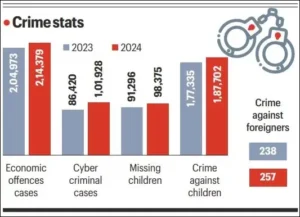
- Cases: ↑17.9% from 86,420 (2023) to 1,01,928 (2024).
- Rate: 7.3 per lakh population (vs. 6.2 in 2023).
- Motives:
- Cyber fraud – 72.6% (73,987 cases).
- Sexual exploitation, extortion, defamation, revenge.
- State Trends: Telangana (27,230) highest; Karnataka (21,003) next.
- Metro Cities: ~35,000 cases.
- Burden: 1.2 lakh pending investigations; 75,000 pending trials.
- Key Point: Cybercrime is India’s emerging security challenge.
Economic Offences
- Rise: ↑4.6% to 2,14,379 cases (2024).
- Major Component: Forgery, cheating & fraud – 90% (1,92,382 cases).
- Implication: Growth of online scams, weak consumer protection, need for stronger fintech regulation.
Crimes Against Women
- Cases: Slight decline from 4.48 lakh (2023) to 4.41 lakh (2024).
- Rate: 64.6 per lakh women (vs. 66.2 in 2023).
- Categories: Domestic cruelty, kidnapping, crimes against minors, sexual assault.
- Issue: Decline masks underreporting, low conviction, and patriarchal barriers.
Crimes Against SCs & STs
- SCs: ↓3.6% (55,698 cases).
- STs: ↓23.1% (9,966 cases).
- States: UP, MP, Bihar (SCs); MP, Rajasthan, Maharashtra (STs).
- Observation: Decline may reflect underreporting, not reduced discrimination.
Child Safety & Juvenile Concerns
- Missing Children: ↑7.8% to 98,375 (girls 75,603; boys 22,768).
- Children in Conflict with Law: Delhi highest (2,306 cases).
- Implication: Urban vulnerability, trafficking risks, juvenile delinquency.
Suicides & Social Distress
- Total Suicides: 1,70,746 (2024).
- Groups:
- Farmers/cultivators – 4,633; agri labourers – 5,913.
- Daily wage workers – 31% of suicides.
- Unemployed – 14,778; Students – 14,488; Homemakers – 22,113.
- Interpretation: Reflects agrarian distress, unemployment, mental health crisis.
Drug Overdose Deaths
- Rise: ↑50% (978 deaths in 2024).
- States: Tamil Nadu (313), Punjab (106), MP (90).
- Implication: Expanding drug abuse networks, weak rehabilitation systems.
Crimes Against the State
- Cases: ↑6.6% to 5,194.
- Laws: Public Property Act (84.6%), UAPA (649 cases).
- Interpretation: Persistent concerns of extremism and public disorder.
Way Forward
- Cyber Security: More cyber police stations, forensic labs, awareness campaigns.
- Justice Reforms: Fasttrack cyber and economic offence trials, reduce pendency.
- Social Protection: Strengthen mental health support, farmer welfare, employment schemes.
- Women & Child Safety: Expand helplines, legal aid, tracking systems.
- Drug Abuse Prevention: More rehab centres, narcotics intelligence sharing.
Conclusion
The NCRB 2024 report shows declining overall crime but rising digital and socioeconomic vulnerabilities. India needs modernised policing, cyber governance, mental health interventions, and inclusive welfare policies to ensure justice and public trust in a rapidly changing society.
BUILDING HAZARDS AND INDIA’S FIRE SAFETY CHALLENGES
TOPIC: (GS3) DISASTER MANAGEMENT: THE HINDU
A recent fire accident in Shahdara, East Delhi, killed nine people and injured several others. The incident exposed serious gaps in building safety, evacuation planning, and firefighting preparedness in Indian cities.
Fire Safety in Urban India
- Multiple Causes: Urban fire accidents usually arise from a mix of factors rather than a single trigger.
- Common Weaknesses: Poor evacuation planning and blocked escape routes. Faulty or overloaded electrical systems. Inadequate firefighting infrastructure in residential and mixeduse buildings.
- Persistent Neglect: Despite repeated tragedies, preventive measures remain weak and enforcement of safety norms is inconsistent.
Legal Gaps:
- India lacks a uniform national fire safety law; rules vary across states.
- National Building Code provisions exist but are poorly implemented.
- No clear accountability framework fixing responsibility on builders, housing societies, or local authorities for lapses.
- Current laws emphasise postdisaster relief rather than
Case Studies of Recent Fires
- Shahdara (2026): Building had electronic locks, inaccessible terrace, and metallic grills. Rescue operations delayed as fire personnel had to cut grills.
- Palam (March 2026): Nine deaths in a mixeduse building lacking firefighting facilities. Hydraulic lifts malfunctioned, hampering rescue.
- Dwarka (2025): Fire engines blocked by society’s name board, delaying response.
Issues in Fire Preparedness
- Evacuation Planning: Buildings often lack accessible exits, open terraces, or safe stairways.
- Firefighting Infrastructure: Delayed response times in Delhi. Malfunctioning equipment like hydraulic lifts.
- MixedUse Buildings: Many lack mandatory firefighting systems.
Electrical Hazards
- Overloading of Equipment: Airconditioners and other appliances strain wiring during summers.
- Weak Circuit Protection: Circuit breakers often fail to trip under overload.
- Unsafe Practices: Residences packed with highload devices beyond safe capacity.
- Result: Wires overheat, leading to short circuits and fires.
Governance Gaps in Fire Safety
- Focus on Technology, Neglect of Basics: Authorities often discuss advanced tools like drones and robots, but basic preventive measures such as proper exits, fire alarms, and extinguishers are missing.
- Weak Enforcement of Codes: Building regulations and fire safety norms are poorly enforced, leading to unsafe construction practices and lack of mandatory firefighting infrastructure.
- Coordination Failures: Municipal bodies and fire services work in silos, resulting in delayed response and ineffective rescue operations.
Legal Shortcomings
- Absence of Uniform Fire Safety Law: India lacks a comprehensive national fire safety legislation; rules vary across states and municipalities.
- Implementation Gaps: Even where codes exist (e.g., National Building Code provisions), enforcement is weak and inconsistent.
- Accountability Issues: No clear legal framework fixing responsibility on builders, housing societies, or local authorities for lapses in fire preparedness.
- Reactive Approach: Current laws emphasise postdisaster compensation rather than preventive compliance and liability.
Way Forward
- Strict Enforcement: Ensure compliance with fire safety norms in residential and mixeduse buildings.
- Evacuation Planning: Mandate accessible exits, open terraces, and removal of obstructive grills.
- Electrical Safety: Enforce hierarchy of loads and circuit breakers. Promote awareness on safe use of appliances.
- Infrastructure Upgrade: Modernise fire services with reliable equipment and better access routes.
Conclusion
Preventing fires requires stronger enforcement of building codes, electrical safety, and evacuation planning. Without addressing these basics, advanced firefighting technologies will remain ineffective, and lives will continue to be lost.
ABORTION LAW AND MINOR RAPE VICTIMS
TOPIC: (GS2) POLITY: THE HINDU
Recent debates highlight whether India’s abortion law should be amended to remove rigid time limits, especially for minor rape victims who often seek termination late due to trauma and lack of awareness.
Current Legal Framework
- Regulating Laws:
- Bharatiya Nyaya Sanhita (BNS): Sections 88–94 criminalise abortion.
- Medical Termination of Pregnancy (MTP) Act, 1971: Provides conditional exceptions.
Gestational Limit in Abortion Law
- General Rule: Pregnancy can be legally terminated only up to 24 weeks.
- Exceptions Allowed: If the foetus has serious abnormalities (confirmed by a medical board).
- Supreme Court (2022): Expanded rights to include unmarried women, transgender persons, and decisional autonomy.
GroundLevel Challenges
- DoctorCentric Authority: Decision rests with medical providers, leading to refusals based on personal beliefs or fear of liability.
- Infrastructure Gaps: Shortage of certified providers and facilities for lateterm abortions.
- Stigma & Criminalisation: Linking abortion to criminal law creates social stigma, delays care, and pushes women toward unsafe practices.
Need for amendment
- Delayed Access: Survivors often realise pregnancy late due to trauma, stigma, or restricted mobility.
- Rigid Limits: Statutory cutoffs ignore medical realities; SC has allowed terminations up to 33 weeks in anomaly cases.
- Clinical Judgment: Experts argue risk should be assessed medically, not by inflexible law.
- Broader Interpretation Needed: Survivors of sexual assault, minors, and adolescents require flexible access.
Criminal Liability Concerns
- Burden on Doctors: Conditional framework risks prosecution if protocols are not strictly followed.
- Overlap with Other Laws: PCPNDT and POCSO complicate abortion access.
- Example: A Meghalaya doctor jailed in 2021 despite not performing termination.
- Chilling Effect: Fear of police involvement deters providers, especially in lateterm cases.
International Perspective
- Many countries allow abortion on demand in early stages.
- Rightsbased frameworks emphasise pregnant person’s autonomy over State control.
- Restrictive laws often push women toward unsafe providers, defeating the purpose of MTP Act.
Interaction with POCSO Act
- Mandatory Reporting: Doctors must report minors seeking abortion → deters adolescents from accessing services.
- Supreme Court (2022): Harmonised POCSO with MTP Act, allowing minors to seek abortion without identity disclosure.
- Ground Reality: Implementation remains weak; fear of police action persists.
Medical Termination of Pregnancy (MTP) Act, 1971
The Medical Termination of Pregnancy (MTP) Act, 1971 (amended in 2021) provides the legal framework for abortion in India, balancing women’s reproductive rights with medical safety. It sets gestational limits, conditions, and safeguards for termination.
Provisions of the MTP Act
Origin & Purpose:
- Enacted in 1971 to reduce maternal mortality from unsafe abortions.
- Provides safe, legal access to abortion under defined conditions.
Gestational Limits:
- Up to 20 weeks: Termination allowed with opinion of one registered medical practitioner.
- 20–24 weeks: Permitted for certain categories (rape survivors, minors, differentlyabled, etc.) with opinion of two doctors.
- Beyond 24 weeks: Allowed only in cases of serious foetal abnormalities, certified by a medical board.
Grounds for Termination:
- Risk to the life or health of the woman (physical or mental).
- Foetal abnormalities likely to cause serious handicap.
- Pregnancy due to rape → presumed grave injury to mental health.
- Failure of contraception in married women (extended to unmarried women after 2021 amendment).
Consent Requirements:
- Adult woman → her own consent is sufficient.
- Minors or mentally ill women → consent of guardian required.
Conclusion
A shift toward a rightsbased framework—removing strict gestational limits, reducing criminal liability, and ensuring safe clinical judgment—would better uphold reproductive autonomy and protect vulnerable groups.
KERALA’S OIL SPILL CONTINGENCY PLAN (OSCP)
TOPIC: (GS3) ENVIRONMENT: THE HINDU
Kerala prepared a draft Oil Spill Contingency Plan (OSCP) after two shipwrecks in 2025 (MSC Elsa 3 and MV Wan Hai 503) threatened its marine ecosystem and coastal environment.
What Prompted the Plan
- Shipwrecks in 2025: MSC Elsa 3 sank with 640 containers, including hazardous cargo and calcium carbide. MV Wan Hai 503 wrecked soon after.
- Environmental Impact: Hazardous chemicals and nurdles (plastic pellets) washed ashore. Raised alarm over marine biodiversity and fishing livelihoods.
- Initiation: Proposal first made in 2016 under chemical accident preparedness review, delayed due to technical and financial hurdles.
- Scope: Covers marine oil spills within 12 nautical miles (24 km) of coast and river systems up to 40 km inland.
Oil Spills
- Definition: Leakage of crude oil or petroleum products into sea or rivers due to accidents, shipwrecks, or industrial mishaps.
- Detrimental Effects: Coats marine life (fish, turtles, birds) with toxic layers. Damages coral reefs, mangroves, and coastal ecosystems. Pollutes beaches, affecting tourism and fishing.
- Examples: Deepwater Horizon (2010, Gulf of Mexico): Worst marine oil spill, massive ecological damage. MSC Elsa 3 (2025, Kerala): Plastic nurdles and hazardous cargo polluted southern coast.
Kerala’s OSCP
- Mapping: Environmental Sensitivity Index for vulnerable coastal areas.
- Response Plans: Shipboard pollution emergency plans. Wildlife rescue and rehabilitation. Tactical booming and sitespecific response.
- Crisis Management: Clear chain of command, departmental responsibilities, and contact database.
- Shoreline Cleanup: Guidelines for assessing oil type, site conditions, and prioritised methods.
- Integration: Prepared in line with National Oil Spill Disaster Contingency Plan (NOSDCP) guidelines (2015, 2018, 2024).
Steps Before Finalisation of OSCP
- Technical Inputs in Draft: The draft plan incorporates hydrodynamic modelling, marine sensitivity mapping, and net environmental benefit analysis to assess risks and responses.
- Expert Review: The draft will be examined by a committee of specialists to ensure scientific accuracy and practical feasibility.
- Submission to Authority: After vetting, the final Oil Spill Contingency Plan (OSCP) will be submitted to the Indian Coast Guard, the nodal agency responsible for tackling marine oil pollution.
Conclusion
By combining scientific mapping, clear response protocols, and interagency coordination, the plan strengthens disaster preparedness and ensures protection of marine biodiversity, fishing livelihoods, and coastal communities.
SCOPE OF LEGAL FICTION IN PARTY MERGERS
TOPIC: (GS2) POLITY: THE HINDU
The merger of seven AAP MPs with BJP in April 2026 was accepted by the Rajya Sabha Chairman based only on a twothirds resolution of legislators. This has revived debate on the scope of legal fiction in party mergers under the Tenth Schedule.
Concept of Legal Fiction
- Meaning: A legal fiction is when the law pretends something false is true for a specific purpose.
- Example: A company is treated as a “person” in law, even though it is not a human being.
- Henry Maine (1861): Said legal fiction is one of the tools (along with equity and legislation) that helps law adapt to changing societies.
- Lon Fuller (1967): Warned that legal fiction is useful only if we remember it is a pretence. If people start treating it as a real fact, it becomes dangerous and misleading.
Indian Judicial Principles
- Bengal Immunity Co. vs State of Bihar (1955): Legal fiction must serve a definite purpose and not extend beyond its field. Deeming clause in Article 286(1) could not override constitutional bar on interState taxation.
- East End Dwellings (UK, 1952): Consequences of fiction must be imagined, but not stretched beyond purpose.
- J.K. Cotton Mills vs Union of India (1987): Indian SC confined excise fiction to its stated purpose.
- Registrar Cane Cooperative Societies vs Gurdeep Singh Narval (2026): Fiction in MultiState Cooperative Act could not be extended to societies confined to one State.
Party Mergers
- Paragraph 4(2): Legislators protected from disqualification if their original political party merges with another and twothirds of legislature party members agree.
- Core Principle: Merger of original party = substantive condition. Twothirds support = verification threshold, not merger itself.
- Rajendra Singh Rana vs Swami Prasad Maurya (2007): Legislature party alone cannot effect merger; decision must come from parent party.
- Kuldeep Bishnoi case (2011): Speaker has no independent power to recognise merger; substantive decision lies with original party leadership.
- Doctrinal Concern: Treating legislators’ resolution as merger itself distorts legal fiction and undermines antidefection law.
- Recent Controversy: Some rulings (Goa HC, 2022 & 2025; RS Chairman, 2026) upheld mergers based only on twothirds resolution, conflicting with established judicial discipline.
Recent Distortions
- Bombay High Court (Goa Bench): Twice upheld mergers based only on twothirds resolution (2022, 2025).
- Rajya Sabha Chairman (April 2026): Accepted AAP MPs’ merger with BJP on same reading.
- Issue: Treating legislators’ resolution as merger itself extends fiction beyond purpose.
Tenth Schedule
Added by the 52nd Constitutional Amendment Act, 1985; strengthened by the 91st Amendment Act, 2003. To prevent political defections that destabilise governments and betray voter trust.
Grounds for Disqualification:
- If a member voluntarily gives up party membership.
- If a member votes/abstains against party whip without prior permission and is not condoned within 15 days.
- Applies to both elected and nominated members.
Independent & Nominated Members:
- Independent members disqualified if they join a political party after election.
- Nominated members disqualified if they join a party after six months of taking seat.
Authority:
- Speaker/Chairman decides on disqualification petitions.
- Their role is quasijudicial; decisions subject to judicial review (Kihoto Hollohan vs Zachillhu, 1992).
Judicial Safeguards:
- Courts can review Speaker’s decisions under Articles 32 and 226.
- Prevents arbitrary or politically motivated rulings.
Criticisms:
- Grants excessive power to Speaker, often leading to partisan decisions.
- Encourages party control over legislators, reducing independence.
- Procedural delays and misuse weaken its effectiveness.
Conclusion
Extending it to let legislators themselves declare mergers distorts constitutional intent and weakens the antidefection law. Judicial clarity is essential to prevent misuse and uphold democratic accountability.
INDIA–VIETNAM RELATIONS ELEVATED TO ENHANCED COMPREHENSIVE STRATEGIC PARTNERSHIP
TOPIC: (GS2) INTERNATIONAL RELATIONS: THE HINDU
During Vietnamese President To Lam’s visit to India (May 2026), both nations elevated ties to an Enhanced Comprehensive Strategic Partnership.
Historical Background
- Diplomatic Relations: Established in 1972, rooted in shared anticolonial struggles.
- Jawaharlal Nehru’s Visit (1954): First foreign leader to visit Vietnam after Hanoi’s liberation.
- Vietnam War: India supported Vietnam’s sovereignty and territorial integrity.
- Post1975: India among first to recognise unified Vietnam.
- Strategic Partnership (2007): Vietnam was India’s first ASEAN partner in this framework.
- Comprehensive Strategic Partnership (2016): Expanded cooperation across politics, defence, economy, and culture.
Bilateral Trade & Economic Cooperation
- Trade Volume (202526): Crossed USD 16 billion (India’s exports: USD 6.11 bn; Vietnam’s exports: USD 10.35 bn).
- Key Sectors:
- Pharmaceuticals: Indian generics gaining market share.
- Agriculture & Fisheries: Grapes, pomegranates (India); durians, pomelos (Vietnam).
- Manufacturing & Electronics: Vietnam emerging as tech hub, inviting Indian investment.
- Renewable Energy & EVs: Joint clean energy transition.
- Digital Economy: Cooperation in ecommerce, payments, MSME integration.
- Strategic Gateway: Vietnam’s ASEAN and RCEP membership provides India access to Southeast Asian markets.
Defence & Security Cooperation
- Defence Lines of Credit: India supplying patrol vessels and equipment.
- Joint Exercises & Training: Regular military exchanges and staff talks.
- Maritime Security: Vietnam to post liaison officer at IFCIOR, Gurugram.
- Industrial Collaboration: Joint research, coproduction, defence exhibitions.
- Coast Guard Cooperation: Searchandrescue and maritime safety.
- IndoPacific Oceans Initiative (IPOI): Vietnam joined, strengthening alignment.
Cultural & PeopletoPeople Ties
- Diaspora: ~8,000 Indians in Vietnam, mainly in business and IT.
- Civilisational Links: Buddhism and Cham civilisation (Hindu influence).
- My Son Sanctuary: UNESCO site reflecting shared heritage.
- Development Partnership: 66 Quick Impact Projects in education, healthcare, infrastructure.
Outcomes of 2026 Visit
- Enhanced Comprehensive Strategic Partnership: Highest diplomatic tier.
- Trade Target: USD 25 billion by 2030.
- Agreements (13): Digital payments (RBI–State Bank of Vietnam), rare earths, urban management, AI, 6G, space, critical minerals.
- South China Sea: Joint call for peace, freedom of navigation, UNCLOS compliance, early Code of Conduct.
- Act East Policy: Vietnam termed a “major pillar” of India’s regional vision.
Conclusion
The 2026 elevation to Enhanced Comprehensive Strategic Partnership signals deeper convergence in trade, defence, digital economy, and IndoPacific security, making Vietnam a crucial partner in India’s Act East Policy.
GULF OF ADEN
TOPIC: (GS2) INTERNATIONAL RELATIONS: THE HINDU
Recently, Yemen’s coast guard reported the hijacking of an oil tanker near Shabwa province, diverted towards the Gulf of Aden, raising concerns about maritime security in this busy shipping route.
Location & Geography
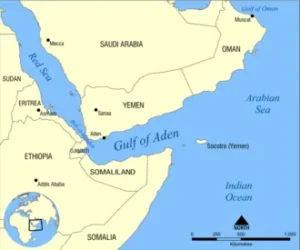
- Extension of Indian Ocean: Lies between the Arabian Peninsula (north) and the Horn of Africa (south).
- Connectivity: Links the Red Sea (west) and Arabian Sea (east) via the Bab elMandeb Strait.
- Boundaries:
- North – Yemen.
- South – Somalia & Socotra Islands (Yemen).
- East – Arabian Sea.
- West – Djibouti.
- Dimensions: ~900 km long, ~500 km wide.
- Relief Feature: Dominated by the Sheba Ridge, part of the Indian Ocean ridge system.
Environmental Features
- Upwelling: Cool, nutrientrich waters during monsoons → supports rich marine life.
- Salinity: Lower than the neighbouring Red Sea.
- Climate: Highenergy marine environment.
Strategic Importance
- Ports: Aden (Yemen), Berbera & Bosaso (Somalia).
- Cities Nearby: Aden, Mukalla, Balhaf, Berbera, Bosaso, Djibouti City.
- Shipping Route: Critical part of the Suez Canal route connecting Red Sea and Mediterranean.
- Traffic: ~21,000 ships annually; ~11% of global seaborne petroleum passes through.
- Security Concerns: Piracy, hijacking, and armed attacks near Somali waters.
Conclusion
The Gulf of Aden is a vital maritime corridor in global oil trade and shipping makes it highly vulnerable to piracy and geopolitical tensions, necessitating stronger international cooperation for maritime security.