
Daily Current affairs 21 September 2026

Daily Current Affairs 21 September 2026

Share this Post

FCRA AMENDMENT BILL (2026) AND STRENGTHENING CIVIL SOCIETY

TOPIC: (GS2) GOVERNANCE: THE HINDU

Recently, the Foreign Contribution (Regulation) Amendment Bill, 2026 has drawn attention over proposed changes in the management of assets and funds of NGOs losing FCRA registration.

Background

  • The Foreign Contribution (Regulation) Act, 2010 (FCRA) regulates the receipt and use of foreign contributions by individuals and organisations.
  • Its broad purpose is to ensure that foreign funding is used lawfully and does not adversely affect national interest, public order or security.
  • The 2026 Bill was introduced in the Lok Sabha on 25 March 2026 and has subsequently been referred to a Joint Parliamentary Committee (JPC) for detailed examination.

Key Proposals

Designated Authority for Assets

  • A Designated Authority would take custody of foreign contributions and assets created wholly or partly from such contributions when an FCRA certificate is cancelled, surrendered or ceases.
  • During the initial period, such vesting would be provisional, allowing restoration of assets if the organisation subsequently obtains or restores valid registration.

Permanent Vesting

  • If registration is not restored within the prescribed period, the assets could become permanently vested.
  • The Authority could transfer assets to government bodies or dispose of them, with proceeds credited to the Consolidated Fund of India.

Greater Compliance Oversight

  • The Bill proposes clearer provisions concerning organisations whose registration expires or is not renewed.
  • It also seeks to strengthen accountability of key functionaries and rationalise penalties for violations.

Why is the Issue Important?

  • National security: Foreign funding can require oversight where there are concerns about unlawful diversion or activities contrary to national interest.
  • Accountability: Clear rules for assets after cancellation can reduce uncertainty over their ownership and management.
  • Continuity of public services: Many NGOs provide education, healthcare, rehabilitation and social services, making regulatory decisions relevant to beneficiaries.
  • Civil-society autonomy: A healthy democracy requires space for independent voluntary organisations alongside effective financial accountability.

Funding Landscape and Emerging Alternatives

  • As of 15 July 2026, around 14,449 FCRA certificates were active, while 22,498 had been cancelled, according to the FCRA portal data cited by PRS.
  • Domestic philanthropy and CSR are increasingly important alternatives. Listed companies spent ₹22,563 crore on CSR in FY2025, up 17.5% from FY2024. Education and skill development accounted for about 41% of this spending.
  • However, CSR allocation is uneven, and direct corporate implementation is also increasing, which may limit opportunities for some NGOs.

Challenges

  • Broad administrative powers may create concerns regarding predictable and transparent implementation.
  • Organisations may face difficulties if assets created partly through foreign contributions become subject to vesting.
  • Smaller NGOs may struggle with increasingly complex regulatory requirements.
  • Disruption of NGOs can affect vulnerable communities dependent on their schools, healthcare and welfare services.

Way Forward

  • Ensure clear, objective and time-bound procedures for cancellation, asset management and restoration.
  • Provide effective appeal, judicial review and grievance-redress mechanisms.
  • Apply FCRA provisions uniformly without discriminating on the basis of religion, region or organisational identity.
  • Encourage domestic philanthropy, CSR and community giving while preserving the independence of civil society.
  • Promote transparent dialogue among government, NGOs, donors and beneficiaries to balance national security with democratic civic space.

Conclusion

India needs an FCRA framework that safeguards national interests while ensuring transparency, proportionality and sufficient space for an independent and effective civil society.

INDIA’S REAL INTEREST RATE CHALLENGE AND MONETARY POLICY

TOPIC: (GS3) ECONOMY: THE HINDU

India’s rising inflation is narrowing the gap between the RBI’s repo rate and the real policy rate, raising concerns about monetary-policy effectiveness.

Understanding the Real Policy Rate

  • Real interest rate means the interest you actually earn or pay after considering inflation.
  • Example: If a bank gives 6% interest but inflation is 4%, your real return is roughly 2%.
  • Ex-ante real interest rate means the real interest rate calculated using expected future inflation.
  • Example: If the RBI’s repo rate is 5.25% and people expect inflation to be 5.25%, the real rate is nearly zero.
  • Why it matters: When the real rate falls, borrowing becomes relatively cheaper, which can increase loans, spending and investment.
  • But if the economy is already growing strongly, too much borrowing and spending can increase inflationary pressure.

Emerging Inflationary Pressures

  • Consumer price inflation rose to 4.82% in August, up from 4.45% in July, according to the data cited in the article.
  • Food inflation reached 5.95%, indicating continuing pressure on household budgets.
  • Core inflation also increased to around 4.2%, suggesting that price pressures may be spreading beyond volatile food items.
  • India’s flexible inflation-targeting framework aims to maintain CPI inflation at 4%, with a tolerance band of 2–6%.

Why Timing Matters for the RBI

  • Supply shocks may persist when households expect higher prices, influencing wages, business pricing, consumption and future inflation expectations.
  • Higher crude prices raise transportation and production costs, while rupee depreciation makes imported commodities increasingly expensive domestically.
  • Robust economic activity and credit growth can make lower real interest rates stimulate demand, potentially increasing inflationary pressures.
  • RBI must balance price stability and economic growth when strong domestic demand coincides with persistent inflationary pressures.
  • Strong credit growth indicates healthy loan demand but may increase inflation when production capacity becomes increasingly constrained.

Risks of Delayed Policy Response

  • Unanchored expectations: Persistent inflation can weaken public confidence in the inflation target.
  • Negative real returns: Savers may experience reduced purchasing power on conventional deposits.
  • Asset substitution: Households may shift towards gold or market-linked investments.
  • Costlier correction later: A delayed response may require stronger monetary tightening, potentially affecting investment and consumption more sharply.

Way Forward

  • The RBI should remain data-dependent and forward-looking, focusing on expected inflation rather than individual monthly readings.
  • Monetary policy should distinguish temporary supply shocks from persistent, broad-based inflation.
  • Government measures should address food supply, logistics and energy-side pressures that monetary policy cannot directly control.
  • Clear communication can help keep inflation expectations anchored while reducing unnecessary market uncertainty.

Conclusion

For India, the challenge is not merely the level of interest rates but timely action that preserves price stability without unnecessarily weakening growth.

INDIA-CHINA TRADE AND THE PARADOX OF SELF-RELIANCE

TOPIC: (GS3) ECONOMY: THE HINDU

Recently, India and China stressed resolving trade imbalances and supply-chain concerns, highlighting India’s continued dependence on Chinese manufacturing inputs.

India-China Trade Imbalance

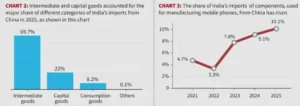
  • India’s trade deficit with China reached $63.97 billion during April–October 2025, rising 10.1% from the previous year.
  • India’s exports to China increased by 24.7% to $10.02 billion during the same period, but imports remained substantially higher.
  • Import dependence is concentrated in raw materials, intermediate goods and capital goods, including electronic parts, machinery, auto components and APIs.
  • Therefore, the deficit is not merely driven by consumer goods; it reflects gaps in domestic manufacturing capabilities.

The “Assembly Trap”

  • India has become a major destination for electronics and mobile-phone assembly, but several critical components are still sourced from abroad.
  • For example, mobile phones assembled in India may contain imported semiconductors, displays, camera modules, batteries and other components.
  • This creates a difference between “Made in India” assembly and deeper domestic value addition.
  • A strong component ecosystem is necessary to move from assembly to design, engineering and high-value manufacturing.
India-China Trade and the Paradox of Self-Reliance

Why China Matters to Indian Manufacturing

  • China has a large and integrated ecosystem covering components, machinery, logistics and supplier networks.
  • Indian manufacturers often import intermediate inputs because they are available at competitive prices and large scale.
  • Such imports can initially support Indian exports and industrialisation.
  • However, excessive concentration in one source country can create supply-chain and strategic vulnerabilities.

Implications for India

  • Economic: Persistent import dependence can widen the trade deficit and reduce domestic value addition.
  • Technological: Dependence on imported components can slow the development of indigenous design and engineering capabilities.
  • Strategic: Disruptions in critical supply chains can affect sectors such as electronics, telecom, pharmaceuticals and renewable energy.
  • Employment: Greater domestic production of components can generate skilled manufacturing jobs beyond assembly-line employment.
  • Global competitiveness: Building supplier networks can help Indian firms participate more deeply in Global Value Chains (GVCs).

Government Initiatives

  • PLI Schemes: Encourage large-scale manufacturing and investment in electronics and other strategic sectors.
  • SPECS: Supports capital investment in electronic components and semiconductor manufacturing.
  • India Semiconductor Mission: Seeks to develop a complete semiconductor and display ecosystem in India.
  • Electronics Component Manufacturing Scheme: Targets sub-assemblies, bare components, supply-chain ecosystems and capital equipment.

Way Forward

  • Shift policy focus from final assembly to component manufacturing, design and technology development.
  • Develop domestic supplier networks involving MSMEs, startups and large manufacturers.
  • Use calibrated tariffs and incentives where necessary without making Indian industry dependent on permanent protection.
  • Increase investment in R&D, semiconductor technology, skilled manpower and industrial infrastructure.

Conclusion

India’s self-reliance should not mean isolation; it should mean building domestic capabilities strong enough to compete and participate confidently in global value chains.

TULU GETS ADDITIONAL OFFICIAL LANGUAGE STATUS IN KARNATAKA

TOPIC: (GS1) INDIAN ART AND CULTURE: THE HINDU

The Karnataka Cabinet has decided to grant additional official language status to Tulu for administrative purposes in Dakshina Kannada and Udupi districts.
What Does the Decision Mean?

  • Tulu is widely spoken in Dakshina Kannada, parts of Udupi and Kasaragod.
  • The proposed status would enable greater use of Tulu in local government and administrative communication.
  • Citizens may submit applications in Tulu, while local-body meetings can permit its use.
  • Government orders and circulars in the concerned districts may also be made available in Tulu.
  • The Karnataka government has proposed ₹82 lakh annually for translation, training and language-related activities.

Constitutional and Legal Framework

  • Article 345 allows a State Legislature to adopt one or more languages for official purposes through law.
  • Karnataka currently recognises Kannada as its official language under the Karnataka Official Language Act, 1963.
  • Therefore, implementing additional official status for Tulu would require appropriate legislative and administrative steps rather than relying only on a Cabinet decision.
  • This provides an example of India’s cooperative accommodation of linguistic diversity within the constitutional framework.

Significance

  • Inclusive governance: Enables citizens to interact with administration in a familiar language.
  • Cultural preservation: Strengthens the institutional use of a historically significant regional language.
  • Grassroots democracy: Facilitates participation in panchayat and urban local-body proceedings.
  • Linguistic diversity: Supports India’s constitutional commitment to protecting diverse linguistic traditions.

Challenges

  • Translation and training require sustained funding and institutional capacity.
  • Limited availability of trained Tulu translators and official terminology may affect implementation.
  • Tulu is not included in the Eighth Schedule, which may remain an important demand among language advocates.

Conclusion

Recognising Tulu in administration can deepen grassroots governance while demonstrating how India’s federal system accommodates its rich linguistic diversity.

CREATIVE ECONOMY AS INDIA’S EMERGING ENGINE OF GROWTH

TOPIC: (GS3) ECONOMY: THE HINDU

India’s media, entertainment, gaming, animation and digital-content sectors are expanding rapidly, creating new opportunities for jobs, exports and entrepreneurship.
What is the Creative Economy?

  • The creative economy includes activities where ideas, culture, artistic skills and intellectual property are major sources of economic value.
  • It covers film, music, publishing, advertising, design, gaming, animation, digital media and live entertainment.
  • Unlike traditional cultural activities, many creative sectors are now technology-driven and can reach global markets through digital platforms.

Major Areas

  • AVGC-XR: Animation, Visual Effects, Gaming, Comics and Extended Reality combine creative talent with AI, 3D modelling, virtual production and immersive technologies.
  • Gaming: India has a large digital user base, growing domestic studios and increasing opportunities in game development and design.
  • Media and Entertainment: Films, streaming platforms, music and digital content have created new avenues for production and distribution.
  • Live Entertainment: Concerts, festivals and cultural events generate employment across hospitality, tourism, transport, event management and local businesses.

India’s Potential

  • India’s media and entertainment industry is estimated at around ₹2.5 trillion, reflecting the sector’s growing economic significance.
  • Around 57 million Indians are estimated to work in cultural and creative occupations.
  • The AVGC-XR sector could require nearly 2 million skilled professionals by 2030, highlighting its employment potential.
  • India’s large youth population, digital infrastructure and diverse cultural heritage provide a strong foundation for creative exports.

Why is it Important?

  • Employment: Creates opportunities for artists, designers, technicians, programmers, content creators and independent entrepreneurs.
  • Women and youth: Digital platforms can lower entry barriers and enable individuals to monetise creative skills.
  • Tourism: Films, festivals, concerts and cultural products can increase visitor spending and support local economies.
  • Soft power: Indian cinema, music, art, literature and digital content can strengthen India’s cultural influence abroad.
  • Innovation: The combination of creativity with AI, gaming, XR and digital design can stimulate new products and business models.
  • Rural opportunities: Handicrafts, traditional art and cultural products can reach wider markets through e-commerce and digital platforms.

Challenges

  • Copyright and piracy: Unauthorised copying and misuse of digital content can reduce creators’ earnings and weaken incentives for innovation.
  • Informal employment: Many creators work on short-term or project-based contracts without stable income or adequate social protection.
  • Limited finance: Banks may find it difficult to value intangible assets such as copyrights, characters, designs and digital intellectual property.
  • Skill gaps: Education and training systems may not adequately cover AI, virtual production, game engines and advanced design tools.
  • Regional inequality: Creative infrastructure and specialised opportunities remain concentrated in major cities.

Way Forward

  • Strengthen copyright enforcement and affordable mechanisms for resolving IP disputes.
  • Develop specialised creative clusters and digital infrastructure beyond major metropolitan centres.
  • Expand industry-linked training in AI, animation, gaming, XR, design and digital production.
  • Create financing mechanisms that recognise the value of intangible creative assets.

GOVERNMENT INITIATIVES

  • Indian Institute of Creative Technologies (IICT): Focuses on developing specialised capabilities in emerging creative technologies.
  • AVGC Creator Labs: Proposed across schools and colleges to expose students to new-age creative skills.
  • WAVES and MyWaves: Provide platforms for creators to develop, publish and showcase digital content.
  • AI skilling initiatives: Training programmes for media and creative professionals can improve adoption of AI-enabled production tools.
  • IT Rules, 2021: Establish a framework covering accountability, grievance redressal and responsibilities of digital intermediaries.

Conclusion

India can convert its cultural diversity and digital talent into a global economic advantage by building a creative ecosystem that rewards innovation, protects creators and expands opportunity.

GLOBAL BUSINESS CLIMATE SURVEY 2026

TOPIC: (GS3) ENVIRONMENT: THE HINDU

India has ranked first among 41 global markets in the Global Business Climate Survey 2026 conducted by Swedish business institutions.
About the Survey

  • The survey is jointly conducted by Business Sweden, Swedish Chambers of Commerce and Swedish diplomatic missions.
  • It captures the experiences and expectations of Swedish businesses operating across 41 international markets.
  • It has been conducted since 2020, enabling comparison of business conditions and investment sentiment over time.

Key Findings

  • India ranked first, followed by Vietnam, indicating strong business confidence in the Indian market.
  • Swedish companies showed continued long-term commitment to India.
  • A majority of respondents reported favourable business conditions and expected to increase investments during the coming year.
  • Asia-Pacific emerged as the most optimistic region, with India and the Philippines among leading destinations for planned investment.
  • India, the Philippines and Poland recorded strong expectations for market growth.
  • Sentiment was more cautious in parts of the Middle East and Africa; Saudi Arabia’s positive outlook declined from 90% in 2025 to 44% in 2026.

Significance for India

  • Stronger investment sentiment can support capital formation, employment and technology transfer.
  • Swedish investment can contribute to sectors such as manufacturing, clean technology, automobiles, telecom and digital solutions.
  • Sustaining this confidence requires predictable regulations, skilled labour, efficient logistics and faster clearances.

Conclusion

India’s strong business sentiment provides an opportunity to deepen reforms and convert investor confidence into productive investment, jobs and sustained economic growth.

Write a Review

Your email address will not be published. Required fields are marked *