
Table of Contents
ToggleUS Russia Sanctions Bill
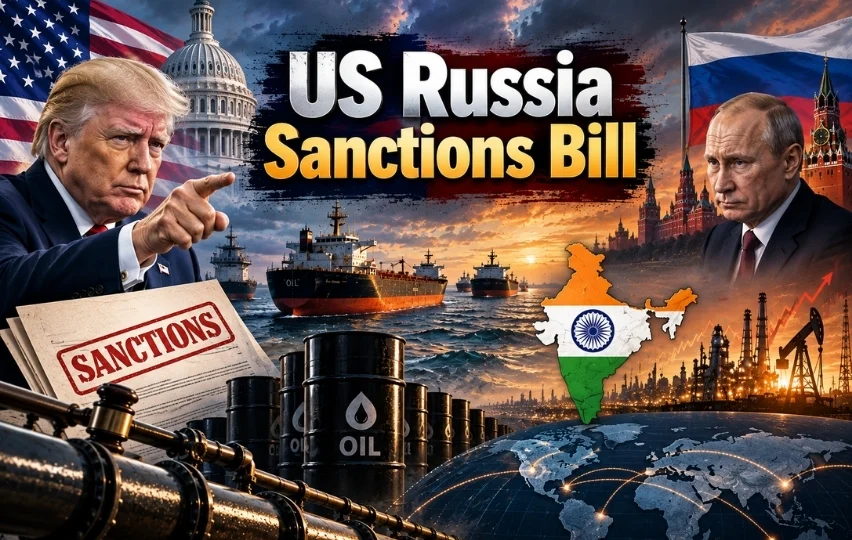
The US House of Representatives has passed the US Russia Sanctions Bill, formally known as the Lindsey O. Graham Sanctioning Russia and Iran Act of 2026, giving the US President authority to impose tariffs of up to 100% on major buyers of Russian oil and natural gas. The legislation has particular significance for India because Russia remains its largest crude-oil supplier. The House passed the measure 262–159, following its earlier passage in the Senate.
India’s Dependence on Imported Crude Oil
India relies heavily on imported crude to meet its energy requirements. Russian oil became particularly important after the Russia-Ukraine conflict in 2022, when discounted Russian supplies became available to countries continuing to purchase them.
According to Kpler data, India imported approximately 2.08 million barrels per day (bpd) of Russian crude in August 2026, accounting for around 45% of its total crude imports. Russia’s share had been higher in July, at about 55.9%.
What Does the US Bill Propose?
The legislation authorises the US President to impose tariffs of up to 100% on countries purchasing Russian energy. The measure is aimed at increasing economic pressure on Russia by raising the costs for major purchasers of its oil and gas.
The legislation has passed both chambers of Congress and has been sent to the US President for consideration. Importantly, passage of the legislation does not automatically mean that a 100% tariff will be imposed on India; implementation would depend on subsequent executive action.
Why Russian Oil Matters to India
Russian crude has been attractive to Indian refiners because of its availability, pricing and compatibility with several Indian refineries. It has also provided an additional source of supply during periods of disruption in traditional oil-producing regions.
Any significant reduction in Russian supplies could therefore require refiners to source more crude from alternative markets, potentially affecting procurement costs, freight expenses and refining margins.
Potential Impact on India
Energy Costs
Greater dependence on alternative suppliers could increase crude procurement costs. Since India imports a large proportion of its crude requirements, higher international oil prices could also affect the import bill and inflationary pressures.
Refinery Economics
Indian refiners have benefited from relatively competitive Russian crude. Changes in supply availability or pricing could alter refinery margins and crude procurement strategies.
India-US Trade Relations
The legislation could add another issue to the broader India-US economic relationship, particularly as the two countries engage on trade and market-access matters.
Global Energy Market Impact
Restrictions on Russian oil purchases could affect global supply if substantial volumes are removed from international markets. At a time of geopolitical tensions and disruptions affecting energy flows, tighter supply could contribute to volatility in international crude prices.
Way Forward for India
India can strengthen energy resilience through supplier diversification, strategic petroleum reserves, alternative import routes, domestic refining capacity and greater energy efficiency. Continued diplomatic engagement with major partners can also help manage the economic implications of sanctions-related measures.
Conclusion
The US sanctions legislation highlights the intersection of geopolitics, energy security and international trade. For India, the issue involves managing its substantial dependence on imported crude while maintaining diversified energy supplies and protecting wider economic interests.


FAQs: US Russia Sanctions Bill
What is the US Russia Sanctions Bill of 2026?
The Lindsey O. Graham Sanctioning Russia and Iran Act of 2026 is legislation that would authorise the US President to impose tariffs of up to 100% on countries purchasing Russian oil and natural gas.
Why is the Bill significant for India?
The Bill is significant for India because Russia is a major supplier of Indian crude oil. According to the article, Russian crude accounted for around 45% of India’s total crude imports in August 2026.
Does the Bill automatically impose a 100% tariff on India?
No. Passage of the legislation does not automatically impose a 100% tariff on India. Any such action would depend on subsequent decisions and implementation by the US President.
How could restrictions on Russian oil affect India?
A reduction in Russian oil supplies could require Indian refiners to source crude from alternative suppliers. This could affect procurement costs, freight expenses, refinery margins and India’s import bill.
How can India strengthen its energy security?
India can improve energy resilience through supplier diversification, strategic petroleum reserves, alternative import routes, domestic refining capacity and greater energy efficiency, along with continued diplomatic engagement.