

Table of Contents
ToggleIndia’s Real Rate Moment: The Cost of Delay
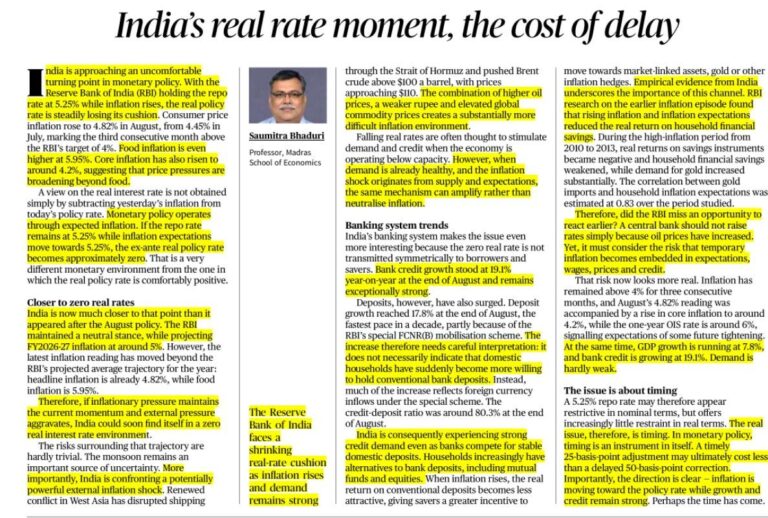
India’s monetary policy is facing a challenging situation as inflation rises while economic growth and bank credit remain strong. The article highlights the importance of the real interest rate—the policy rate adjusted for expected inflation—and argues that the Reserve Bank of India (RBI) faces a shrinking real-rate cushion.
Rising Inflation and the Real Policy Rate
The RBI repo rate is at 5.25%, while headline consumer inflation rose to 4.82% in August, with food inflation reaching 5.95%. Core inflation has also moved higher, suggesting that price pressures are becoming broader.
The real policy rate is not calculated simply by subtracting today’s inflation from the policy rate. It depends on expected inflation. If inflation expectations approach 5.25%, the ex-ante real policy rate could approach zero.
A declining real interest rate can make monetary policy less restrictive and may provide additional support to demand and credit.
External Inflation Risks
The article identifies external risks, particularly higher crude oil prices, disruptions to shipping through the Strait of Hormuz and a weaker rupee. These factors can increase import costs and create additional inflationary pressure.
When demand is already strong, supply-side inflation shocks can become more persistent through expectations, wages and prices.
Strong Credit Growth and Banking Trends
India’s banking system continues to show strong credit growth. Bank credit growth stood at around 19.1% year-on-year, while deposit growth was around 17.8%.
Strong credit demand indicates continued economic activity. However, when inflation rises, the real return on conventional deposits can become less attractive, potentially influencing household financial-saving decisions.
Why Timing Matters
The article argues that the key issue is not simply whether the RBI should raise or lower rates, but when monetary policy should respond to changing inflation conditions.
With GDP growth reported at 7.8% and credit growth remaining strong, demand does not appear weak. At the same time, persistent inflation and external price shocks could reduce the real-rate cushion further.
Conclusion
India’s current monetary policy environment presents a delicate balance between growth, inflation and financial stability. A shrinking real interest-rate cushion, strong credit growth and renewed external inflation risks make the timing of monetary policy decisions increasingly important.
Vocabulary
1. Real Interest Rate – Nominal interest rate adjusted for inflation.
2. Ex-ante Real Rate – Interest rate adjusted for expected future inflation.
3. Inflation Expectations – Expectations about the future rate of price rise.
Prelims MCQs
MCQ 1
Consider the following statements:
1. A rise in inflation can reduce the real interest rate if the nominal interest rate remains unchanged.
2. A near-zero real interest rate necessarily indicates falling credit demand.
3. Inflation expectations influence the effectiveness of monetary policy.
Which are correct?
A) 1 and 3 only
B) 1 and 2 only
C) 2 and 3 only
D) 1, 2 and 3
Answer: A
UPSC Mains Question
“The effectiveness of monetary policy depends not only on the magnitude of interest-rate changes but also on their timing.” Discuss in the context of inflation and growth. (10 Marks)
Frequently Asked Questions (FAQs)
What is the real interest rate?
The real interest rate broadly reflects the nominal interest rate adjusted for inflation expectations and indicates the effective cost of borrowing or return on saving.
Why is the real policy rate important?
It helps determine whether monetary policy is genuinely restrictive or accommodative after accounting for expected inflation.
What inflation risks does India currently face?
The article highlights higher crude oil prices, shipping disruptions through the Strait of Hormuz, a weaker rupee and rising food and core inflation.
Why is strong credit growth significant?
Strong bank credit growth indicates continued demand for loans and economic activity, making the interaction between inflation and monetary policy particularly important.
Why does the timing of monetary policy matter?
A delayed policy response could allow inflation pressures and expectations to become more persistent, while policy changes also need to consider the strength of economic growth and credit.
Source From : The Hindu
India’s De-risking Strategy: Managing Relations with the U.S. and China
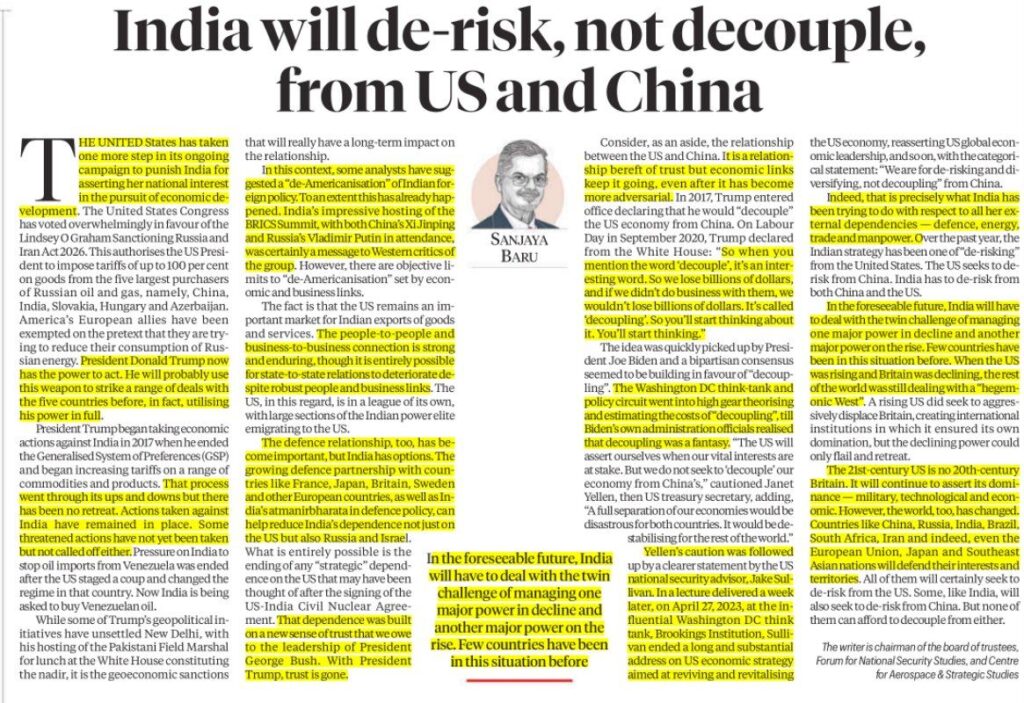
India’s approach towards the United States and China is increasingly shaped by the need to reduce strategic vulnerabilities rather than completely separate from either major power. The article highlights the concept of “de-risking”—diversifying economic, defence and strategic partnerships while maintaining essential relationships.
India and the United States
India–U.S. relations have expanded significantly in areas such as trade, defence, technology and strategic cooperation. However, recent U.S. economic measures and tariff pressures have created uncertainty in bilateral economic relations.
The article notes that the U.S. remains an important market for Indian exports of goods and services. The strong people-to-people and business-to-business connections make a complete economic separation difficult.
At the same time, India is seeking to reduce excessive dependence by diversifying its external economic relationships and strengthening domestic capabilities.
Defence Partnerships and Strategic Diversification
India is also broadening its defence partnerships beyond the United States. Cooperation with countries such as France, Japan, Britain, Sweden and other European partners can expand India’s options in defence technology and production.
Such diversification can reduce dependence on any single country while supporting India’s strategic interests.
India and China: Managing Economic Interdependence
India’s relationship with China presents a different challenge. Despite strategic differences, China remains an important economic partner.
The article argues that “decoupling” is difficult because economic links between countries are deeply interconnected. Instead, India can pursue de-risking by reducing excessive dependence in sensitive areas such as defence, energy, technology and critical supply chains.
De-risking vs Decoupling
Decoupling involves a substantial separation of economic and technological relationships, whereas de-risking focuses on reducing vulnerabilities without completely ending economic engagement.
For India, de-risking can involve:
- Diversifying supply chains
- Expanding export markets
- Developing domestic manufacturing
- Strengthening defence partnerships
- Reducing dependence on critical imports
- Building technological capabilities
India’s Strategic Challenge
The article describes India’s position as a twin challenge: managing relations with a major power whose relative position may decline and another major power whose influence is rising.
This requires maintaining strategic flexibility rather than depending exclusively on one power centre.
Conclusion
India’s emerging approach can be understood through strategic autonomy, multi-alignment and economic de-risking. Rather than completely decoupling from the U.S. or China, India can diversify partnerships and strengthen domestic capabilities while maintaining necessary economic and strategic relationships.
Vocabulary
1. De-risking – Reducing excessive dependence without ending economic ties.
2. Decoupling – Large-scale separation of economic and strategic linkages.
3. Strategic Autonomy – Ability to pursue national interests without rigid alignment with a major power.
Prelims MCQs
MCQ 1
Consider the following statements:
1. De-risking involves diversification of critical economic and strategic dependencies.
2. Decoupling necessarily implies deeper economic integration between countries.
3. Strategic autonomy allows India to engage multiple power centres based on its national interests.
Which are correct?
A) 1 and 3 only
B) 1 and 2 only
C) 2 and 3 only
D) 1, 2 and 3
Answer: A
UPSC Mains Question
“De-risking rather than decoupling offers India greater space to preserve strategic autonomy amid intensifying great-power competition.” Discuss. (10 Marks)
Frequently Asked Questions (FAQs)
What is de-risking in international relations?
De-risking means reducing excessive dependence and vulnerabilities while continuing essential economic and strategic relationships.
How is de-risking different from decoupling?
De-risking seeks to reduce vulnerabilities without ending economic engagement, whereas decoupling involves much deeper separation between economies.
Why is the U.S. important for India?
The U.S. is an important partner in trade, defence, technology and strategic cooperation, as well as a major market for Indian goods and services.
Why can India not easily decouple from China?
The article highlights the depth of existing economic links, making complete separation difficult and encouraging a focus on reducing dependence in sensitive sectors.
How can India strengthen its de-risking strategy?
India can diversify supply chains, export markets and defence partnerships while strengthening domestic manufacturing and technological capabilities.