
Table of Contents
ToggleYouth Power in India: From Demographic Strength to Electoral Force
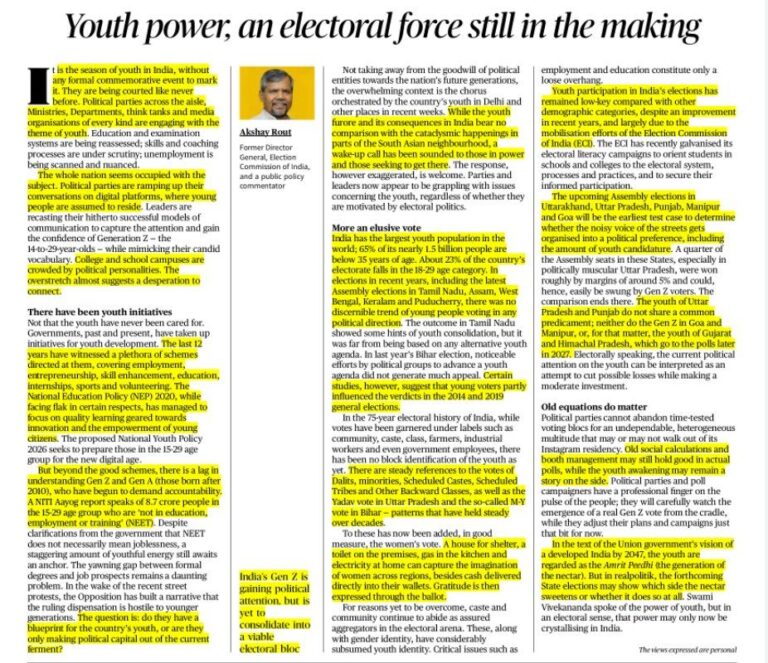
India has one of the world’s largest youth populations, making young people an important force in the country’s democratic and electoral landscape. However, despite their demographic strength, youth participation in elections remains relatively low. The challenge is to convert India’s demographic dividend into meaningful political participation.
India’s Youth Demographic Advantage
India has a large young population, with around 65% of its population below 35 years of age. A significant share of the electorate belongs to the 18–29 age group, making young voters increasingly important for political parties.
Political campaigns are therefore increasingly using digital platforms, social media and youth-oriented communication to engage this demographic.
However, demographic strength does not automatically translate into electoral participation.
Why Is Youth Electoral Participation Low?
The article highlights that youth voter participation remains lower than that of older demographic groups, despite improvements in recent years.
Several factors can contribute to this gap, including:
- Lack of political awareness
- Limited engagement with electoral processes
- Migration for education and employment
- Weak connection with political institutions
- Perception that politics does not adequately address youth concerns
The Election Commission has undertaken initiatives to encourage young people in schools and colleges to understand electoral processes and participate in elections.
Education and Employment: Key Youth Concerns
India’s youth aspirations are closely connected with education, employment and skill development.
Government initiatives such as the National Education Policy (NEP) 2020 and the proposed National Youth Policy 2026 aim to strengthen opportunities for young people.
However, the article points to a continuing gap between government programmes and their actual reach among young people, particularly those outside education, employment or training.
Youth as an Emerging Political Force
The increasing visibility of youth issues in elections indicates that young voters could become an important political constituency.
Issues such as:
- Employment opportunities
- Quality education
- Skill development
- Entrepreneurship
- Affordable housing
- Healthcare
- Urban infrastructure
can influence the political preferences of younger generations.
However, the article cautions against treating youth merely as a political vote bank. Their participation needs to develop into sustained political engagement.
Upcoming Elections and Youth Participation
The upcoming Assembly elections in Assam, Kerala, Tamil Nadu, West Bengal and Puducherry will provide an opportunity to observe changing youth voting patterns.
The political significance of Generation Z is likely to increase as more young citizens enter the electorate.
From Demographic Dividend to Democratic Dividend
India’s demographic advantage can become a democratic dividend only when young people actively participate in elections and public institutions.
Political parties, educational institutions and election authorities need to encourage informed participation rather than relying only on campaign-based mobilisation.
Conclusion
India’s youth represent a powerful demographic and potential electoral force. However, population size alone cannot guarantee political influence.
The real opportunity lies in transforming young people from passive voters into informed, engaged and responsible citizens. Greater youth participation can strengthen Indian democracy and ensure that policies reflect the aspirations of the country’s next generation.
Vocabulary
1. Electoral Bloc – Group voting around common interests
2. Gen Z – Young generation shaping current politics
3. NEET – Not in Education, Employment or Training
4. Electoral Literacy – Awareness of voting and elections
5. Political Mobilisation – Organising people for political participation
Prelims MCQs
MCQ 1
With reference to youth participation in Indian elections, consider the following statements:
- India has around 65% of its population below 35 years of age.
- Youth voter participation has remained lower than that of some older demographic groups.
- The Election Commission has undertaken initiatives to familiarise students with the electoral system.
Which of the statements given above is/are correct?
A) 1 only
B) 1 and 2 only
C) 2 and 3 only
D) 1, 2 and 3
Answer: D) 1, 2 and 3
MCQ 2
Which of the following are major issues influencing the aspirations of India’s youth?
- Employment
- Education and skill development
- Entrepreneurship
- Affordable housing
Select the correct answer using the code below:
A) 1 and 2 only
B) 1, 2 and 3 only
C) 2, 3 and 4 only
D) 1, 2, 3 and 4
Answer: D) 1, 2, 3 and 4
UPSC Mains Question
“India’s large youth population can become a democratic dividend only when demographic strength is converted into meaningful political participation.” Discuss.
Key points to cover:
- India’s large youth population and demographic advantage
- Youth as an emerging electoral constituency
- Relatively lower youth voter participation
- Factors such as migration, education, employment and political disengagement
- Major youth concerns: jobs, education, skills, entrepreneurship and housing
- Role of the Election Commission in promoting electoral awareness
- Role of political parties and educational institutions
- Risks of treating youth merely as a vote bank
- Importance of informed and responsible citizenship
- Link between demographic dividend and democratic dividend
- Need to strengthen sustained youth participation in democratic institutions
Frequently Asked Questions (FAQs)
Why is youth participation important in Indian elections?
With a large share of India’s population below 35 years, young voters represent a significant electoral force. Their participation can influence political priorities and policy choices.
Why is youth voter participation relatively low?
Factors such as education and employment-related migration, limited political engagement and weaker connections with electoral institutions can affect youth participation.
What are the major concerns of India’s youth?
Key concerns include employment, education, skill development, entrepreneurship, housing and access to opportunities.
How is the Election Commission encouraging youth participation?
The Election Commission has undertaken initiatives to introduce students to the electoral system and encourage informed participation among young citizens.
Can India’s youth population become a democratic dividend?
Yes. If young people move beyond being merely a demographic or electoral category and become informed and active participants in democracy, India’s demographic strength can translate into a democratic dividend.
Source From : The Hindu
India’s Growth: Real Numbers, Real Reform Challenges
India’s recent GDP growth numbers point to a resilient economy, but strong headline growth does not eliminate the need for structural reforms. The challenge is to ensure that economic expansion translates into higher incomes, investment, productivity and sustainable development.
India’s GDP Growth Remains Strong
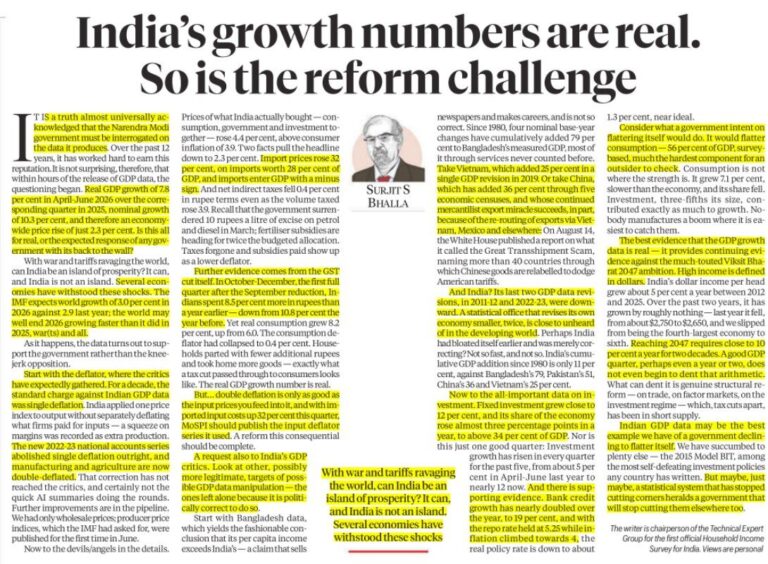
India recorded real GDP growth of 7.8% in the latest quarter discussed in the article, while nominal GDP growth was around 10.3%.
The article argues that these numbers are not merely statistical artefacts. The revised national accounts methodology and the use of appropriate deflators indicate that the growth performance reflects genuine expansion in economic activity.
The services sector, manufacturing and domestic consumption have contributed significantly to this momentum.
Understanding Real GDP and the Deflator
A major issue highlighted is the importance of the GDP deflator.
Real GDP attempts to measure changes in the volume of economic production after removing the effect of price changes. Therefore, the choice of deflator can significantly influence the estimated real growth rate.
The article points out that India’s revised national accounts have moved away from some earlier practices and have incorporated improved methods for measuring manufacturing and agricultural activity.
Consumption and Investment Show Momentum
Consumption remains an important driver of India’s growth. The article notes that real consumption growth has remained strong, supported by improving economic activity.
Investment growth is another positive indicator. Fixed investment has increased as a share of GDP, suggesting strengthening productive capacity.
However, sustaining investment will require continued improvements in infrastructure, business conditions and policy certainty.
India’s Growth Compared With Other Economies
The article places India’s growth performance in a global context.
Despite geopolitical tensions, trade disruptions and global uncertainty, India has maintained relatively strong growth. Several major economies have experienced slower expansion during recent years.
However, the article cautions that maintaining high growth over several decades is considerably more difficult than achieving a few years of rapid expansion.
The 2047 Development Challenge
India’s ambition of becoming a developed economy by 2047 requires sustained high growth and rising per-capita incomes.
The article highlights that India’s per-capita income remains considerably below that of advanced economies. Therefore, simply maintaining current growth rates may not be sufficient.
India needs to sustain productivity improvements, expand employment opportunities and ensure that growth reaches broader sections of society.
Why Structural Reforms Matter
The article argues that strong GDP numbers should not lead to complacency.
Important reform areas include:
- Improving productivity
- Strengthening investment
- Enhancing manufacturing competitiveness
- Creating quality employment
- Improving human capital
- Increasing export competitiveness
- Removing regulatory bottlenecks
The experience of other economies shows that sustained growth requires continuous structural transformation.
Conclusion
India’s growth numbers demonstrate considerable economic resilience, but high growth is only the beginning of the development challenge.
To achieve the long-term vision of a developed India by 2047, the country must convert strong GDP growth into higher per-capita incomes, productive employment, greater investment and sustained productivity gains. The real test will be whether India can maintain this momentum while undertaking the reforms necessary for long-term economic transformation.
Vocabulary
1. GDP Deflator – Measure of economy-wide price changes
2. Real GDP – Output adjusted for inflation
3. Nominal GDP – Output measured at current prices
4. Fixed Investment – Spending on productive capital assets
5. Structural Reforms – Long-term changes improving economic efficiency
Prelims MCQs
MCQ 1
With reference to India’s GDP growth, consider the following statements:
- Real GDP growth measures changes in economic output after accounting for price changes.
- The GDP deflator is relevant for distinguishing changes in output from changes in prices.
- Nominal GDP growth is always higher than real GDP growth.
Which of the statements given above is/are correct?
A) 1 and 2 only
B) 1 only
C) 2 and 3 only
D) 1, 2 and 3
Answer: A) 1 and 2 only
MCQ 2
Which of the following factors were identified in the article as supporting India’s recent economic momentum?
- Domestic consumption
- Services sector activity
- Manufacturing activity
- Investment
Select the correct answer using the code below:
A) 1 and 2 only
B) 1, 2 and 3 only
C) 2, 3 and 4 only
D) 1, 2, 3 and 4
Answer: D) 1, 2, 3 and 4
UPSC Mains Question
“India’s strong GDP growth reflects economic resilience, but sustaining high growth requires deeper structural reforms.” Discuss in the context of India’s development aspirations.
Key points to cover:
- India’s recent real GDP growth of 7.8%
- Difference between real and nominal GDP
- Importance of the GDP deflator
- Role of domestic consumption and investment
- Contribution of services and manufacturing
- Resilience despite geopolitical and global economic uncertainties
- Importance of sustained productivity growth
- Low per-capita income compared with developed economies
- Need for quality employment and human-capital development
- Strengthening manufacturing and export competitiveness
- Removing regulatory and infrastructure bottlenecks
- Linking high GDP growth with inclusive and sustainable development
- Long-term challenge of achieving India’s 2047 development vision
Frequently Asked Questions (FAQs)
What is India’s recent GDP growth rate?
India recorded 7.8% real GDP growth in the latest quarter discussed in the article, indicating strong economic momentum despite global uncertainties.
Why is the GDP deflator important?
The GDP deflator helps distinguish changes in economic output from changes in prices. Its measurement can therefore influence the calculation of real GDP growth.
What are the major drivers of India’s economic growth?
Domestic consumption, services, manufacturing and investment are important contributors to India’s recent growth performance.
Why is India’s 2047 development target challenging?
Sustaining high growth over several decades is difficult. India needs continued productivity growth, higher per-capita incomes, quality employment and structural economic transformation.
What reforms are needed to sustain India’s growth?
India needs reforms focused on productivity, investment, manufacturing, employment, human capital, exports and removal of regulatory bottlenecks to sustain long-term growth.