
Table of Contents
ToggleRetail Inflation Rises Above RBI Target
Why in News?
India’s retail inflation, measured by the Consumer Price Index (CPI), rose to 4.4% in June 2026. This crossed the Reserve Bank of India’s medium-term target of 4% for the first time since January 2025 and reached an 18-month high.
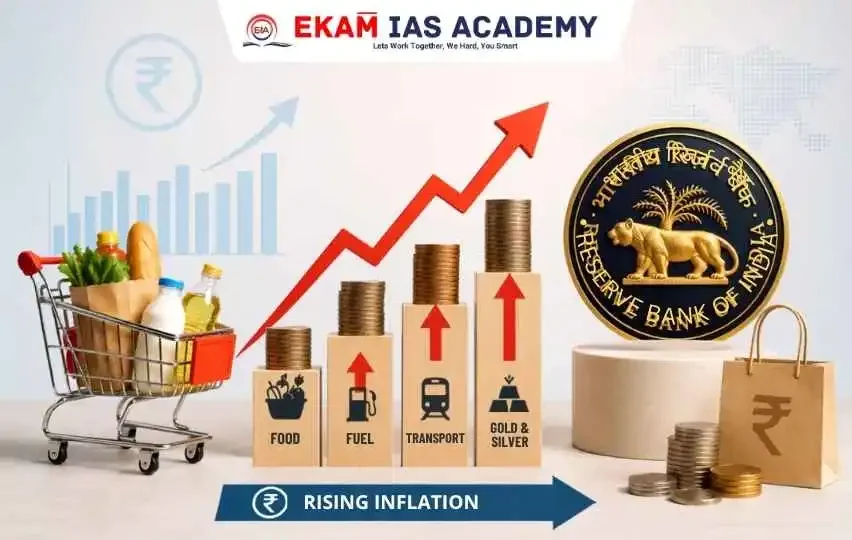
The rise was mainly driven by higher food inflation, increasing fuel prices due to the West Asia crisis, uneven monsoon conditions and global supply chain disruptions. Rising transport costs and higher prices of gold and silver also contributed to the overall increase in inflation.
What is Inflation?
Inflation refers to a sustained increase in the general price level of goods and services over a period of time.
When inflation rises, the purchasing power of money declines. This means people need to spend more money to buy the same quantity of goods and services.
Who Manages Inflation in India?
The Reserve Bank of India (RBI) is the primary authority responsible for controlling inflation in India through monetary policy.
The Monetary Policy Committee (MPC) of the RBI decides the Repo Rate and other policy measures to maintain price stability.
Under the Monetary Policy Framework Agreement, 2015 and the RBI Act, 1934, India follows an inflation-targeting framework.
Inflation Target in India
| Parameter | Details |
|---|---|
| Target Inflation | 4% |
| Tolerance Band | ±2% |
| Acceptable Range | 2% to 6% |
| Managed By | RBI and Monetary Policy Committee |
Key Drivers of Inflation Rise
The increase in retail inflation was mainly due to:
- Higher food inflation at 5.05%
- Rising fuel prices due to West Asia tensions
- Uneven monsoon conditions
- Global supply chain disruptions
- Higher transport costs
- Increase in gold and silver prices
Effects of Inflation on the Economy
1. Reduces Purchasing Power
Inflation reduces the real value of money. As prices rise, consumers are able to buy fewer goods and services with the same income.
2. Increases Cost of Living
Essential items such as food, fuel, transport and household goods become costlier. This affects low-income and middle-income households the most.
3. Impacts Savings and Investments
High inflation reduces the real value of savings. It may encourage people to invest in assets such as gold, real estate and other inflation-protected assets.
4. Influences Interest Rates
When inflation rises, the RBI may increase the Repo Rate to control excess demand. This leads to higher borrowing costs for individuals, businesses and industries.
5. Affects Economic Growth
Moderate inflation may support economic activity, but persistently high inflation can reduce consumption, discourage investment and slow down economic growth.
6. Increases Business Costs
Rising prices of raw materials, fuel, wages and logistics increase production costs. Businesses may pass these costs to consumers through higher prices.
7. Worsens Income Inequality
Fixed-income earners, pensioners and economically weaker sections are more affected by inflation because their incomes may not rise at the same pace as prices.
Significance for India
Retail inflation crossing the RBI’s 4% target is significant because it affects household consumption, monetary policy decisions and overall economic stability.
If inflation remains high for a longer period, the RBI may adopt a tighter monetary policy stance. This can affect loans, investments, consumption demand and business expansion.
Conclusion
The rise in retail inflation above the RBI’s 4% target highlights the challenges of maintaining price stability in a global environment marked by fuel price volatility, supply chain disruptions and food price pressures. For India, controlling inflation while supporting growth remains a key policy challenge for the RBI and the government.



Retail Inflation Rises Above RBI Target-FAQs Answered
Why is retail inflation in news?
Retail inflation rose to 4.4% in June 2026, crossing the RBI’s medium-term target of 4% and reaching an 18-month high.
What is retail inflation?
Retail inflation refers to the rise in prices of goods and services purchased by consumers. It is measured using the Consumer Price Index (CPI).
What is the RBI’s inflation target?
The RBI’s inflation target is 4%, with a tolerance band of ±2%, meaning the acceptable range is 2% to 6%.
What caused the recent rise in inflation?
The rise was mainly due to higher food inflation, fuel price increases, uneven monsoon conditions, global supply chain disruptions, rising transport costs and higher gold and silver prices.
How does inflation affect people and the economy?
Inflation reduces purchasing power, increases cost of living, affects savings, raises borrowing costs and can slow down economic growth if it remains high for a long time.