
Table of Contents
ToggleU.S.–Iran Conflict and the Strait of Hormuz
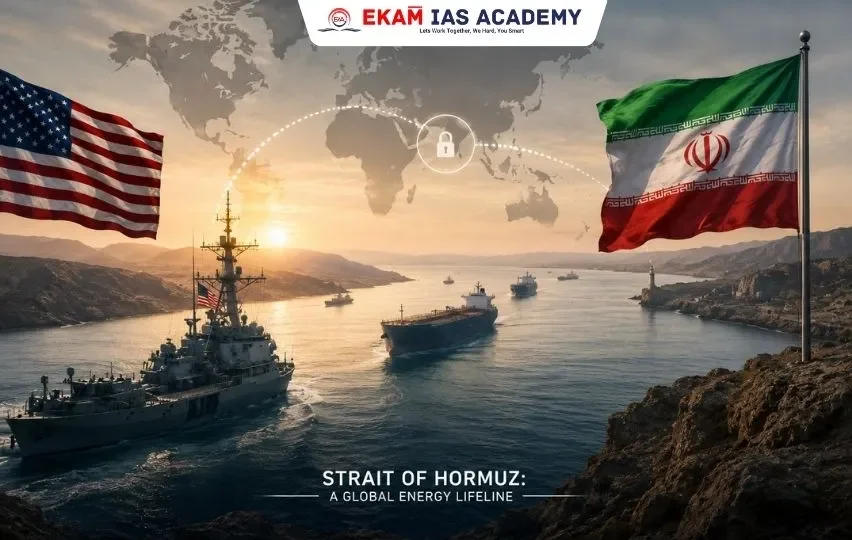
The Strait of Hormuz has once again become the focus of global attention following rising tensions between the United States and Iran. The recent announcement by U.S. President Donald Trump regarding the reinstatement of a blockade on Iranian ports and the proposal for the United States to act as the “Guardian of the Strait of Hormuz” has drawn sharp criticism from Iran. Tehran rejected the move, warning against foreign intervention and asserting its own role in safeguarding the strategic waterway.
As one of the world’s most important maritime chokepoints, any escalation in the Strait of Hormuz has far-reaching implications for global energy security, international trade, crude oil prices, and geopolitical stability. The issue is particularly significant for India, which relies heavily on energy imports from the Gulf region. For UPSC aspirants, this topic is relevant under International Relations, Geography, Economy, Energy Security, and Global Affairs.
Why is the Strait of Hormuz in the News?
The Strait of Hormuz has come into the spotlight after the United States announced plans to strengthen its maritime role in the region by imposing a blockade on Iranian ports and proposing charges on commercial vessels passing through the Strait.
Iran strongly opposed the proposal, describing it as a violation of regional sovereignty and warning that any unilateral action could destabilize one of the world’s busiest shipping lanes.
The developments have renewed concerns over disruptions to global oil supplies and increasing geopolitical tensions in West Asia.
What is the Strait of Hormuz?
The Strait of Hormuz is a narrow but strategically vital maritime passage located between:
- Iran to the north
- Oman (Musandam Peninsula) to the south
- United Arab Emirates (UAE) along the southern coast
It serves as the only maritime gateway connecting the Persian Gulf to the Gulf of Oman, which further opens into the Arabian Sea and the Indian Ocean.
Maritime Route
Persian Gulf → Strait of Hormuz → Gulf of Oman → Arabian Sea → Indian Ocean
This route enables Gulf countries to export crude oil, natural gas, and other goods to markets across Asia, Europe, and the Americas.
Countries Connected to the Strait of Hormuz
The countries directly bordering the Strait are:
- Iran
- Oman (Musandam Peninsula)
- United Arab Emirates (UAE)
Several Gulf nations also depend on the Strait as their primary export route:
- Saudi Arabia
- Iraq
- Kuwait
- Bahrain
- Qatar
- United Arab Emirates
- Iran
Why is the Strait of Hormuz Strategically Important?
Global Energy Lifeline
The Strait of Hormuz is the world’s most important energy chokepoint.
Approximately:
- Around 20% of global oil consumption
- Nearly one-fifth of global LNG trade
passes through this narrow waterway every year.
Any disruption immediately affects global energy markets.
Critical Maritime Chokepoint
The Strait is the only sea passage connecting the oil-rich Persian Gulf with the Indian Ocean.
Without this route, Gulf countries would face severe challenges in exporting petroleum products to international markets.
Importance for India's Energy Security
India imports a significant portion of its:
- Crude oil
- Liquefied Natural Gas (LNG)
from Gulf countries through the Strait of Hormuz.
Any interruption could:
- Increase India’s import bill
- Raise fuel prices
- Affect energy availability
- Increase inflationary pressures
Backbone of Global Trade
Apart from oil and gas, the Strait also facilitates the movement of:
- Petrochemicals
- Fertilizers
- Industrial goods
- Container cargo
Its uninterrupted functioning is essential for maintaining global supply chains.
Geopolitical Significance
The Strait has become one of the world’s most militarized maritime regions.
Major stakeholders include:
- United States
- Iran
- Gulf Cooperation Council (GCC) countries
- India
- China
- European nations
The strategic importance of the region has resulted in a continuous naval presence by several countries to ensure freedom of navigation.
Influence on Global Oil Prices
Any conflict, blockade, piracy incident, or military confrontation in the Strait can rapidly trigger:
- Increase in crude oil prices
- Higher shipping costs
- Rising marine insurance premiums
- Supply chain disruptions
- Global inflation
Because global energy markets are highly sensitive, even the possibility of disruption can cause price volatility.
Impact of Rising U.S.–Iran Tensions
The renewed tensions may lead to:
- Increased geopolitical instability in West Asia
- Higher crude oil prices worldwide
- Disruptions in maritime trade
- Increased naval deployments in the Gulf region
- Greater risks for commercial shipping
- Pressure on energy-importing countries like India
Maintaining freedom of navigation in the Strait remains essential for ensuring global economic stability.
Importance for India
India has significant strategic and economic interests in the Strait of Hormuz because:
- A large share of India’s crude oil imports originates from the Gulf.
- Energy security depends on uninterrupted maritime trade.
- Indian naval deployments frequently monitor the safety of sea lanes.
- Stable shipping routes are essential for India’s economic growth and external trade.
Therefore, peace and stability in the region remain a key component of India’s foreign and maritime policy.
UPSC Prelims Quick Facts
| Topic | Details |
|---|---|
| Location | Between Iran and Oman (Musandam Peninsula), with the UAE on the southern side |
| Connects | Persian Gulf to Gulf of Oman |
| Opens into | Arabian Sea and Indian Ocean |
| Importance | World’s most critical energy chokepoint |
| Oil Transit | Around 20% of global oil consumption passes through |
| LNG Transit | Nearly one-fifth of global LNG trade |
| Major Stakeholders | Iran, USA, GCC countries, India, China, European nations |
| UPSC Relevance | International Relations, Energy Security, Geography, Economy |
UPSC Mains Perspective
GS Paper II
- India–West Asia Relations
- Maritime Security
- International Conflicts
- Global Governance
GS Paper III
- Energy Security
- Oil Supply Chains
- Global Trade
- Economic Impact of Geopolitical Conflicts
- Strategic Maritime Routes
Conclusion
The Strait of Hormuz remains one of the world’s most strategically important maritime passages, serving as the primary gateway for energy exports from the Persian Gulf to global markets. The recent U.S.–Iran tensions have once again highlighted the vulnerability of this critical chokepoint and its potential impact on international trade, global energy prices, and regional stability. For India, ensuring uninterrupted navigation through the Strait is vital for energy security and economic resilience. As geopolitical competition intensifies in West Asia, maintaining peace, freedom of navigation, and international cooperation in the Strait of Hormuz will remain essential for global stability and sustainable economic growth.



Frequently Asked Questions (FAQs) About U.S.–Iran Tensions over the Strait of Hormuz
What is the Strait of Hormuz?
The Strait of Hormuz is a narrow maritime passage located between Iran and Oman, connecting the Persian Gulf to the Gulf of Oman, the Arabian Sea, and the Indian Ocean. It is one of the world’s most important shipping routes for oil and natural gas.
Why is the Strait of Hormuz strategically important?
The Strait of Hormuz is considered the world’s most critical energy chokepoint because around 20% of global oil consumption and nearly one-fifth of global LNG trade pass through it. Any disruption can significantly impact global energy supplies and trade.
Why are the U.S.–Iran tensions over the Strait of Hormuz in the news?
The issue gained attention after U.S. President Donald Trump announced a blockade on Iranian ports and proposed that the United States would act as the “Guardian of the Strait of Hormuz.” Iran rejected the move, raising concerns over regional stability, maritime security, and global energy markets.
How do developments in the Strait of Hormuz affect India?
India imports a substantial share of its crude oil and LNG from Gulf countries through the Strait of Hormuz. Any disruption in the waterway can increase India’s energy import costs, fuel prices, inflation, and shipping expenses, affecting the overall economy.
Why is the Strait of Hormuz important for UPSC preparation?
The Strait of Hormuz is an important UPSC topic under International Relations, Geography, Energy Security, Maritime Security, and Global Trade. Questions related to its strategic location, geopolitical significance, and impact on India’s energy security are frequently relevant for both Prelims and GS Paper II & III (Mains).