Table of Contents
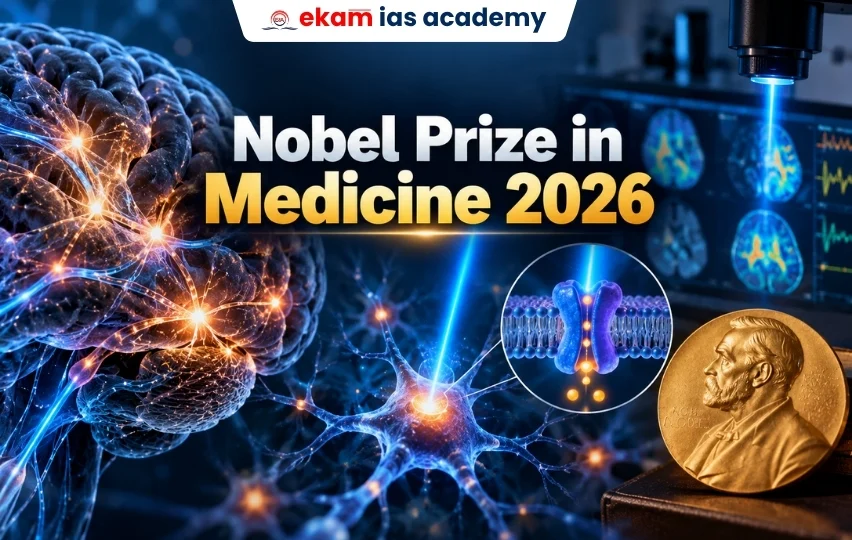
ToggleThe 2026 Nobel Prize in Physiology or Medicine has been jointly awarded to Karl Deisseroth, Peter Hegemann and Georg Nagel for their discoveries concerning light-gated ion channels and optogenetics. Their research has enabled scientists to control selected nerve cells using light, creating a powerful new approach to understanding how the brain works.
The Nobel Laureates
- Karl Deisseroth: Professor of Bioengineering and Psychiatry & Behavioral Sciences at Stanford University, USA.
- Peter Hegemann: Professor of Neuroscience at Humboldt University of Berlin, Germany.
- Georg Nagel: Professor of Molecular Plant Physiology at the University of Würzburg, Germany.
What Are Light-Gated Ion Channels and Optogenetics?
Light-gated ion channels are specialised proteins that function like microscopic doors in cell membranes. Light causes these proteins to change shape and open, allowing electrically charged ions to pass through.
Optogenetics uses this principle to control selected cells. Scientists introduce light-sensitive proteins called opsins into particular neurons and then use light to activate or inhibit them. This allows researchers to investigate individual neural circuits with exceptional precision.
From Francis Crick’s Idea to a New Field
The conceptual foundation can be traced to Francis Crick, who suggested that light could potentially be used to control individual neurons because nerve signals operate extremely rapidly.
The breakthrough came from studies of the microscopic alga Chlamydomonas, which responds rapidly to light. Peter Hegemann investigated its light-sensing mechanism, while Georg Nagel helped demonstrate that channelrhodopsins function as light-responsive ion channels.
Their work showed that ChR-2 could produce electrical signals in response to light, providing the essential tool for later experiments.
Karl Deisseroth and Optogenetics
Karl Deisseroth took the discovery into neuroscience. He introduced the ChR-2 gene into rat nerve cells and demonstrated that blue light could trigger neural activity. His work, published in 2005, helped establish the experimental foundation of optogenetics, a term formally adopted in 2006.
Applications of Optogenetics
Optogenetics has helped scientists investigate neural circuits involved in pain, reward, appetite, attention, social behaviour, sleep and other functions. It has also contributed to research into conditions including depression, anxiety, schizophrenia, Parkinson’s disease and Alzheimer’s disease.
The technology is also being explored for medical applications. Experimental approaches using light-sensitive proteins have shown potential for partially restoring vision in people with certain retinal disorders.
Safety and Limitations
Optogenetics requires deliberate genetic modification of targeted cells. Moreover, the skull and scalp significantly limit the ability of visible light to reach precise brain regions from outside the body. Importantly, activating selected neurons does not amount to controlling a person’s thoughts or behaviour.
Conclusion
The work of Deisseroth, Hegemann and Nagel transformed neuroscience from simply observing neural activity to precisely manipulating specific circuits. What began with an unusual light-sensitive alga and an ambitious scientific idea has developed into a major research tool with potential applications in understanding—and eventually treating—neurological disorders.


FAQs on Nobel Prize in Medicine 2026
Who won the Nobel Prize in Physiology or Medicine 2026?
The 2026 Nobel Prize in Physiology or Medicine was jointly awarded to Karl Deisseroth, Peter Hegemann and Georg Nagel for discoveries related to light-gated ion channels and optogenetics.
What is optogenetics?
Optogenetics is a technique that uses light-sensitive proteins called opsins to activate or inhibit selected neurons, allowing scientists to study neural circuits with high precision.
What are light-gated ion channels?
Light-gated ion channels are specialised proteins in cell membranes that respond to light by opening and allowing electrically charged ions to pass through.
How did Chlamydomonas contribute to optogenetics?
Research on the light-sensitive alga Chlamydomonas helped reveal how channelrhodopsins work as light-responsive ion channels, providing a foundation for the development of optogenetics.
What are the applications of optogenetics?
Optogenetics is used to study neural circuits involved in pain, reward, appetite, attention, social behaviour and sleep, and has potential applications in researching neurological and psychiatric disorders and restoring vision.