

Daily Current affairs 06 June 2026

Daily Current Affairs 06-June-2026

Share this Post

FII TAX REFORMS AND INDIA’S ECONOMIC OUTLOOK

TOPIC: (GS3) ECONOMY: THE HINDU

The Government of India scrapped capital gains tax and withholding tax on bonds held by Foreign Institutional Investors (FIIs) to attract foreign funds.

Who are Foreign Institutional Investors (FIIs)?

  • Definition: Foreign Institutional Investors (FIIs) are overseas entities such as investment funds, hedge funds, insurance companies, pension funds, and banks that invest in a country’s financial markets.
  • Role: They bring in foreign capital by purchasing shares, bonds, and other financial instruments in domestic markets.
  • Regulation: In India, FIIs are regulated by the Securities and Exchange Board of India (SEBI) and must register before investing.

Policy Shift in Taxation

  • India has historically imposed taxes on FII investments in debt markets. However, with rising external vulnerabilities, the government has opted for tax relief measures to encourage foreign participation.
  • This reform is expected to stabilize the rupee, strengthen the Balance of Payments (BoP), and enhance capital inflows.

Capital Gains Tax

Tax on profit earned from selling capital assets like property, shares, gold, or bonds.

  • Types:
    • ShortTerm: Assets held for a short period (≤ 12–24 months depending on type).
    • LongTerm: Assets held longer; taxed at lower rates.
  • Capital Gain = Sale Value – (Purchase Cost + Transfer Expenses)
  • Exemptions: Reinvestment in property or specified bonds can save tax.
  • Purpose: Ensures taxation of wealth gains and contributes to government revenue.

Withholding Tax (TDS in India)

Tax deducted at the source of income before payment is made to the recipient.

  • Examples: Salary, interest, dividends, contractor fees, rent, and payments to nonresidents.
  • Mechanism:
    • Payer deducts tax at prescribed rate.
    • Deposits it with the government.
    • Recipient gets credit when filing returns.
  • Indian Context: Known as Tax Deducted at Source (TDS) under the Income Tax Act.

Features of the Reform

  • Capital Gains Tax Removal: FIIs will no longer pay tax on gains from the sale or transfer of government bonds. This reduces transaction costs and makes Indian debt markets more attractive.
  • Withholding Tax Abolished: Interest income from government bonds held by FIIs exempted from withholding tax. Aligns India with global practices, improving competitiveness.
  • Boost to Debt Inflows: Debt inflows rose from $12,143 mn (2023) to $28,202 mn (2024), showing investor preference for bonds. Policy expected to sustain this momentum.

Economic Context

  • Rupee Under Pressure: Depreciation due to global oil prices and West Asia crisis.
  • BoP Deficit: Estimated at $50–60 bn, requiring urgent corrective measures.
  • Growth Outlook: FY26 GDP growth revised upward to 7.7%, reflecting strong domestic momentum.
  • RBI Measures: Relaxed norms for PSUs and banks to attract foreign funds.

Significance of the Move

  • Investor Confidence: Removal of taxes makes Indian debt markets more attractive, encouraging longterm foreign participation.
  • Rupee Stability: Higher inflows help reduce pressure on the rupee and strengthen India’s external position.
  • Liquidity Boost: Increased foreign capital enhances liquidity in debt markets, supporting credit availability.
  • Global Competitiveness: Aligns India with global practices, positioning it as a preferred Asian investment hub.

Challenges Ahead

  • Volatility Risk: Surge in shortterm speculative inflows may cause market instability.
  • Debt Monitoring: Rising dependence on foreign debt requires strong oversight to avoid unsustainable liabilities.
  • Dependence Dilemma: Overreliance on foreign capital could weaken domestic resource mobilization.

Conclusion

India’s tax reforms on FIIs mark a strategic step to stabilize the rupee and attract global capital, but require careful management to avoid risks.

EXAM LEAKS AND TRUST IN INDIA’S EDUCATION SYSTEM

TOPIC: (GS2) POLITY: THE HINDU

Persistent exam leaks and cheating scandals have weakened the credibility of India’s examination system, affecting education and recruitment processes, raising concerns about governance and fairness in exams.

The Crisis of Exam Integrity

  • Examinations are the backbone of education, employment, and social mobility in India. However, repeated paper leaks, cheating rackets, and weak accountability have eroded public trust.
  • The issue is not limited to school boards but extends to medical, engineering, and public service recruitment exams, making it a systemic challenge.

Extent of the Problem

  • Weak Convictions Between 2002–2025, over 1,650 arrests were made in paper leak cases, but only 45 convictions were secured. This conviction gap shows poor accountability and weak enforcement.
  • Investigation Gaps Barely 55% of cases reached the chargesheet stage, reflecting inefficient investigation and delays in judicial processes. Many highprofile cases like NEETUG 2024 remain unresolved, with trials dragging on for years.
  • Massive Impact More than 3.8 crore students have faced exam cancellations or postponements in the last two decades. This has caused loss of time, financial burden, and psychological stress, undermining trust in the system.
  • Recruitment Disruptions Key recruitment exams, UPSC, SSC, RPSC, UPPSC, and police recruitments have been repeatedly disrupted directly affecting India’s youth workforce.

Causes of Exam Leaks

  • Corruption Networks: Involvement of officials and coaching mafias fuels malpractice.
  • Poor Security: Weak encryption and careless distribution make papers vulnerable.
  • Digital Risks: Online platforms are prone to hacking and manipulation.
  • Policy Negligence: Lack of strict deterrent laws and accountability worsens the crisis.

Implications

  • Trust Deficit: Public faith in education and recruitment systems is eroded.
  • Student Stress: Candidates face mental pressure and financial losses.
  • Merit Undermined: Genuine talent is sidelined, weakening fair selection.
  • Human Capital Loss: Longterm damage to India’s workforce and development potential.

Way Forward

  • Strict National Law: Enact tough legislation with higher penalties for offenders.
  • Digital Safeguards: Use encryption and blockchain to secure exam systems.
  • FastTrack Justice: Strengthen investigation and set up special courts for speedy trials.
  • Transparent Recruitment: Independent oversight to ensure fairness in exams.
  • Student Support: Build grievance redressal systems to restore confidence.

Conclusion

Exam leak convictions in India remain shockingly low despite widespread arrests, exposing serious flaws in investigation and accountability.

INDIA’S FIGHT AGAINST TUBERCULOSIS AND NEED FOR INNOVATION

TOPIC: (GS2) POLITY: THE HINDU

India continues to face the world’s highest TB burden, with over 2.8 million cases annually, raising concerns about meeting the 2030 elimination target.

TB as a Public Health Challenge

  • Tuberculosis (TB) remains a major infectious disease in India, affecting millions each year and causing significant mortality and economic loss.
  • Despite progress through the National TB Elimination Programme (NTEP), challenges like drug resistance, undernutrition, and weak surveillance persist.
  • India’s commitment to eliminate TB by 2030 requires innovative approaches beyond conventional methods.

Current Status of TB in India

  • High Burden: India accounts for 27% of global TB cases.
  • Drug Resistance: Nearly 135,000 MDRTB cases reported annually.
  • Mortality: Around 450,000 deaths per year, making TB a leading infectious killer.
  • Nutrition Link: Undernutrition contributes to 40% of TB cases, highlighting socioeconomic dimensions.

Challenges

  • Vaccine Limitations: The BCG vaccine offers limited protection, especially in adults.
  • Diagnostic Gaps: Delays in detection due to poor access in rural areas.
  • Treatment Adherence: Long treatment cycles lead to dropouts and resistance.
  • Stigma: Social discrimination discourages patients from seeking timely care.

Innovative Strategies Needed

  • New Vaccines: Clinical trials for vaccines like M72/AS01E show promise.
  • Nutritional Support: Expansion of Nikshay Poshan Yojana to ensure food security for patients.
  • Community Engagement: Awareness campaigns to reduce stigma and improve adherence.

WHAT IS TUBERCULOSIS

  • Definition: TB is an infectious disease caused by Mycobacterium tuberculosis.
  • Primary Site: Usually affects the lungs, but can also involve the kidneys, brain, spine, lymph nodes, and bones.
  • Spread: Transmitted through the air when an infected person coughs, sneezes, or spits. Prolonged exposure is usually required for infection.
  • Latent vs Active:
    • Latent TB: Bacteria remain inactive in the body, no symptoms, not contagious.
    • Active TB: Bacteria multiply, symptoms appear, and the disease becomes contagious.

Conclusion

India’s TB elimination goal demands innovation in vaccines, diagnostics, and social support, beyond conventional strategies.

INDIA’S ‘PARTNER-LESS’ POPULATION

TOPIC: (GS2) POLITY: INDIAN EXPRESS

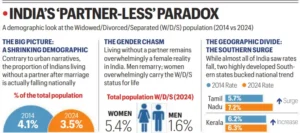
Recent Sample Registration System (SRS) data (2014–2024) shows India’s widowed/divorced/separated (W/D/S) population has declined nationally, but Tamil Nadu and Kerala recorded increases.

Partner-less Demographic

  • The term ‘partner-less’ population refers to individuals who are widowed, divorced, or separated (W/D/S).
  • This demographic is crucial for analyzing social structures, gender inequality, and welfare needs.

National Decline

    • India’s overall W/D/S population has shrunk in the last decade, showing improved marital stability in many regions.
    • Men’s share declined from 3.5% (2014) to 1.6% (2024), while women’s share rose slightly from 4.1% to 5.4%, highlighting a gender divide.

Southern States Rising

    • Tamil Nadu: 5.7% → 8.2% (highest increase).
    • Kerala: 4.6% → 6.3%.
    • Indicates regional divergence compared to North India, where W/D/S numbers declined.
India Partner-Less Population

Gender Inequality

    • Women remain disproportionately affected due to longer life expectancy, higher widowhood, and social stigma around remarriage.
    • Men show declining proportions, reflecting greater remarriage opportunities and social acceptance.

Social Change Factors

    • Higher literacy and migration in South India encourage independence and acceptance of separation/divorce.
    • Changing family structures weaken traditional joint family support systems.
    • Urbanization and digital connectivity allow individuals to make choices outside traditional norms.

Policy Concerns

    • Rising partner-less women in southern states demand gender-sensitive welfare schemes.
    • Need for targeted pensions, housing, and healthcare support for widows and divorced women.
    • Importance of community support systems to reduce isolation and vulnerability.

Impacts of the Trend

  • Gender Vulnerability Women remain disproportionately affected due to longer life expectancy, higher widowhood rates, and social stigma around remarriage, leading to economic and emotional insecurity.
  • Policy Gaps Existing welfare schemes often fail to address the specific needs of widows and divorced women, requiring targeted pensions, housing, and healthcare support.
  • Social Transformation Rising acceptance of separation and divorce in certain regions reflects changing family structures, urbanization, and migration patterns, signaling evolving social norms.

Way Forward

  • Expand Social Security Strengthen schemes for widows and divorced women, ensuring financial independence and dignity.
  • Gender-Sensitive Policies Integrate pensions, housing, and healthcare with a focus on women’s vulnerabilities in partner-less households.
  • Community Support Systems Encourage local networks, self-help groups, and NGOs to reduce isolation and provide emotional support.

Conclusion

India’s partner-less population shows declining national trends but rising southern disparities, demanding gendersensitive policies and regional focus.


NATIONAL AWARDS FOR EGOVERNANCE

TOPIC: (GS2) POLITY: PIB

Recently, the Union Government announced 16 winning projects under the National Awards for eGovernance (NAeG) 2026, recognizing excellence in digital governance across central, state, and local levels.

What is E-Governance

  • EGovernance refers to the application of ICT in government functioning to achieve good governance.
  • It involves digitizing processes to ensure efficiency, transparency, accountability, and accessibility in public service delivery.
  • Goes beyond computerization, it requires reengineering of government processes and building direct, citizencentric interfaces.

National eGovernance awards

  • The National Awards for eGovernance (NAeG) are India’s premier recognition for outstanding achievements in digital transformation of governance.
  • Instituted by the Ministry of Personnel, Public Grievances & Pensions, these awards aim to encourage innovation, efficiency, and citizencentric service delivery through technology.
  • Purpose: Promote excellence in eGovernance initiatives and motivate replication of successful models.
  • Award Components: Winners receive a trophy, certificate, and financial incentive — ₹10 lakh for Gold and ₹5 lakh for Silver — to strengthen project implementation.
  • Coverage: Open to Central Ministries, State/UT departments, District Administrations, Organisations, and Gram Panchayats.
  • 2026 Awards: A total of 16 awards — 10 Gold and 6 Silver — were conferred this year.

Categories in 2026

  • Process Reengineering: Using technology for digital transformation.
  • AI & New Tech: Citizencentric services through AI and emerging technologies.
  • Cyber Security: Innovations in safeguarding digital platforms.
  • District Initiatives: Locallevel projects improving service delivery.
  • Grassroots Governance: Deepening service delivery at village level.
  • Replication & Scaling: Adapting nationally awarded projects across states/UTs.
  • Data Analytics: Leveraging analytics for digital transformation.

Conclusion

The NAeG Awards 2026 highlight India’s commitment to digital governance, fostering innovation and citizencentric reforms.

AGRICULTURAL AND PROCESSED FOOD PRODUCTS EXPORT DEVELOPMENT AUTHORITY (APEDA)

TOPIC: (GS3) ECONOMY: PIB

The Agricultural and Processed Food Products Export Development Authority (APEDA) recently facilitated the first sea shipment of milletbased functional foods from Karnataka to New Zealand, marking a milestone in India’s agriexports.

Introduction

  • The Agricultural and Processed Food Products Export Development Authority (APEDA) is a statutory body set up in 1985 under the APEDA Act.
  • It works under the Ministry of Commerce and Industry to promote and develop the export of agricultural and processed food products.
  • APEDA plays a crucial role in enhancing India’s global agritrade competitiveness.

Structure and Reach

  • Headquarters: Located in New Delhi.
  • Leadership: Headed by a Chairman appointed by the Central Government.
  • Regional Offices: 15 offices across major cities including Mumbai, Bengaluru, Kolkata, Guwahati, Chennai, Kochi, Tripura, Srinagar, Jammu, and Ladakh to support exporters.

Objectives

  • Export Promotion: Develop and promote exports of scheduled products such as fruits, vegetables, processed foods, and organic produce.
  • Capacity Building: Provide training and technical support to stakeholders.
  • Quality Assurance: Set standards, conduct inspections, and ensure compliance with international norms.
  • Financial Assistance: Offer subsidies and support for infrastructure and technology adoption.

Functions

  • Standard Setting: Define specifications for scheduled products.
  • Exporter Registration: Register exporters and facilitate trade.
  • Inspection & Certification: Ensure product quality for global markets.
  • Organic Exports: Acts as Secretariat to the National Accreditation Board (NAB) for implementing the National Programme for Organic Production (NPOP).
  • Industry Development: Conduct surveys, feasibility studies, and promote new agriindustries.

Significance

  • Strengthens India’s position in global agriexports.
  • Promotes millets and superfoods, aligning with India’s International Year of Millets 2023 legacy.
  • Enhances farmer income by connecting them to premium international markets.
  • Supports food security and sustainability through organic and processed food exports.

Conclusion

APEDA is central to India’s agriexport growth and global branding, ensuring quality, innovation, and farmer prosperity.

The Agricultural and Processed Food Products Export Development Authority (APEDA) recently facilitated the first sea shipment of milletbased functional foods from Karnataka to New Zealand, marking a milestone in India’s agriexports.

Introduction

  • The Agricultural and Processed Food Products Export Development Authority (APEDA) is a statutory body set up in 1985 under the APEDA Act.
  • It works under the Ministry of Commerce and Industry to promote and develop the export of agricultural and processed food products.
  • APEDA plays a crucial role in enhancing India’s global agritrade competitiveness.

Structure and Reach

  • Headquarters: Located in New Delhi.
  • Leadership: Headed by a Chairman appointed by the Central Government.
  • Regional Offices: 15 offices across major cities including Mumbai, Bengaluru, Kolkata, Guwahati, Chennai, Kochi, Tripura, Srinagar, Jammu, and Ladakh to support exporters.

Objectives

  • Export Promotion: Develop and promote exports of scheduled products such as fruits, vegetables, processed foods, and organic produce.
  • Capacity Building: Provide training and technical support to stakeholders.
  • Quality Assurance: Set standards, conduct inspections, and ensure compliance with international norms.
  • Financial Assistance: Offer subsidies and support for infrastructure and technology adoption.

Functions

  • Standard Setting: Define specifications for scheduled products.
  • Exporter Registration: Register exporters and facilitate trade.
  • Inspection & Certification: Ensure product quality for global markets.
  • Organic Exports: Acts as Secretariat to the National Accreditation Board (NAB) for implementing the National Programme for Organic Production (NPOP).
  • Industry Development: Conduct surveys, feasibility studies, and promote new agriindustries.

Significance

  • Strengthens India’s position in global agriexports.
  • Promotes millets and superfoods, aligning with India’s International Year of Millets 2023 legacy.
  • Enhances farmer income by connecting them to premium international markets.
  • Supports food security and sustainability through organic and processed food exports.

Conclusion

APEDA is central to India’s agriexport growth and global branding, ensuring quality, innovation, and farmer prosperity.

NATIONAL EVIDHAN APPLICATION (NEVA)

TOPIC: (GS2) POLITY: PIB

The West Bengal Legislative Assembly has signed an MoU for the implementation of the National eVidhan Application (NeVA), a step toward paperless and digitally integrated legislative functioning.

What is National eVidhan Application (NeVA)

  • The National eVidhan Application (NeVA) is a flagship initiative under the Digital India Programme, designed to digitize legislative processes across all State and Union Territory assemblies.
  • It embodies the vision of “One Nation, One Application”, ensuring transparency, efficiency, and accessibility in lawmaking.

About NeVA

  • Mission Mode Project: Part of the 44 Mission Mode Projects under Digital India.
  • Objective: To make legislative functioning paperless, integrating all Houses on a single digital platform.
  • MemberCentric: Provides legislators with access to rules, bills, notices, bulletins, and contact details in real time.
  • Chair Support: Assists presiding officers in conducting proceedings smoothly.
  • Cloud Hosting: Hosted on Meghraj 2.0, India’s cloud infrastructure, ensuring scalability, security, and data integrity.

Key Features

  • RealTime Access: Instant availability of agendas, bills, and reports.
  • Secure Repository: Protects confidentiality and integrity of legislative data.
  • Multilingual Support: Caters to India’s linguistic diversity, making it inclusive.
  • Device Neutral: Accessible across smartphones, tablets, laptops, and desktops.

Significance

  • Promotes digital transformation in legislative functioning.
  • Enhances transparency and accountability in lawmaking.
  • Reduces paper usage, aligning with sustainability goals.
  • Strengthens citizen engagement by making legislative data more accessible.

Conclusion

NeVA is a transformative step toward paperless, transparent, and citizencentric legislatures.

Write a Review

Your email address will not be published. Required fields are marked *