Table of Contents
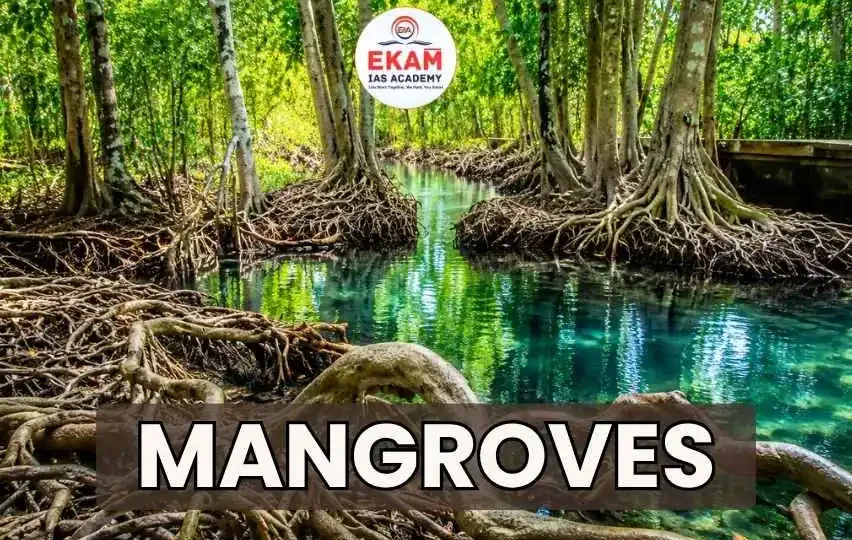
ToggleMangroves are specialized forest ecosystems found in the intertidal zones of tropical and subtropical sheltered coasts. They are unique because they thrive in conditions that would kill most other plants—high salinity, extreme tides, and oxygen-poor soil. In India, the Sunderbans stand as the largest contiguous mangrove forest in the world, a testament to the resilience of this biome.
Definition of Mangroves
Mangroves are a group of trees and shrubs that grow in the halophytic (salt-tolerant) zone of coastal areas. They are characterized by their ability to survive in saline water and their complex root systems that stabilize the shoreline against erosion and storm surges.
Characteristics of Mangroves
- Salt Tolerance: They have specialized mechanisms to either exclude salt at the roots or excrete it through glands in their leaves.
- Anaerobic Survival: Since they grow in waterlogged soil lacking oxygen, they develop specialized breathing roots.
- Viviparity: This is a unique reproductive trait where seeds germinate while still attached to the parent tree to ensure survival in a tidal environment.
- Zonation: Different species occupy specific bands based on their tolerance to tidal frequency and salinity.
Distribution of Mangroves
- Global: They are found between 25°N and 25°S latitudes. Southeast Asia, particularly Indonesia, holds the largest share of the world’s mangroves.
- India: According to the India State of Forest Report (ISFR), mangroves cover approximately 0.15% of the country’s total geographical area. The major distribution is along the East Coast (due to large deltas) and the West Coast (estuaries and creeks).
Types of Mangroves
Mangroves are often categorized by their proximity to the water and root structure:
Red Mangroves: Found closest to the water; identified by their arched prop roots.
Black Mangroves: Found slightly further inland; known for their finger-like pneumatophores (breathing roots).
White Mangroves: Found furthest inland; lack specialized roots but have salt-excreting glands at the base of leaves.
Adaptations of Mangroves
For the mangroves UPSC syllabus, understanding their physiological “hacks” is vital:
- Pneumatophores: Vertical roots that grow upward out of the mud to absorb oxygen during low tide.
- Stilt/Prop Roots: These provide mechanical support to the tree in unstable, shifting mud.
- Buttress Roots: Large, wide roots at the base of the trunk that provide stability.
- Succulent Leaves: Thick leaves that store water, similar to desert plants, to manage high salinity.
Components of Mangrove Ecosystem
- Abiotic: Fine-grained alluvial soil, high humidity, tidal fluctuations, and brackish water.
- Biotic:
- Flora: Species like Avicennia, Rhizophora, and Sonneratia.
- Fauna: Home to the Royal Bengal Tiger (Sunderbans), Mudskippers, Fiddler Crabs, Olive Ridley Turtles, and various migratory birds.
Importance of Mangroves
- Disaster Mitigation: They act as bio-shields, absorbing the energy of tsunamis, cyclones, and storm surges.
- Carbon Sequestration: Mangroves are “Blue Carbon” sinks, storing up to four times more carbon than tropical rainforests.
- Coastal Protection: Their dense roots trap sediments, preventing coastal erosion and building new land.
- Livelihoods: They serve as nurseries for 80% of global fish catches, supporting local fisheries.
Threats to Mangroves
- Aquaculture Expansion: The conversion of mangrove forests into commercial shrimp farms.
- Climate Change: Rising sea levels can drown mangroves if they have no room to migrate inland.
- Pollution: Oil spills and plastic waste block the lenticels of pneumatophores, suffocating the trees.
- Deforestation: For fuel, timber, and coastal urban development.
Mangrove Conservation in India
India has one of the best legal frameworks for mangrove conservation in india:
- MISHTI (Mangrove Initiative for Shoreline Habitats & Tangible Incomes): Launched in the 2023-24 Budget to promote mangrove plantation along the coastline.
- Coastal Regulation Zone (CRZ): Mangroves are classified under CRZ-I (most protected), where no industrial activity is allowed.
- Magrove Society of India: Works on restoration and community awareness.
- UNESCO Sites: The Sunderbans is recognized as a World Heritage Site and a Ramsar Site.
Conservation Measures
- Community-Based Restoration: Involving local “Mangrove Mitras” in planting and monitoring.
- Regulating Aquaculture: Moving shrimp farms away from ecologically sensitive zones.
- Integrated Coastal Zone Management (ICZM): A multidisciplinary approach to managing coastal resources sustainably.
Conclusion
Mangroves are the silent sentinels of our shores. For environment ecology notes UPSC, it is clear that their conservation is not just an ecological goal but a strategic necessity for India’s climate resilience. Protecting the mangroves ecosystem UPSC ensures that our coastlines remain shielded and our “Blue Carbon” stores remain locked, securing a sustainable future for both nature and people.
UPSC Prelims: PYQs & Practice Questions
Previous Year Questions (Prelims)
Q: Which one of the following regions of India has a combination of mangrove forest, evergreen forest, and deciduous forest?
(a) North Coastal Andhra Pradesh
(b) South West Bengal
(c) Southern Saurashtra
(d) Andaman and Nicobar Islands
Answer: (d) Andaman and Nicobar Islands
Explanation:
The Andaman and Nicobar Islands possess a unique combination of ecosystems because of their equatorial climate and island geography. The region contains extensive mangrove forests along creeks and estuaries, dense tropical evergreen forests, and patches of moist deciduous forests. In contrast, regions like West Bengal mainly contain mangroves and deciduous vegetation but lack extensive tropical evergreen forests.
UPSC CSE Prelims 2015
Q: Which of the following statements is/are correct regarding mangroves?
1. Mangrove plants require high solar radiation and high temperature.
2. Mangroves are found in the inter-tidal zones of sheltered coasts.
3. Mangroves are called “Coastal Guardians” because they protect the shoreline from erosion.
Select the correct answer:
(a) 1 and 2 only
(b) 2 and 3 only
(c) 1 and 3 only
(d) 1, 2 and 3
Answer: (d) 1, 2 and 3
Explanation:
All the statements are correct. Mangroves thrive in tropical and subtropical climates with high temperature and strong solar radiation. They grow in the inter-tidal zones of sheltered coastal areas such as estuaries and deltas. Mangroves are also known as “Coastal Guardians” because their dense root systems reduce coastal erosion and protect shorelines from cyclones, waves, and storm surges.
Practice Questions
Q: In the context of mangrove adaptations, what is "Viviparity"?
(a) The ability to excrete excess salt through specialized leaf glands.
(b) The process of seeds germinating while still attached to the parent tree.
(c) The development of upward-growing roots to absorb atmospheric oxygen.
(d) The shifting of the ecosystem inland in response to sea-level rise.
Answer: (b) The process of seeds germinating while still attached to the parent tree
Explanation:
Viviparity is a critical adaptation in mangrove ecosystems. Since mangroves grow in saline and waterlogged soils, ordinary seeds may rot or get washed away before germinating. Therefore, the seeds germinate while still attached to the parent tree, forming elongated propagules that can immediately establish themselves after falling into the mud.
Q: Which of the following Indian states has the largest area under mangrove cover according to the India State of Forest Report (ISFR)?
(a) Gujarat
(b) Odisha
(c) West Bengal
(d) Andhra Pradesh
Answer: (c) West Bengal
Explanation:
West Bengal, home to the Sundarbans mangrove ecosystem, has the largest share of India’s mangrove cover, accounting for nearly 42% of the total. It is followed by Gujarat and the Andaman & Nicobar Islands. The Sundarbans also represent the world’s largest contiguous mangrove forest.
UPSC Mains – Previous Year & Practice Questions
Mains Previous Year Questions
Question: Coastal regions of India are prone to cyclones. Discuss the role of mangroves in reducing the impact of such disasters. (Mains 2019)
Question: Explain the causes and effects of coastal erosion in India. What are the available shore protection measures? (Mains 2021)
(Mangroves act as an important biological barrier against erosion)
Question: Discuss the causes of the depletion of mangroves and explain their importance in maintaining coastal ecology. (Mains 2018)
Question: Write a critical note on the Sunderbans as a unique ecosystem. (Mains 2011)
Question: What is the economic importance of the marine ecosystem in India? Discuss the potential of the Blue Economy. (Mains 2015)
(Mangroves function as breeding and nursery grounds for fisheries)
Mains Practice Questions
[10 Marks | 150 Words]
Question: Analyze the physiological and morphological adaptations of mangroves that enable them to survive in saline and anaerobic conditions.
[15 Marks | 250 Words]
Question: Critically evaluate the MISHTI (Mangrove Initiative for Shoreline Habitats & Tangible Incomes) scheme in the context of India’s climate change commitments and Nationally Determined Contributions (NDCs).
[15 Marks | 250 Words]
Question: How does “Blue Carbon” sequestration in mangrove ecosystems compare to terrestrial forests? Discuss its potential in the global carbon credit market.



Mangroves-FAQs
Why are mangroves called 'Halophytes'?
Halophytes are plants that have evolved to live in high-salinity environments. Mangroves use salt-filtration or salt-excretion systems to survive where other plants would dehydrate.
What are 'Pneumatophores'?
They are specialized vertical “breathing roots” that grow upwards from the water and mud. Since mangrove soil is anaerobic (oxygen-poor), these roots have pores called lenticels to take in air during low tide.
Is the 'Sunderban' the only mangrove site in India?
No. While it is the largest, other significant sites include Bhitarkanika (Odisha), Pichavaram (Tamil Nadu), Coringa (Andhra Pradesh), and the various creeks of Gujarat and Maharashtra.
How do mangroves protect against Tsunamis?
The dense network of prop and stilt roots acts as a physical barrier that dissipates the energy of the incoming water, significantly reducing the wave height and velocity before it reaches human settlements.
What is the 'MISHTI' initiative?
Launched in the Union Budget 2023-24, MISHTI focuses on mangrove plantation along India’s coastline and on salt pans, aiming for intensive afforestation through the convergence of MGNREGS and the CAMPA fund.