
Table of Contents
ToggleNational Green Tribunal (NGT) in India: Role, Powers, and Landmark Judgments
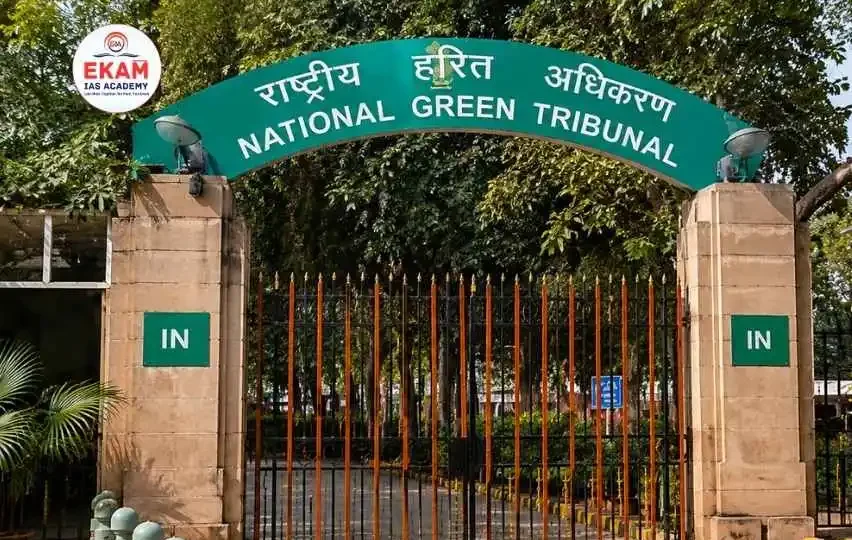
The NGT Full Form stands for the National Green Tribunal. It is a specialized, fast-track statutory body established to handle environmental disputes involving multi-disciplinary issues. Often described as a premier Environmental Tribunal in India, it operates with a high degree of autonomy to ensure that infrastructure and industrial projects align with ecological safety standards.
Background and Establishment
The genesis of the tribunal stems from India’s international commitments made during the 1992 Rio de Janeiro Earth Summit, where India pledged to provide judicial and administrative remedies for victims of environmental degradation.
The tribunal was formally established on October 18, 2010, under the National Green Tribunal Act 2010. With its creation, India became only the third country in the world—and the first developing nation—to set up a specialized environmental court, following in the footsteps of Australia and New Zealand.
[1992 Rio Earth Summit Commitments]
│
▼
[Law Commission’s Recommendations]
│
▼
[National Green Tribunal Act, 2010]
│
▼
[Establishment of NGT
(18 October 2010)]
Composition and Structure of the Tribunal
The National Green Tribunal balances legal knowledge with scientific expertise through its unique multi-disciplinary composition:
- The Leadership: The tribunal is headed by a Chairperson, who is a retired Judge of the Supreme Court of India or a retired Chief Justice of a High Court.
- The Benches: The Act mandates that the tribunal must consist of a minimum of 10 and a maximum of 20 full-time Judicial Members, alongside an equal number of Expert Members (reputed scientists and environmental policy professionals).
- Geographical Distribution: New Delhi serves as the Principal Place of Sitting for the tribunal. To ensure country-wide reach, four regional benches operate in Bhopal (Central), Pune (Western), Kolkata (Eastern), and Chennai (Southern).
Jurisdiction, Principles, and Powers
The NGT holds wide-ranging jurisdiction over all civil cases where a substantial question relating to the environment is involved.
A. The 7 Environmental Laws Under NGT Jurisdiction
The tribunal derives its operational power by hearing civil appeals filed under seven primary statutory frameworks:
The Water (Prevention and Control of Pollution) Act, 1974
The Water (Prevention and Control of Pollution) Cess Act, 1977
The Forest (Conservation) Act, 1980
The Air (Prevention and Control of Pollution) Act, 1981
The Environment (Protection) Act, 1986
The Public Liability Insurance Act, 1991
The Biological Diversity Act, 2002
Core Core Principles Applied by the NGT
Unlike traditional civil courts, the Green Tribunal is not bound by the strict, technical rules of the Code of Civil Procedure, 1908. Instead, it is guided by the principles of Natural Justice. Under the National Green Tribunal Act 2010, the court must base its judgments on three foundational concepts:
- Sustainable Development: Balancing economic development with ecological protection.
- The Precautionary Principle: Taking preventive action ahead of scientific certainty to stop potential environmental damage.
- The Polluter Pays Principle: Mandating that the party responsible for environmental degradation must pay for restoration costs and compensate affected victims.
Landmark Judgments and Achievements
The NGT has reshaped India’s environmental policy landscape by issuing several historic directives:
- Almitra H. Patel Case: The tribunal issued a complete ban on the open burning of municipal solid waste across all cities, accelerating waste segregation reforms.
- Save Mon Region Federation Case: The NGT suspended a multi-crore hydro project in Arunachal Pradesh to safeguard the wintering habitat of the endangered Black-necked crane.
- Stubble Burning Directive: The tribunal directed northern states to enforce a strict ban on crop residue burning, introducing fine structures to protect the ambient air quality index of Delhi-NCR.
Challenges and Criticisms
Despite its strong record, the tribunal faces significant structural hurdles:
- High Vacancy Rates: Delays in appointing judges and scientists often leave several regional benches understaffed, slowing down the resolution of cases.
- The High Court Dilemma: Even though the National Green Tribunal Act 2010 states that appeals against NGT orders go directly to the Supreme Court, petitioners often challenge NGT rulings in regional High Courts using constitutional writ petitions under Article 226, leading to legal delays.
- Limited Enforcement Mechanism: The tribunal relies heavily on state pollution control boards and district magistrates to enforce its penalty orders, which can lead to slow execution on the ground.
Conclusion
Analyzing the National Green Tribunal highlights that economic progress cannot come at the expense of ecological safety nets. For civil services aspirants compiling an institutional analysis summary, the NGT remains a vital model of proactive environmental governance. By addressing its administrative gaps, India can strengthen this specialized court to protect public health, preserve biodiversity, and ensure long-term, eco-friendly growth.
UPSC Prelims: PYQs & Practice Questions
Previous Year Questions (Prelims)
UPSC CSE Prelims 2018
Q: The National Green Tribunal (NGT) Act, 2010 was enacted in consonance with which of the following provisions of the Constitution of India?
1. Right to healthy environment, construed as a part of Right to Life under Article 21.
2. Provision of grants for raising the level of administration in the Scheduled Areas for the welfare of Scheduled Tribes under Article 275(1).
Select the correct answer using the code given below:
A. 1 only
B. 2 only
C. Both 1 and 2
D. Neither 1 nor 2
Answer: A. 1 only
Explanation:
The enactment of the NGT Act is closely linked with Article 21 of the Constitution, which guarantees the Right to Life. The judiciary has interpreted it to include the right to a clean and healthy environment. Article 275(1) deals with financial grants to states and has no connection with the establishment of the National Green Tribunal.
UPSC CSE Prelims 2014
Q: How is the National Green Tribunal (NGT) different from the Central Pollution Control Board (CPCB)?
1. The NGT has been established by an Act whereas the CPCB has been created by an executive order of the Government.
2. The NGT provides environmental justice and helps reduce the burden of litigation in the higher courts whereas the CPCB promotes cleanliness of streams and wells, and aims to improve the quality of air in the country.
Which of the statements given above is/are correct?
A. 1 only
B. 2 only
C. Both 1 and 2
D. Neither 1 nor 2
Answer: B. 2 only
Explanation:
Statement 1 is incorrect because both the NGT and the CPCB are statutory bodies created by Acts of Parliament. The NGT was created under the NGT Act, 2010, while the CPCB was created under the Water (Prevention and Control of Pollution) Act, 1974. Statement 2 is correct because the NGT delivers environmental justice, while the CPCB focuses on pollution control, monitoring, and improvement of water and air quality.
Practice Questions
Q: Consider the following statements regarding the structural jurisdiction of the National Green Tribunal:
1. Appeals against any order, decision, or direction issued by the NGT lie directly before the Supreme Court of India.
2. The tribunal has been barred from hearing cases arising out of disputes relating to the Scheduled Tribes and Other Traditional Forest Dwellers (Recognition of Forest Rights) Act, 2006.
Which of the statements given above is/are correct?
A. 1 only
B. 2 only
C. Both 1 and 2
D. Neither 1 nor 2
Answer: C. Both 1 and 2
Explanation:
Both statements are correct. Section 22 of the NGT Act, 2010 provides that an appeal against an NGT order lies directly before the Supreme Court. Further, while the NGT covers core environmental laws, it does not have jurisdiction over disputes under the Forest Rights Act, 2006 and the Wildlife (Protection) Act, 1972.
Q: The National Green Tribunal is not bound by the technical procedures laid down under the Code of Civil Procedure, 1908. Instead, it is guided by which of the following principles?
A. The Doctrine of Pith and Substance
B. Principles of Natural Justice
C. The Rule of Strict Interpretation
D. The Doctrine of Eminent Domain
Answer: B. Principles of Natural Justice
Explanation:
To ensure quick and flexible access to environmental justice, the NGT is exempted from the technical rigidities of the Code of Civil Procedure. It is guided by the Principles of Natural Justice and applies ecological principles such as the Precautionary Principle and the Polluter Pays Principle.
UPSC Mains – Previous Year & Practice Questions
Mains Previous Year Questions
Mains 2019
Question: Public Interest Litigation (PIL) has been both a boon and a bane for environmental governance in India. Discuss with reference to the active role played by specialized environmental courts.
Allows you to evaluate the role of the NGT in clearing public interest environment petitions.
Mains 2018
Question: How far do you agree with the view that tribunals have diluted the power and prestige of the traditional High Courts in India? Analyze with reference to recent apex court rulings.
Directly maps to the jurisdictional conflicts between the NGT and Article 226 writ powers of High Courts.
Mains 2016
Question: Environmental Impact Assessment (EIA) studies are increasingly becoming a mere bureaucratic formality rather than a tool for sustainable development. Critically comment.
Can be connected to how the NGT acts as an appellate body to review and strike down weak environmental clearances.
Mains 2015
Question: Discuss the major challenges faced by specialized regulatory bodies in India due to human resource deficiencies and institutional vacancies.
Mains 2013
Question: Enumerate the National Green Tribunal’s roles, responsibilities, and major achievements since its inception under the National Green Tribunal Act, 2010.
Mains Practice Questions
[10 Marks | 150 Words]
Question: The NGT balances judicial knowledge with scientific input by utilizing expert members. Evaluate how this multi-disciplinary composition improves the quality of environmental jurisprudence compared to traditional civil courts.
[15 Marks | 250 Words]
Question: Despite delivering historic environmental judgments, the NGT is frequently criticized for lacking independent enforcement machinery. Analyze the challenges the tribunal faces when relying on state apparatuses to execute its penalty orders.
[15 Marks | 250 Words]
Question: The exclusion of the Wildlife (Protection) Act, 1972, from the NGT's schedule creates an artificial separation between habitat conservation and species protection. Critically analyze the consequences of this legislative exclusion on integrated environmental governance.



National Green Tribunal-FAQs
What is the National Green Tribunal?
The National Green Tribunal is a specialized judicial body in India established to handle environmental disputes and cases involving pollution, forest conservation, biodiversity, and environmental protection.
When was the National Green Tribunal established?
The National Green Tribunal was established on October 18, 2010, under the National Green Tribunal Act, 2010.
What is the full form of NGT?
The full form of NGT is National Green Tribunal. It is India’s specialized environmental tribunal for quick disposal of environmental cases.
What are the main principles followed by the NGT?
The NGT follows key environmental principles such as Sustainable Development, the Precautionary Principle, and the Polluter Pays Principle while deciding environmental cases.
Which laws come under the jurisdiction of the NGT?
NGT has jurisdiction over cases under major environmental laws such as the Water Act, 1974, Air Act, 1981, Environment Protection Act, 1986, Forest Conservation Act, 1980, Public Liability Insurance Act, 1991, and Biological Diversity Act, 2002.