Table of Contents
ToggleBIMSTEC UPSC notes define the Bay of Bengal Initiative for Multi-Sectoral Technical and Economic Cooperation as a unique regional organization. Comprising seven member states, it bridges South Asia and Southeast Asia, representing 22% of the global population and a combined GDP of over $5 trillion. Established in 1997, it serves as a contiguous regional unity centered around the Bay of Bengal.
Historical Background
The organization was founded on June 6, 1997, through the Bangkok Declaration.
- Evolution: Initially formed as BIST-EC (Bangladesh, India, Sri Lanka, and Thailand).
- Expansion: Myanmar joined in late 1997 (renamed BIMST-EC). Nepal and Bhutan became full members in 2004, leading to its current name.
- Charter: A major milestone was the signing of the BIMSTEC Charter at the 5th Summit (2022), providing it with a formal legal identity and a flag.
Member Countries
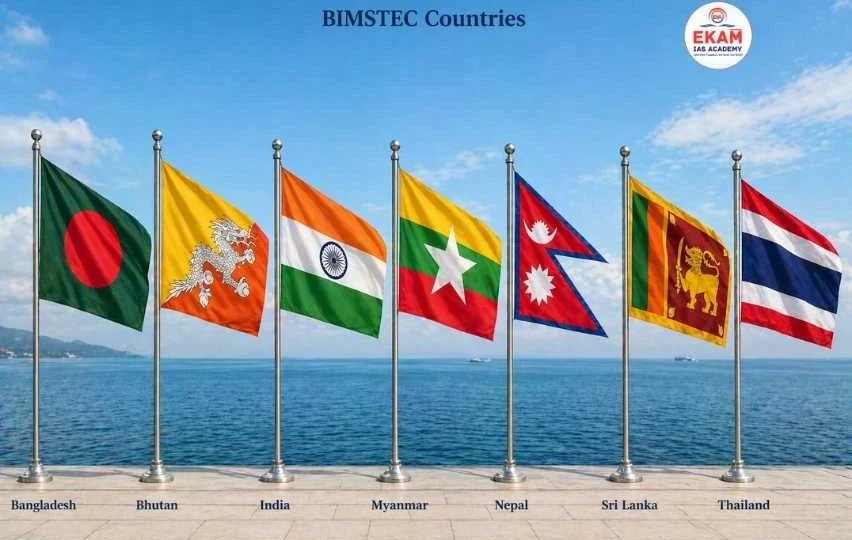
The IR BIMSTEC Countries upsc notes categorize members into two regions:
- South Asia: Bangladesh, Bhutan, India, Nepal, and Sri Lanka.
- Southeast Asia: Myanmar and Thailand.
Objectives and Sectors of Cooperation
The primary BIMSTEC Countries and objectives are to create an enabling environment for rapid economic development and promote active collaboration in matters of common interest.
Following the 5th Summit, the 14 original sectors were streamlined into 7 Pillar Sectors, each led by a member state:
- Trade, Investment & Development: Bangladesh
- Environment & Climate Change: Bhutan
- Security (Counter-Terrorism, Energy, Disaster Mgmt): India
- Agriculture & Food Security: Myanmar
- People-to-People Contact: Nepal
- Science, Technology & Innovation: Sri Lanka
- Connectivity: Thailand
Institutional Structure
- Summit: Highest policy-making body (Heads of State).
- Ministerial Meeting: Foreign Ministers’ forum.
- Senior Officials’ Meeting (SOM): Managed by Foreign Secretaries.
- BIMSTEC Permanent Working Committee (BPWC): Handles daily operations.
- Secretariat: Located in Dhaka, Bangladesh.
- Secretary-General: Currently Indra Mani Pandey (India) as of 2024.
Strategic Significance
- Bridge between SAARC and ASEAN: It provides a platform for cooperation between the two regional blocs without the historical baggage of SAARC.
- Indo-Pacific Gateway: The Bay of Bengal is the “heart” of the Indo-Pacific, making BIMSTEC crucial for maritime security.
- Countering Influence: It offers a multilateral alternative to China’s Belt and Road Initiative (BRI) in the region.
BIMSTEC Importance for India
- Neighborhood First & Act East: BIMSTEC is the intersection of these two core Indian foreign policies.
- North-East Development: Connecting India’s landlocked Northeast to the Bay of Bengal via projects like the Kaladan Multi-modal Transit Transport Project.
- Security Hub: As the lead for the Security Pillar, India coordinates counter-terrorism and disaster management (e.g., PANEX exercises).
- SAARC Alternative: With SAARC dysfunctional due to Pakistan’s non-cooperation, India views BIMSTEC as its primary vehicle for regional integration.
Key Initiatives and Agreements
- Master Plan for Transport Connectivity: A 10-year strategy to enhance regional logistics.
- BIMSTEC Free Trade Agreement (FTA): Negotiated to boost intra-regional trade (currently under progress).
- Convention on Mutual Legal Assistance in Criminal Matters: Enhancing security cooperation.
Challenges
- Inconsistent Momentum: Unlike ASEAN, summits have been infrequent (only 6 in 27 years).
- Resource Crunch: The Secretariat remains underfunded compared to its mandate.
- Bilateral Frictions: Issues like the Rohingya crisis (Bangladesh-Myanmar) can affect group harmony.
- Intra-regional Trade: Currently remains low at around 5-7%.
Recent Developments
- 6th BIMSTEC Summit (Thailand): Adoption of the Bangkok Vision 2030, focusing on a “Prosperous, Resilient, and Open” region.
- Establishment of Centres of Excellence: India’s commitment to centres for Disaster Management and Traditional Medicine.
- BODHI Programme: Launched for human resource infrastructure and capacity building.
Way Forward
- Finalizing the FTA: Crucial to unlock economic potential.
- Digital Infrastructure: Implementing India’s proposal for a Digital Public Infrastructure (DPI) pilot project.
- Blue Economy: Leveraging the Bay of Bengal’s maritime resources sustainably.
Conclusion
BIMSTEC represents a “Bay of Hope” for regional integration. For UPSC aspirants, it is a quintessential case study of Regionalism vs. Multilateralism. As the center of global gravity shifts to the Indo-Pacific, BIMSTEC’s success will determine the stability and prosperity of South and Southeast Asia.
UPSC Prelims: PYQs & Practice Questions
Previous Year Questions (Prelims)
Q: Consider the following pairs: (2022)
1. Anatolia — Turkey
2. Amhara — Ethiopia
3. Cabo Delgado — Spain
4. Catalonia — Italy
How many pairs given above are correctly matched?
(a) Only one pair
(b) Only two pairs
(c) Only three pairs
(d) All four pairs
Answer: (b) Only two pairs
Explanation:
Anatolia is in Turkey, and Amhara is in Ethiopia. Cabo Delgado is in Mozambique, while Catalonia is in Spain. UPSC often tests regional geography linked to international relations.
Note: This is relevant for BIMSTEC geography, such as Rakhine State in Myanmar and Chittagong in Bangladesh.
Q: Which of the following is/are the member(s) of BIMSTEC? (Based on 2014–2016 trends)
1. Bhutan
2. Maldives
3. Myanmar
4. Thailand
Select the correct answer:
(a) 1, 2, and 3 only
(b) 2, 3, and 4 only
(c) 1, 3, and 4 only
(d) 1, 2, 3, and 4
Answer: (c) 1, 3, and 4 only
Explanation:
BIMSTEC members are Bangladesh, India, Sri Lanka, Thailand, Myanmar, Nepal, and Bhutan. Maldives is a member of SAARC but not BIMSTEC.
Practice Questions
Q: Regarding the 'BIMSTEC Charter', consider the following statements:
1. It was signed during the 5th BIMSTEC Summit held in Colombo, Sri Lanka (2022).
2. The Charter provides BIMSTEC with a formal legal identity as an intergovernmental organization.
Which of the statements given above is/are correct?
(a) 1 only
(b) 2 only
(c) Both 1 and 2
(d) Neither 1 nor 2
Answer: (c) Both 1 and 2
Explanation:
Until 2022, BIMSTEC operated without a formal charter. The Colombo Summit was a turning point, providing the legal basis for the organization, its flag, and a defined institutional structure.
Q: The 'Bangkok Vision 2030' recently seen in the news is related to:
(a) A climate change roadmap for ASEAN countries.
(b) A strategic document to make BIMSTEC a prosperous, resilient, and open region.
(c) A digital payment initiative between India and Thailand.
(d) A naval cooperation framework for the South China Sea.
Answer: (b)
Explanation:
Adopted at the 6th BIMSTEC Summit, the Bangkok Vision 2030 aims to guide the organization toward sustainable and inclusive growth by the end of the decade.
UPSC Mains – Previous Year & Practice Questions
Mains Previous Year Questions
Question: Do you agree that BIMSTEC is a parallel organization like the SAARC? What are the similarities and dissimilarities between the two? How are Indian interests served by being a part of an emerging organization? (2022)
Question: The ‘Neighborhood First’ policy of India is a cornerstone of its foreign policy. In this context, discuss the role of BIMSTEC in fostering regional cooperation. (Based on 2017–2020 trend)
Question: Analyze the importance of BIMSTEC in India’s 'Act East' Policy. How does it act as a bridge between South and South-East Asia?
Question: Discuss the significance of the BIMSTEC Master Plan for Transport Connectivity in enhancing regional trade and logistics.
Question: Evaluate the challenges faced by BIMSTEC in achieving its full potential as a regional grouping.
Mains Practice Questions
[15 Marks | 250 Words]
Question: SAARC is a non-starter, whereas BIMSTEC is a ‘Bay of Hope.’ Critically analyze the reasons for the stagnation of SAARC and the rising importance of BIMSTEC for India.
[10 Marks | 150 Words]
Question: BIMSTEC serves as a natural platform for India to implement its 'Security and Growth for All in the Region' (SAGAR) vision. Elaborate.
[15 Marks | 250 Words]
Question: The Bay of Bengal is becoming a theatre of great power competition. Discuss the role of BIMSTEC in maintaining a rules-based order in the Indo-Pacific.



BIMSTEC-FAQs
Why is BIMSTEC considered an "Alternative to SAARC"?
Due to the perpetual deadlock in SAARC (caused by India-Pakistan tensions), India has pivoted toward BIMSTEC. Unlike SAARC, BIMSTEC countries generally share a common vision for connectivity and economic growth without being paralyzed by bilateral territorial disputes.
What is the "Lead Country" concept in BIMSTEC?
To ensure efficiency, each member state leads a specific “Pillar” of cooperation. For example, India leads the Security Pillar, which includes Counter-Terrorism, Disaster Management, and Energy.
What are the major connectivity projects under BIMSTEC?
Key projects include the Kaladan Multi-modal Transit Transport Project (India-Myanmar), the India-Myanmar-Thailand Trilateral Highway, and the BIMSTEC Coastal Shipping Agreement.
Is BIMSTEC part of the "Indo-Pacific"?
Yes. Geographically, the Bay of Bengal is the gateway between the Indian and Pacific Oceans. Therefore, BIMSTEC is central to the maritime security and trade architecture of the Indo-Pacific region.
What is the significance of the BIMSTEC Secretariat in Dhaka?
The Dhaka Secretariat provides institutional continuity. While it was historically under-resourced, recent years have seen an increase in funding and personnel, particularly after the signing of the BIMSTEC Charter in 2022.