Table of Contents
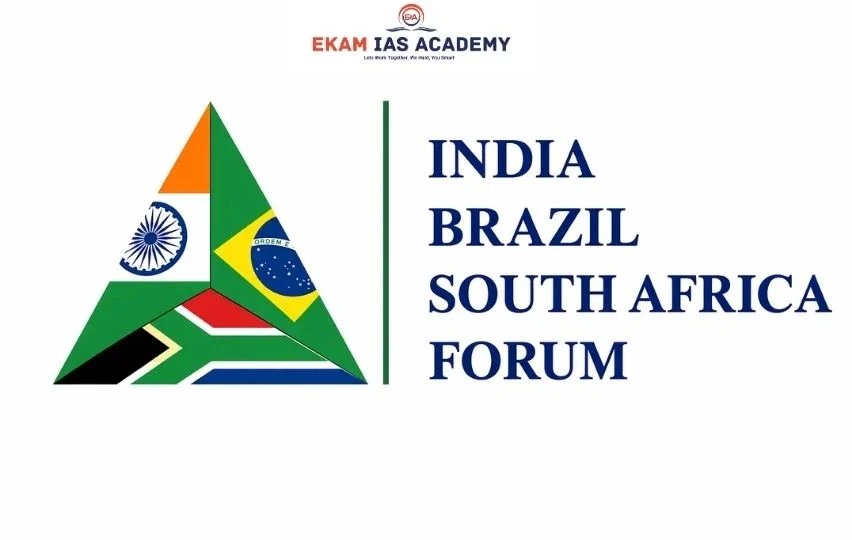
ToggleIBSA UPSC notes define the India-Brazil-South Africa (IBSA) Dialogue Forum as a unique trilateral initiative that brings together three large democracies and major economies from three different continents. Unlike other groupings that may include non-democratic or strictly regional powers, IBSA is bound by the shared values of pluralism, democracy, and human rights, acting as a collective voice for the Global South.
Historical Background
- Brasilia Declaration (2003): The grouping was formalized on June 6, 2003, when the Foreign Ministers of the three countries met in Brazil and issued this founding document.
- Genesis: The idea was discussed on the sidelines of the G-8 Summit in Evian (2003) to address common challenges in trade, governance, and development.
- Evolution: While the emergence of BRICS (adding Russia and China) somewhat overshadowed IBSA’s visibility after 2011, the forum remains relevant as the “democratic core” of South-South cooperation.
Member Countries
The IR IBSA Countries upsc notes identify the members as:
India (Asia)
Brazil (Latin America)
South Africa (Africa)
Objectives and Principles
The core IBSA Dialogue Forum notes emphasize:
- South-South Cooperation: Strengthening ties among developing nations to reduce dependence on the “Global North.”
- Global Governance Reform: Specifically advocating for the reform of the UN Security Council (UNSC) and the World Trade Organization (WTO).
- Poverty Alleviation: Collaborative efforts to meet Sustainable Development Goals (SDGs).
Institutional Mechanisms & Structure
IBSA does not have a permanent secretariat. It operates through:
- Trilateral Summits: Highest level meetings of Heads of State.
- Ministerial Commission: Regular meetings of Foreign Ministers.
- Joint Working Groups (JWGs): 14 sectors including Agriculture, Health, Science & Technology, and Defence.
- People-to-People Forums: 6 forums including the Parliamentary, Women’s, and Academic forums.
Key Initiatives: The IBSA Fund
The IBSA Facility for Poverty and Hunger Alleviation (IBSA Fund) is a flagship initiative.
- Established in 2004 and managed by the UN Office for South-South Cooperation (UNOSSC).
- Each member contributes $1 million annually.
- It funds projects in fellow developing countries (LDCs) in areas like solar energy, health centers, and agriculture, winning several UN awards for its “partner-centric” model.
Strategic Significance
- Continental Bridge: It links three distinct geographical regions—Asia, South America, and Africa.
- Democracy for Development: It promotes the idea that development can be achieved within a democratic framework, countering the “authoritarian capitalism” model.
- Joint Naval Exercises: IBSAMAR is a trilateral naval exercise that enhances maritime security and interoperability among the three navies.
Challenges
- Overlap with BRICS: Many observers argue that BRICS has more political and economic “heft,” leading to fewer IBSA-only summits since 2011.
- Domestic Issues: Economic slowdowns or political shifts within any member country can stall trilateral momentum.
- Geographical Distance: Large physical distances make trade logistics more complex compared to regional blocs.
Recent Developments
- India’s Contribution: In April 2026, India contributed another $1 million to the IBSA Fund, taking its total contribution to over $18 million.
- Governance Reforms: Recent meetings have focused on institutionalizing the National Security Adviser (NSA) level dialogue to tackle terrorism and cybersecurity.
- AI Impact Summit: India has invited IBSA partners to collaborate on “Human-Centric AI” to ensure digital public infrastructure (DPI) remains equitable.
Way Forward
- Regularity of Summits: Reinvigorating the trilateral summits is essential to maintain political visibility.
- Digital Public Infrastructure (DPI): Sharing India’s UPI/CoWIN stack with Brazil and South Africa to foster digital inclusivity.
- UNSC Reform: A united front within the G4 and L.69 groups to push for permanent seats for India and Brazil.
Conclusion
IBSA remains a vital platform for democratic emerging powers. While BRICS handles broader geopolitical balancing, IBSA focuses on the functional and moral leadership of the Global South. For the UPSC, IBSA represents the “True South-South Solidarity” that began at Bandung and continues to strive for a fairer world order.
UPSC Prelims: PYQs & Practice Questions
Previous Year Questions (Prelims)
Q: With reference to the 'IBSA Fund', consider the following statements:
1. It is officially known as the IBSA Facility for Poverty and Hunger Alleviation.
2. It is managed by the World Bank's International Development Association (IDA).
Which of the statements given above is/are correct?
(a) 1 only
(b) 2 only
(c) Both 1 and 2
(d) Neither 1 nor 2
Answer: (a) 1 only
Explanation:
Statement 1 is correct. Statement 2 is incorrect because the IBSA Fund is managed by the United Nations Office for South-South Cooperation (UNOSSC), not the World Bank.
Q: The 'IBSAMAR' is a series of maritime exercises between the navies of:
(a) India, Brazil, and Argentina
(b) India, Bangladesh, and South Africa
(c) India, Brazil, and South Africa
(d) Italy, Brazil, and Spain
Answer: (c) India, Brazil, and South Africa
Explanation:
IBSAMAR is a trilateral naval exercise conducted by India, Brazil, and South Africa to enhance maritime security in the Atlantic and Indian Oceans. Recent editions have focused on interoperability and tactical maneuvers.
Practice Questions
Q: Which of the following groups of countries are known as the 'G4 Nations' which frequently coordinate within IBSA for UNSC reforms?
(a) India, Brazil, Japan, and Germany
(b) India, South Africa, Brazil, and Nigeria
(c) USA, UK, France, and Russia
(d) Japan, Germany, Italy, and Canada
Answer: (a) India, Brazil, Japan, and Germany
Explanation:
While IBSA is a trilateral group, two of its members, India and Brazil, are part of the G4, a group of four countries that support each other’s bids for permanent seats on the United Nations Security Council.
Q: The 'Brasilia Declaration' (2003) is the founding document of:
(a) BRICS
(b) IBSA
(c) MERCOSUR
(d) G-20
Answer: (b) IBSA
Explanation:
Signed on June 6, 2003, the Brasilia Declaration by the Foreign Ministers of India, Brazil, and South Africa officially launched the IBSA Dialogue Forum.
UPSC Mains – Previous Year & Practice Questions
Mains Previous Year Questions
Question: The IBSA Dialogue Forum is a unique grouping of three multi-ethnic and multi-cultural democracies. In what ways does it differ from the BRICS grouping?
Question: South-South cooperation is no longer a peripheral issue in international relations. Discuss this in the light of the working of the IBSA Fund.
Question: Evaluate the role of IBSA in advocating for the reform of global governance institutions like the UN Security Council and the WTO.
Question: India’s engagement with Brazil and South Africa is a pillar of its 'South-South' diplomacy. Analyze the strategic significance of this trilateral for India’s maritime security.
Question: Discuss the challenges faced by IBSA in maintaining its relevance after the emergence of BRICS as a more powerful economic bloc.
Mains Practice Questions
Q1. [15 Marks | 250 Words]
Question: IBSA is the 'Democratic Core' of the Global South. Examine the potential of IBSA in setting a normative standard for development without authoritarianism.
Q2. [10 Marks | 150 Words]
Question: Despite the overlap with BRICS, IBSA remains relevant due to its focus on people-to-people cooperation and functional collaboration. Elaborate.
Q3. [15 Marks | 250 Words]
Question: The 'IBSA Fund' is a small fund with a large impact. Analyze its role in enhancing India’s soft power among Least Developed Countries (LDCs).



IBSA-FAQs
Why has there been no IBSA Summit for several years?
Since the expansion of BRICS in 2011, many high-level discussions moved to the BRICS platform. However, IBSA continues to meet at the Ministerial level and through Joint Working Groups. India, as a recent chair, has been pushing to revitalize the trilateral summit.
What is the "IBSA Fund" contribution per country?
Each of the three countries contributes $1 million annually. While the amount is small, the fund has successfully completed over 35 projects in 20+ countries, focusing on scalable, low-cost solutions for poverty and hunger.
How is IBSA different from BRICS?
IBSA is purely for democracies and focuses on South-South cooperation through shared democratic values. BRICS includes Russia and China (non-democracies/differing systems) and is more focused on global geopolitical and economic balancing against the West.
What is the importance of IBSAMAR?
It is the only major trilateral naval exercise involving these three countries. It builds interoperability and strengthens the security of the South Atlantic and Indian Ocean sea lanes, which are vital for global trade.
Does IBSA have a Headquarters?
No. IBSA does not have a permanent secretariat or a headquarters. This is intentional to keep the forum flexible and consultative. Coordination is handled by the Foreign Ministries of the three countries on a rotational basis.