Table of Contents
ToggleReducing India’s Exposure to U.S. Tariff Risks
India faces growing exposure to U.S. tariff risks amid changes in global trade policies and increasing geopolitical tensions. The proposed U.S. sanctions on countries importing Russian crude could create additional pressure on India’s energy security, exports and economic growth. At the same time, export diversification and domestic reforms can help India reduce these vulnerabilities.
U.S. Sanctions and India’s Russian Crude Imports
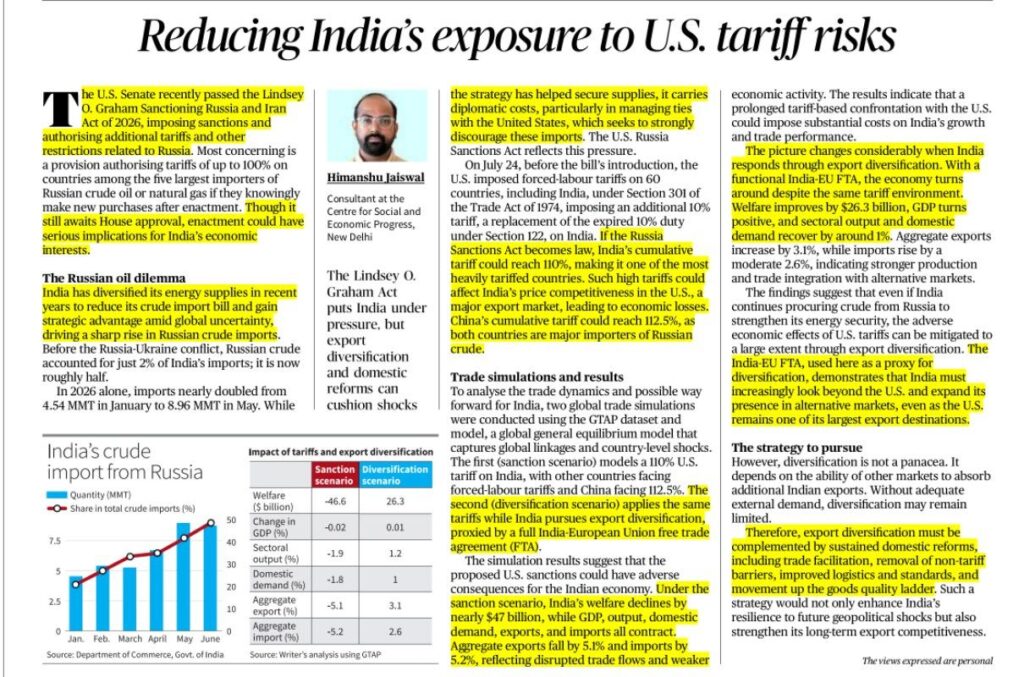
The Lindsey O. Graham Sanctioning Russia and Iran Act of 2026 proposes additional sanctions and tariffs related to Russia. A key provision could impose tariffs of up to 100% on countries importing Russian crude oil or natural gas if they knowingly make significant purchases.
India has increased its dependence on Russian crude in recent years. According to the article, Russian crude accounted for around 2% of India’s imports before the Russia-Ukraine conflict, but its share subsequently increased substantially.
This creates a potential economic challenge if additional U.S. tariffs are imposed.
Impact of Higher U.S. Tariffs on India
The article uses trade simulations to assess the possible impact of U.S. sanctions. Under a sanction scenario involving an additional 110% U.S. tariff on India, India’s welfare could decline substantially, while GDP, domestic demand, exports and imports could also contract.
Such tariffs could particularly affect India because the United States is an important export market.
Higher tariffs could therefore reduce India’s export competitiveness and weaken external demand.
Export Diversification as a Solution
The article highlights export diversification as an important strategy for reducing India’s vulnerability.
A proposed India-European Union Free Trade Agreement (FTA) is used as a proxy for diversification. The analysis suggests that diversification could improve India’s welfare and GDP while supporting domestic demand and sectoral output.
The broader objective is to expand India’s presence in alternative international markets rather than remaining excessively dependent on any single major trading partner.
Need for Domestic Economic Reforms
Export diversification alone cannot completely eliminate tariff-related risks. India also needs to improve its domestic competitiveness.
Important measures include:
- Trade facilitation
- Removal of non-tariff barriers
- Better logistics
- Improved product standards
- Higher manufacturing competitiveness
- Integration with global value chains
- Expansion into alternative export markets
These reforms can help Indian businesses compete more effectively in international markets.
Balancing Energy Security and Trade Interests
India faces a strategic dilemma between maintaining access to competitively priced Russian crude and managing its economic relationship with the United States.
The article suggests that energy security, trade diversification and diplomatic engagement need to be pursued simultaneously.
Reducing dependence on a single market or supplier can provide greater resilience against future geopolitical and trade shocks.
Conclusion
India’s exposure to U.S. tariff risks highlights the importance of building a diversified and resilient external sector. While continued access to Russian crude may support India’s energy security, potential sanctions could create significant economic costs.
India should therefore combine export diversification with domestic reforms, stronger logistics, improved competitiveness and wider trade partnerships. Such measures can help India withstand future global trade disruptions while strengthening its position in the international economy.
Vocabulary
1. Tariff – Tax on imports
2. Sanctions – Economic restrictions
3. Export Diversification – Expanding exports across markets
4. FTA – Free Trade Agreement
5. Non-Tariff Barrier – Trade restriction other than tariffs
Prelims MCQs
MCQ 1
With reference to the Lindsey O. Graham Sanctioning Russia and Iran Act, 2026, consider the following statements:
- It proposes additional sanctions and tariffs related to Russia.
- It could impose tariffs of up to 100% on countries importing Russian crude oil or natural gas under specified conditions.
- Such measures could affect countries importing Russian energy.
Which of the statements given above is/are correct?
A) 1 only
B) 1 and 2 only
C) 2 and 3 only
D) 1, 2 and 3
Answer: D) 1, 2 and 3
MCQ 2
Consider the following as possible benefits of export diversification for India:
- Reducing dependence on a single export market
- Expanding access to alternative markets
- Cushioning the impact of external trade shocks
- Improving long-term export competitiveness
Which of the above are correct?
A) 1 and 2 only
B) 1, 2 and 3 only
C) 2, 3 and 4 only
D) 1, 2, 3 and 4
Answer: D) 1, 2, 3 and 4
UPSC Mains Question
“India’s growing exposure to geopolitical and tariff-related disruptions highlights the need for export diversification and domestic economic reforms.” Discuss.
Key points to cover:
- Rising importance of Russian crude in India’s energy imports
- Potential impact of secondary U.S. sanctions and tariffs
- Risk to India’s exports due to dependence on major markets
- Impact on GDP, welfare, domestic demand and trade performance
- Importance of export diversification
- India–EU FTA as an example of expanding alternative markets
- Strengthening logistics and trade facilitation
- Removing non-tariff barriers
- Improving product quality and standards
- Greater integration with global value chains
- Balancing energy security, economic interests and geopolitical relations
- Need for a resilient and diversified external sector
Frequently Asked Questions (FAQs)
Why is India vulnerable to U.S. tariff risks?
India could face higher tariffs and export losses if the U.S. imposes secondary sanctions related to Russian crude imports, affecting India’s trade and economic growth.
Why is Russian crude important for India?
India has significantly increased its imports of Russian crude in recent years. It has helped meet energy needs, but growing dependence creates geopolitical and trade-related risks.
How can export diversification reduce tariff risks?
Expanding exports to markets such as the European Union and other alternative destinations can reduce India’s dependence on the U.S. market and improve economic resilience.
What reforms can strengthen India’s export competitiveness?
India needs better logistics, trade facilitation, product standards, removal of non-tariff barriers and stronger integration with global value chains.
Can export diversification completely eliminate tariff risks?
No. Diversification can cushion external shocks, but its effectiveness depends on India’s ability to expand exports and improve domestic competitiveness.
Source From : The Hindu
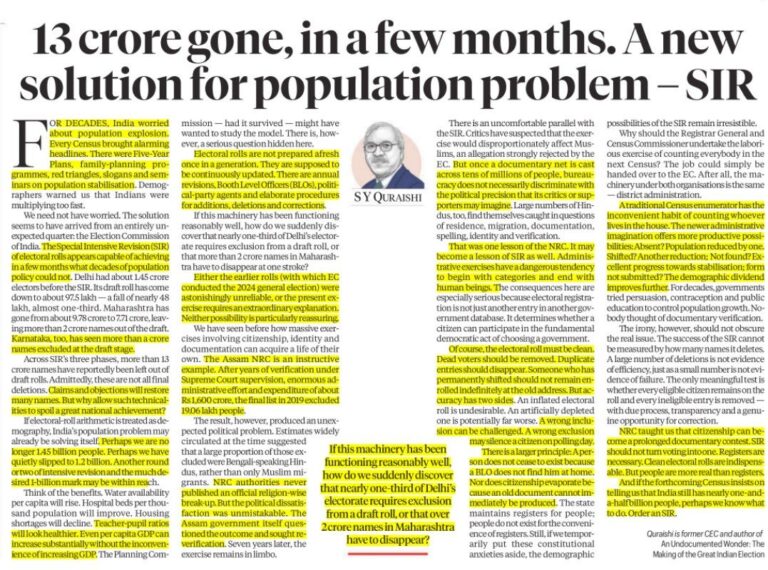
Special Intensive Revision: Can SIR Solve India’s Population Challenge?
India has long debated the challenges of population growth, electoral administration and demographic change. The Special Intensive Revision (SIR) of electoral rolls has emerged as a major exercise aimed at improving the accuracy of voter lists. However, the scale of deletions and the administrative burden involved have raised questions about whether SIR can address deeper demographic challenges.
What Is Special Intensive Revision (SIR)?
The Special Intensive Revision of electoral rolls involves a detailed verification and revision of voter lists. Unlike routine annual revisions, SIR requires extensive scrutiny of voter information, including verification, documentation and corrections.
The article highlights the possibility of a very large number of names being removed from electoral rolls within a relatively short period. This makes the exercise significant from both an electoral and administrative perspective.
Why Has SIR Become Important?
India has experienced major demographic changes over several decades. Population stabilisation programmes, family planning and public awareness campaigns have attempted to address population growth.
Against this background, the article draws attention to the potential scale of electoral-roll deletions under SIR.
It questions whether a process designed primarily to clean electoral rolls could indirectly influence the way demographic trends are understood and administered.
Concerns About Electoral Roll Deletions
A major concern is that deletion from electoral rolls must not result in the exclusion of eligible citizens.
The article stresses that electoral rolls should be carefully examined to identify:
- Duplicate entries
- Deaths
- Permanent migration
- Incorrect addresses
- Ineligible entries
At the same time, genuine voters should not lose their voting rights merely because of documentation or verification difficulties.
Lessons from the NRC Experience
The article draws a comparison with the National Register of Citizens (NRC) exercise in Assam, where extensive verification and documentation were undertaken.
The experience demonstrates the enormous administrative and financial requirements involved in conducting large-scale population and citizenship-related verification exercises.
This raises questions about whether similar approaches can be implemented efficiently across India’s much larger population.
SIR and the Right to Vote
The article highlights the importance of ensuring that electoral-roll revision does not unintentionally deprive citizens of their democratic rights.
Transparency, accessibility and effective grievance-redressal mechanisms are therefore essential. Citizens whose names are removed should have a meaningful opportunity to challenge the decision and establish their eligibility.
Can SIR Solve India’s Population Problem?
The article questions whether electoral-roll revision can actually address India’s broader population challenge.
Population growth is influenced by factors such as fertility, education, healthcare, economic development and social conditions. Electoral roll management and population stabilisation are therefore fundamentally different policy areas.
Conclusion
The Special Intensive Revision (SIR) can potentially improve the accuracy and credibility of electoral rolls, but its success depends on careful implementation.
The priority should be to remove genuinely ineligible entries while ensuring that no eligible citizen is excluded. A transparent verification process, accessible documentation and strong grievance mechanisms are essential to protect electoral participation.
Ultimately, India’s population challenges require long-term social and economic interventions rather than relying on electoral-roll revision alone.
Vocabulary
1. SIR – Special Intensive Revision
2. Electoral Roll – Official list of eligible voters
3. Disenfranchisement – Loss/denial of voting rights
4. Verification – Checking authenticity
5. Inclusion – Ensuring eligible voters are registered
Prelims MCQs
MCQ 1
With reference to the Special Intensive Revision (SIR) of electoral rolls, consider the following statements:
- It involves detailed verification and revision of electoral rolls.
- It can help identify duplicate, deceased and migrated voters.
- Its primary objective is population stabilisation.
Which of the statements given above is/are correct?
A) 1 only
B) 1 and 2 only
C) 2 and 3 only
D) 1, 2 and 3
Answer: B) 1 and 2 only
MCQ 2
Which of the following are important considerations during a large-scale electoral-roll revision?
- Preventing exclusion of eligible voters
- Providing grievance-redressal mechanisms
- Verifying voter information
- Removing duplicate entries
Select the correct answer using the code below:
A) 1 and 2 only
B) 1, 2 and 3 only
C) 1, 2, 3 and 4
D) 2 and 4 only
Answer: C) 1, 2, 3 and 4
UPSC Mains Question
“Electoral-roll revision is essential for maintaining the credibility of elections, but it must not become a source of exclusion of eligible citizens.” Discuss in the context of Special Intensive Revision (SIR).
Key points to cover:
- Meaning and purpose of Special Intensive Revision (SIR)
- Verification and updating of electoral rolls
- Identification of duplicate, deceased and migrated entries
- Risk of exclusion of genuine voters
- Documentation and administrative challenges
- Importance of transparency and grievance redressal
- Lessons from large-scale verification exercises such as the NRC experience
- Distinction between electoral-roll management and population stabilisation
- Importance of protecting democratic participation
- Need for accurate, inclusive and credible electoral rolls
Frequently Asked Questions (FAQs)
What is Special Intensive Revision (SIR)?
SIR is a detailed exercise to verify and update electoral rolls. It aims to identify duplicate, deceased, migrated or otherwise ineligible entries while maintaining accurate voter lists.
Why is SIR being discussed in India?
The exercise has gained attention because of the potentially large number of electoral-roll deletions. This has raised concerns about ensuring that genuine voters are not excluded.
What are the main objectives of electoral-roll revision?
The key objectives are to remove duplicate and ineligible entries, correct voter details and ensure that eligible citizens remain on the electoral rolls.
What concerns are associated with SIR?
Large-scale verification can create documentation and administrative challenges. There is a concern that eligible citizens could be excluded if verification and grievance-redressal mechanisms are inadequate.
Can SIR solve India’s population problem?
No. Electoral-roll revision and population stabilisation are different policy areas. Population trends depend on factors such as fertility, education, healthcare and socio-economic development.