

Daily Current affairs 12 May 2026

Daily Current Affairs 12-May-2026

Share this Post

VB-GRAM G AND TRANSITION FROM MGNREGA

TOPIC: (GS2) POLITY: THE HINDU

The Government of India has announced the Viksit Bharat Guarantee for Rozgar and Ajeevika Mission (Gramin) [VB-GRAM G], which will replace MGNREGA from July 1, 2026.

Background

  • MGNREGA, launched in 2005, guaranteed 100 days of wage employment to rural households.
  • Over time, issues such as delayed payments, misuse of funds, and lack of asset creation were highlighted.
  • The new scheme seeks to modernize rural employment guarantees and integrate them with digital monitoring and livelihood diversification.

Features of VB-GRAM G

  • Employment Guarantee: Continues to provide assured work opportunities in rural areas.
  • Integrated Livelihoods: Expands scope beyond manual labour to include skill-based and productive activities.
  • Digital Attendance: Mandatory use of digital systems for transparency and accountability.
  • Repeal of MGNREGA Rules: All earlier guidelines, notifications, and schemes under MGNREGA will stand repealed.
  • Funding Mechanism: Normative budget and state shares yet to be clarified, raising concerns about implementation.
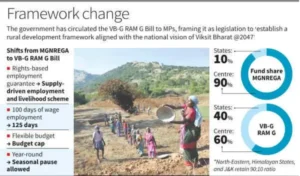
VB-Gram G and Transition From MGNREGA

Concerns and Challenges

  • Lack of clarity: No clear formula for budget allocation and state contributions.
  • Transition issues: Risk of confusion during the shift from MGNREGA to VB-GRAM G.
  • Social impact: Protests by workers’ groups highlight fears of reduced employment security.
  • Implementation capacity: States may face difficulties in adapting to new digital systems.

Significance

  • Aligns rural employment with national development goals.
  • Promotes productive asset creation and skill development.
  • Enhances transparency through digital monitoring.
  • Supports the vision of inclusive growth under Viksit Bharat 2047.

Conclusion

The VB-GRAM G scheme promises modernization and efficiency, its success will depend on clarity in rules, adequate funding, and smooth transition from MGNREGA.

INDUS WATERS TREATY IN ABEYANCE

TOPIC: (GS2) INTERNATIONAL RELATIONS: THE HINDU

The Indus Waters Treaty (IWT) is in the news because India placed the Treaty “in abeyance” in April 2025 after the Pahalgam terror attack, linking water cooperation with Pakistan to its credible action against cross-border terrorism.
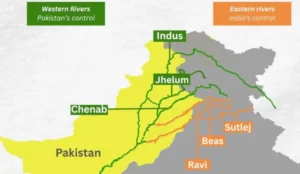
Indus Waters Treaty in Abeyance

About the Treaty

  • Signed by PM Jawaharlal Nehru and President Ayub Khan.
  • Divides six rivers of the Indus system:
    • Eastern Rivers (Ravi, Beas, Sutlej): Allocated to India for unrestricted use.
    • Western Rivers (Indus, Jhelum, Chenab): Allocated to Pakistan, with India allowed limited non-consumptive use (hydropower, irrigation, navigation).
  • Established the Permanent Indus Commission for cooperation.
  • Dispute resolution: Commission → Neutral Expert → Court of Arbitration.

India’s Decision

  • After Operation Sindoor, India suspended Treaty obligations.
  • Implications:
    • Halted data-sharing and commission meetings.
    • Disrupted river flows reaching Pakistan.
    • Created uncertainty in Pakistan’s flood and drought planning.
  • India argues the Treaty needs renegotiation due to:
    • Population growth and rising water demand.
    • Climate change altering river flows.
    • Development needs of Jammu & Kashmir.
    • Technological advances making old provisions outdated.

Pakistan’s Response

  • Internationalisation strategy:
    • Raised issue at UN Security Council.
    • Approached World Bank for mediation.
    • Sought ICJ intervention (unlikely).
    • Framed it as a human rights issue at UNHRC.
  • Legal stance: Treaty has no clause for suspension, only dispute resolution.
  • Court of Arbitration ruled India’s suspension does not prevent proceedings, but India refused participation.

Strategic Approach of India

  • Infrastructure push: Accelerating projects on eastern rivers and permissible works on western rivers.
  • Techno-legal strengthening: Expert committees gathering data to justify India’s position.
  • Security linkage: Treaty suspension tied to Pakistan’s support for cross-border terrorism.

Challenges Ahead

  • Diplomatic escalation at global forums.
  • Risk of conflict as Pakistan views water as existential.
  • Regional stability threatened by water scarcity.
  • Precedent setting: Linking water treaties to terrorism may influence future transboundary agreements.

Conclusion

While India seeks to align water cooperation with national security, Pakistan views it as a violation of international law. The future of the Treaty will depend on balancing developmental needs, climate realities, and regional peace.

NASA’S PSYCHE SPACECRAFT MISSION

TOPIC: (GS3) SCIENCE AND TECHNOLOGY: THE HINDU

NASA’s Psyche spacecraft, recently captured a crescent image of Mars from nearly 5 million km away, highlighting its progress.

Psyche Mission

  • Launched on October 13, 2023 by NASA.
  • Target: Asteroid Psyche, believed to be composed largely of nickel and iron.
  • Timeline:
    • Asteroid’s gravity will capture the spacecraft in July 2029.
    • Prime mission begins in August 2029.
    • Duration: Around two years of orbiting, imaging, and mapping.

Features of the Spacecraft

  • Size: Comparable to a small van.
  • Propulsion: Solar-electric system using xenon gas, gradually increasing speed.
  • Design: Built for long-duration deep space travel with efficient energy use.

Scientific Instruments

  • Magnetometer: Detects traces of ancient magnetic fields.
  • Gamma-ray and neutron spectrometer: Determines surface chemical composition.
  • Multispectral imager: Equipped with telescopic lenses and filters to capture images in multiple wavelengths.

Significance of the Mission

  • Planetary science: Offers insights into how rocky planets’ cores may have formed.
  • Asteroid composition: Psyche may represent the remnants of a protoplanet’s core.
  • Space resources: Understanding metallic asteroids could inform future space mining.
  • Technological innovation: Demonstrates solar-electric propulsion for deep space missions.

Conclusion

The Psyche mission findings could reshape our understanding of solar system evolution and open pathways for space resource utilisation. For UPSC, it exemplifies the intersection of science, technology, and strategic exploration.

DELHI HEAT CRISIS

TOPIC: (GS3) ENVIRONMENT: THE HINDU

Delhi and the National Capital Region (NCR) are facing intensifying heatwaves, marked by prolonged high temperatures and minimal cooling at night.

Delhi’s Heat Retention

  • Heat-absorbing infrastructure: Concrete, asphalt, steel, and glass dominate construction, storing heat during the day and releasing it slowly at night.
  • High surface temperatures: Densely built areas record 50–60°C on peak afternoons, acting as thermal reservoirs.
  • Glass-heavy architecture: Modern buildings in Gurgaon/Noida trap solar radiation indoors, increasing dependence on air conditioning.
  • Vehicular emissions: Traffic corridors like NH-48 act as “thermal corridors,” adding continuous heat.
  • Poor urban design: Narrow streets and dense construction restrict airflow, eliminating traditional cooling features like courtyards and shaded pathways.

Cooling Systems and Heat Feedback

  • Air conditioners expel heat outdoors, raising local temperatures by 1–2°C.
  • Feedback loop: Rising heat → more AC use → more outdoor heat.
  • Energy demand: Delhi’s summer power demand has crossed 8,000 MW, with cooling systems as the main contributor.
  • Future challenge: By 2050, cooling demand may overwhelm power grids, risking blackouts during extreme heat.

Economic and Ecological Impact

  • Industrial productivity loss: Factories and warehouses see a 2–3% decline per degree rise above optimal levels.
  • Supply chain disruptions: Heat slows transport and damages storage, raising costs.
  • Economic losses: India loses over $100 billion annually due to heat-related productivity decline.
  • Shrinking natural cooling systems: Loss of wetlands, Yamuna floodplains, and green cover reduces evapotranspiration, worsening heat stress.

Mitigation Strategies

  • Heat-resilient materials: Use cool roofs, reflective coatings, and high-albedo surfaces.
  • Passive cooling design: Promote insulation, shading, and natural ventilation.
  • Urban planning reforms: Restore ventilation corridors and reduce dense heat-trapping layouts.
  • Green & blue infrastructure: Expand parks, wetlands, and water bodies to regulate temperature.

Conclusion

The Delhi heat crisis requires a multi-pronged approach from sustainable infrastructure and energy-efficient cooling to restoring ecological buffers. Balancing development with resilience is essential to safeguard Delhi’s population and economy against escalating heatwaves.

PM MITRA PARK

TOPIC: (GS3) ECONOMY: THE HINDU

Recently, the Prime Minister inaugurated the PM MITRA Park at Warangal, Telangana, marking a major step in boosting textile manufacturing and exports.
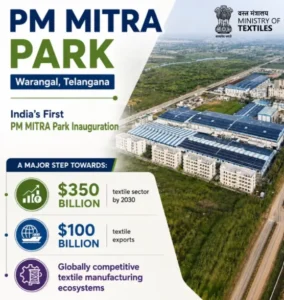
  PM Mitra Park                                              

PM MITRA Park

  • Objective: To create mega textile hubs that integrate all stages of production — spinning, weaving, dyeing, printing, and garment-making — in one location.
  • Types: Parks can be Greenfield (new sites) or Brownfield (existing sites upgraded).
  • Approved Locations: Tamil Nadu (Virudhunagar), Telangana (Warangal), Gujarat, Karnataka, Madhya Pradesh, Uttar Pradesh (Lucknow), and Maharashtra.
  • Nodal Ministry: Ministry of Textiles.

Key Features

  • Integrated Value Chain: Reduces transport costs and time by housing all processes in one zone.
  • World-Class Infrastructure:
    • 50% area for manufacturing activity.
    • 20% for utilities.
    • 10% for commercial development.
  • Public–Private Partnership (PPP): Managed by a Special Purpose Vehicle (SPV) jointly owned by the Centre and State governments.

Capital Support and Incentives

  • Financial assistance: Up to ₹800 crore per park for Greenfield projects. Up to ₹500 crore per park for Brownfield projects.
  • State role: Provide land and utility infrastructure.

Significance

  • Enhances global competitiveness of Indian textiles.
  • Generates employment opportunities across the textile value chain.
  • Promotes exports and foreign investment.
  • Supports Make in India and Atmanirbhar Bharat initiatives.

Conclusion

By combining policy support, PPP models, and state participation, the initiative is expected to make India a global leader in textiles and apparel manufacturing.

OMAN

TOPIC: (GS2) INTERNATIONAL RELATIONS: THE HINDU

Recently, Oman’s Sohar and Salalah ports have become vital gateways for India’s food exports to GCC nations, underlining its economic and strategic relevance.
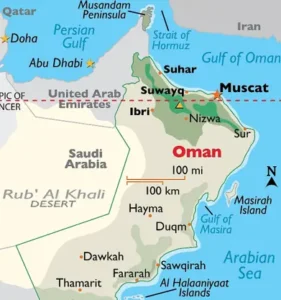
Omans Sohar and Salalah Ports                                                    

Location and Borders

  • Situated in Western Asia on the Arabian Peninsula.
  • Borders: UAE (northwest), Saudi Arabia (west), Yemen (southwest).
  • Coastline: Along the Arabian Sea (south and east) and the Gulf of Oman (northeast).
  • Offshore territories: Masirah Island and Al-Hallaniyyah Island.
  • Capital: Muscat.

Geographical Features

  • Climate: Predominantly arid desert, hot and humid along coasts, dry interiors; southern regions experience southwest monsoon (May–September).
  • Highest Point: Mount Shams (9,777 feet).
  • Ports: Port of Salalah is the largest and a major transshipment hub.
  • Deserts: Shares the Rub’ al-Khali (Empty Quarter) desert with Saudi Arabia and Yemen.
  • Natural Resources: Petroleum, natural gas, copper, chromium, gypsum, marble, limestone, and asbestos.

Strategic Importance

  • Maritime location: Controls access to the Strait of Hormuz, a critical chokepoint for global oil trade.
  • Trade hub: Ports like Salalah and Sohar facilitate India’s exports to six GCC nations.
  • Energy and security: Oman’s resources and location make it a key partner in India’s energy security and maritime strategy.

Conclusion

Oman’s geostrategic location, resource wealth, and maritime infrastructure make it a pivotal player in West Asia. For India, Oman is not only a trade and energy partner but also a strategic ally in ensuring stability and connectivity in the Indian Ocean region.


NATIONAL PANCHAYAT AWARDS

TOPIC: (GS2) GOVERNANCE: THE HINDU

The National Panchayat Awards (NPA) were recently announced, highlighting the role of Panchayati Raj Institutions (PRIs) in advancing local governance and Sustainable Development Goals (SDGs).

Background

  • Instituted under the Incentivization of Panchayats (IoP) scheme, a key component of the Rashtriya Gram Swaraj Abhiyan (RGSA).
  • Revamped in 2022 to align with 9 themes of Localization of SDGs (LSDGs), covering all 17 SDGs.
  • Objective: To assess Panchayat performance, encourage competitive spirit, and catalyze the process of achieving LSDGs by 2030.

Themes for Evaluation

Panchayats are ranked based on performance under nine LSDG themes:

  • Poverty-free Panchayat and enhanced livelihoods.
  • Healthy Panchayat.
  • Child-friendly Panchayat.
  • Water-sufficient Panchayat.
  • Clean and Green Panchayat.
  • Self-sufficient infrastructure in Panchayat.
  • Socially just and secured Panchayat.
  • Good governance Panchayat.
  • Women-friendly Panchayat.

Award Categories

  • Deen Dayal Upadhyay Panchayat Satat Vikas Puraskar (DDUPSVP): Recognises outstanding Gram Panchayats across the nine LSDG themes.
  • Nanaji Deshmukh Sarvottam Panchayat Satat Vikas Puraskar (NDSPSVP): Awarded to the best-performing Panchayats at District, Block, and Gram Panchayat levels on an overall basis.

Significance

  • Promotes grassroots democracy and strengthens local governance.
  • Encourages Panchayats to act as agents of SDG localization.
  • Enhances accountability and transparency in developmental outcomes.
  • Builds momentum for inclusive and sustainable rural development.

Conclusion

By rewarding innovation and efficiency, these awards reinforce the role of PRIs as the foundation of India’s democratic and developmental framework.

INDIA ROAD ACCIDENT FATALITIES

TOPIC: (GS2) GOVERNANCE: THE HINDU

Recently, India’s road accident fatalities came into news as official figures for 2024 showed discrepancies between reports released by the Ministry of Road Transport and Highways (MoRTH) and the National Crime Records Bureau (NCRB), raising concerns over data consistency and reliability for policy planning.

Sources of Road Accident Data

  • Police records: Primary source, as police are first responders.
  • MoRTH data collection: Through its Transport Research Wing (TRW), using formats under the UNESCAP Asia-Pacific project.
  • Information gathered: Accident identification, road conditions, vehicles, driver details.
  • Shift to eDAR/iRAD: Designed for real-time reporting, but state-level delays persist.
  • NCRB data: Compiled via State Crime Record Bureaus (SCRBs), District Crime Record Bureaus (DCRBs), and local police stations.

Legal Basis of Road Accident Data Recording

  • Section 106 of Bharatiya Nyaya Sanhita: Fatal road accidents caused by negligence are registered under this section (earlier covered under IPC Section 304-A).
  • WHO Global Practice: Nearly half of the countries worldwide rely primarily on police data for accident reporting.

Reasons for Discrepancies

  • Different reporting channels: NCRB (Home Ministry) vs MoRTH (coordination with States).
  • Mandatory reporting bias: Police must report to NCRB, but MoRTH depends on state cooperation.
  • Data limitations: TRW formats restrict details, leading to gaps.
  • Under-reporting risks: Victims dying after 30 days often not updated.
  • Subjective bias: Police judgments may affect accuracy.
  • Persistent challenges: Despite eDAR/iRAD, states report inconsistently.

India’s Global Position

  • India has the highest total fatalities worldwide, followed by China and the USA.
  • Countries like Iran report higher per capita death rates.
  • Several developing nations (Pakistan, Nigeria, Ethiopia, China) show lower per capita fatality rates compared to India.

Measures to Improve Data Accuracy

  • Unified Reporting System: Establish a single national platform integrating police, transport, and health departments to ensure consistency.
  • Real-time Digital Tools: Strengthen use of e-DAR/iRAD systems with mandatory updates from all states to reduce delays and mismatches.
  • Standardized Formats: Adopt uniform templates across ministries and states for accident reporting to avoid variation in categories and definitions.
  • Health Department Integration: Include hospital and emergency care data to capture fatalities occurring after the accident, reducing under-reporting.

Conclusion

Reliable statistics are essential for effective policy design, infrastructure planning, and enforcement strategies. Strengthening real-time reporting systems, harmonising data channels, and reducing under-reporting are critical to addressing India’s road safety crisis.

Write a Review

Your email address will not be published. Required fields are marked *