

Table of Contents
ToggleAMOC COLLAPSE AND IMPACT ON INDIA
TOPIC: (GS1) GEOGRAPHY: THE HINDU
Scientists have warned of a possible collapse of the Atlantic Meridional Overturning Circulation (AMOC), with studies suggesting it could weaken by nearly 59% by 2100. This has serious implications for India’s monsoon, agriculture, and water security.
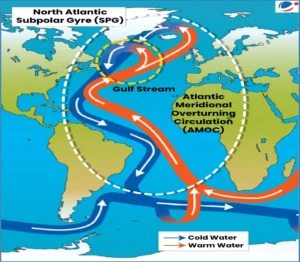
What is AMOC
- A vast system of ocean currents in the Atlantic, often called a global conveyor belt.
- Warm, salty water flows northwards, cools near Greenland, sinks, and returns southward as deep currents.
- Cycle is slow (≈1,000 years for one loop) but crucial for global climate stability.
Role in Climate
- Distributes heat worldwide, moderating Europe’s climate.
- Influences rainfall patterns across Africa, Americas, and Asia.
- Interconnected with other systems like El Niño.
Why Scientists Fear Collapse
- Melting Arctic ice adds freshwater, reducing salinity and density.
- This disrupts sinking of cold water, slowing circulation.
- Past studies: AMOC slowed ~15% in 50 years; new data warns of 59% slowdown by 2100.
- Seen as a climate tipping point – once weakened beyond threshold, collapse may be irreversible.
AMOC–El Niño Link
- Weak AMOC alters heat balance between hemispheres.
- Can intensify and destabilise El Niño events.
- Strong El Niño episodes (2015–16, 2023–24) already reduced South Asian monsoon rainfall.
Impact on India
- Monsoon Disruption:
- Weak AMOC shifts tropical rain belt southwards.
- Reduces moisturecarrying winds from Arabian Sea.
- Likely Outcomes:
- Shorter monsoon seasons.
- Longer dry spells.
- Overall drying trend in parts of India.
- Agriculture & Economy: Threatens food security, water supply, and livelihoods of millions.
- Climate Instability: Amplified El Niño could cause droughts and floods in India.
Conclusion
AMOC collapse is not just a global issue but a direct threat to India’s monsoon system. It highlights the urgent need for climate resilience, diversified agriculture, water management, and global cooperation to mitigate risks from such tipping points.
GOVERNOR’S DISCRETION VS DEMOCRATIC MANDATE
TOPIC: (GS2) POLITY: THE HINDU
Tamil Nadu Governor Rajendra Arlekar delayed the swearingin of TVK leader Vijay as Chief Minister, asking him to show proof of majority support. This has revived the debate on the Governor’s discretionary powers versus democratic mandate.
Political Background
- Tamilaga Vettri Kazhagam (TVK): Emerged as single largest party with 108 MLAs.
- Congress support: Raised tally to 113 MLAs, still short of majority (118 in 234member House).
- Governor’s stance: Asked for prior proof of majority before inviting TVK to form government.
- Criticism: Seen as undermining convention where the floor test decides majority.
Constitutional Position
- Article 164:
- Governor appoints Chief Minister.
- Other ministers appointed on CM’s advice.
- Ministers hold office during “pleasure of Governor.”
- Interpretation: In parliamentary democracy, “pleasure” is not personal discretion but guided by constitutional norms.
Conventional Procedure
- Governor invites party/coalition staking claim.
- Administers oath to CMdesignate.
- Appoints protem Speaker.
- Directs floor test to prove majority.
- Floor test: Only legitimate forum to determine majority support.
Supreme Court’s Stand
- Uttarakhand (2016): Floor test is the “ultimate” mechanism to prove majority.
- Karnataka (2018): SC advanced floor test to 36 hours amid horsetrading fears; BJP failed, CongressJD(S) formed government.
- Judiciary consistently emphasises Assembly floor, not Raj Bhavan, as the place to test majority.
Discretion vs Mandate
- Governor: Ensure stable government. Prevent opportunistic defections. Safeguard against uncertainty.
- Arguments against Governor: Cannot impose subjective standards. Delaying swearingin undermines democratic verdict. Governor’s role is ceremonial, not political.
- Criticism: Former Law Minister Ashwani Kumar called it a “constitutional heresy” and “political outrage.”
Governance Issues
- Governor’s discretion: Lack of clarity in constitutional limits during hung assemblies.
- Political bias: Frequent allegations that Governors act in favour of ruling party at the Centre.
- Delay in government formation: Creates instability, governance vacuum, and scope for horsetrading.
- Federal principles weakened: Repeated controversies erode cooperative federalism and state autonomy.
Way Forward
- Codify conventions: Establish clear rules for inviting parties to form government.
- Timebound floor tests: Make quick floor tests compulsory to avoid instability.
- Neutral Governors: Ensure Governors act as impartial constitutional heads, not political actors.
- Commission recommendations: Implement reforms suggested by Sarkaria and Punchhi Commissions to limit discretionary powers.
- Judicial oversight: Courts must safeguard constitutional morality and prevent misuse of office.
Conclusion
The Tamil Nadu episode highlights recurring tension between Governor’s discretion and democratic legitimacy. While Governors have constitutional powers, these must operate within the framework of federalism, neutrality, and democratic conventions. The floor test remains the ultimate test of majority.
OPERATION SINDOOR A WATERSHED IN INDIA’S DEFENCE POSTURE
TOPIC: (GS3) SEQURITY: THE HINDU
India’s Operation Sindoor (May 2025) marked a decisive response to the Pahalgam terror attack, representing a paradigm shift in India’s defence doctrine and politicomilitary resolve.
Background
- Trigger: April 22, 2025 – Pahalgam carnage by crossborder terrorists.
- Operation Sindoor: Began May 7, 2025, with surgical strikes on nine terror hubs in Pakistan.
- Targets: Bahawalpur, Muridke, and other highvalue sites.
- Outcome: Massive destruction despite Pakistan’s alertness; showcased India’s new “zero tolerance” policy.
Strategic Shift
- From Restraint to Resolve: Earlier “reactive restraint” replaced by direct retaliation.
- New Red Lines: Crossborder terrorism treated as act of war.
- CivilMilitary Synergy: Clear political directive, free hand to armed forces.
- Integration: Army, Navy, Air Force coordinated seamlessly.
Military Actions
- Air Force: Strikes on 11 Pakistani bases (Nur Khan, Sargodha, Murid, Bholari).
- Navy: Strategic deployments near Karachi.
- Army: Aggressive operations along LoC and IB.
- Air Defence: S400 systems denied Pakistani airspace access.
- Result: Pakistan requested ceasefire by May 10, 2025.
Significance
- Escalation Control: India managed nuclear overhang with calibrated strikes.
- Global Impact: Analysts hailed it as a defining action against a nucleararmed adversary.
- Message: Terror backers warned; Pakistani public confronted military leadership’s failures.
Challenges
- Escalation Risks: Managing conflict under nuclear shadow.
- High Readiness: Forces must sustain preparedness for rapid operations.
- Global Pressure: Balancing external diplomatic reactions.
- Industrial Gaps: Defence industry must scale up indigenous production.
Way Forward
- Atmanirbhar Defence: Accelerate indigenous R&D, manufacturing, and integration of MSMEs/startups.
- WholeofNation Approach: Strengthen synergy between DRDO, DPSUs, private sector.
- Continuous Readiness: Maintain high operational preparedness across services.
- Diplomatic Strategy: Balance military assertiveness with global engagement.
- Codify Doctrine: Institutionalise “zero tolerance” as permanent national security redline.
Conclusion
Operation Sindoor is a watershed moment in India’s defence posture, proving the nation’s ability to deliver rapid, highimpact integrated strikes under nuclear risk. It signals irreversible redlines against terrorism, while reinforcing the urgency of indigenous defence growth and sustained military readiness.
YILDIRIMHAN MISSILE
TOPIC: (GS3) SEQURITY: THE HINDU
Turkiye has unveiled the prototype of the Yildirimhan intercontinental ballistic missile (ICBM), signalling its ambition to become selfreliant in defence and strengthen its role among NATO allies and Middle Eastern powers.
About Yildirimhan Missile
- Type: Intercontinental Ballistic Missile (ICBM) developed by Turkiye.
- Range: ~6,000 km → can strike targets across Europe, Africa, and Asia.
- Speed: Up to Mach 25 (~8 km per second), placing it in the extreme hypersonic category.
- Propulsion: Equipped with four rocket engines; powered by liquid nitrogen tetroxide fuel.
- Liquid fuel → slower launch readiness but allows greater optimisation of range and payload.
- Payload Capacity: Can carry single or multiple warheads with a combined weight of up to 3 tonnes.
- Launch Platform: Designed for deployment from a mobile wheeled launcher.
Strategic Significance
- Enhances Turkiye’s longrange strike capability.
- Positions Turkiye as a serious defence player in the Middle East and within NATO.
- Raises concerns about regional security dynamics and global arms race trends.
- Demonstrates Turkiye’s push for indigenous defence technology and reduced reliance on external suppliers.
Conclusion
The Yildirimhan missile marks a major leap in Turkiye’s defence ambitions. With its long range, hypersonic speed, and heavy payload capacity, it could reshape regional security equations and add new dimensions to NATO’s strategic posture.
GUT MICROBIOME
TOPIC: (GS3) SCIENCE AND TECHNOLOGY: THE HINDU
New studies highlight that the human gut microbiome—the trillions of microbes in our digestive tract—plays a major role in health and disease, with changes linked to obesity, diabetes, and inflammatory bowel disorders.
What is Gut Microbiome
- Refers to trillions of microorganisms (bacteria, viruses, fungi, parasites) living in the human gut.
- Establishment: Infants acquire microbes during birth (vaginal delivery) and breastfeeding. Later shaped by diet, lifestyle, and environment.
Functions of Gut Microbiota
- Helps in energy extraction from food.
- Provides protection against harmful pathogens.
- Regulates immune system activity.
- Strengthens gut lining and biochemical barriers.
Health & Disease Links
- Beneficial vs Harmful Bacteria: Good microbes aid digestion and immunity. Harmful microbes can cause food poisoning, diarrhea, vomiting.
- Chronic Conditions: Altered microbiota linked to Inflammatory Bowel Disease (IBD) like Crohn’s disease and ulcerative colitis. Low diversity associated with obesity, type2 diabetes, metabolic syndrome.
- Antibiotics Impact: Overuse disturbs microbial balance. Can lead to antibioticresistant infections.
Research Significance
- Gut microbiome acts as a “second genome” influencing metabolism, immunity, and even mental health.
- Personalized medicine and probiotics/prebiotics are being explored to restore healthy microbiota.
Conclusion
Balanced microbial diversity supports digestion, immunity, and disease prevention, while disturbances can trigger chronic illnesses. Strengthening gut health through dietary choices, reduced antibiotic misuse, and microbiomebased therapies is vital for public health.
JANANI PLATFORM
TOPIC: (GS3) SCIENCE AND TECHNOLOGY: THE HINDU
The Union Ministry of Health and Family Welfare has launched the JANANI (Journey of Antenatal, Natal and Neonatal Integrated Care) platform, a digital system to strengthen maternal and child health tracking across India.
JANANI Platform
- Nature: Serviceoriented digital platform for women’s health records during reproductive age.
- Upgraded from: The earlier RCH portal.
- Objective:
- Seamless monitoring of maternal and child health services.
- Covers antenatal care, delivery preparedness, postnatal care, newborn and young child care, and family planning.
Key Features
- Digital MCH Cards: QRenabled Mother & Child Health cards ensure portability and easy access.
- Smart Tracking:
- Automated alerts for highrisk pregnancies.
- Realtime dashboards for supervisors.
- Duelist generation for timely interventions.
- Interoperability: Integrates with national platforms like UWIN (immunisation) and POSHAN (nutrition).
- Beneficiary Registration:
- Uses ABHA ID, Aadhaar (OTP/biometric), mobile number.
- PanIndia search functionality.
- SelfRegistration: Web and mobile access empowers women to engage directly in their healthcare journey.
- Citizen Support: Timely scheduling of antenatal visits and immunisations. Alerts/reminders to avoid missing critical health milestones.
Significance
- Strengthens continuum of care from pregnancy to child health.
- Improves data accuracy and portability across states.
- Enhances early detection of risks and targeted interventions.
- Promotes digital empowerment of women in healthcare.
Conclusion
The JANANI platform represents a major step in India’s digital health ecosystem, ensuring that maternal and child health services are tracked seamlessly, risks are identified early, and beneficiaries are empowered through accessible digital records.
STRAIT OF HORMUZ U.S. PROJECT FREEDOM
TOPIC: (GS2) INTERNATIONAL RELATIONS: THE HINDU
The U.S. launched Project Freedom (May 2026) to secure free navigation in the Strait of Hormuz amid Iranian blockade, but suspended it within a day after merchant ships and U.S. Navy vessels came under attack.
Background
- Strait of Hormuz: Vital chokepoint carrying ~20% of global energy trade.
- Project Freedom: Announced by U.S. to reopen safe navigation using advanced systems (warships, drones, underwater assets).
- Outcome: Suspended quickly; shipping industry remained unconvinced of safety.
Historical Context
- Tanker Wars (1980s): U.S. succeeded in escorting merchant fleets under Operation Earnest Will.
- Escorted ~250 ships in 14 months; despite attacks, strait remained open.
- Iran then used Silkworm missiles, speedboats, mines.
- U.S. naval superiority forced Iran to back off.
Current Challenges
- Drone Warfare: Lowcost drones can inflict visible damage. Even minor attacks raise insurance costs and deter shipping.
- Industry Reluctance: Firms like HapagLloyd refused transits despite U.S. assurances. Lack of clear operational details reduced confidence.
- Iran’s Strategy: Declared only coastal routes safe; marked danger zones across strait. Demonstrated firepower by damaging merchant ships and U.S. destroyers.
Governance & Cooperation Issues
- Ambiguity in U.S. commitment: No clear plan for continuous deployment.
- Lack of multilateralism: Initiative seen as unilateral, without broader coalition support.
- Absence of coordination: Shipowners hesitant without guarantees from multiple nations.
- Risk of escalation: Without cooperation, chances of miscalculation and instability rise.
Way Forward
- Multilateral Naval Cooperation: Joint patrols by global powers to ensure free navigation.
- Timebound & transparent protocols: Clear operational details to reassure shipping industry.
- Technological countermeasures: Develop antidrone defences and strengthen convoy protection.
- Diplomatic engagement: Dialogue with Iran to reduce blockade tensions.
- Insurance & trade safeguards: International mechanisms to stabilise shipping costs.
- Respect for international law: Uphold UNCLOS principles of freedom of navigation.
Conclusion
Project Freedom’s suspension shows how new technologies like drones and lack of multilateral cooperation have changed the security equation in the Strait of Hormuz. only collective security, diplomacy, and technological innovation can ensure uninterrupted global energy flows.
WHITEBELLIED HERON
TOPIC: (GS3) ENVIRONMENT: THE HINDU
A proposal for Arunachal Pradesh’s KalaiII hydropower project has drawn criticism for ignoring the habitat of the critically endangered WhiteBellied Heron (Ardea insignis).
WhiteBellied Heron
- Species: Large heron, secondlargest living heron species.
- Other Names: Imperial heron, great whitebellied heron.
- Habitat: Wetlands of tropical and subtropical forests in eastern Himalayan foothills.
- Distribution: Found in Northeast India, Bhutan, northern Myanmar.
- Morphological Traits:
- Long flexible neck, compact body, shorter legs.
- Serrated bill helps catch fish in deep waters.
- Diet: Prefers freeflowing rivers with low disturbance; mainly fish from river rapids.
- Ecological Role: Indicator of river health, fish population, and water quality.
Threats
- Habitat loss due to agriculture and settlement expansion.
- Disturbance & degradation from hydropower projects and human activity.
- Small population size makes species highly vulnerable.
Conservation Status
- IUCN Red List: Critically Endangered.
- Wildlife Protection Act, 1972: Schedule I (highest protection).
Governance Issues
- Project oversight: Hydropower proposals often skip ecological impact on rare species.
- Weak enforcement: Environmental clearance processes lack strict biodiversity safeguards.
- Federal gaps: State vs Centre coordination on conservation remains weak.
Challenges
- Hydropower expansion: Threatens fragile riverine habitats.
- Lack of cooperation: Limited collaboration between government agencies, NGOs, and local communities.
- Absence of multilateralism: Regional species conservation (India, Bhutan, Myanmar) lacks coordinated framework.
- Data scarcity: Poor monitoring of population trends.
Conclusion
The WhiteBellied Heron is a rare ecological sentinel of Himalayan rivers. Ignoring its habitat in development projects risks irreversible biodiversity loss.