

Table of Contents
ToggleU.S INDIA CALL FOR ‘UNIMPEDED’ SEA TRADE
TOPIC: (GS2) INTERNATIONAL RELATIONS: THE HINDU
The United States and India recently reaffirmed their commitment to ensuring free and open sea trade routes, emphasizing IndoPacific and West Asian maritime corridors.
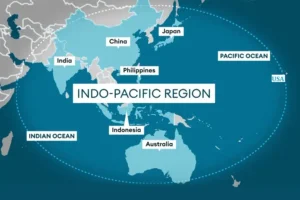
What is the IndoPacific Region?
- The IndoPacific refers to the interconnected space covering the Indian Ocean and Pacific Ocean, including South Asia, Southeast Asia, East Asia, and Oceania.
- It is home to three of the world’s largest economies (China, India, Japan) and seven of the largest military forces.
- The region is central to global trade, with the South China Sea and Malacca Strait serving as chokepoints for oil and goods movement.
Why Security is Important
- Global Trade Routes: Nearly onethird of world trade and majority of maritime oil shipments pass through IndoPacific waters.
- Energy Security: India and other Asian economies depend heavily on energy imports transiting through this region.
- Geopolitical Rivalries: China’s assertive maritime claims and artificial island building in the South China Sea have shifted the security dynamic.
- The U.S., India, Japan, and Australia (QUAD) emphasize freedom of navigation and counterbalance China’s rise.
Key Highlights of the Meeting
- Maritime Security Cooperation: Both nations stressed the need for safe and open sea lanes vital for energy and trade flows. Focus on joint naval exercises like Malabar and enhanced coordination in the IndoPacific region.
- Energy and Trade Discussions: Talks included energy diversification, supply chain resilience, and reducing dependency on conflictprone routes.
- Diplomatic and Strategic Alignment: The dialogue reinforced Quad cooperation (India, U.S., Japan, Australia) for maritime domain awareness.
- Visa and Economic Issues: Discussions also covered visa reforms, technology exchange, and bilateral trade growth, reflecting broader strategic trust.
Significance of IndoPacific Security
- Global Supply Chain Stability: The IndoPacific carries ~60% of global GDP and twothirds of world trade. Around $5 trillion worth of trade passes annually through the South China Sea.
- Energy Security: Nearly 80% of India’s crude oil imports pass through the Strait of Hormuz and Malacca Strait.
- India as Net Security Provider: India’s Navy is the 5th largest globally, operating 130+ warships and 70 aircraft in the Indian Ocean.
- RulesBased Maritime Order: India and QUAD partners emphasize adherence to UNCLOS (UN Convention on the Law of the Sea).
Conclusion
The U.S.–India call for unimpeded sea trade reflects their shared vision of a secure, stable, and inclusive maritime order, vital for global prosperity and regional peace.
WEST BENGAL TO SET UP HOLDING CENTRES FOR DETAINED FOREIGNERS
TOPIC: (GS2) POLITY: THE HINDU
The West Bengal government has directed all District Magistrates to establish holding centres for detained illegal foreigners and released foreign prisoners awaiting deportation.
Who are illegal migrants
- Definition: As per the Foreigners Act, 1946, an illegal migrant is a foreign national who enters India without valid passport/visa or stays beyond the permitted period.
- Those not covered under the Citizenship Act, 1955 or Citizenship (Amendment) Act, 2019 (CAA) are considered illegal migrants.
- Entry Without Authorization: Many cross borders through unfenced or porous routes, especially along India’s eastern frontier. Common entry points: Bangladesh, Myanmar, Nepal borders.
- Overstaying Visas: Foreign nationals who enter legally but remain after visa expiry. Includes overstaying tourist, student, or work visas.
Who are Detained Personnel?
- Illegal Migrants: Foreign nationals who enter India without valid documents or overstay visas.
- Foreign Prisoners: Those who have completed their sentence but cannot be released until deportation arrangements are made.
- Security Detainees: Individuals held under special laws like the National Security Act (NSA) for posing threats to public order.
- Civil/Administrative Detention: People detained for noncriminal issues such as immigration checks or pending verification.
Authorities Responsible for Redressal
- District Magistrates: Empowered to set up holding centres and oversee detainee welfare.
- State Police & Border Security Force (BSF): Handle detection, custody, and coordination with border agencies.
- Union Home Ministry: Issues guidelines for detention, deportation, and monitoring of foreign nationals.
- Judiciary: Courts can review detention cases, ensure human rights compliance, and provide legal remedies.
- National Human Rights Commission (NHRC): Monitors conditions in detention centres and addresses complaints of rights violations.
Illegal Migration in India
- Bangladesh: India’s long porous border (4,096 km) with Bangladesh makes infiltration easy.
- Myanmar: Migration linked to ethnic conflicts, military crackdowns, and the Rohingya crisis.
- Nepal: India and Nepal share an open border under the 1950 Treaty, allowing visafree entry.
Features of the Initiative
- Purpose of Holding Centres: These centres will serve as temporary shelters for foreigners detained under the Foreigners Act, 1946.
- Legal Framework: The initiative follows the Union Home Ministry’s directives under the Citizenship Act, 1955 and Foreigners Order, 1948.
- Implementation in West Bengal: The policy particularly targets illegal infiltrators not covered under the Citizenship (Amendment) Act, 2019.
- Coordination with Agencies: The State Police, Border Security Force (BSF), and Bangladesh Border Guards (BGB) will coordinate for verification and deportation.
Conclusion
The establishment of holding centres in West Bengal marks a significant step toward systematic management of foreign detainees, balancing national security with humanitarian responsibility.
CHINA’S HAINAN FREE TRADE PORT (FTP) INITIATIVE
TOPIC: (GS3) ECONOMY: THE HINDU
China’s Hainan province has been developed as a Free Trade Port (FTP), with new policies on tariffs, trade rules, and tourism, making it a hub for global commerce and regional connectivity.
Free Trade Ports
- DutyFree Imports: Goods can be imported, stored, and reexported without paying customs duties. Encourages global companies to use the port as a trade hub.
- Relaxed Regulations: Simplified customs procedures and reduced restrictions on foreign investment. Businesses enjoy tax incentives and easier licensing.
- Global Connectivity: Located along strategic maritime routes to facilitate international shipping. Helps countries integrate into global supply chains.
- Boost to Tourism and Services: Many FTPs allow visafree entry and dutyfree shopping. Promotes tourism, hospitality, and luxury services.
Features of Hainan FTP
- Tariff Reforms: Zero tariffs on most imported goods. Dutyfree shopping policies to boost tourism and consumption.
- Visa and Travel Policies: Visafree entry for tourists from 59 countries. Promotes Hainan as a global tourism destination.
- Business and Investment: Simplified customs procedures and reduced restrictions on foreign investment. Attracts enterprises in finance, shipping, and hightech industries.
- Tourism and Infrastructure: Development of international yacht centres, airports, and resorts. Boosts Hainan’s image as a luxury tourism hub.
- Strategic Importance: Located in the South China Sea, a critical maritime route. Strengthens China’s role in regional trade and geopolitics.
- By 2025, Hainan FTP attracted over 4,000 new enterprises, including global firms in finance and logistics.
- Tourism revenue crossed USD 20 billion, making it one of China’s fastestgrowing tourist destinations.
- The FTP is projected to contribute significantly to China’s goal of becoming a global trade leader by 2035.
Significance for India and the World
- Reflects China’s economic assertiveness in the IndoPacific.
- May influence regional trade dynamics, impacting India’s maritime strategy.
- Offers lessons for India in developing coastal economic zones and free trade hubs.
Conclusion
The Hainan FTP initiative showcases China’s ambition to build a global trade and tourism hub, reinforcing its influence in the South China Sea and global commerce.
INDIA’S GREEN TRANSITION AND COAL DEPENDENCE
TOPIC: (GS3) ENVIRONMENT: THE HINDU
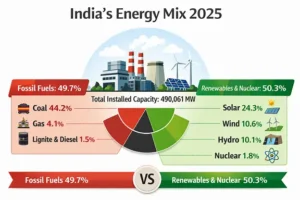
Despite rapid growth in renewable energy capacity, India continues to rely heavily on coal for electricity generation, raising concerns about the pace and sustainability of its green transition.
India’s Renewable Energy Transition
- Ambitious Targets: India aims for 500 GW of nonfossil fuel capacity by 2030. Longterm goal: Netzero emissions by 2070.
- Coal Dependence: Despite renewable growth, coal remains the backbone of India’s power sector. In 2025, coal contributed nearly 70% of electricity generation.
Why Energy Transition is Necessary
- Environmental Protection: India is the thirdlargest emitter of CO₂ globally, contributing about 7% of global emissions (IEA 2025).
- Energy Security: India imports nearly 85% of its crude oil and 50% of its natural gas, making it vulnerable to global price shocks.
- Economic Growth & Job Creation: Renewable energy sector could create over 1 million jobs by 2030 (IRENA report). Investments in solar, wind, and green hydrogen attract foreign capital and technology partnerships.
- Climate Commitments: India pledged to achieve 500 GW of nonfossil fuel capacity by 2030 and netzero emissions by 2070.
Challenges for India’s Green Energy Transition
- Economic Challenges: Renewable projects need $20–25 billion annually to meet 2030 targets (IEA 2025). Financing gaps and fossil fuel subsidies make clean energy less competitive.
- Technological Challenges: Storage capacity is still low (<5 GW in 2025) making solar/wind unreliable at scale. India imports ~70% of solar modules from China, creating supply chain risks.
- Policy & Regulatory Challenges: Land acquisition delays and limited R&D spending (0.7% of GDP) slow innovation.
- Social & Environmental Challenges: Over 2 million workers in coal sector risk job loss without reskilling programs.
Conclusion
India’s energy transition is progressing but incomplete, coal continues to power the majority of electricity, even as renewables expand rapidly. The future depends on storage, diversification, and policy innovation.
DEVELOPMENT AND TRIBAL PROTECTION IN GREAT NICOBAR
TOPIC: (GS2) POLITY: THE HINDU
Recently Union Minister stated that development projects in Great Nicobar Island can coexist with tribal protection, responding to concerns raised about the impact on the Shompen community and forest rights.
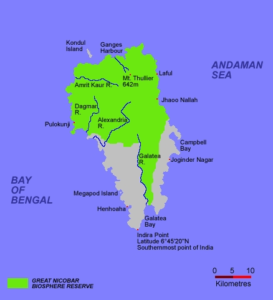
Great Nicobar Island
- Strategic Location: Positioned near the Malacca Strait, one of the world’s busiest trade routes. Offers India a major geostrategic advantage in the IndoPacific.
- Proposed Infrastructure Projects: Plans include a transshipment port, international airport, and township development. Designed to boost trade, connectivity, and economic growth.
- Economic & Strategic Benefits: Enhances India’s role in global maritime trade and supply chains. Strengthens national security and regional influence in the Indian Ocean.
Issues Facing the Shompen Tribe
- Loss of Habitat: Infrastructure projects like ports, airports, and townships require massive forest diversion. This threatens the tribe’s traditional forestbased livelihood of hunting, gathering, and shifting cultivation.
- Cultural Disruption: The Shompens live in isolation with minimal contact with outsiders.
- Health & Vulnerability: Contact with outsiders increases risk of disease outbreaks, as PVTGs often lack immunity to common infections.
- Legal & Rights Concerns: The Forest Rights Act, 2006 protects tribal rights over land and resources.
Balancing Infrastructure Development and Ecological Sustainability
- Accelerate Renewable Energy Deployment: Expand solar, wind, and hydro projects to meet the 500 GW nonfossil fuel target by 2030.
- Green Urban & Transport Planning: Wasterecycling facilities increased from 829 in 2019–20 to 3,036 in 2024–25, diverting 103 lakh tonnes of plastic waste—a model to expand nationwide.
- Strengthen Policy & Governance: Ensure stable renewable tariffs, clear land acquisition rules, and stronger Environmental Impact Assessments (EIA).
- Inclusive Community Participation: Empower Gram Sabhas and local communities to manage forests and natural resources.
Forest Rights Act (2006)
Forest rights act legally recognize the rights of forestdwelling Scheduled Tribes and other traditional forest dwellers who have lived in forests for generations.
- Livelihood & Food Security
- Ensures access to forest resources for daily needs like fuel, fodder, minor forest produce, and cultivation.
- Strengthens economic security of tribal and forest communities.
- Sustainable Forest Management
- Promotes conservation of biodiversity and ecological balance.
- Empowers communities to protect forests while using them sustainably.
Important Provisions of FRA
Individual Rights
- Right to hold and live on forest land for habitation or selfcultivation (up to 4 hectares per family).
Community Rights
- Rights over minor forest produce, grazing, fishing, and access to traditional forest resources.
- Recognition of Community Forest Resource (CFR) rights, allowing villages to manage forests collectively.
Habitat Rights
- Special rights for Particularly Vulnerable Tribal Groups (PVTGs) to protect their traditional habitats.
Protection from Eviction
- Forest dwellers cannot be evicted until their claims are settled under FRA.
Institutional Mechanism
- Gram Sabha is the key authority to initiate claims and manage community rights.
- State and districtlevel committees oversee recognition and implementation.
Conclusion
The Great Nicobar project highlights India’s effort to combine strategic development with tribal protection, ensuring growth does not come at the cost of ecological and cultural heritage.
SYRIA HOLDS LEGISLATIVE POLLS IN KURDISH-MAJORITY REGIONS
TOPIC: (GS2) INTERNATIONAL RELATIONS: THE HINDU
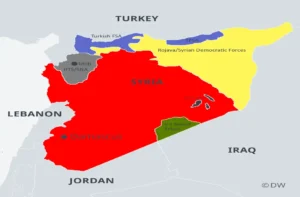
Syria recently conducted follow-up parliamentary elections in Hassakeh and Kobani, Kurdish-majority areas that came under government control earlier this year.
Syria Political Dynamics
- Civil War Fragmentation; Since 2011, Syria has been embroiled in a civil war. Territories are divided among Assad government forces, Kurdish groups, and other factions.
- Kurdish Elections: Recent elections held in Kurdishmajority regions. Seen as an effort by the Assad government to reassert control over these areas.
- Political Integration: Elections reflect attempts to integrate Kurdish regions into the national political framework. Part of broader efforts at postconflict governance and central authority restoration.
- Regional Significance: Developments highlight challenges in ethnic relations between Kurds and the Syrian state. Critical for understanding Syria’s future stability and regional geopolitical balance.
Syria PostElection
- Political Transition: Elections conducted in areas earlier under Syrian Democratic Forces (SDF) control. Seating of Syria’s first Parliament after Assad’s ouster, marking a new phase in governance.
- Public Expectations: Citizens demand better infrastructure, agriculture, and employment opportunities. • Strong emphasis on electing leaders who can voice local concerns effectively.
- Ethnic & Regional Dynamics: Kurdishmajority regions like Hassakeh and Kobani continue to seek autonomy. • Participation in national polls reflects efforts at reconciliation, though tensions persist.
- SocioEconomic & Geopolitical Challenges: Widespread poverty, unemployment, and displacement remain pressing issues. • Reconstruction slowed by international sanctions and limited resources. • Stability in Kurdish regions seen as vital for regional security and reducing external influence.
Conclusion
The legislative polls in Kurdish-majority regions highlight Syria’s effort to consolidate governance and rebuild political legitimacy, though challenges of poverty, ethnic tensions, and reconstruction persist.

INDIA’S COLDWATER FISHERIES
TOPIC: (GS3) ECONOMY: THE HINDU
India’s coldwater fisheries sector is emerging as a key pillar of the Blue Economy. Latest government data (2026) shows trout production up 1.8 times in a decade, with strong policy support and international collaborations.
India’s ColdWater Fisheries
- Growing Contribution: Coldwater fisheries now account for ~3% of inland fish production. Support livelihoods of over 23.5 lakh families in mountain and hill regions.
- Rising Trout Production: Trout output has surged to ~6,000 metric tonnes in 2025–26, nearly 1.8 times growth in a decade.
- Species & Ecosystem: Over 278 species identified, including rainbow trout, golden mahseer, and snow trout.
Distribution & Ecosystem
- Found across Jammu & Kashmir, Ladakh, Himachal Pradesh, Uttarakhand, Arunachal Pradesh, Sikkim, Meghalaya, Nagaland, and hill districts of West Bengal, Kerala, Karnataka, Tamil Nadu.
- Cover 5.33 lakh sq. km of mountainous terrain.
- Over 278 coldwater fish species identified, including rainbow trout, golden mahseer, and snow trout.
Current Status & Production
- Total fish production (2024–25): 197.75 lakh tonnes.
- Coldwater fisheries share: ~7,000 MT (≈3% of inland production).
- Trout production: ~6,000 MT in 2025–26, led by:
- Jammu & Kashmir: 3,010 MT (Kokernag hatchery + 2,000 private units).
- Himachal Pradesh: 1,673 MT (909 farmers, 1,739 units).
- Uttarakhand: 710 MT (2,500 raceways).
- Ladakh: 50 MT despite harsh climate.
Policy Initiatives
- Pradhan Mantri Matsya Sampada Yojana (PMMSY, 2020–26): ₹21,963 crore approved, including ₹5,638 crore for coldwater states.
- FIDF (2018–26): ₹7,761 crore for hatcheries, training centres, and infrastructure.
- Blue Revolution Scheme (2015–20): foundation for scientific trout farming.
- PMMKSSY (2023–28): ₹6,000 crore for aquaculture insurance, startup grants, and value chain efficiency.
- Model Guidelines 2026: site selection, hatchery standards, disease management, branding, certification, and etrading.
- International collaborations: knowledge exchange with Norway and Iceland.
Conclusion
India’s coldwater fisheries are becoming a strategic driver of the Blue Economy, combining livelihood generation, biodiversity conservation, and ecotourism. With rising trout production and strong policy support, the sector is poised to expand further.
HUTTI GOLD MINES COMPANY LIMITED (HGML)
TOPIC: (GS3) ECONOMY: THE HINDU
HGML, India’s only operational primary gold mine, reported an additional ₹633.34 crore revenue in 2025–26 due to rising global gold prices. The company produced 1,691.57 kg of gold and 145.76 kg of silver as a byproduct.
HGML – India’s Primary Gold Producer
- Establishment & Ownership: Founded in 1947 as a Government of Karnataka undertaking. Headquarters located in Bengaluru.
- Unique Distinction: Holds the status of being the only producer of primary gold in India. Plays a strategic role in India’s mineral economy.
- Mining Operations: Operates the Hutti underground mine, along with Uti opencast and HeeraBuddinni exploratory mine. The Hutti mine is among the world’s oldest metal mines, dating back to the PreAshokan period.
- Production Contribution: Produced 1,691.57 kg of gold and 145.76 kg of silver in 2025–26. Meets less than 1% of India’s annual gold demand (≈700 tonnes).
Operations & History
- HGML manages the Hutti underground mine, along with Uti opencast and HeeraBuddinni exploratory mine.
- The Hutti mine is considered one of the oldest metal mines globally, dating back to the PreAshokan period.
- Activities include exploration, development, and exploitation of gold deposits in Karnataka.
Production Status (2025–26)
- Gold output: 1,691.57 kg.
- Silver output (byproduct): 145.76 kg.
- Contribution: Meets <1% of India’s annual gold demand (≈700 tonnes).
- Rising global prices boosted HGML’s profit margins significantly.
Policy & Economic Significance
- HGML strengthens state revenues and supports local employment in Raichur district.
- Plays a role in reducing India’s dependence on imported gold.
- Government initiatives focus on modernizing mining technology, improving beneficiation processes, and expanding exploration.
Conclusion
HGML remains India’s only functional primary gold producer, contributing modestly to national demand but significantly to state revenue and mining heritage.