Table of Contents
ToggleAgriculture and wild ecosystems rely fundamentally on genetic diversity. However, the global push for high-yielding crop varieties has triggered a severe decline in indigenous plant strains. Seed banks serve as artificial genetic repositories, protecting plant species from terminal extinction and securing future food systems.
Defining Seed Banks and Their Core Objectives
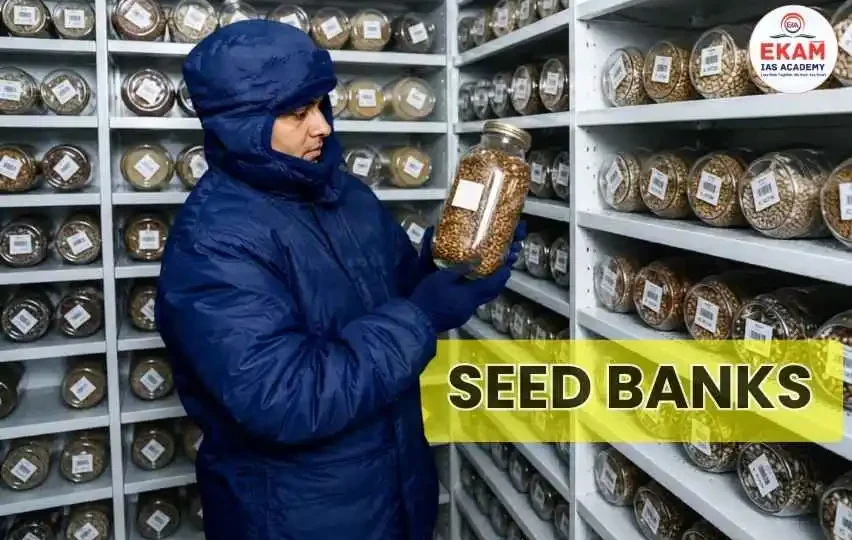
A seed bank is a type of gene bank that stores seeds of diverse plant species under precisely controlled environmental conditions to maintain their viability over long periods.
Core Objectives:
- To prevent the permanent extinction of rare, endemic, and threatened plant species.
- To preserve the genetic diversity of crops and wild crop relatives, which is essential for breeding climate-resilient plants.
- To act as a biological insurance policy against natural disasters, war, or plant pandemics that could destroy entire agricultural landscapes.
Characteristics and Types of Seed Banks
Seeds behave differently when stored, which determines how a seed bank operates:
- Orthodox Seeds: These seeds can survive severe dehydration and ultra-low freezing temperatures without losing their viability (e.g., wheat, rice, corn). Most seed banks focus on these species.
- Recalcitrant Seeds: These seeds are damaged or killed if dried or frozen (e.g., mango, cocoa, rubber). They cannot be stored in standard seed banks and must be maintained via continuous cultivation or tissue cryopreservation.
Classification of Seed Banks:
- Community Seed Banks: Localized, decentralized networks managed by farmers to preserve regional, traditional crop varieties.
- National Seed Banks: State-funded facilities that maintain a country’s baseline botanical wealth.
- International Seed Banks: Large-scale global facilities designed to coordinate transboundary agricultural and ecological security.
The Working Process of a Seed Bank
The preservation sequence in a high-tech seed bank follows a strict scientific workflow to ensure maximum long-term survival:
- Drying: Collected seeds are carefully dried in specialized rooms to reduce their moisture content to around 5%. This slows down cellular metabolism and prevents ice crystals from rupturing cell walls during freezing.
- Freezing: Sealed in airtight containers, the seeds are placed in vaults maintained at $-18^\circ\text{C}$ to $-20^\circ\text{C}$.
- Regeneration: Because seeds eventually degrade, samples are periodically withdrawn, germinated, and grown into mature plants to harvest a fresh batch of viable seeds.
Global Distribution: Major Seed Banks
- Svalbard Global Seed Vault (Norway): Known as the “Doomsday Vault,” it is built deep inside a sandstone mountain on a remote Arctic island. It relies on natural permafrost to keep samples frozen even if the facility loses power, acting as the ultimate global backup system.
- Millennium Seed Bank Partnership (UK): Managed by the Royal Botanic Gardens, Kew, it is the largest ex-situ conservation project for wild plant species globally.
Seed Banks in India
India’s status as a megadiverse nation makes its national plant repositories highly significant:
- National Gene Bank India: Located at the National Bureau of Plant Genetic Resources (NBPGR) in New Delhi, it is one of the largest facilities of its kind in the world. It holds over 400,000 accessions of diverse crop groups, wild relatives, and medicinal plants.
- The Chang La Seed Vault: Situated in Ladakh at an altitude of over 17,300 feet, this facility is managed by the Defence Research and Development Organisation (DRDO). Like Svalbard, its extreme high-altitude location provides natural permafrost cooling, reducing operating costs and energy risks.
Seed Banks and Biodiversity Conservation
The intersection of a seed bank biodiversity conservation focus centers on rescuing genetic resources from ecological bottlenecks:
- Climate Adaptation: They preserve rare wild plant relatives that hold genetic traits for drought tolerance, pest resistance, and soil salinity resilience.
- Ecosystem Restoration: Following catastrophic events like mega-wildfires or mining operations, seed banks supply indigenous seeds to restore original forest canopies (in-situ).
Government and International Initiatives
- The International Treaty on Plant Genetic Resources for Food and Agriculture (ITPGRFA): Also known as the “Seed Treaty,” it ensures a legally binding global system for the sustainable use and fair exchange of plant genetic material.
- The Biological Diversity Act, 2002: Protects India’s seed wealth from unauthorized foreign exploitation and guarantees that the benefits of using native seeds return to local communities.
Seed Bank vs. Gene Bank
It is essential to distinguish these terms clearly for the examination:
| Parameter | Seed Bank | Gene Bank |
| Scope | A specific type of repository focused exclusively on storing plant seeds. | An umbrella term covering repositories for all genetic material, including animal tissue, semen, eggs, microbes, and plant tissue. |
| Storage Forms | Dried, frozen intact seeds. | Cryopreserved cells, tissue cultures, DNA strands, and seeds. |
Challenges and Conclusion
Seed banks face distinct challenges, including continuous energy demands for cooling, vulnerability to localized geopolitical conflicts, and the difficulty of preserving recalcitrant species.
For the seed bank UPSC curriculum, the core takeaway is that these repositories must be viewed as an essential insurance policy for the planet. However, storing seeds in a vault cannot replace protecting living ecosystems. Seed banks achieve their true value only when integrated into wider agricultural management and habitat protection programs, ensuring that Earth’s genetic wealth remains a living part of our global biosphere.
UPSC Prelims: PYQs & Practice Questions
Previous Year Questions (Prelims)
UPSC Prelims 2020
Q: Which of the following are the most likely places where one can find crop gene banks?
1. Food and Agriculture Organization
2. International Agricultural Research Centres
3. National Bureau of Plant Genetic Resources
Select the correct answer using the code below:
(a) 1 and 2 only
(b) 2 and 3 only
(c) 1 and 3 only
(d) 1, 2 and 3
Answer: (b) 2 and 3 only
Explanation:
Gene banks are repositories used for conserving plant genetic material.
International Agricultural Research Centres and the
National Bureau of Plant Genetic Resources maintain seed and gene banks.
The Food and Agriculture Organization mainly coordinates agricultural policy,
technical support, and global cooperation, but it is not itself a typical crop gene bank location.
UPSC Prelims 2018
Q: Why is a plant called Prosopis juliflora often mentioned in news?
(a) Its extract is widely used in cosmetics
(b) It tends to reduce biodiversity in the area in which it grows
(c) Its extract is used in the synthesis of pesticides
(d) None of the above
Answer: (b) It tends to reduce biodiversity in the area in which it grows
Explanation:
Prosopis juliflora is an invasive alien species that spreads rapidly and
threatens native biodiversity. Such invasive plants can suppress local vegetation, alter habitats,
and reduce ecological diversity. Seed conservation and gene banks
help protect native plant diversity from such ecological threats.
Practice Questions
Q: With reference to Seed Banks, consider the following statements:
1. Seed Banks are a form of ex-situ conservation.
2. Seeds are generally stored at low temperature and humidity.
3. Seed Banks help preserve genetic diversity.
Which of the statements given above are correct?
(a) 1 and 2 only
(b) 2 and 3 only
(c) 1, 2 and 3
(d) 1 only
Answer: (c) 1, 2 and 3
Explanation:
Seed banks conserve plant species outside their natural habitats, making them a form of
ex-situ conservation. Seeds are generally stored under controlled conditions of
low temperature and low humidity to maintain their viability for long periods.
They are also crucial for preserving genetic diversity, especially of rare, threatened,
endemic, and agriculturally important plant species.
Q: Which of the following is/are limitations of seed banks?
1. High maintenance cost
2. Unsuitability for recalcitrant seeds
3. Loss of biodiversity over time
Select the correct answer using the code below:
(a) 1 and 2 only
(b) 2 and 3 only
(c) 1, 2 and 3
(d) 1 only
Answer: (c) 1, 2 and 3
Explanation:
Seed banks require advanced infrastructure, regular monitoring, and controlled storage,
which makes them costly to maintain. They are unsuitable for recalcitrant seeds,
which cannot tolerate drying and freezing. Over time, if seeds lose viability or are not regenerated properly,
there can also be a gradual loss of biodiversity.
UPSC Mains – Previous Year & Practice Questions
Mains Previous Year Questions
UPSC CSE Mains 2018
Question: What are biodiversity hotspots? Why is biodiversity important for human lives? (GS-3)
UPSC CSE Mains 2020
Question: Discuss the role of biosphere reserves in biodiversity conservation. (GS-3)
UPSC CSE Mains 2016
Question: Discuss various methods of biodiversity conservation in India. (GS-3)
UPSC CSE Mains 2015
Question: How does climate change affect food security in India? Discuss mitigation measures. (GS-3)
UPSC CSE Mains 2013
Question: What are the major causes of loss of biodiversity? Suggest conservation strategies. (GS-3)
Mains Practice Questions
[15 Marks | 250 Words]
Question: Discuss the significance of Seed Banks in ensuring food security and biodiversity conservation.
[15 Marks | 250 Words]
Question: “Seed Banks are the insurance policy of humanity against biodiversity loss.” Examine.
[10 Marks | 150 Words]
Question: Explain the role of gene banks and cryopreservation in ex-situ conservation.



Seed Banks-FAQs
What is a Seed Bank?
A Seed Bank is a storage facility where seeds are preserved under controlled environmental conditions for future use.
Is Seed Bank an example of in-situ or ex-situ conservation?
Seed Banks are examples of Ex-situ Conservation.
Why are Seed Banks important?
They help:
- Preserve genetic diversity
- Protect endangered plant species
- Ensure food security
- Support future agricultural research
What is the world’s largest Seed Bank?
The world’s largest backup seed storage facility is the:
- Svalbard Global Seed Vault
What are recalcitrant seeds?
Recalcitrant seeds are seeds that cannot survive drying and freezing conditions used in seed banks.
Examples:
- Coconut
- Cocoa
- Rubber