Table of Contents
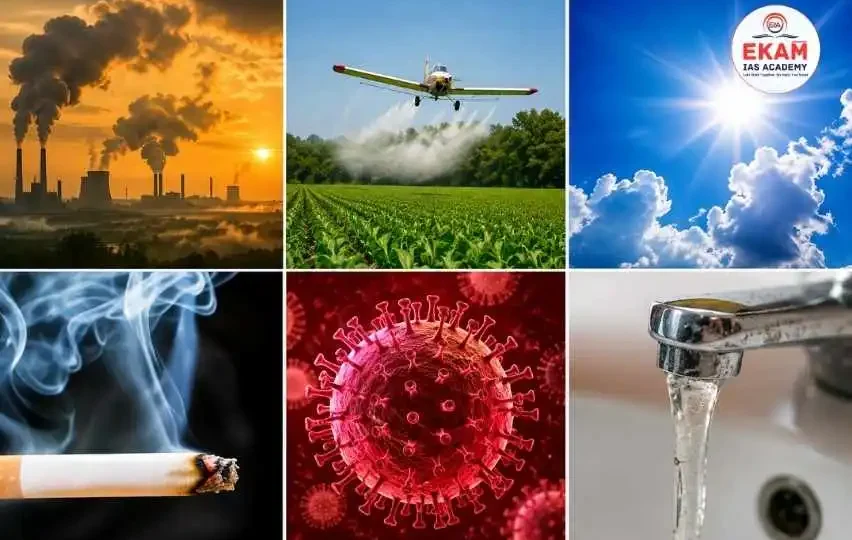
ToggleRapid industrialization, intensive chemical agriculture, and poor waste management have introduced thousands of synthetic compounds into our ecosystems. Among these, environmental carcinogens UPSC modules highlight demand careful study.
What is Carcinogenesis
A carcinogen is any physical, chemical, or biological agent capable of inducing cancer in living tissue. The biological process by which normal cells are transformed into cancer cells is known as carcinogenesis. This multi-stage process begins when a toxic agent damages an organism’s DNA, causing mutations that lead to uncontrolled cell division and tumor growth.
Characteristics and Types of Carcinogens
Carcinogens possess distinct structural properties that allow them to interact directly with biological systems. They can modify cellular metabolism, induce chronic oxidative stress, and bypass natural DNA repair mechanisms.
                         ┌──> Genotoxic: Directly damage DNA (e.g., Polycyclic Aromatic Hydrocarbons)
                         │
[Types of Carcinogens] ──┼──> Non-Genotoxic: Promote tumors without changing DNA (e.g., Hormonal disruptors)
  Structural Pathways   │
                         └──> Physical & Biological: Radiation (UV, Radon) and viral pathogens (HPV)
To understand the types of carcinogens for the civil services examination, they are broadly categorized by their operational pathways:
- Chemical Carcinogens: Synthetic or naturally occurring molecules, such as heavy metals, asbestos, and synthetic pesticides, that enter food chains and water tables.
- Physical Carcinogens: Ionizing radiation (like radon gas from rocks) and non-ionizing radiation (such as solar ultraviolet rays) that break molecular bonds.
- Biological Carcinogens: Pathogenic organisms, including viruses like Hepatitis B and C, or fungi-produced toxins like aflatoxins found in improperly stored crops.
Global Classification and Sources of Exposure
The International Agency for Research on Cancer (IARC), a specialized branch of the World Health Organization (WHO), classifies these toxic agents into distinct risk tiers:
- Group 1: Definitely carcinogenic to humans (e.g., benzene, arsenic, asbestos).
- Group 2A: Probably carcinogenic to humans (e.g., glyphosate, high-temperature frying emissions).
- Group 2B: Possibly carcinogenic to humans (e.g., lead, diesel fuel).
Major Environmental Sources:
- Industrial Effluents: Petrochemical, textile, and tannery units discharging untreated wastewater containing benzene, chromium, and cadmium directly into river basins.
- Agricultural Runoff: Excessive application of organophosphate pesticides and chemical fertilizers that contaminate rural groundwater networks.
- Ambient Air Pollution: Incomplete combustion of fossil fuels in transport vehicles and thermal power stations releasing Polycyclic Aromatic Hydrocarbons (PAHs) and heavy particulate matter (PM2.5).
Environmental Impact and Realities in India
Carcinogenic agents do not remain isolated; they cycle continuously through air, water, and soil. Many chemical pollutants resist natural breakdown, leading to bioaccumulation within individual organisms and biomagnification across ecological food webs. Top predators, including humans, often consume the highest concentrations of these toxins.
The Indian Context:
India faces distinct geographic hotspots plagued by high concentrations of environmental carcinogens:
- The Malwa Cancer Belt (Punjab): Intensive chemical farming has heavily contaminated local groundwater with uranium, arsenic, and pesticide residues, leading to high regional cancer rates.
- E-Waste and Plastic Burning: Informal recycling hubs across major urban centers release highly toxic dioxins and furans into the air during open-air plastic burning.
- Geogenic Contamination: Large parts of the Indo-Gangetic plain suffer from naturally occurring, high-level arsenic contamination in deep aquifers, impacting millions of rural livelihoods.
Regulatory Frameworks and Sustainable Development
Mitigating the risks of toxic pollutants and cancer requires strong domestic laws working alongside international health treaties:
- The Stockholm Convention: A legally binding global treaty designed to eliminate or restrict the production and use of Persistent Organic Pollutants (POPs), many of which are potent carcinogens.
- Water & Air (Prevention and Control of Pollution) Acts: India’s core legal frameworks that empower Central and State Pollution Control Boards (CPCB/SPCBs) to monitor and penalize industrial units discharging toxic waste.
- E-Waste and Hazardous Waste Management Rules: Mandate strict “Extended Producer Responsibility” (EPR) protocols to ensure safe collection and disposal of heavy-metal-bearing consumer components.
Carcinogens and Sustainable Development
Unchecked exposure to environmental carcinogens directly hinders the achievement of the United Nations Sustainable Development Goals (SDGs), particularly SDG 3 (Good Health and Well-Being) and SDG 12 (Responsible Consumption and Production). Shifting toward safer alternatives is critical for sustainable development. This involves enforcing cleaner production techniques, implementing rigorous Environmental Impact Assessments (EIA) before issuing industrial permits, and replacing carcinogenic agricultural pesticides with organic bio-pesticides.
Conclusion
Analyzing carcinogens UPSC notes demonstrates that human health is completely dependent on environmental safety. Industrial growth must be balanced with strict toxicity controls to prevent widespread ecological damage. By upgrading toxic chemical regulations, cleaning up contaminated water basins, and prioritizing zero-pollution circular manufacturing, India can support clean economic expansion while safeguarding public health and preserving the biosphere.
UPSC Prelims: PYQs & Practice Questions
Previous Year Questions (Prelims)
UPSC CSE Prelims 2021
Q: Triclosan, suspected to be harmful when exposed to high levels for a long time, is most commonly used in which of the following?
(a) Food preservatives
(b) Fruit-ripening substances
(c) Plastic ware
(d) Toiletries
Answer: (d) Toiletries
Explanation:
Triclosan is a common antibacterial and antifungal agent used in consumer toiletries such as soaps, toothpastes, cosmetics, deodorants, and personal-care products.
Long-term exposure to high levels of triclosan has raised concerns because it is suspected to act as an endocrine disruptor and may alter cellular metabolism. It also creates ecological risks because it can enter urban wastewater systems and affect aquatic organisms.
UPSC CSE Prelims 2015
Q: Which of the following are the reasons for the occurrence of multi-drug resistance in microbial pathogens in India?
1. Genetic predisposition of some people
2. Taking incorrect doses of antibiotics to cure diseases
3. Using antibiotics in livestock farming
4. Multiple chronic diseases in some people
Select the correct answer using the code given below:
(a) 1 and 2
(b) 2 and 3 only
(c) 1, 3 and 4
(d) 2, 3 and 4
Answer: (b) 2 and 3 only
Explanation:
Multi-drug resistance (AMR) is mainly driven by the misuse and overuse of antibiotics.
Statement 2 is correct. Taking incorrect doses, stopping antibiotics midway, or using them without medical supervision allows resistant microbes to survive and multiply.
Statement 3 is correct. The use of antibiotics in livestock farming and aquaculture, especially as growth promoters, contributes to the spread of resistant pathogens.
Statements 1 and 4 are incorrect. Genetic predisposition or the mere presence of multiple chronic diseases does not directly create drug resistance in external microbial pathogens.
Practice Questions
Q: In the context of the study of toxic pollutants and cancer, consider the following statements regarding Aflatoxins:
1. They are naturally occurring, highly potent chemical carcinogens produced by certain species of the
Aspergillus fungus.
2. They commonly contaminate agricultural crops like
peanuts, corn, and tree nuts due to improper storage in hot, humid conditions.
3. The International Agency for Research on Cancer (IARC) classifies aflatoxins under
Group 1, definitely carcinogenic to humans.
Which of the statements given above are correct?
(a) 1 and 2 only
(b) 2 and 3 only
(c) 1 and 3 only
(d) 1, 2 and 3
Answer: (d) 1, 2 and 3
Explanation:
All three statements are correct.
Aflatoxins are toxic biological carcinogens produced mainly by
Aspergillus flavus and Aspergillus parasiticus.
They commonly contaminate food crops such as groundnuts, maize, tree nuts, and other stored grains when storage conditions are hot and humid.
Regular consumption of aflatoxin-contaminated food can damage liver cells, alter cellular structures, and increase the risk of hepatocellular carcinoma, or liver cancer. Hence, the IARC classifies aflatoxins as Group 1 carcinogens.
Q: Large rural populations across the Indo-Gangetic Plain face severe exposure to a geogenic, Group 1 carcinogen through contaminated groundwater. Which chemical agent is responsible for this environmental crisis?
(a) Methyl Mercury
(b) Inorganic Arsenic
(c) Strontium-90
(d) Fluoride Ion
Answer: (b) Inorganic Arsenic
Explanation:
Inorganic arsenic contamination of groundwater is one of the most serious
geogenic environmental health crises in the Indo-Gangetic Plain.
States such as West Bengal, Bihar, and parts of Uttar Pradesh have reported arsenic contamination in alluvial aquifers.
Long-term consumption of arsenic-contaminated groundwater can cause arsenicosis, skin lesions, and increased risk of skin, lung, and bladder cancers. This makes inorganic arsenic a major environmental carcinogen for UPSC environment and public health topics.
UPSC Mains – Previous Year & Practice Questions
Mains Previous Year Questions
Mains 2022
Question: Describe the various causes and the effects of
landslides in the Himalayan region.
(Can be used to contrast with human-induced environmental toxic crises like heavy metal leaching.)
Mains 2021
Question: Describe the key points of the Revised
Global Air Quality Guidelines issued by the
World Health Organization (WHO) and how these differ from its last update of 2005. What changes in India's
National Clean Air Programme are required to achieve these revised standards?
(Directly connects to tracking airborne carcinogens like PM2.5-bound PAHs.)
Mains 2020
Question: How does the draft
Environment Impact Assessment (EIA) Notification differ from the existing
EIA Notification, 2006?
(Tests how strictly the state reviews projects processing hazardous or carcinogenic compounds before granting permits.)
Mains 2019
Question: Coastal regions of India are prone to
cyclones. Discuss the role of
mangroves in reducing the impact of such disasters.
(Useful for linking coastal ecosystem protection with pollution buffering and environmental health security.)
Mains 2013
Question: What are the reasons for the
oil pollution around the world's oceans? What are its impacts on
marine ecosystems?
(Directly links to how petroleum spills release carcinogenic aromatic hydrocarbons into marine food webs.)
Mains Practice Questions
[15 Marks | 250 Words]
Question: Explain the ecological mechanisms of Bioaccumulation and Biomagnification. Analyze how persistent environmental carcinogens move through agricultural food webs to impact human health, with special reference to the Malwa region of Punjab.
[15 Marks | 250 Words]
Question: The informal recycling of electronic waste (e-waste) and open-air burning of plastics release highly carcinogenic dioxins and furans into urban air sheds. Evaluate the effectiveness of India’s E-Waste Management Rules in checking this specific environmental threat.
[10 Marks | 150 Words]
Question: Discuss the mandate of the Stockholm Convention on Persistent Organic Pollutants (POPs). How do its international restrictions support the realization of UN Sustainable Development Goal 3 — Good Health and Well-Being?



Environmental Carcinogens-FAQs
Difference between Genotoxic and Non-Genotoxic carcinogens?
Genotoxic carcinogens directly damage DNA and cause mutations. Non-genotoxic carcinogens do not directly damage DNA but promote cancer through inflammation, hormone disruption, or altered cell signaling.
How do carcinogens biomagnify in aquatic ecosystems?
Toxins like mercury enter plankton and accumulate in their tissues. As small fish, big fish, and top predators eat them, toxin concentration increases at each food-chain level.
Why are Dioxins and Furans dangerous?
They are toxic pollutants released during waste burning, plastic burning, and industrial processes. They persist in the environment, enter food chains, and can cause cancer and reproductive harm.
What is the Malwa Cancer Belt?
The Malwa region of Punjab has high cancer cases linked to pesticide-heavy farming and contaminated groundwater. Chemicals, uranium, and arsenic exposure are key concerns.
How does EPR prevent environmental carcinogenesis?
Extended Producer Responsibility makes producers collect and recycle plastic and e-waste safely. It prevents open burning and unsafe dismantling that release lead, cadmium, dioxins, and other carcinogens.