Table of Contents
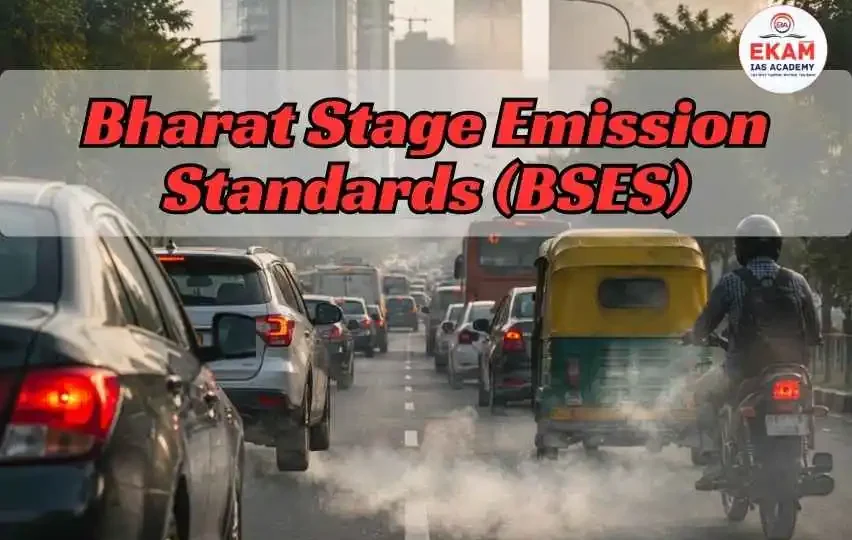
ToggleVehicular exhaust is a primary contributor to urban air crises. To regulate the output of air pollutants from internal combustion engines, the Government of India instituted the Bharat Stage Emission Standards (BSES).
Background
The background of these norms traces back to 2000, when India introduced its first set of nationwide standards, heavily modeled after the Euro emission standards. Following the recommendations of the landmark Mashelkar Committee Report (2002), the country adopted the National Auto Fuel Policy, which established a clear timeline for rolling out progressively cleaner fuel and engine technologies across the country.
Objectives and Evolution of Bharat Stage Norms
The primary objectives of the BSES framework are to reduce harmful tailpipe emissions, mandate automotive technological innovation, and improve ambient air quality.
India’s journey through these emission stages highlights a fast-tracked regulatory evolution:
- BS-I to BS-IV: Implemented in phases between 2000 and 2017, gradually lowering permissible limits for toxic gases.
- The Historic Leap: In 2016, realizing the severity of urban smog, the government made a bold policy decision to skip BS-V entirely and transition directly from BS-IV to Bharat Stage VI emission standards nationwide by April 2020.
Bharat Stage-VI (BS-VI) Standards
The implementation of BS6 norms UPSC modules evaluate marked a major shift in India’s fuel chemistry and automotive engineering.
                          ┌──> Sulfur Content: Slashed from 50 ppm down to 10 ppm
                          │
[BS-VI Regulatory Shift] ─┼──> Diesel Engines: Mandates DPF and SCR technology
  Core Advancements       │
                          ├──> Gasoline Engines: Tightens NOx limits by 25%
                          │
                          └──> Monitoring: Real-time tracking via OBD-II systems
Key Technical Pillars of BS-VI:
- Ultra-Low Sulfur Fuel: BS-VI fuel slashes sulfur content from 50 ppm (under BS-IV) down to a maximum of 10 ppm for both petrol and diesel. This reduction is critical because sulfur damages advanced exhaust after-treatment systems.
- Advanced Diesel Tech: It introduces Diesel Particulate Filters (DPF) to trap fine soot and Selective Catalytic Reduction (SCR) systems, which use urea (Diesel Exhaust Fluid) to convert toxic nitrogen oxides into harmless nitrogen and water.
- On-Board Diagnostics (OBD-II): Mandates real-time, continuous tracking of a vehicle’s emission control systems during operation.
Comparison: BS-IV vs. BS-VI Standards
The transition to Bharat Stage VI emission standards brought dramatic reductions in permissible tailpipe pollution:
| Pollutant Parameter | Diesel Vehicles (BS-IV vs. BS-VI) | Petrol Vehicles (BS-IV vs. BS-VI) |
| Nitrogen Oxides (NOx) | Slashed by 70% (From 250 mg/km to 80 mg/km) | Reduced by 25% (From 60 mg/km to 45 mg/km) |
| Particulate Matter (PM2.5) | Drastically cut by 82% (From 25 mg/km to 4.5 mg/km) | No historic limit; strictly capped under BS-VI |
Challenges, Recent Developments, and Global Alignment
While the environmental significance of these standards is clear, implementing them has faced structural hurdles. Automotive manufacturers had to invest heavily to re-engineer assembly lines in a short timeframe, while oil refineries spent billions to upgrade desulfurization units.
Recent Developments:
- Real Driving Emissions (RDE): India has implemented RDE testing, requiring vehicles to meet emission limits during real-world driving conditions on actual roads, rather than just during laboratory test cycles.
- Corporate Average Fuel Economy (CAFE Phase-II): Works alongside BS-VI to force manufacturers to lower overall carbon dioxide emissions across their entire fleet of vehicles.
Conclusion
Analyzing the Bharat Stage Emission Standards UPSC syllabus covers demonstrates that technical regulation is vital for environmental health. Achieving cleaner air requires combining strict engine standards with broader structural shifts. By aligning BS-VI norms with global standards, scaling up electric transit via the FAME scheme, and expanding ethanol blending under the National Biofuels Policy, India can clean up its transport sector and safeguard public health.
UPSC Prelims: PYQs & Practice Questions
Previous Year Questions (Prelims)
UPSC CSE Prelims 2024
Q: Consider the following statements regarding the Bharat Stage VI (BS-VI) emission norms in India:
1. They mandate a significant reduction in particulate matter
(PM2.5) emissions from diesel vehicles compared to BS-IV norms.
2. Under BS-VI norms, the permissible sulfur content in both petrol and diesel is capped at a maximum of
10 ppm.
Which of the statements given above is/are correct?
(a) 1 only
(b) 2 only
(c) Both 1 and 2
(d) Neither 1 nor 2
Answer: (c) Both 1 and 2
Explanation:
Both statements are correct. India skipped the BS-V stage and directly shifted from
BS-IV to BS-VI.
Under BS-VI norms, particulate matter emissions from diesel engines are reduced by over 80%. The permissible sulfur concentration in both petrol and diesel was also reduced from 50 ppm under BS-IV to an ultra-low level of 10 ppm.
Hence, BS-VI is a major milestone in India’s air pollution control measures and vehicle emission regulation.
UPSC CSE Prelims 2016
Q: In the cities of our country, which among the following atmospheric gases are normally considered in calculating the value of the Air Quality Index (AQI)?
1. Carbon dioxide
2. Carbon monoxide
3. Nitrogen dioxide
4. Sulfur dioxide
5. Methane
Select the correct answer using the code given below:
(a) 1, 2 and 3 only
(b) 2, 3 and 4 only
(c) 1, 4 and 5 only
(d) 1, 2, 3, 4 and 5
Answer: (b) 2, 3 and 4 only
Explanation:
India’s National Air Quality Index (AQI) tracks eight major pollutants:
PM10, PM2.5,
NO2, SO2,
CO, O3,
NH3, and Pb.
Carbon monoxide, nitrogen dioxide, and sulfur dioxide are local criteria air pollutants and are considered in AQI calculation.
Carbon dioxide and methane are greenhouse gases linked mainly with long-term climate change. They are not used in daily AQI calculation.
Bharat Stage emission standards help control pollutants like NOx, SO2, PM, and CO, thereby improving urban air quality.
Practice Questions
Q: With reference to the automotive technologies introduced under the Bharat Stage VI emission standards, consider the following statements:
1. Selective Catalytic Reduction (SCR) technology utilizes an aqueous urea solution to reduce toxic nitrogen oxides
(NOx) into harmless nitrogen and water.
2. Diesel Particulate Filters (DPF) are designed to capture microscopic soot particles, but they require low-sulfur fuel to prevent catalytic poisoning of the filter substrate.
Which of the statements given above is/are correct?
(a) 1 only
(b) 2 only
(c) Both 1 and 2
(d) Neither 1 nor 2
Answer: (c) Both 1 and 2
Explanation:
Both statements are correct. BS-VI diesel powertrains depend heavily on
SCR systems and DPF hardware to meet strict emission limits.
SCR uses an aqueous urea solution, commonly known as AdBlue, which is injected into the exhaust stream to convert harmful NOx emissions into nitrogen and water.
DPF traps ultra-fine particulate matter and soot particles. Both SCR and DPF require ultra-low sulfur fuel of around 10 ppm, because high sulfur content can poison catalysts and damage filter performance.
Q: The Real Driving Emissions (RDE) testing protocol, which has recently become a mandatory component of BS-VI implementation Phase-II in India, is best described by which of the following?
(a) Measuring car emissions using computer simulations before an engine is physically manufactured.
(b) Tracking a vehicle's emissions in real-time under actual on-road driving conditions using Portable Emissions Measurement Systems (PEMS).
(c) Testing fuel quality at commercial retail outlets to verify exact ethanol blending percentages.
(d) Calculating the hypothetical lifetime carbon footprint of electric vehicle batteries during recycling stages.
Answer: (b) Tracking a vehicle's emissions in real-time under actual on-road driving conditions using Portable Emissions Measurement Systems (PEMS).
Explanation:
Real Driving Emissions (RDE) is an advanced emission testing protocol introduced to make vehicle pollution testing more realistic.
Earlier, vehicle emissions were mainly tested under controlled laboratory conditions on a dynamometer. However, real-world emissions may differ due to changing traffic, road gradient, acceleration, speed, temperature, and driving behaviour.
Under RDE, vehicles are tested on actual public roads using Portable Emissions Measurement Systems (PEMS). This ensures that vehicles comply with emission limits not only in laboratories but also under real driving conditions.
UPSC Mains – Previous Year & Practice Questions
Mains Previous Year Questions
Mains 2021
Question: Describe the key points of the Revised
Global Air Quality Guidelines issued by the
World Health Organization (WHO) and how these differ from its last update of 2005. What changes in India's
National Clean Air Programme are required to achieve these revised standards?
(Directly tests your ability to link international air thresholds with domestic vehicle fuel upgrades.)
Mains 2022
Question: Clean energy is the order of the day. Describe briefly India’s changing policy towards
climate change in various international fora in the context of
COP-26.
(Allows you to frame BS-VI and fleet transitions under national mitigation commitments.)
Mains 2020
Question: How does the draft
Environment Impact Assessment (EIA) Notification differ from the existing
EIA Notification, 2006?
(Useful for linking regulatory scrutiny with transport, industrial corridors, and pollution control.)
Mains 2016
Question: Give an account of the current status and the targets to be achieved pertaining to
renewable energy sources in the country.
(Can be connected with India’s broader transition from fossil-fuel dependence to cleaner mobility and energy systems.)
Mains 2015
Question: Industrial corridors are engines of economic growth but come with heavy environmental costs. Discuss.
(Can discuss how freight transit corridors demand advanced emission monitoring and cleaner fuel standards.)
Mains Practice Questions
[10 Marks | 150 Words]
Question: Examine the technical and environmental significance of India's historic policy shift in skipping the Bharat Stage V (BS-V) emission tier to transition directly to Bharat Stage VI (BS-VI) standards.
[15 Marks | 250 Words]
Question: Explain how the introduction of the Real Driving Emissions (RDE) protocol under the second phase of BS6 norms enhances the accountability of vehicular emission testing. What structural challenges does this pose to the automotive industry?
[15 Marks | 250 Words]
Question: While upgrading to advanced fuel standards like Bharat Stage VI emission standards reduces tailpipe emissions, it cannot solve urban air crises on its own. Discuss the complementary structural interventions needed alongside engine upgrades to clear urban skies.



Bharat Stage Emission Standards-FAQs
Why did India skip BS-V emission standards?
India skipped BS-V to quickly tackle severe urban air pollution and smog. It directly shifted from BS-IV to BS-VI by April 2020, saving several years of delay.
Why is sulfur reduced to 10 ppm in BS-VI fuel?
Low sulfur fuel prevents damage to advanced emission-control devices like DPF and SCR. It helps reduce SO₂, NOx, and particulate matter from vehicle exhaust.
How does SCR clean diesel exhaust?
SCR injects AdBlue/urea solution into exhaust gases. It converts harmful NOx into harmless nitrogen and water vapour.
What is OBD-II under BS-VI?
OBD-II continuously monitors vehicle emission-control systems during driving. If emissions rise or a system fails, it alerts the driver and records the fault.
Difference between BS norms and CAFE standards?
BS norms control harmful pollutants like PM, NOx, and CO. CAFE standards focus on fuel efficiency and reducing CO₂ emissions across a company’s vehicle fleet.