Table of Contents
ToggleSalt mining is the process of extracting sodium chloride (NaCl) from natural deposits, inland brine lakes, or subterranean wells. While legal salt production is a critical economic activity regulated by the Salt Commissioner’s Organization under the Ministry of Commerce and Industry, illegal salt mining occurs when operators extract brine without environmental clearances, exploit protected wetlands, drill unauthorized deep borewells, or exceed their leased land boundaries.
Distribution and Causes of Illegal Salt Mining in India
India is the third-largest producer of salt globally. The geographical layout of salt panning spans both coastal and inland regions:
- Coastal Panning: Concentrated in Gujarat (specifically the Rann of Kutch, which accounts for more than 75% of India’s total output), Tamil Nadu, and Maharashtra.
- Inland Brine Extraction: Centered around hyper-saline lakes, primarily Sambhar Lake and Didwana in Rajasthan.
The primary causes driving illegal extraction include skyrocketing industrial demand for salt across the chemical, textile, and pharmaceutical sectors. This is worsened by weak enforcement of zoning laws along remote coastal stretches, alongside a lack of clear ownership boundaries in vast desert flats.
Environmental Impact of Salt Mining on Wetlands and Biodiversity
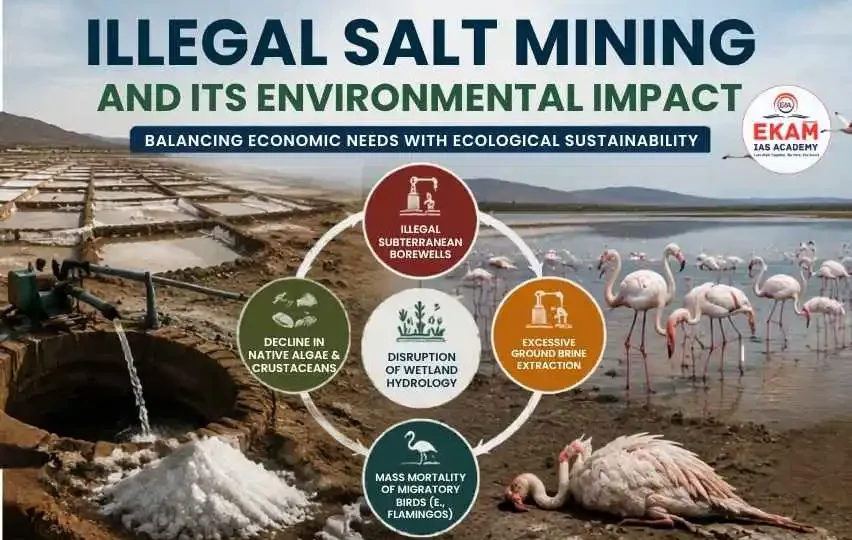
The uncontrolled expansion of illegal pans causes severe, irreversible ecological damage. The intersection of salt mining and wetlands results in profound habitat degradation:
| Stage | Impact |
|---|---|
| 1 | Illegal Subterranean Borewells |
| 2 | Excessive Ground Brine Extraction |
| 3 | Disruption of Wetland Hydrology |
| 4 | Decline in Native Algae & Crustaceans |
| 5 | Mass Mortality of Migratory Birds (e.g., Flamingos) |
A. Severe Destruction of Wetland Hydrology
Illegal operators frequently build unauthorized earthen bunds and illegal check dams to block and divert natural freshwater streams into their private brine collection pans. This modification deprives natural water bodies of essential freshwater flushing. In inland water bodies like Sambhar Lake, this has caused a drastic reduction in the lake’s overall surface area, turning a dynamic wetland into a fragmented network of dry, concrete-lined evaporation pits.
B. Impact on Biodiversity and Avian Habitats
The Sambhar Lake environmental issues gained global attention during severe ecological crises marked by mass avian mortality. Unregulated deep-well brine extraction drastically alters the water’s salinity and chemical balance.
This change wipes out populations of native green algae and brine shrimp (Artemia), which serve as the primary food source for millions of migratory birds, including Lesser Flamingos, that travel along the Central Asian Flyway. Furthermore, stagnant, hyper-saline water in modified pans creates ideal breeding conditions for anaerobic bacteria, triggering deadly outbreaks of avian botulism that paralyze and kill thousands of birds.
Socio-Economic Impacts and Climate Change
Beyond its biological damage, illegal panning causes severe socio-economic problems. Excessive extraction of deep groundwater brine causes salinity intrusion into surrounding freshwater aquifers, ruining the agricultural soils of nearby villages and poisoning local drinking water wells.
The Climate Change Variable:
Climate change worsens this crisis. Rising global temperatures speed up evaporation rates in salt pans, pushing operators to drill even deeper illegal borewells to reach remaining brine. At the same time, wetlands modified by illegal mining lose their natural capacity to store carbon and buffer regional climates, leaving surrounding areas highly vulnerable to severe droughts and intense dust storms.
Policy Comparison: Legal vs. Illegal Salt Mining
| Feature/Dimension | Legal Salt Mining | Illegal Salt Mining |
| Regulatory Clearances | Operates with valid leases and mandatory Environmental Impact Assessment (EIA) approvals. | Operates without approvals, often encroaching directly into protected forest zones and wetlands. |
| Water Resource Use | Relies on monitored surface brine evaporation or regulated groundwater extraction. | Uses thousands of unmonitored, deeply drilled subterranean borewells, draining aquifers. |
| Waste Management | Mandates proper disposal of highly concentrated, toxic residual bitterns. | Dumps hyper-saline chemical waste directly onto nearby agricultural land and open plains. |
Environmental Laws, Governance, and Sustainable Practices
To protect these fragile biomes, India’s judicial and executive bodies have stepped up enforcement:
- National Green Tribunal (NGT) Interventions: In landmark judgments concerning Sambhar Lake, the NGT issued strict directives to state authorities to remove thousands of illegal electricity connections powering unauthorized borewells and ordered the complete demolition of illegal commercial bunds inside the wetland’s boundaries.
- Wetlands (Conservation and Management) Rules, 2017: This framework strictly bans any non-wetland activities—including unauthorized industrial expansion and unregulated salt panning—within designated Ramsar sites.
The Climate Change Variable:
To protect local ecosystems, water management must move toward sustainable models. This involves enforcing strict buffer zones around protected bird habitats, using remote sensing and satellite monitoring to track land-use changes in real time, and helping local salt workers transition to eco-friendly panning techniques that safeguard natural water channels.
Conclusion
Analyzing illegal salt mining UPSC study profiles cover demonstrates that economic resource extraction must be balanced with ecological preservation. Treating wetlands as mere industrial raw material zones threatens vital biodiversity corridors and coastal safety nets. By strictly enforcing NGT judgments, sealing illegal deep borewells, and restoring natural freshwater flows, India can protect its unique inland lakes and secure its vital ecosystems for the long term.
UPSC Prelims: PYQs & Practice Questions
Previous Year Questions (Prelims)
Q: Which of the following is/are Ramsar site(s) in India that have faced severe ecological degradation due to anthropogenic pressures like illegal salt panning and encroachment? (UPSC CSE Prelims)
1. Chilika Lake
2. Sambhar Lake
3. Wular Lake
Select the correct answer:
A. 1 only
B. 2 only
C. 1 and 2 only
D. 1, 2 and 3
Answer: B
Explanation:
Sambhar Lake in Rajasthan has faced severe ecological stress due to illegal salt panning, unregulated brine extraction, and extensive borewell drilling. Chilika Lake has largely recovered due to successful ecological restoration measures, while Wular Lake is primarily affected by willow encroachment and sewage inflow rather than salt mining.
Q: “Birds of a Feather” — Massive migratory bird deaths at Sambhar Lake have been linked to which disease, aggravated by stagnant hypersaline conditions in salt pans? (UPSC CSE Prelims 2022)
A. Avian Influenza
B. Avian Botulism
C. Ranikhet Disease
D. New Castle Disease
Answer: B
Explanation:
The mass mortality event at Sambhar Lake was attributed to Avian Botulism, caused by toxins produced by Clostridium botulinum. The outbreak was intensified by warm, stagnant, and highly alkaline hypersaline conditions created in disturbed salt pan ecosystems, enabling toxin accumulation and rapid spread among migratory birds.
Practice Questions
Q: In the context of the environmental impact of salt mining on inland wetlands, consider the following statements regarding ‘Residual Bitterns’:
1. Bitterns are the highly concentrated, toxic liquid wastes left behind after sodium chloride (NaCl) crystallizes out of natural brine in evaporation pans.
2. The unregulated dumping of bitterns creates hyper-saline soil crusts that permanently destroy the seed banks of native vegetation.
Which of the statements given above is/are correct?
A. 1 only
B. 2 only
C. Both 1 and 2
D. Neither 1 nor 2
Answer: C
Explanation:
Both statements are correct. Bitterns are the dense residual liquid left after salt crystallization and contain high concentrations of magnesium, potassium, and calcium salts. In illegal salt mining operations, these toxic residues are often discharged directly onto surrounding land, forming hyper-saline crusts. This leads to long-term soil degradation, destruction of microbial activity, and permanent loss of native seed banks, making ecological recovery extremely difficult.
Q: The National Green Tribunal (NGT) frequently issues enforcement directives against illegal salt mining in Rajasthan under which legal framework?
A. Forest Conservation Act, 1980
B. Hazardous and Other Wastes Rules, 2016
C. Wetlands (Conservation and Management) Rules, 2017
D. Coastal Regulation Zone (CRZ) Notification, 2019
Answer: C
Explanation:
Inland salt mining activities often fall within or adjacent to notified wetland ecosystems. The Wetlands (Conservation and Management) Rules, 2017 prohibit reclamation, encroachment, and non-wetland industrial activities in protected wetland areas. Hence, the NGT uses these rules as the primary enforcement framework to curb illegal salt panning and protect Ramsar-designated sites and inland saline ecosystems.
UPSC Mains – Previous Year & Practice Questions
Mains Previous Year Questions
Mains 2024
Question: Discuss the ecological and economic importance of wetlands in India. What are the major threats faced by them?
(Directly connects to how salt mining and wetlands clash over land-use transformations)
Mains 2023
Question: Identify the main causes of the loss of biodiversity in India.
(Can discuss how altering wetland water balance destroys unique local ecosystems like brine shrimp habitats)
Mains 2020
Question: How does the draft Environment Impact Assessment (EIA) Notification differ from the existing EIA Notification, 2006?
(Allows you to evaluate how minor mineral leases or illegal expansions slip past formal environmental clearances)
Mains 2018
Question: With growing scarcity of water, focus has shifted to conservation of groundwater. Analyze the issues associated with unregulated exploitation of groundwater in India.
(Directly applies to the deep subterranean brine pumping seen in illegal salt mining areas)
Mains 2014
Question: Enumerate the indirect services provided by an ecosystem. How do wetlands act as “Earth’s Kidneys”?
Mains Practice Questions
[10 Marks | 150 Words]
Question: Analyze the link between unauthorized groundwater extraction, altered water chemistry, and the rise of wildlife diseases, with special reference to Sambhar Lake environmental issues.
[15 Marks | 250 Words]
Question: The economic benefits of minor mineral extraction often conflict with the long-term preservation of fragile ecosystems. Evaluate the institutional challenges faced by regulatory bodies when trying to curb illegal salt panning in ecologically sensitive zones.
[15 Marks | 250 Words]
Question: Unregulated brine extraction from deep aquifers causes long-term soil degradation and ruins local drinking water supplies. Suggest sustainable salt-panning practices and state-level policy changes needed to restore the health of inland wetland basins.



Illegal Salt Mining in India-FAQs
Difference between legal and illegal salt mining?
Legal salt mining operates with government leases, environmental clearances, and regulated groundwater use. Illegal mining bypasses permissions, encroaches on wetlands, and dumps saline waste without environmental safeguards.
How does illegal salt mining contaminate groundwater?
Excessive pumping from deep borewells lowers the water table and causes salinity intrusion, where salty brine spreads into freshwater aquifers, making drinking water and soil unfit for use.
Why does salt mining threaten migratory birds?
It destroys hyper-saline wetland food chains (like brine shrimp and algae). This removes key food sources for migratory birds such as flamingos along the Central Asian Flyway.
What is Avian Botulism and how does mining worsen it?
Avian botulism is a paralytic disease caused by bacteria in warm, oxygen-poor water. Illegal salt pans create stagnant pools that promote bacterial growth, triggering outbreaks in birds.
What actions did NGT take for Sambhar Lake?
NGT ordered shutdown of illegal borewells, removal of unauthorized bunds, and creation of a Wetland Authority with monitoring and protection measures for ecosystem restoration.