Table of Contents
ToggleMass Coral Bleaching
When environmental conditions fluctuate drastically, this relationship breaks down. Mass coral bleaching occurs when entire reef systems across vast geographic zones—spanning hundreds of kilometers—bleach simultaneously due to large-scale regional or global environmental shifts, rather than localized pollution.
Coral Bleaching
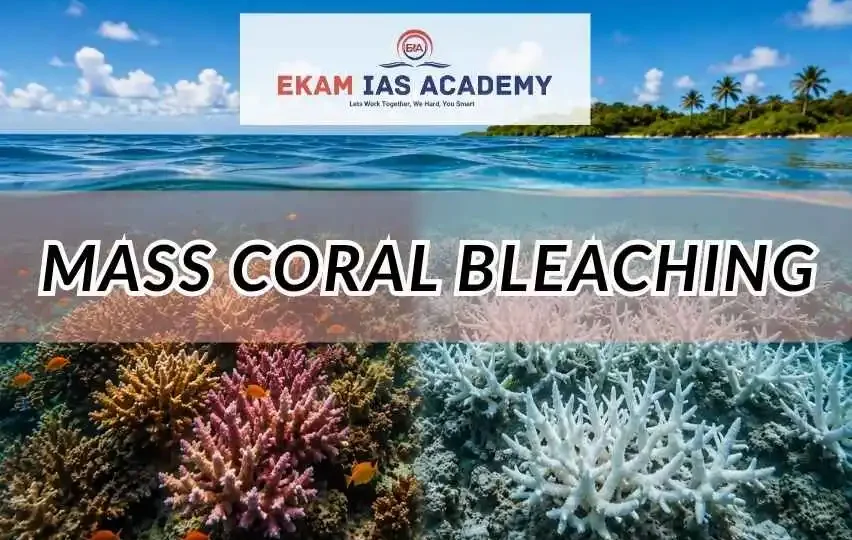
Coral bleaching is a stress response that occurs when corals lose their vibrant colors. Corals share a symbiotic relationship with microscopic algae called zooxanthellae, which live inside their tissues. The zooxanthellae provide the coral with food through photosynthesis, while the coral offers the algae shelter.
Mass Coral Bleaching vs. Coral Death
Bleaching does not automatically mean the coral is dead. A bleached coral is highly vulnerable and starving. If the environmental stress is reduced quickly, the coral can reabsorb zooxanthellae and fully recover. However, if the stress continues for several weeks, the coral will die of starvation and become covered in turf algae.
Process and Causes of Mass Coral Bleaching
The primary coral bleaching causes and effects are tied directly to changing water conditions. When corals experience stress, the photosynthetic pathways of the zooxanthellae malfunction, causing them to produce toxic oxygen radicals. To protect itself, the coral host expels the algae, exposing its pale white calcium carbonate skeleton.
Primary Drivers:
- Elevated Sea Surface Temperatures (SSTs): An increase of just 1°C above the summer average can trigger a bleaching event.
- El Niño-Southern Oscillation (ENSO): El Niño phases temporarily warm global ocean basins, triggering widespread bleaching.
- Ocean Acidification: Excess atmospheric CO2 dissolves into seawater, lowering pH levels and weakening the structural integrity of coral skeletons.
Climate Change and Global Mass Bleaching Events
The link between climate change and coral bleaching is direct and scientifically proven. Marine heatwaves are growing more frequent, intense, and prolonged. The planet has experienced several devastating global mass bleaching events, notably in 1998, 2010, and 2014–2017. The multi-year event starting in 2014 damaged more than 70% of the world’s coral reefs, including Australia’s Great Barrier Reef.
Environmental and Socio-Economic Impacts
The consequences of mass bleaching reach far beyond marine ecosystems:
- Loss of Marine Biodiversity: Reefs occupy less than 0.1% of the ocean floor but support over 25% of all marine life. Their collapse triggers a domino effect that impacts fish, sea turtles, and marine mammals.
- Socio-Economic Fallout: Bleached reefs hurt global tourism and commercial fisheries, threatening the livelihoods and food security of over 500 million people worldwide.
- Loss of Coastal Protection: Healthy reefs act as natural breakwaters, absorbing up to 97% of wave energy. Without them, coastal communities face severe erosion and storm surges.
Coral Reefs in India
A close look at coral reefs in India UPSC notes highlight shows that the country’s major reef formations are categorized into four primary zones:
| Coral Reef Region | Key Characteristics |
|---|---|
| Gulf of Mannar | Fringing reefs facing heavy industrial runoff pressures. |
| Gulf of Kutch | Fringing reefs facing high sedimentation and temperature spikes. |
| Lakshadweep Islands | Atoll reefs highly vulnerable to open-ocean heatwaves. |
| Andaman & Nicobar | Fringing reefs with high biodiversity, recovering from bleaching. |
Indian reefs face severe threats from local human activities, including illegal coral mining and destructive fishing practices, as well as global marine heatwaves.
Conservation Frameworks and Government Initiatives
Protecting these underwater ecosystems requires a mix of national enforcement and international cooperation:
- Government Initiatives in India: Corals are granted the highest level of statutory protection under Schedule I of the Wild Life (Protection) Act, 1972. Additionally, the Coastal Regulation Zone (CRZ) notifications strictly ban any commercial development near reef ecosystems.
- Innovative Restoration: India is using advanced techniques like Biorock technology (low-voltage electrical currents passed through seawater to speed up calcium carbonate formation) to restore damaged reefs in the Gulf of Kutch.
- International Efforts: Global initiatives like the International Coral Reef Initiative (ICRI) and the Global Coral Reef Monitoring Network (GCRMN) coordinate data sharing and conservation policies worldwide.
Conclusion
Analyzing mass coral bleaching UPSC data shows that saving coral reefs is an urgent ecological necessity. Reef degradation signals a wider crisis in ocean health. Protecting these biomes requires moving past localized restoration toward global climate action. By combining carbon reduction targets with marine protected areas and innovative reef-seeding technologies, the global community can protect marine biodiversity and preserve these vital ecosystems for future generations.
UPSC Prelims: PYQs & Practice Questions
Previous Year Questions (Prelims)
UPSC CSE Prelims 2015
Q: Consider the following statements regarding coral reefs:
1. Most of the world's coral reefs are in tropical waters.
2. More than one-third of the world's coral reefs are located in the territories of Australia, Indonesia and Philippines.
3. Coral reefs host far more number of animal phyla than those hosted by tropical rainforests.
Select the correct answer:
A. 1 and 2 only
B. 3 only
C. 1 and 3 only
D. 1, 2 and 3
Answer: D (1, 2 and 3)
Explanation:
Coral reefs thrive in warm, shallow, clear tropical waters (30°N to 30°S) (Statement 1). The Coral Triangle and Great Barrier Reef ensure that Australia, Indonesia, and the Philippines hold over one-third of global reefs (Statement 2). While tropical rainforests support more species numerically, coral reefs host 32 of 34 recognized animal phyla, surpassing rainforests in high-level taxonomic diversity (Statement 3).
UPSC CSE Prelims 2014
Q: Which of the following regions in India have coral reefs?
1. Andaman and Nicobar Islands
2. Gulf of Kutch
3. Gulf of Mannar
4. Sunderbans
Select the correct answer:
A. 1, 2 and 3 only
B. 2 and 4 only
C. 1 and 3 only
D. 1, 2, 3 and 4
Answer: A (1, 2 and 3 only)
Explanation:
India’s major coral reef regions include Andaman and Nicobar Islands, Gulf of Kutch, and Gulf of Mannar. The Sunderbans, being a low-salinity estuarine delta dominated by mangroves and heavy mudflows, does not host coral reefs. Corals require high salinity and clear, sediment-free water to thrive.
Practice Questions
Q: In the context of active reef restoration techniques utilized in India to mitigate coral bleaching causes and effects, consider the following statements regarding 'Biorock Technology':
1. It passes a low-voltage electrical current through seawater, causing dissolved minerals to precipitate into calcium carbonate structures that corals can easily bond with.
2. It has been successfully deployed by the Zoological Survey of India (ZSI) to regenerate degraded fringing reefs within the Gulf of Kutch.
Select the correct answer:
A. 1 only
B. 2 only
C. Both 1 and 2
D. Neither 1 nor 2
Answer: C (Both 1 and 2)
Explanation:
Biorock or mineral accretion technology is an innovative method where steel structures are submerged and connected to a low-voltage electrical source. Calcium carbonate crystallizes on the structure, creating an artificial limestone framework. Corals grafted onto Biorocks grow up to six times faster and show higher resilience to coral bleaching. India successfully deployed its first Biorock in the Gulf of Kutch in 2020.
Q: From a physiological standpoint, what is the immediate catalyst that forces a coral host to expel its symbiotic zooxanthellae during a marine heatwave?
A. The algae freeze completely and stop moving through the coral's tissue layers.
B. Thermal stress damages the algae's photosynthetic systems, causing them to release toxic oxygen radicals that harm the coral.
C. The ocean's falling salinity prompts the algae to dissolve the coral's internal calcium carbonate skeleton.
D. The coral consumes all available zooxanthellae to compensate for a lack of external plankton.
Answer: B
Explanation:
When sea surface temperatures exceed a coral’s tolerance, the photosynthetic systems of the zooxanthellae algae are damaged. Malfunctioning algae produce toxic reactive oxygen species (ROS). To avoid internal poisoning, the coral expels the algae, leading to bleaching and energy deprivation.
UPSC Mains – Previous Year & Practice Questions
Mains Previous Year Questions
Mains 2022
Question: Discuss the causes and effects of ocean warming on global marine ecosystems.
Directly requires analyzing how rising sea surface temperatures drive mass bleaching events.
Mains 2019
Question: Coastal regions of India are prone to cyclones. Discuss the role of mangroves in reducing the impact of such disasters.
Can connect to how coral reefs and mangroves act as integrated natural barriers protecting coasts from wave energy.
Mains 2018
Question: Assess the impact of global warming on the coral reef ecosystems of the world, with examples from major degradation zones.
Directly tests mass coral bleaching UPSC core themes.
Mains 2017
Question: Clarify how mid-latitude climate anomalies are linked to the El Niño-Southern Oscillation phenomenon.
Allows you to explain how El Niño warming phases drive global mass bleaching crises.
Mains 2014
Question: Enumerate the indirect services provided by an ecosystem. How do wetlands act as “Earth’s Kidneys”?
Mains Practice Questions
[10 Marks | 150 Words]
Question: Explain the physiological mechanism of mass coral bleaching. Distinguish clearly between a bleached coral reef and a dead coral ecosystem.
[15 Marks | 250 Words]
Question: Coral reefs occupy a microscopic fraction of the ocean floor but support over a quarter of all marine biodiversity. Analyze the environmental and socio-economic consequences that would result from a large-scale collapse of these reef systems.
[15 Marks | 250 Words]
Question: Evaluate the statutory protections provided to coral reefs in India under the Wild Life (Protection) Act, 1972. Discuss how advanced technologies like Biorock accretion and larval seeding can strengthen these legal frameworks.



Mass Coral Bleaching-FAQs
What is coral bleaching?
Coral bleaching is a stress response in which corals lose their colour after expelling the microscopic algae called zooxanthellae that live inside their tissues. These algae provide food to corals through photosynthesis.
What causes mass coral bleaching?
Mass coral bleaching is mainly caused by rising sea surface temperatures, marine heatwaves, El Niño events, ocean acidification, pollution, and other environmental stresses affecting large reef systems at the same time.
Is bleached coral dead?
No, bleached coral is not immediately dead. It becomes weak and vulnerable because it loses its main food source. If conditions improve quickly, coral can recover; if stress continues for weeks, it may die.
Why are coral reefs important?
Coral reefs support more than 25% of marine biodiversity, protect coastlines from waves and storm surges, support fisheries, promote tourism, and provide livelihoods to millions of people worldwide.
Where are coral reefs found in India?
Major coral reefs in India are found in the Gulf of Mannar, Gulf of Kutch, Lakshadweep Islands, and Andaman and Nicobar Islands. These reefs are important for marine biodiversity and UPSC Environment preparation.