Table of Contents
TogglePollution Control Boards in India: CPCB, SPCB and Key Functions
Historical Background and Legal Framework
The genesis of institutionalized pollution control in India began as a response to global environmental consciousness following the 1972 Stockholm Conference.
The primary legal framework governing these bodies is split across foundational environmental legislations:
- The Water (Prevention and Control of Pollution) Act, 1974: This is the parent statute that mandated the creation of pollution control boards to restore and maintain the wholesomeness of water bodies.
- The Air (Prevention and Control of Pollution) Act, 1981: This legislation expanded the jurisdiction of these boards to encompass ambient air quality management.
- The Environment (Protection) Act, 1986 (EPA): This serves as an umbrella legislation under which the central government issues comprehensive waste management rules executed by the boards.
Types of Pollution Control Boards in India
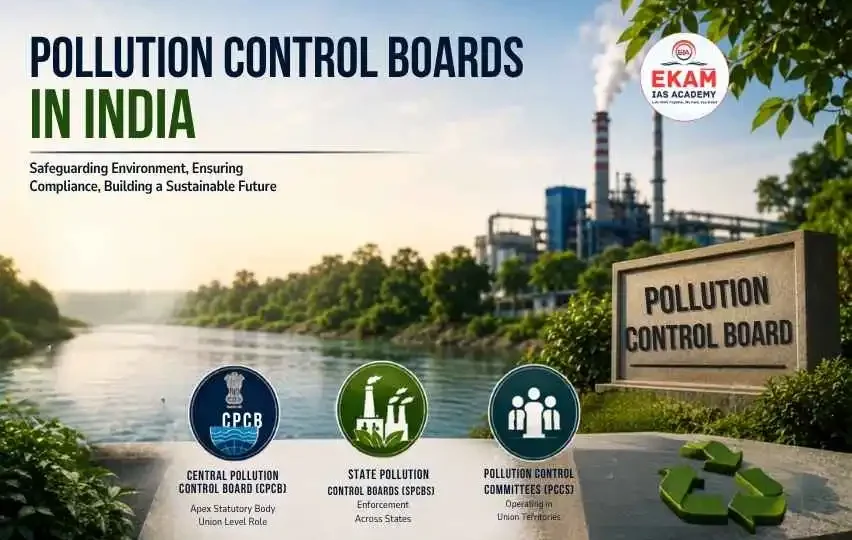
The executive network for pollution monitoring is structured into three distinct administrative tiers:
| Organization | Jurisdiction | Primary Function |
|---|---|---|
| CPCB | National Level | Apex statutory body for pollution control and environmental monitoring |
| SPCBs | States | Enforcement of pollution control laws and standards |
| PCCs | Union Territories | Pollution control administration in UTs |
Comparative Institutional Matrix: CPCB vs. SPCB
To score high marks in written mains answers, candidates must understand how the apex body differs from its state counterparts:
| Structural Dimension | Central Pollution Control Board (CPCB) | State Pollution Control Boards (SPCBs) |
| Jurisdiction & Status | Apex statutory body operating at the national level under the Ministry of Environment, Forest and Climate Change (MoEFCC). | State-level statutory bodies operating under their respective state departments of environment. |
| Primary Mandate | Advises the Central Government, coordinates state activities, plans national campaigns, and sets baseline environmental standards. | Grants operational consents, inspects industrial units, and directly enforces compliance at the grassroots level. |
| Coercive Power | Can issue sweeping directives to any SPCB and performs a supervisory role. | Directly issues closure notices and disconnects utility services (water/electricity) to violating units. |
Major Functions and Powers
The baseline CPCB functions and SPCB operations revolve around a set of combined administrative actions:
- Consent Management: Industrial entities must secure a Consent to Establish (CTE) before constructing a plant and a Consent to Operate (CTO) before starting production.
- Environmental Monitoring: Running extensive data networks like the National Air Quality Monitoring Programme (NAMP) and the National Water Quality Monitoring Programme (NWMP).
- Standard Formulation: Laying down specific limits for industrial effluents and emissions, such as the updated sewage treatment plant discharge norms.
- Enforcement & Penalties: Under the Air and Water Acts, boards have the power to enter and inspect industrial premises, take samples for verification, and shut down non-compliant facilities.
Role in Environmental Clearance, Compliance, and Sustainable Development
Pollution control boards serve as the critical technical link in the environmental clearance in India cycle. While macro clearances are processed through the PARIVESH portal, the actual enforcement of the legally binding Environmental Management Plan (EMP) depends on field oversight by SPCBs.
By forcing industries to adopt eco-friendly technologies, treat hazardous wastes, and recycle wastewater, these boards attempt to convert abstract goals of sustainable development into practical compliance realities.
Challenges and Recent Developments
Despite strong legal powers, the system faces severe operational hurdles. The Economic Survey 2025-26 highlighted that monitoring is heavily constrained by limited institutional capacity and stretched SPCBs. Many state boards face immense resource shortages, with nearly 50% of technical and scientific posts sitting vacant, leading to weak post-clearance oversight. Furthermore, a lack of independent funding leaves state units vulnerable to local political and industrial pressures.
Recent Regulatory Updates:
- The Environment Audit Rules: Moving toward outsourced verification through certified third-party environmental auditors to ease the burden on state inspectors.
- Circular Economy Integration: The newly implemented Solid Waste Management Rules mandate a centralized online tracking portal developed by the CPCB to manage waste segregation and Extended Producer Responsibility (EPR) credits
Conclusion
Analyzing the Central Pollution Control Board UPSC profiles emphasize alongside state frameworks proves that environmental governance UPSC tracks requires strong regulatory enforcement to succeed. Moving forward, India must transform its boards from slow, bureaucratic permitting bodies into agile, data-driven institutions. By filling technical vacancies, ensuring financial independence, and adopting transparent, automated online tracking portals, India can strengthen its pollution control boards to guard public health and support sustainable economic growth.
UPSC Prelims: PYQs & Practice Questions
Previous Year Questions (Prelims)
UPSC CSE Prelims 2018
Q: Consider the following statements:
1. The Central Pollution Control Board (CPCB) was constituted under the Air (Prevention and Control of Pollution) Act, 1981.
2. The State Pollution Control Boards (SPCBs) are established under the Water (Prevention and Control of Pollution) Act, 1974.
Which of the statements given above is/are correct?
(a) 1 only
(b) 2 only
(c) Both 1 and 2
(d) Neither 1 nor 2
Answer: (b) 2 only
Explanation:
Statement 1 is incorrect because the Central Pollution Control Board (CPCB) was originally constituted under Section 3 of the Water (Prevention and Control of Pollution) Act, 1974. It was later given additional executive powers under the Air Act, 1981.
Statement 2 is correct. The State Pollution Control Boards (SPCBs) are established under the Water Act, 1974 to execute state-level pollution control and abatement schemes.
UPSC CSE Prelims 2022
Q: With reference to the National Clean Air Programme (NCAP) launched by the Government of India, consider the following statements:
1. It aims to achieve a 20% to 30% reduction in Particulate Matter (PM10 and PM2.5) concentrations by 2024 across non-attainment cities.
2. The Central Pollution Control Board (CPCB) serves as the primary technical executing agency to monitor implementation.
Which of the statements given above is/are correct?
(a) 1 only
(b) 2 only
(c) Both 1 and 2
(d) Neither 1 nor 2
Answer: (c) Both 1 and 2
Explanation:
Both statements are correct. The National Clean Air Programme (NCAP) is a major initiative to tackle air pollution across non-attainment cities.
As part of important CPCB functions, the apex board coordinates with SPCBs, monitors air quality stations, analyses compliance data, and supports targeted action plans for pollution reduction.
Practice Questions
Q: In the context of industrial compliance monitoring, consider the following statements regarding Consent Management by State Pollution Control Boards (SPCBs):
1. Consent to Establish (CTE) must be obtained by an industry after setting up manufacturing equipment but prior to commercial distribution.
2. Consent to Operate (CTO) is a recurring statutory clearance that requires regular validation based on emission standards.
Which of the statements given above is/are correct?
(a) 1 only
(b) 2 only
(c) Both 1 and 2
(d) Neither 1 nor 2
Answer: (b) 2 only
Explanation:
Statement 1 is incorrect because Consent to Establish (CTE) is a pre-construction clearance. An entrepreneur must secure it before breaking ground or establishing any infrastructure.
Statement 2 is correct. Consent to Operate (CTO) is a mandatory operational licence that must be renewed periodically based on the industry’s actual compliance with ambient emission and effluent standards.
Q: If an industrial facility discharges highly toxic chemical effluents into a local river, which combination of legislative frameworks empowers the State Pollution Control Board to disconnect its electricity and water supply directly?
(a) The National Green Tribunal Act, 2010 and the Forest Conservation Act, 1980
(b) The Water (Prevention and Control of Pollution) Act, 1974 and Section 5 of the Environment (Protection) Act, 1986
(c) The Wildlife Protection Act, 1972 and the Public Liability Insurance Act, 1991
(d) The Biological Diversity Act, 2002 and the Disaster Management Act, 2005
Answer: (b) The Water Act, 1974 and Section 5 of the Environment Protection Act, 1986
Explanation:
The administrative power to issue closure notices, shut down industrial facilities, and cut off vital utilities like electricity and water comes from Section 33A of the Water Act, 1974 and Section 5 of the Environment (Protection) Act, 1986.
These provisions give pollution control boards executive authority to enforce environmental compliance at the ground level.
UPSC Mains – Previous Year & Practice Questions
Mains Previous Year Questions
Mains 2024
Question: Discuss the institutional mechanism for monitoring and regulating air pollution in major urban agglomerations of India.
(Directly evaluates CPCB and SPCB urban monitoring frameworks)
Mains 2021
Question: Explain the principle of Polluter Pays and discuss how it can be effectively integrated into India's environmental laws.
(Provides the foundational legal logic behind SPCB penalty systems)
Mains 2018
Question: What is water stress? How and why does it differ regionally in India?
(Can link to how SPCBs must manage water pollution to maintain usable freshwater pools)
Mains 2015
Question: Industrial corridors are engines of economic growth but come with heavy environmental costs. Discuss.
(Requires analyzing the weaknesses of post-clearance monitoring by state boards)
Mains 2013
Question: Enumerate the National Green Tribunal’s roles and responsibilities in handling appeals against decisions made by State Pollution Control Boards.
Mains Practice Questions
[15 Marks | 250 Words]
Question: The effectiveness of State Pollution Control Boards UPSC modules track is often compromised by high vacancy rates for technical staff and limited financial independence. Critically analyze the institutional challenges hampering environmental enforcement at the state level.
[15 Marks | 250 Words]
Question: While the CPCB sets uniform national standards, the actual enforcement of environmental laws depends entirely on the administrative capacity of individual SPCBs. Evaluate the structural friction that arises between central guidelines and state-level enforcement realities.
[10 Marks | 150 Words]
Question: Discuss how transitioning from traditional command-and-control state inspections to mandatory, third-party certified environmental audits can improve regulatory efficiency and transparency in India.



Central Pollution Control Board-FAQs
What is the Central Pollution Control Board?
The Central Pollution Control Board is India’s apex statutory body for pollution control. It advises the Central Government, coordinates State Pollution Control Boards, sets pollution standards, and monitors air and water quality.
What is the difference between CPCB and SPCB?
CPCB works at the national level and sets broad environmental standards, while SPCBs work at the state level and directly enforce pollution control laws, issue consents, inspect industries, and take action against violators.
What are the main functions of Pollution Control Boards?
The main functions include monitoring air and water quality, granting Consent to Establish and Consent to Operate, inspecting industries, setting emission and effluent standards, and enforcing pollution control laws.
Which laws govern Pollution Control Boards in India?
Pollution Control Boards are mainly governed by the Water Act, 1974, the Air Act, 1981, and the Environment Protection Act, 1986.
Why are Pollution Control Boards important for UPSC?
Pollution Control Boards are important for UPSC because they relate to environmental governance, pollution control laws, sustainable development, industrial regulation, public health, and climate-related policy implementation.