
Table of Contents
ToggleIndia’s Ballistic Missile Defence System: DRDO Tests and Strategic Importance
India has achieved a major defence milestone by demonstrating its multi-layered Ballistic Missile Defence (BMD) capability, strengthening its preparedness against long-range missile threats. The Defence Research and Development Organisation (DRDO) conducted three consecutive flight tests on June 10 and 11, 2026, showcasing India’s ability to counter ballistic missile and anti-ship threats through advanced indigenous systems.
What is Ballistic Missile Defence?
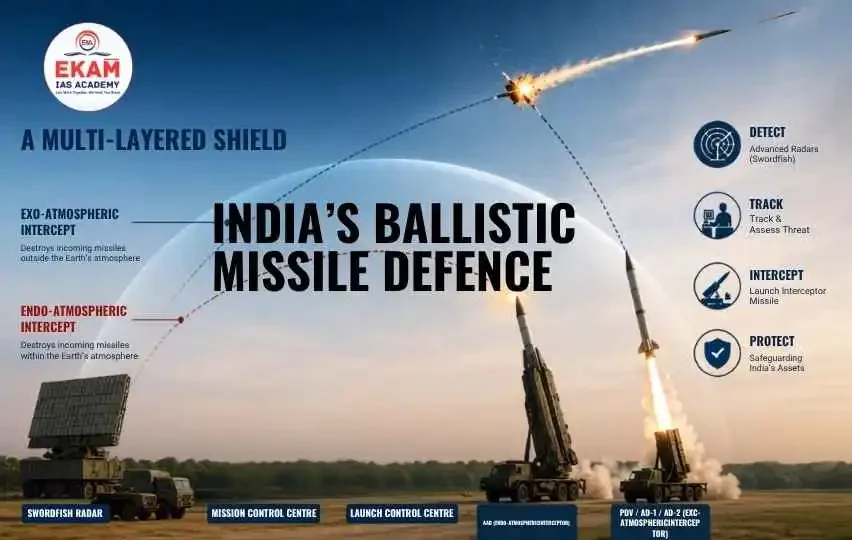
Ballistic Missile Defence (BMD) is a security system designed to detect, track, intercept and destroy incoming ballistic missiles before they hit their targets. It uses a network of radars, command centres, interceptor missiles and secure communication systems.
For India, BMD is not just a military technology; it is a strategic shield that protects critical cities, military assets and key infrastructure from hostile missile attacks.
Why India’s BMD Capability Matters
India’s regional security environment makes missile defence highly important. The presence of nuclear-armed neighbours and the rise of long-range missile technologies have increased the need for a reliable defensive system.
India’s successful demonstration of multi-layered defence against long-range ballistic missiles enhances national security and strengthens strategic deterrence. It also reflects India’s growing self-reliance in advanced defence technologies under Atmanirbhar Bharat. DRDO is India’s defence research and development wing, working to equip the armed forces with advanced indigenous weapon systems.
Two-Tier Defence System
India’s BMD programme works through a two-tier interception mechanism:
Endo-Atmospheric Interception
Endo-atmospheric interception destroys incoming missiles within the Earth’s atmosphere. This layer acts closer to the target and is crucial for terminal-stage defence.
Exo-Atmospheric Interception
Exo-atmospheric interception destroys hostile missiles outside the Earth’s atmosphere. This provides an early layer of protection and increases the chances of neutralising threats before they re-enter the atmosphere.
Together, these two layers create a multi-layered missile shield, improving India’s ability to respond to different missile trajectories and ranges.
Key Components of India’s BMD System
India’s BMD architecture includes interceptor missiles, Swordfish radar, Launch Control Centres (LCC), Mission Control Centres (MCC) and secure communication networks. These components work together to identify the missile threat, calculate its path and launch an interceptor at the right moment.
Three Phases of India’s BMD Programme
Phase I focuses on countering short and medium-range ballistic missiles up to around 2,000 km using interceptors such as Prithvi Defence Vehicle (PDV) and Advanced Air Defence (AAD).
Phase II strengthens protection against missiles up to around 5,000 km through advanced interceptors like AD-1 and AD-2.
Phase III is expected to focus on future threats such as hypersonic glide vehicles, MIRV-based missiles and advanced long-range missile systems.
About Ballistic Missiles
A ballistic missile is powered by rockets during the initial phase and then follows an unpowered, free-falling trajectory towards its target. Examples include missiles like Agni-V.
Classification by Range
Ballistic missiles are generally classified as SRBM below 1,000 km, MRBM between 1,000–3,000 km, IRBM between 3,000–5,500 km and ICBM above 5,500 km.
Conclusion
India’s successful demonstration of Ballistic Missile Defence capability marks a significant step in building a secure, self-reliant and technologically advanced defence ecosystem. It strengthens India’s strategic deterrence and reinforces the vision of Atmanirbhar Bharat, Surakshit Bharat.



Ballistic Missile Defence System-FAQs Answered
What is Ballistic Missile Defence?
Ballistic Missile Defence is a security system designed to detect, track, intercept and destroy incoming ballistic missiles before they reach their target.
Why is India’s BMD system important?
India’s BMD system is important because it strengthens national security, protects critical cities and military assets, and improves strategic deterrence against long-range missile threats.
What is endo-atmospheric interception?
Endo-atmospheric interception refers to destroying an incoming missile within the Earth’s atmosphere, usually during the terminal phase of its flight.
What is exo-atmospheric interception?
Exo-atmospheric interception means destroying an incoming ballistic missile outside the Earth’s atmosphere before it re-enters and approaches the target.
Why is Ballistic Missile Defence important for UPSC?
Ballistic Missile Defence is important for UPSC GS Paper 3 because it connects with defence technology, internal security, DRDO, strategic deterrence, indigenisation of defence and national security preparedness.