

Table of Contents
ToggleTHE DIGITAL CONSTITUTIONAL GUARDRAILS FOR AI
TOPIC: (GS2) POLITY: THE HINDU
Concerns have been raised that unchecked artificial intelligence (AI) and large technology monopolies could create a new form of digital slavery, undermining democracy and human dignity.
AI and Human Dignity
- Humancentric concern: AI threatens to reduce individuals to data points, eroding autonomy.
- Pope’s warning: Governance must be legal and constitutional, not left to engineers’ ethics.
- Accountability: Every automated decision (loan, job, healthcare) must have a human answerable.
Challenges in Regulation
- Speed vs Law: AI develops at breakneck speed, while legislatures move slowly. For example, the EU AI Act (2024) and UK Online Safety Act (2023) were already outdated when passed, as newer generative AI harms had emerged.
- Global Examples: International laws show the lag between innovation and regulation. The EU classified AI into “risk categories,” but deepfake misuse grew faster. Similarly, the UK’s Online Safety Act struggled to address synthetic media.
- Indian Context: India has 950+ million internet users (2025), yet digital literacy remains low. Studies show a 214% rise in misinformation during COVID19, with India accounting for 1 in 6 fake news items globally. This makes India highly vulnerable to AI misuse.
Democracy’s Digital Vulnerability
- Disinformation: Deepfakes blur truth and destabilise elections. Example: manipulated videos of leaders circulated during campaigns, confusing voters.
- Algorithmic Manipulation: Social media platforms amplify outrage for profit. A UNESCOIpsos survey (2024) found 85% of urban Indians encountered online hate speech, with 64% blaming algorithms.
- Foreign Interference: AIdriven psychological operations exploit India’s social fault lines. Coordinated misinformation campaigns target religion, caste, and ethnicity, threatening national sovereignty.
Way Forward
- Rightsbased framework: Citizens must have unalienable rights over their personal data. The Digital Personal Data Protection Act, 2023 provides a legal base, but India must strengthen consent protocols and prevent algorithmic bias in jobs, loans, and healthcare.
- Platform accountability: Big Tech firms should not enjoy blanket safeharbour protections. Independent audits of algorithms and liability for harmful amplification are essential. Example: EU mandates algorithmic audits under its AI Act.
- Free speech safeguards: Regulation must target structural issues like bot networks and deepfake creators, not censor individual opinions. This ensures democratic dissent remains intact while tackling systemic manipulation.
- Media literacy drive: India has 950+ million internet users, but digital literacy is uneven. A national curriculum on digital citizenship in schools and rural centres can build resilience against misinformation. Example: Finland’s media literacy model is globally recognised.
- Earlywarning systems: India must establish crosssector detection networks. Agencies like CERTIn can collaborate with factcheckers and ethical hackers to identify coordinated misinformation campaigns in real time.
Conclusion
AI governance must be elevated to a constitutional imperative — protecting truth, dignity, and democracy from digital slavery.
INDIA–U.K. FREE TRADE AGREEMENT
TOPIC: (GS2) INTERNATIONAL RELATIONS: THE HINDU
India and the U.K. have signed a Comprehensive Economic and Trade Agreement (CETA), set to take effect from July 15, 2026, marking the most significant trade deal for both nations in recent years.
Trade Deal
- Lengthy Negotiations: The India–U.K. Free Trade Agreement (CETA) was finalised after nearly three years of talks, making it one of the most comprehensive trade deals India has signed postindependence.
- Existing Trade Volume: Bilateral trade between India and the U.K. stood at £48 billion in 2025, reflecting strong preexisting economic ties.
- Growth Potential: The deal is projected to raise India’s GDP by £5.1 billion, the U.K.’s GDP by £4.8 billion, and bilateral trade by £25.5 billion annually in the long run.
- Employment Impact: Thousands of jobs have already been created on both sides even before the agreement’s enforcement, with further gains expected in labourintensive sectors like textiles, leather, and jewellery.
- Global Positioning: India remains the fastestgrowing G20 economy, while the U.K. was the third fastestgrowing G7 economy in 2025, making this partnership strategically significant for both.
Features of the Agreement
- Tariff Reductions: 99% of U.K. tariff lines dutyfree for Indian products. India to reduce tariffs on 90% of its tariff lines for U.K. goods.
- Sectoral Gains: India: Boost for textiles, leather, jewellery, IT, and finance services. U.K.: Gains in aerospace, automotives, medical devices, and whisky exports.
- Beyond Tariffs: Provisions on customs, digital trade, and services to reduce red tape.
- Dedicated chapters on anticorruption, gender, labour, and environment — first of their kind in India’s trade deals.
Wider Impact
- Regional Benefits: Not limited to metros, SMEs and manufacturers in smaller cities (e.g., Indore textiles, Birmingham autoparts) gain easier market access.
- Job Creation: Thousands of jobs already created preimplementation; more expected across labourintensive sectors.
- Domestic Protections: Safeguards remain, India protects dairy and edible oils, U.K. shields sugar, rice, poultry, and eggs.
Strategic Significance
- India strengthens its position as the fastestgrowing G20 economy, while the U.K. consolidates its postBrexit trade strategy.
- Sets a template for modern trade agreements — balancing growth, sustainability, and fairness.
- Enhances India’s global credibility in trade diplomacy, complementing other FTAs (e.g., India–Australia ECTA, India–UAE CEPA).
Conclusion
This agreement cements India–U.K. trade relations, combining scale, depth, and longterm growth potential across diverse sectors.
TUNGABHADRA DAM AND INTERSTATE COOPERATION
TOPIC: (GS3) ECONOMY: THE HINDU
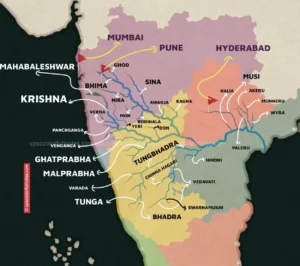
The inauguration of 33 new spillway gates at the Tungabhadra dam on June 25, 2026 brought together leaders from Karnataka, Andhra Pradesh, Telangana.
Importance of Tungabhadra Dam
- Location: Situated in Koppal district, Karnataka.
- Irrigation Lifeline: Provides water to 16.4 lakh acres — 9.26 lakh in Karnataka, 6.25 lakh in Andhra Pradesh, and 87,000 in Telangana.
- Water Storage: Originally 133 tmc ft, now reduced to 106 tmc ft due to siltation.
- Recent Repairs: New highgrade steel gates installed at a cost of ₹51 crore, expected to last 60 years.
Key Issues and Challenges
- Upper Bhadra Project: Karnataka’s lift irrigation scheme upstream has raised concerns in Andhra Pradesh and Telangana about reduced inflows.
- Siltation: Excessive sediment has lowered storage capacity, affecting irrigation and hydropower.
- Dam Safety: Crest gate failure in 2024 showed vulnerability. Union government plans nationwide silt removal and rehabilitation under Dam Rehabilitation and Improvement Project (DRIP).
Cooperative Framework
- Tungabhadra Board: Regulates water releases, ensuring minimal disputes among States.
- InterState Collaboration: Leaders pledged to strengthen cooperation, echoing the spirit of river basin management.
- National Context: India has 20+ major interState water disputes (e.g., Cauvery, Krishna). Tungabhadra stands out as relatively disputefree due to clear sharing formula.
TACKLING ADOLESCENT MALNUTRITION THROUGH SCHOOLS
TOPIC: (GS2) POLITY: THE HINDU
The NFHS6 (202324) data reveals a sharp rise in obesity and high blood sugar among adolescents and adults, signalling a growing nutrition crisis.
The Emerging Nutrition Crisis
- Double burden of malnutrition: India faces both undernutrition and obesity.
- Obesity among women (1549 yrs): 24% → 30.7%; men: 22.9% → 27.3%.
- High blood sugar among men (15+): 15.6% → 20.9%; women: 13.5% → 17.8%.
- Thinfat phenotype: Children appear lean but carry high metabolic risk — a precursor to diabetes and heart disease.
- Stunting data: CNNS2019 found 27.4% of adolescents stunted; 35% of children under five show adultlevel triglycerides.
SchoolBased Nutrition Interventions
- Balanced diets:
- Promote fruits and vegetables, half the plate by volume.
- Improve midday meals and canteen menus to include proteins and micronutrients.
- Encourage school gardens and “fruit breaks” using local seasonal produce.
- Reducing sugar and UPFs:
- WHO reports 13.7% annual rise in ultraprocessed food consumption among Indian adolescents.
- Schools should ban HFSS (High Fat, Sugar, Salt) foods and display “hidden sugar” boards.
- Reinforcement campaigns must replace onetime awareness drives.
- Physical activity:
- Make sports and structured movement mandatory.
- Address sedentary lifestyles and screen addiction, now common even in rural areas.
Policy and Institutional Support
- Let’s Fix Our Food (LFOF) Initiative:
- Led by ICMRNational Institute of Nutrition, focuses on healthier school food environments.
- Advocates taxation on sugary drinks, regulation of HFSS advertising, and nutrition literacy.
- Provides model school nutrition curriculum and food label reading kits.
- Future projections:
- Lancet (2025) estimates 21.8 crore men and 23.1 crore women will be overweight by 2050, steepest rise among ages 1524 years.
Conclusion
Schools must evolve into publichealth institutions, shaping food habits, physical activity, and awareness to secure India’s future health.
NSS 80TH ROUND (CMSE, 2025) SURVEY FINDINGS
TOPIC: (GS3) ECONOMY: THE HINDU
Findings from Survey
- Fee incidence: 28.1% of government school students reported paying fees; in rural areas, male (27.1%) and female (27.2%) students showed similar patterns.
- High fee categories: Some rural government school students reported paying above ₹10,000, even higher than private school averages.
- State anomalies:
- Ladakh (0%), Tripura (2.6%), West Bengal (43%), Kerala (53%) reported unusually low “nofee” shares.
- Himachal Pradesh: 55.6% rural vs 78.3% urban students with no fees — contradicting policy expectations.
- Expenditure comparison: In some categories, government school expenditure was comparable or higher than private schools (−50.4% to +4% in rural; −57.2% to +34.3% in urban).
Survey Credibility Concerns
- Contradiction with RTE Act: The NSS 80th Round CMSE survey (2025) reported that 27% of students in government schools paid course fees (admission, tuition, exam, development charges). This directly conflicts with the Right to Education Act, 2009, which mandates free schooling for children up to Class 8.
- Household Coverage: The survey covered 52,085 households (28,401 rural, rest urban). Data showed 28.1% of government school students reported fee payments, compared to 89.1% in private aided and 93.2% in private unaided schools.
- Rural–Urban Disparity: In rural areas, 27.1% boys and 27.2% girls reported paying fees, while in urban areas the figure was much higher (71.4% boys, 70.7% girls). This suggests possible misclassification or survey error.
- Statelevel anomalies: Some States reported unusually low “nofee” shares in government schools: Ladakh (0%), Tripura (2.6%), West Bengal (43%), Kerala (53%). In Himachal Pradesh, only 55.6% rural students reported no fees compared to 78.3% urban students — inconsistent with policy.
- Expenditure anomalies: In higher fee categories (above ₹10,000), average expenditure in government schools (rural) was reported as ₹9,667, even exceeding private school averages. This challenges the perception that government schools are always cheaper.
Analytical Concerns
- Policy contradiction: RTE Act guarantees free education up to age 14; survey findings suggest possible violation or misreporting.
- Data collection error:
- Confusion over “tuition fees” — respondents may have reported private coaching costs instead of school fees.
- Use of ComputerAssisted Personal Interviewing (CAPI) forced enumerators to enter values, eliminating “nonresponse” (39.4% in NSS 75th Round vs 0% in NSS 80th Round). This may have led to arbitrary entries.
- Credibility risk: Misclassification distorts policy research, undermines trust in government schools, and could mislead Parliament debates.
NSO SURVEY
- Conducting Agency: National Statistics Office (NSO), under MoSPI.
- Survey Period: April – June 2025, part of the 80th Round of National Sample Survey (NSS).
- Coverage:
- 52,085 households surveyed (28,401 rural, rest urban).
- Geographic coverage: All India, excluding inaccessible villages in Andaman & Nicobar Islands.
- 4,409 First Stage Units (FSUs) canvassed.
- Focus: Household expenditure on education — course fees, transport, textbooks, uniforms, stationery, boarding, lodging, and coaching/tuition.
- Methodology:
- Data collected via ComputerAssisted Personal Interviewing (CAPI) on tablets.
- Random sampling of households based on Census 2011 (villages for rural, UFS blocks for urban).
- Designed to fill gaps not covered by administrative records.
Conclusion
Unless investigated and corrected, survey errors risk damaging the credibility of government schools and weakening trust in India’s education policy framework.
NEUTRAL MERCHANT VESSELS AND INTERNATIONAL LAW
TOPIC: (GS2) INTERNATIONAL RELATIONS: THE HINDU
Three Indian seafarers were killed when U.S. naval strikes hit neutral oil tankers in the Strait of Hormuz, raising questions about legality under international law.
Protections for Neutral Merchant Vessels
- International Humanitarian Law (IHL): Civilians and civilian objects (tankers, pipelines, food carriers) are protected.Principles of necessity, and precaution apply.
- Law of the Sea: UNCLOS guarantees transit passage rights through international straits, including Hormuz. Neutral vessels retain protection even during armed conflict.
- Maritime Neutrality: Neutral shipping cannot be interfered with unless carrying contraband or breaching a lawful blockade. Neutral states must avoid giving military assistance to belligerents.
When Neutral Ships Lose Protection
- San Remo Manual 1994: Neutral merchant vessels may be attacked if:
- Carrying contraband (e.g., arms, oil for enemy military).
- Breaching a declared blockade.
- Refusing to stop after warning or resisting search/capture.
- Directly contributing to enemy military action.
- Helsinki Principles 1998: Similar rules neutral vessels lose protection only if they aid enemy operations.
Oil Tankers and Blockade Runners
- Contraband status: Oil can be treated as contraband if destined for enemy military use.
- Military objective test: Tankers must make an effective contribution to military action and destruction must yield definite military advantage.
- Warsustaining theory: U.S. claims oil revenues sustain Iran’s war effort, but many scholars reject this as too broad.
- Blockade enforcement: Blockades must be declared, impartial, and effective. Without UN Security Council authorisation, enforcement against neutral vessels violates UN Charter Article 2(4).
India’s Legal Remedies
- Diplomatic Protection: India can espouse claims for wrongful deaths of its nationals.
- Accountability Measures:
- Demand explanation and compensation.
- Call for independent investigation.
- Raise issue at UN forums and invoke UNCLOS transit rights.
Conclusion
Neutral merchant vessels enjoy strong legal protection; unlawful attacks not only breach international law but also demand accountability and diplomatic redress.
SMART AI CACHING FOR DISASTER RESPONSE
TOPIC: (GS3) DISASTER MANAGEMENT: THE HINDU
Researchers from Trinity College Dublin proposed a new AIbased cooperative caching system to improve communication during disasters, published in IEEE Transactions on Services Computing.
Disasters and Communication Gaps
- Recent disasters:
- Kerala landslides (2024) killed hundreds.
- Uttarakhand village washed away (2025).
- Northeast India floods (2025).
- Uttar Pradesh heavy rains (2026) killed 100+.
- Problem: Telecom towers collapse, power lines fail, roads close → rescue teams lack realtime information.
- Impact: Delayed rescue, higher casualties, and property loss.
Cooperative Caching Explained
- Concept: Satellites, drones, base stations, and emergency vehicles store and share data collectively.
- Benefit: Rescue teams access nearest cached data (maps, videos, alerts) instead of distant servers and reduces delay.
- Examples:
- Satellite images cached in drones.
- Road maps cached in rescue vehicles.
- Emergency alerts cached in local base stations.
AI Models for DecisionMaking
- Contextual MultiArmed Bandit (CMAB):
- Learns from past caching decisions.
- Prioritises data based on recency, demand, and storage limits.
- Example: A flood photo taken 10 minutes ago is more valuable than one taken an hour earlier.
- Federated MultiArmed Bandit (FMAB):
- Nodes share learning with nearby nodes.
- Improves efficiency by spreading optimal caching decisions across the network.
Space–Air–Ground Integrated Network (SAGIN)
- Threetier system:
- Space: Satellites provide wide coverage.
- Air: Drones capture live visuals.
- Ground: Vehicles and base stations support local communication.
- Caching role: Reduces latency, ensures critical data (usable bridges, floodplain alerts) reaches rescuers quickly.
Conclusion
Smart AI caching transforms disaster communication into a resilient, realtime lifeline and ensuring that the right information reaches the right place at the right time.
COOPERATIVE RIDEHAILING PLATFORM
TOPIC: (GS2) GOVERNANCE: THE HINDU
The Union Home Minister recently launched Bharat Taxi, India’s first cooperativemodel ridehailing platform, in Gujarat.
Features of Bharat Taxi
- Cooperative Ownership: Registered under the MultiState Cooperative Societies Act, 2002; drivers (“Sarathis”) are shareholders, not just service providers.
- Government Support: Developed under the Union Ministry of Cooperation and National eGovernance Division (NeGD).
- Institutional Backing: Supported by major cooperatives — NCDC, GCMMF (Amul), NDDB, NAFED, IFFCO, KRIBHCO, NABARD, NCEL.
Advantages
- DriverOwned Fleet: Drivers purchase shares, gain voting rights, and participate in decisionmaking.
- Zero Commission: Entire fare goes to drivers, unlike private aggregators that charge 20–30% commission.
- Transparent Pricing: No surge charges; predictable fares ensure passenger trust.
- Digital Integration: Linked with DigiLocker, UMANG, API Setu for seamless services.
- Security & Compliance: Adheres to Government of India’s data protection norms and cybersecurity standards.
Conclusion
Bharat Taxi marks a paradigm shift in urban mobility — combining cooperative values, digital integration, and driver empowerment to create a fairer ridehailing ecosystem.
ESUSHRUT@CLINIC
TOPIC: (GS3) SCIENCE AND TECHNOLOGY: THE HINDU
The Union Health Ministry is set to launch eSushrut@Clinic, a lightweight digital platform for small outpatient clinics.
eSushrut@Clinic
- Cloudbased HMIS: Designed for small and medium healthcare providers — general practitioners, specialists, pharmacists, lab technicians.
- Developer: Created by CDAC as a lighter version of the flagship eSushrut HMIS, already used in 17 AIIMS and 4,000+ health facilities.
- Target Users: Clinics, subcentres, and medium hospitals struggling with manual records and billing.
Key Features
- Easy Onboarding: Providers can register via Health Facility Registry (HFR) and Health Professionals Registry (HPR); new users can register directly on the platform.
- Digitisation: Patient records, prescriptions, and billing digitised with minimal technical overhead.
- Low Cost: Affordable peruser pricing, suitable for small clinics.
- Online & Offline Support: Ensures continuity even when internet connectivity is weak.
- Integration with ABDM: Links with national platforms like DigiLocker, UMANG, API Setu.
- Clinical Decision Support: Free AIIMS CDSS modules for diabetes and hypertension, improving diagnosis and treatment.
Conclusion
eSushrut@Clinic is a milestone in India’s digital health journey — empowering small clinics with affordable technology and strengthening the Ayushman Bharat Digital Mission.